High-Level Overview
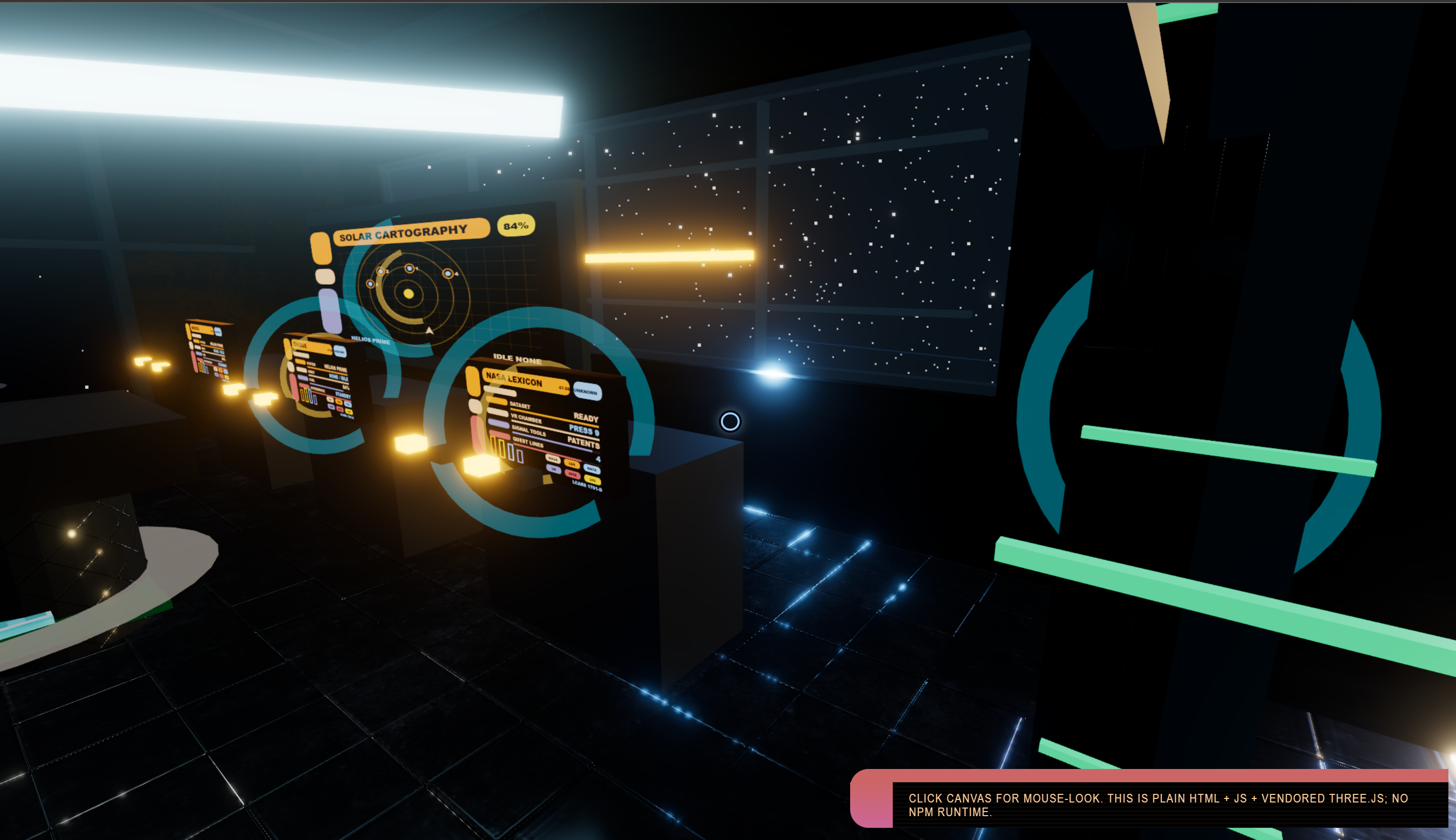
NASAPD is a GameLab experiment that wraps NASA patent records in a first-person starship bridge. The prototype uses a local copy of the NASA Patents dataset, companion enrichment files, generated textures, music, ship geometry, and a WebGL scene to make the source material feel like an explorable research deck.
The build is closer to a graphics stress test than a polished web product. The useful question is whether a dense public dataset becomes easier to approach when it is staged as an environment with stations, maps, research logs, and visible mission context.
Important Notes
What the Prototype Lets You Do
- Launch a static starship viewer that redirects into the project-local
viewer/index.htmlruntime. - Move through a generated bridge with patent-facing interface panels, research stations, and a NASA lexicon view.
- Inspect NASA patent themes, center context, and source-data caveats from local CSV and JSON companion files.
- Test a cinematic Three.js pipeline with bloom, generated textures, long-range audio, and ship/surface scene systems.
Source Backbone
The data layer starts with the public NASA Patents CSV, then adds local JSON enrichment for center summaries, topic facets, licensing context, and experience copy. The CSV remains the source of truth.
nasa_patents.csv, with 1,393 data rows and 7 columns preserved from the source distribution.
- Source note: nasa_patents.md
- Enrichment note: nasa_patents_enrichment.md
- Catalog page: https://catalog.data.gov/dataset/nasa-patents
- Direct download used: https://data.nasa.gov/docs/legacy/NASA_Patents/NASA_Patents_rows.csv
Build Detail
The viewer is plain HTML, JavaScript modules, and vendored Three.js. It uses a first-person canvas, generated ship and surface systems, GLTF assets, local data files, EffectComposer, UnrealBloomPass, and OutputPass. Those choices are the point of the experiment, but they also explain the hardware warning above.
Related builds
MMS4 Ephemeris Lens is another NASA data exhibit. Transporter TSI Riot turns public transportation data into an interactive scene. Timestorm Baseball is another browser-heavy 3D prototype.