Source note: First published on Eric's Advisory Hour Substack. Read the canonical post.

Also slays the 5 hour token budget, but that’s for another day. See, here’s the thing. There’s more magic in Hermes than ships with on the packaging. Hermes is a wild bit of software-it’s a strange onion-peel gallery of features. Your comprehension comes in waves as the realization of what’s possible only occurs over the odd days of interactions with the agent. On the even days we’re busy getting work done.
I’d grown so used to one-prompt and magic happening that I grew a sick skepticism on any multi-stage workflow when it came to AI generated work. The ease of one prompt to an output that simply worked, empowered by the pure range of clever writing and technical sophistication of /goal I’d just assumed that there would never be a day when I’d need to look at a Kanban again.
And, of course, I was wrong.
What I failed to realize is that Kanban has a different taste to it within Hermes. It’s really not meant for a human operator beyond unblocking agentic work-doing the gnarly plumbing work of a clogged pipe or overfilled sink. Drudgery and plumbing as the most durable skills of the future somehow doesn’t surprise me.
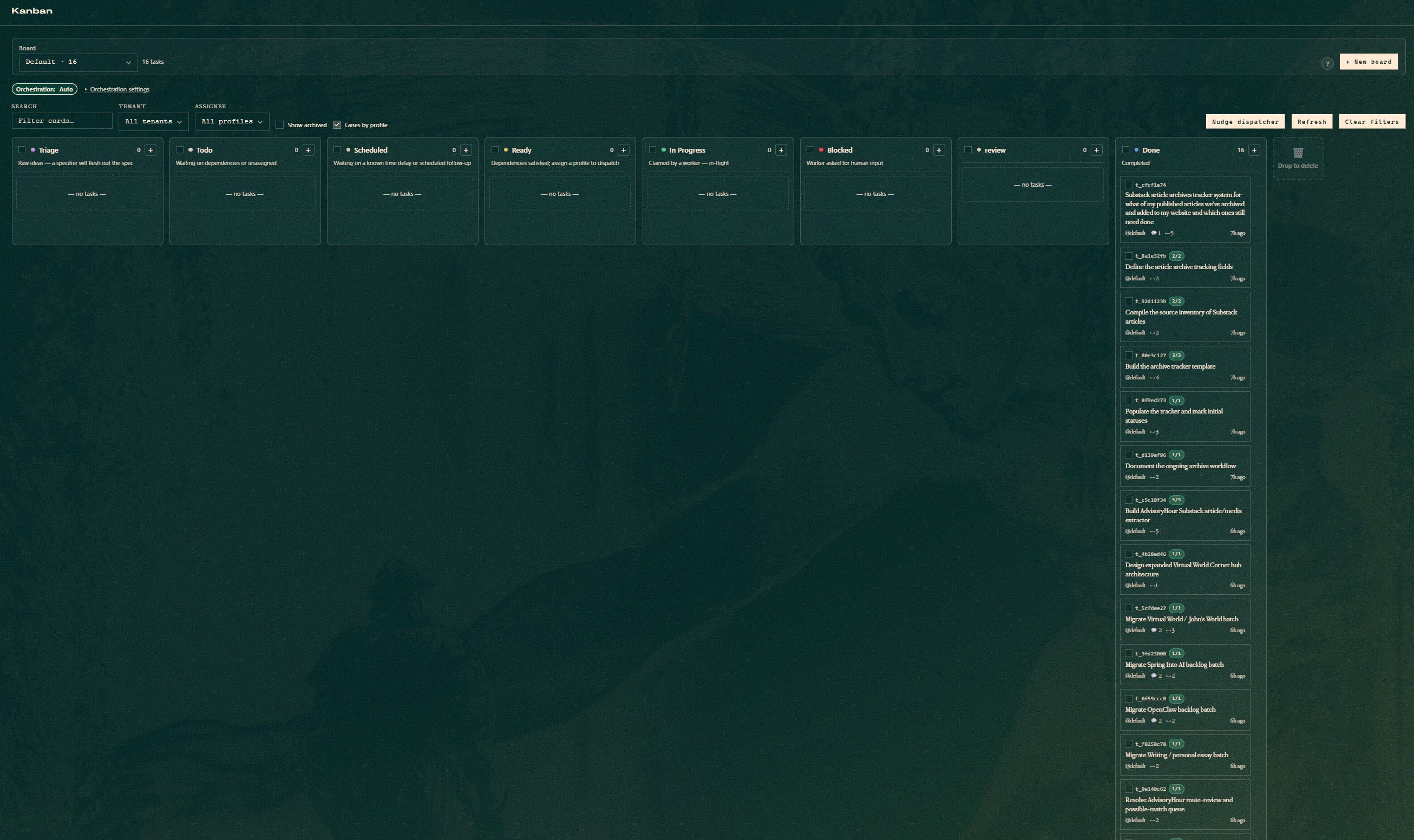
My favorite part of the Hermes Kanban isn’t just it’s user interactions. It’s that it feels like something out of the kind of RPGs that I often discussing taking apart and putting back together again. Hermes takes the art of project management, then improves it in a way that I’ve not seen in task management software since ostensibly the software Overlord, from well over a decade ago-perhaps two!
What Hermes Kanban Gets Right
It just works. Working might not be a compelling enough reason to lean in on some fancy new technology, and I’m not even writing this article to sell you on it. Instead, I’m writing to educate myself on what I like and where I feel the opportunities for improving my workflow are at.
Workflow in taking a concept and the magical act of transformation of turning a concept into a glob of digital bits that illuminates pixelated screens for humans to look at is as close to modern wizardry as it comes. And the interaction of myself to the Kanban thru the agent or via the website is an epiphany that the future will largely be driven by autonomous software building and fixing things, and we’re all just in this awkard “not quite there stage”.
The interactions with the Kanban can take place in the WebUI, but that’s really an inefficient use of time. I find it easier to engage in conversation with the Hermes agent about the work, what’s going on and what’s not. The interactions become more fluid in a way that brings to light a discord first approach has a place, but just as importantly isn’t the only place.
Those mistakes bring me to Triage.
Triage
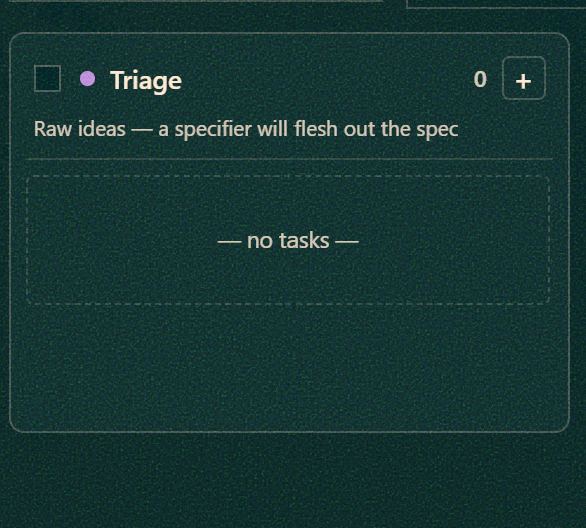
The power of triage is in taking a raw idea and watching Hermes map it out to subtasks that are gradually expanded and executed on. The allure of your mere whisper and wish become multi-faceted acts that lead to multiple subtasks that are worked in parallel (unless dependent!). It’s a fantastic act and for all the things I already rather enjoyed about Hermes, this one feature is power.
You can ask your agent to seed over these triage moments. The seeds can get planted after going over a conversation about the work that could be done, work that maybe before would have been a “ok do it” style prompt. Now, you can see a clearer path to a higher quality outcome by replacing that can-do attitude prompt with “seed these as a series of stories in triage”.
And then the magic begins.
Thanks for reading! Subscribe for free to receive new posts and support my work.
Steering the Craft
I appreciate you humoring me with this post. I categorized it under writing, as I’m using a technique that I learned-using it as a novice. If it looks like I tied my shoes and tripped over a shrubbery, then that’s exactly true.
I’m in the thick of application of techniques, making sense of the first chapter of a book on writing. I find myself using commas again-which I am keenly aware each strange punctuation in any phrase risks sending a reader to anywhere but the next word on this page. There’s writing examples on how other great writers, scattered across time and place, managed to take words and plant them one by one. Each sprung up from the seeding a healthy harvest and let loose a world in the mind of the reader.
This entry today makes use of these techniques, too. It feels somewhat disheartening to me to take the power of the ancients and then swiftly swirl such words into an article about Kanban. However, what I said about Hermes and it’s Kanban is quite true. I do rather like the setup, and it does solve problems around organizing workflow. And even better it really shines a light on how antiquated a system like Jira is, let alone Scrum.
Related notes
This note belongs with the agent-operations side of Custom Model Training: queues, handoffs, eval loops, and the practical work of keeping model-assisted systems observable enough to trust.
Original source
First published on Eric's Advisory Hour Substack. Read or subscribe at the canonical post: https://advisoryhour.substack.com/p/what-i-learned-from-90-ai-agent-benchmark.