Originally published as an Advisory Hour Substack post on 2026-09-23. This local copy preserves the text and public supporting media alongside the research record.
Original post
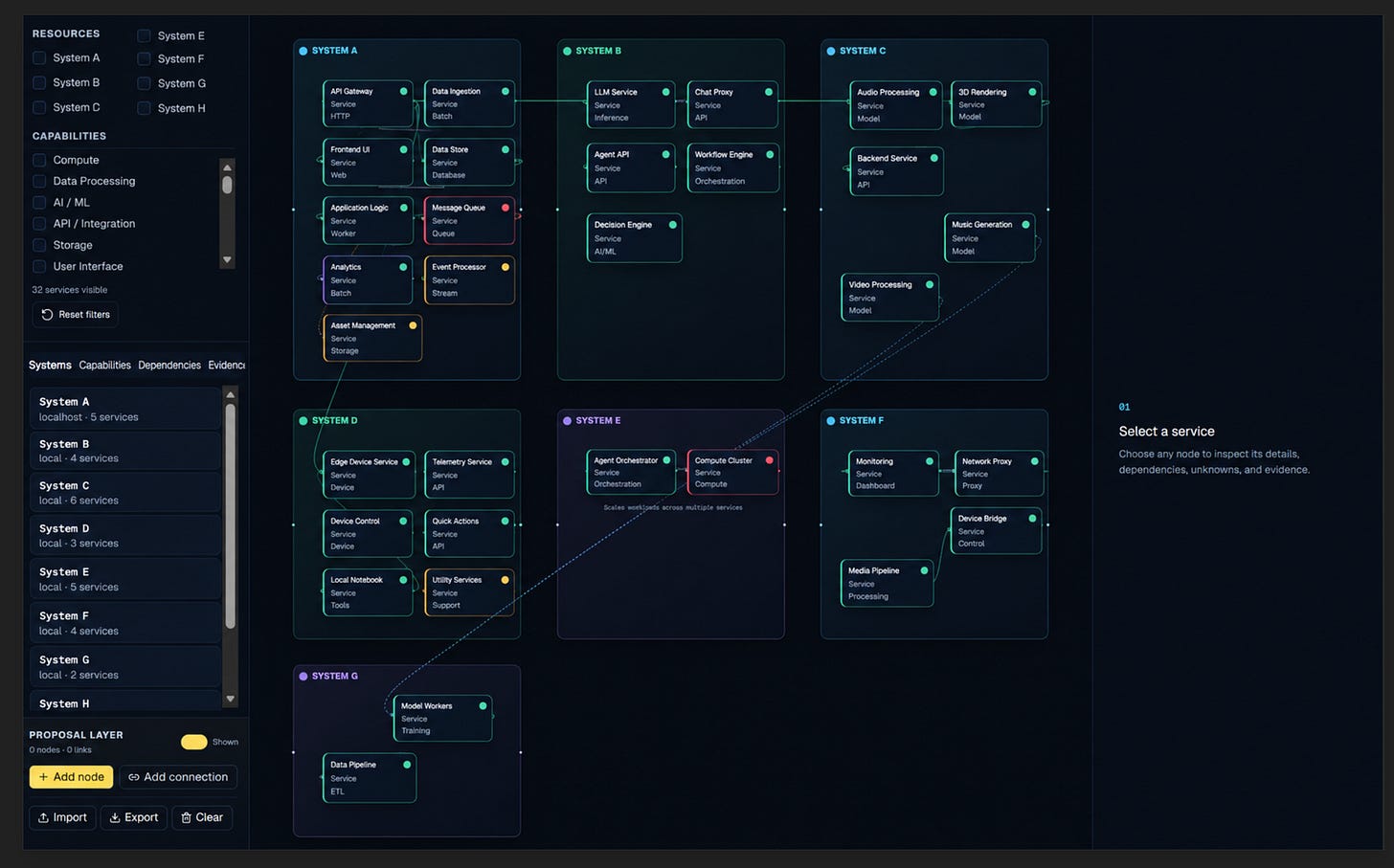
The image just above this text is a network topology map that shows capabilities and inter-service linkages. It’s running on a distributed platform that has an extensive capability map. I’ve redacted my services down to “in-kind” so you can have an understanding of what all is where and how things are presently organized. This, it turns out, was an unexpected win for codex.
A great puzzle of a platform at scale is how to solve for capability searching. Sure, kuberenetes and other platforms have discovery and lookups, but let’s look at the scale of the problem. Often times an enterprise will send out humans and systems to figure out what exactly they have, and then promptly forget about it in two years and repeat the process. This is for lots of reasons, and some of them less than clear for those not inside such massive machinery. Teams change, people come and go, ad-hoc over night changes and entire team driven organization priorities reshuffle the topology of a network faster than one would think. An thought one has that humans willingly will document up a platform as they work on it is a laughable one, as entire industry exists with one clear purpose: what is on the network?
And this became a sudden problem at home as I began late last year with one single-minded purpose: to evolve and grow out a computing platform for local AI capabilities. I wanted freedom and liberty from cloud providers less from a data privacy concern and primarily from a protect-my-wallet concern. I’ve written quite often on the merits of local AI. Not everyone needs an intelligence factory in their home. However, if you like building things it is increasingly hard to do so without your own factory.
The Verdant Relay project fell apart after I layered in a fourth “brain type” and it got me thinking pretty seriously about the Cambrian explosion of intelligence happening in my garage. I knew where most everything was, and it suddenly dawned on me that I was forgetting APIs and capabilities simply because of the sheer size of, well, everything. That’s when I had a spark of insight: why don’t I just send codex out to every machine that has a remote login on the secure network and have it do read-only capability evaluation and build me a topological map?
And that image above, with the cool breakouts, segmentations and designer surface? Yes, all mapped out in one-shot. If you’re in the business of mapping out corporate infrastructure, then now would be an appropriate time to click ‘start’ on the pivot.
The great thing is that Codex created a taxonomy that allows me to easily navigate pinpoint capabilities. Even better? I can now plan out my datacenter project.
The point to all of this is that if you’re a YOLO garage hacker with Codex and have several machines running in your garage, then send them out to map out what’s living on your network. After you get back the inventory (do this step first), then in that second step get an interactive topological map. Step 3? Well, you know that one.