Originally published as an Advisory Hour Substack post on 2026-02-15. This first-party site copy preserves the text, localizes public supporting media, and connects the record to its project trail.
Original post
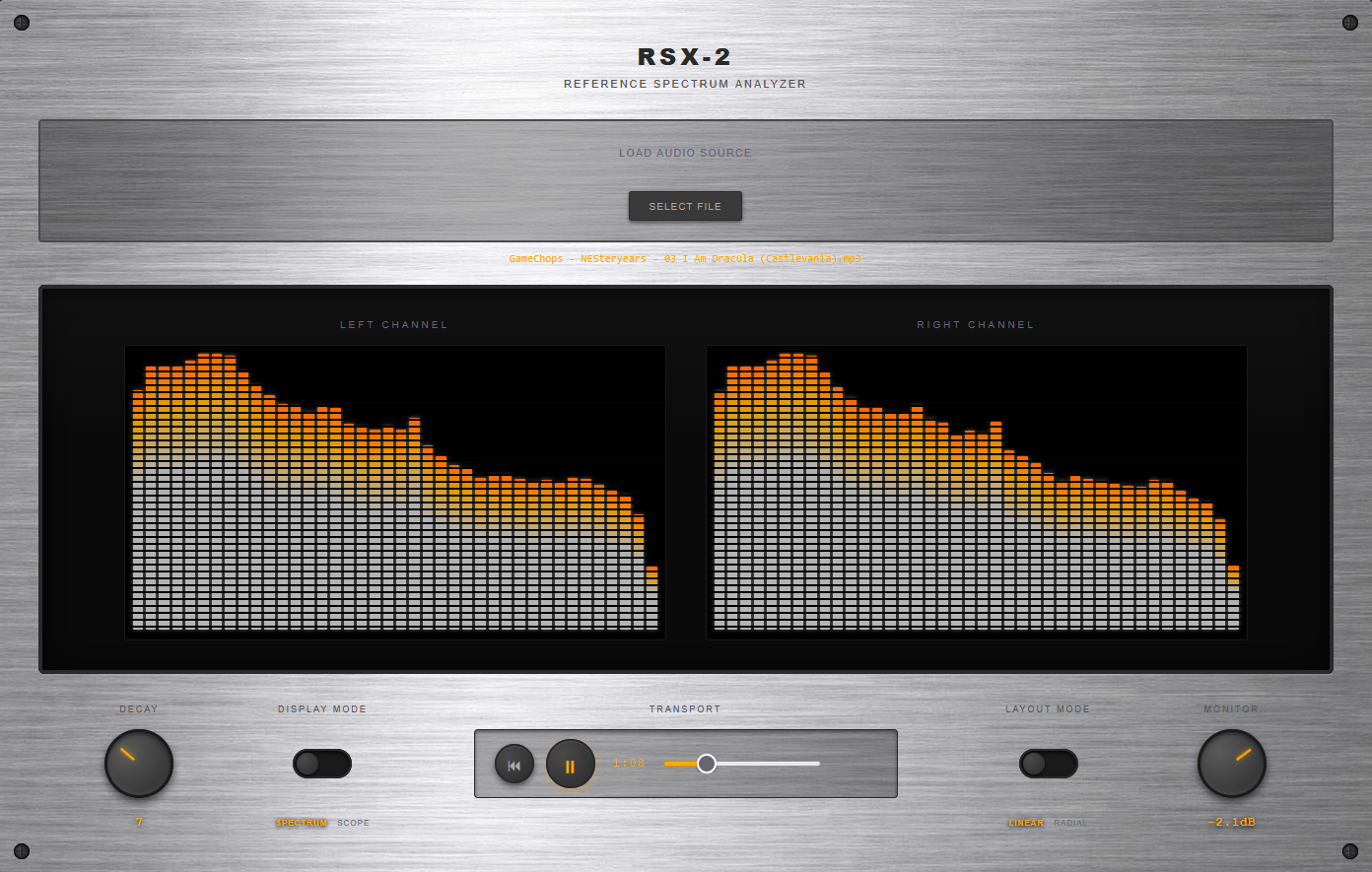
On Saturday, Kyle Sebeysten released Spectrum Analyzer. It was such a cool concept seeing actual physical hardware simulated via Agentic Coding.
The brushed metal reminded me of Astromech droids from the Star Wars Universe. I began thinking… what if I built the UI the droid uses? What would that be like?
If you haven’t seen Kyle’s breakdown on the RSX-2, check that out here.
On Saturday I’ll admit to being in a local favorite Mexican restaurant where I had ordered up a Margarita cocktail the size of my large, oval-shaped head. The ingestion of said liquid were to be found, as they say, ideas. One went like this…
What if I took the well-formed base of what Kyle built, and tried building an Astromech style interface? Something a Slicer might see in Star Wars?
It was so crazy that it might work. Socrates and Socrazy start looking like the same words by the time the gallon of tonic works it’s way thru your system.

After doing work on this, I now think FFT might be secretly a way to understand what’s happening to software at large. It’s being transformed for speed.
The FFT Magic Trick That Hides in Plain Sight
Most of us never think about the mathematics humming in our pockets-cancer risk, yes. Battery level-also, yes. Math? Nope. But every time you Spotify a song, butter a call on your phone, or stream a video, one particular piece of math is working overtime: the Fast Fourier Transform (FFT). (Not related to Fast and the Furious Transform-that’s something completely other)

Here’s the thing.
It’s not new.
It’s ancient-arguably, as the kids say, as ancient as me. It even predates those of us with birthdays, you see, in them ancient 1900s. “You’re old!” I already hear it in the back.
It’s also not sexy in the way artificial intelligence is. But it’s doing more heavy lifting than most algorithms you’ll ever meet.
So What Is It, Really?
Imagine you’re in a crowded room, say a Mexican Restaurant featuring a live band. Everyone is talking simultaneously. You can hear the *combined* noise — a muddy blur of voices — but you can’t pick out individual speakers just by listening to the chaos.
Now imagine being able to instantly separate that mess into: Ah, that’s Sarah laughing, and that’s the espresso machine, and that’s someone complaining about their commute.
That’s what the FFT does. It takes a complex signal — sound, radio waves, images, vibrations, stock prices, DNA sequences — and decomposes it into its component frequencies. It finds the hidden structure lurking inside what looks like noise.
Why “Fast” Matters
The underlying math (the Fourier Transform) has been around since 1822. Joseph Fourier discovered that any wave pattern, no matter how complicated, could be built by stacking simple sine waves together. Pure math elegance.
The problem? Actually doing it was painfully slow. Like, “your laptop would take a year to process one audio file” slow.
Enter the Fast Fourier Transform. In 1965, Cooley and Tukey found a shortcut. Because of symmetry in waves, you could compute the same result with dramatically fewer steps. What previously took n² operations now took just n log n… which resembles what’s happening to all software if you look at it thru the glass. Another day, perhaps.
What’s that formula translated? It’s millions of times faster. Suddenly, real-time processing became possible. The revolution wasn’t in the math - it was in the speed.
So where does FFT actually … exist?
Where It Actually Lives
Your Phone Calls
When you speak into a phone, FFT algorithms compress your voice by identifying which frequencies actually matter. Most are redundant. Keep the important ones, discard the rest. That’s how modern voice calls fit through narrow bandwidth.
Music Apps
Spotify doesn’t store recordings. It FFTs the audio, extracts frequency peaks (the “thumbprint” of the song), and compares against a database. The entire process happens in seconds because FFTs are fast.
WiFi and (5 or whatever)G
Wireless signals are crowded. Your router uses FFT to separate overlapping transmissions, find the clean channels, and decode your Netflix stream while ignoring interference from neighbors, microwaves, and that weird humming from cheap LED lights.
Medical Imaging (MRI)
MRI machines don’t take pictures directly. They collect frequency data. The FFT turns that frequency soup into the anatomical images radiologists actually read. No FFT, no MRI.
Astronomy (wen aliens?)
Radio telescopes collect signals from deep space — weak, noisy, buried in interference. FFTs filter out Earth-based radio noise, revealing the faint whispers of quasars and pulsars billions of light years away.
The Deeper Truth
The Fast Fourier Transform represents something profound about computation: often, the insight isn’t *what* you calculate, but *how cleverly you organize the calculating*.
Cooley and Tukey didn’t discover new mathematics. They found symmetry. Exploited redundancy. Reused partial results. The FFT is less algorithm than strategy: don’t work harder, work smarter. Wait, is this an article on FFT or AI adoption?
It’s a pattern.
This pattern repeats across computing.
Modern GPUs aren’t just faster processors — they’re architectures that exploit parallelism. Neural networks aren’t new statistical theories — they’re old ones organized to take advantage of modern hardware. The FFT was the prototype.
Why It’s Still Interesting
In an era of AI hype, the FFT is almost aggressively unglamorous. No neural nets. No “training data.” Just elegant mathematics that happens to be *useful*.
It reminds us that the most enduring technologies aren’t always the flashiest. Sometimes they’re the ones that solved a basic problem so thoroughly, so efficiently, that they become invisible infrastructure. We only notice when they fail.
The Fast Fourier Transform is everywhere because it works. It unscrambles signals, compresses data, cleans images, and separates signal from noise — literally and metaphorically. It turns chaos into components. And it does it fast enough that we forget it’s even there.
Enter the Astromech Slicer
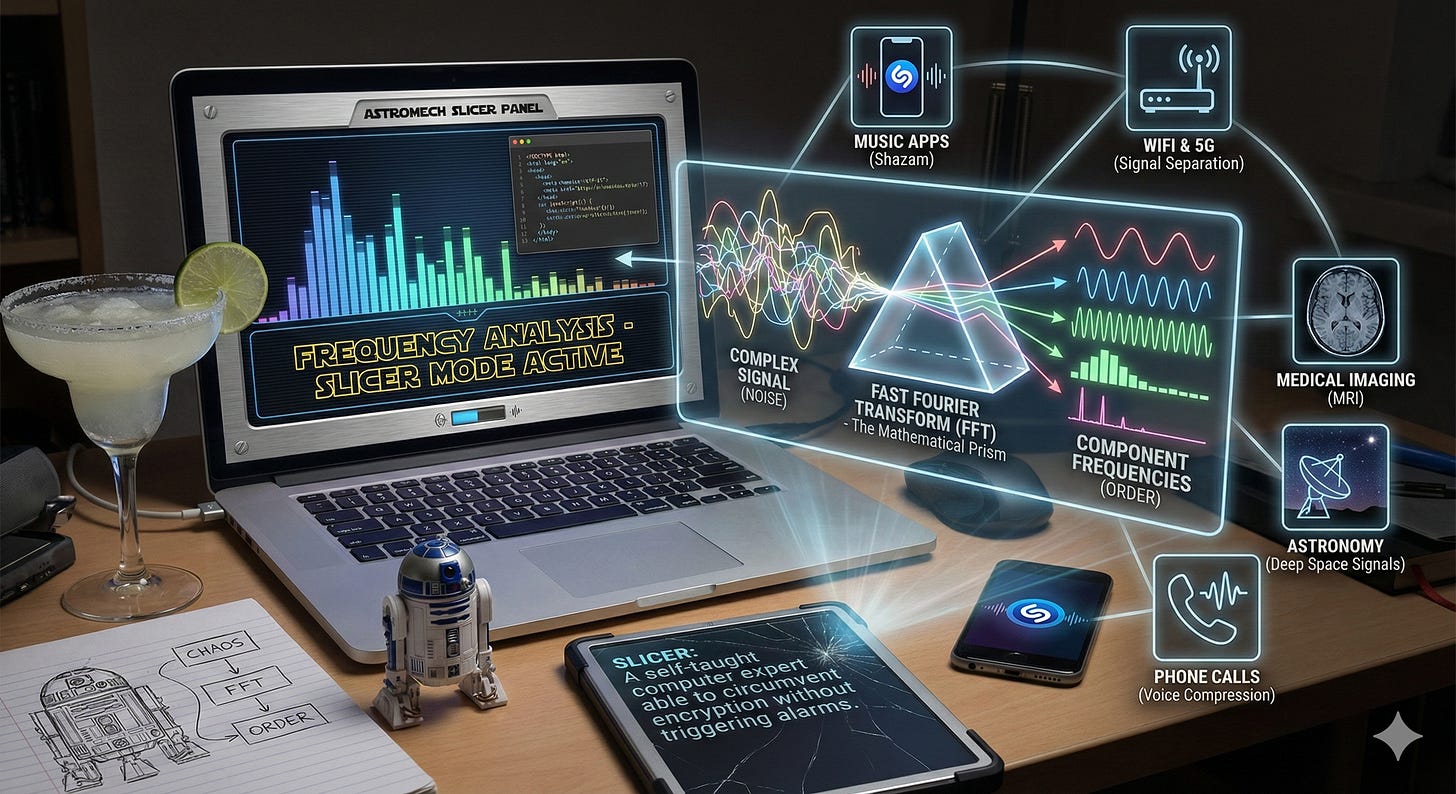
Slicer is an intentional term. Let’s learn some esoteric Star Wars lore.
A slicer was a computer expert, often self-taught, who excelled at working within a complex computer network, and could extract information from this network with great skill. Often, this information was secured by any number and manner of encryption and lockout systems, and a skilled slicer was able to circumvent these systems without triggering alarms. ( Wookipedia )
So the idea with Astromech Slicer is that YOU are the Slicer. Only, there’s no much of a game mechanic here. There IS a game, but it’s a game in the name only. And I certainly wouldn’t put too much stock into it.
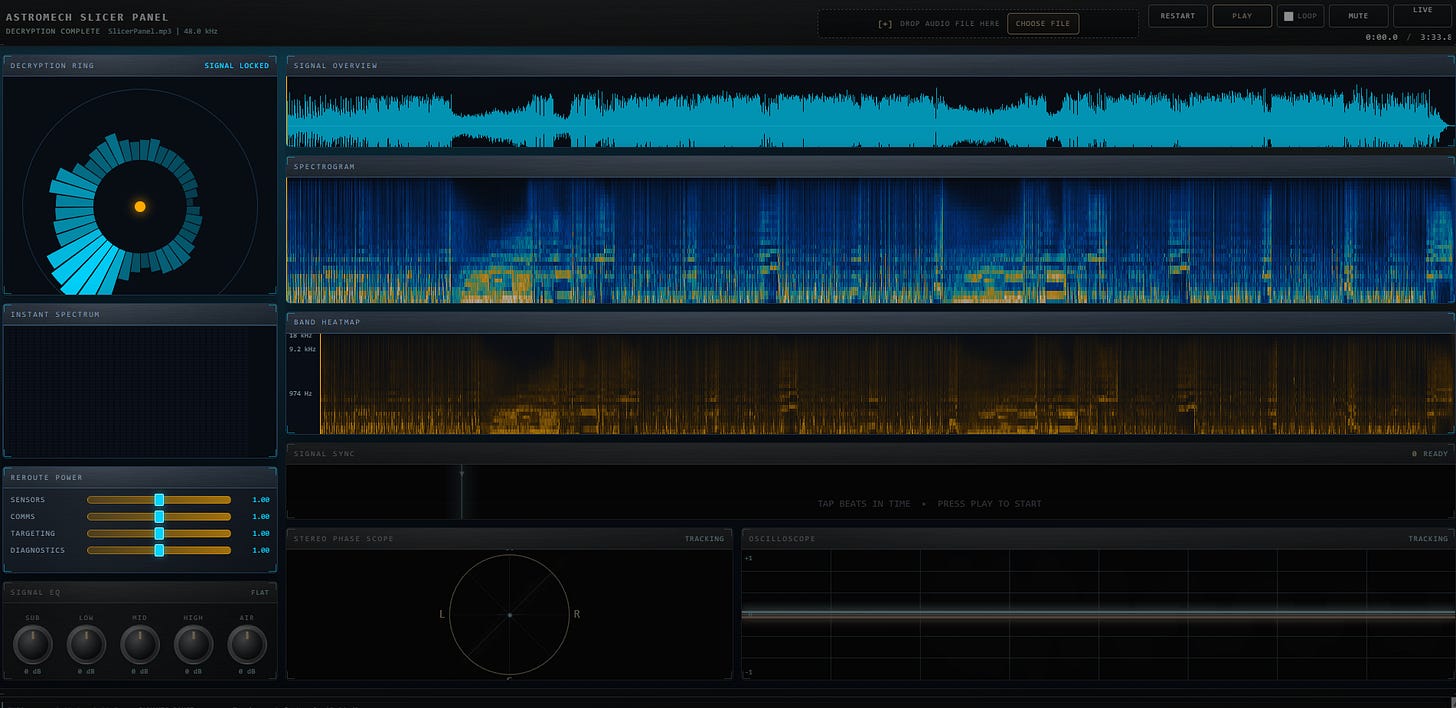
Just to make it interesting, I also enabled an “auto-play” style mode that could be shown on a big television on repeat. It even comes with a curtain reveal!

Once your music track kicks on, you’ll see the various visualizations at play with transitions between them.
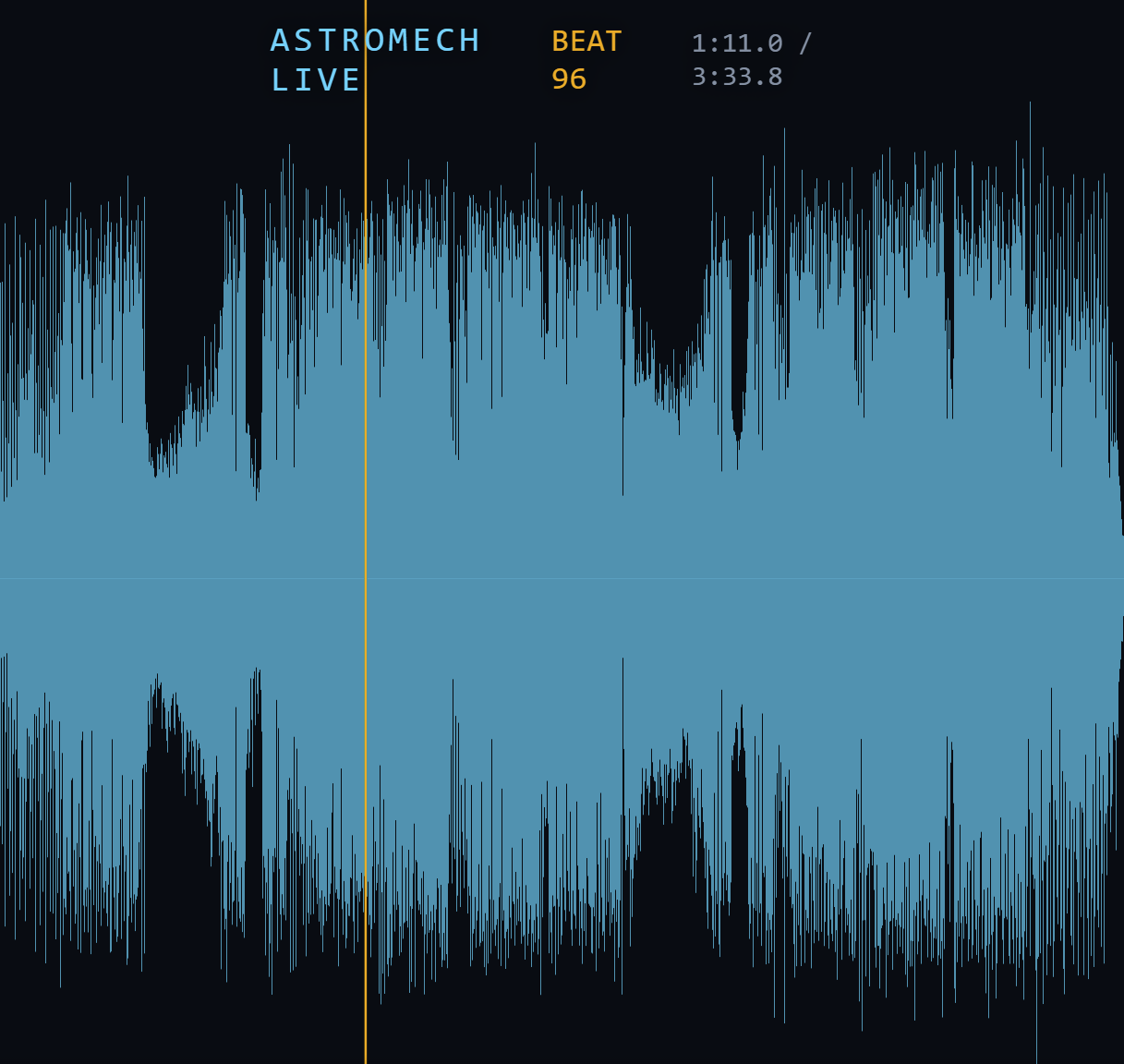
It’s really incredible what you can do. You can just build things.
Now, I go into even more detail about this in the YouTube video and how it all works. You can jump down below to give it a try (if you’re on desktop).
I mention this in the video but a process Evan Rhea covered in his week1 video is a specific way to create a virtual team of Claude and OpenAI Codex in order to rapidly accomplish a task result.
You can try the Astromech Slicer Panel here
The least remarkable thing in my mind is that the app doesn’t work so well on my phone. I’ll confess to putting very little time into fixing mobile support. The most remarkable thing about this app is that it’s pure HTML, CSS and Javascript and that it just… works at all. No frameworks, no big react components or vue modules or <insert javascript framework>.
It just works.
https://ericrhea.com/static-apps/slicer-panel-main/
The Code
I found the most interesting way to make sense of code repositories is to toss the repo into deepwiki and then review the assembled documentation. You can access the deepwiki on slicer panel here.
https://deepwiki.com/arkbuilder/slicer-panel
You can download the code (and mp3s I mentioned in the YouTube) in my Github here- https://github.com/arkbuilder/slicer-panel/
Thanks for reading! Subscribe for free to receive new posts and support my work.