Source note: Originally published on Eric's Advisory Hour Substack. Read the canonical post.
Organizer clarification — July 12, 2026: Every submitted Substack post earns +15 base publishing points, including an article or an embedded video with no separate app, demo URL, or code repository. Demo and code links add proof points, but they are not required for the publishing points. A Substack-only entry receives its publishing points and no proof points. The detailed rules below reflect this clarification.

Today kicks off Summer challenge #2. This article covers the mechanics of the competition. The first theme drops on Monday 6/15/2026.
How do I signup?
Reading this? Congratulations. You’re signed up. Now here’s the important part:
I am using my substack which has posts scheduled of my experiments in addition to the theme drop and competition news. The subject line will contain SUMMER INTO AI — so you can filter accordingly. If you aren’t subscribed, well, here’s how.
What changed?
If you participated in “Spring into AI” in early 2026. then here’s a few notable changes to the rules.
Github is a suggestion not a requirement. You’re no longer flatlined if you don’t have a github repo contribution. This means you can use a wider variety of AI tools. Before if you made a kickass 2 minute video, well, it didn’t count. Now it does. The important step this competition is angling for here is visible proof
Substack matters. There’s a higher weight on substack writing over youtube. These are now equal weighted. The reason is simple: writing has a huge impact on AI. How do you prompt AI? By writing. How do you score points in this competition? By writing.
Points for standalone competitor posts. We saw something interesting in the first competition: some of us started writing and contemplating other competitor entries. You’re now rewarded for this. Easy points! Make sure you submit that with your submission package!!
Multiple submissions rack up your points! If you are ambitious and do two things, you win. Do one submission, and it gets you off the slacker list. The most anyone has done is three. It can help offset a later week when you’re busy.
In Spring into AI, it wasn’t very clear how to send me your contributions. So I’m going to simplify that. You tag me on your substack with your submission. You can tag me on LinkedIn, but I have a special reason for substack.
New? You write a post about the project (and tag me with your details). I’m flexible-what I do is take your information that you share in a public post and then I’ll enter it into a spreadsheet. The “I” is an AI agent. This data we use at the end of the competition so there’s clarity on who won, and who wins the “owes Eric a beer” prize.
Submission update
Project title
Short description
Theme connection
-
Public post links:
LinkedIn
YouTube
blog
Substack
Snap
Instagram
Facebook
X
others! Have your own site?
-
Proof link:
demo URL, and/or
code repo/shared code
competitors you talk about in a post
Competitor reference link, if claiming the bonus
Any notes needed for scoring
AI Competition #2 Rules
1. Core Idea
AI Competition #2 is a public AI build sprint.
The goal is not to build the biggest or most complex thing. The goal is to:
build something real,
publish it publicly,
show proof that it works,
explain what happened,
learn from others,
reference other competitors,
and repeat the process each week.
The core loop is:
Build → Publish → Submit → Score → Repeat
Small shipped work beats ambitious unfinished work.
2. How to Win
The winner is the participant with the most total points at the end of the competition.
There are no secret judges and no vibes-only scoring. The scoreboard is points-based.
Top three finishers may receive medals or other visible recognition.
Tie Breakers
If there is a tie, use this order:
Most weeks with a valid submission.
Most public demos.
Most competitor references.
If still tied: public random tiebreaker, recorded or screenshared.
3. Weekly Schedule
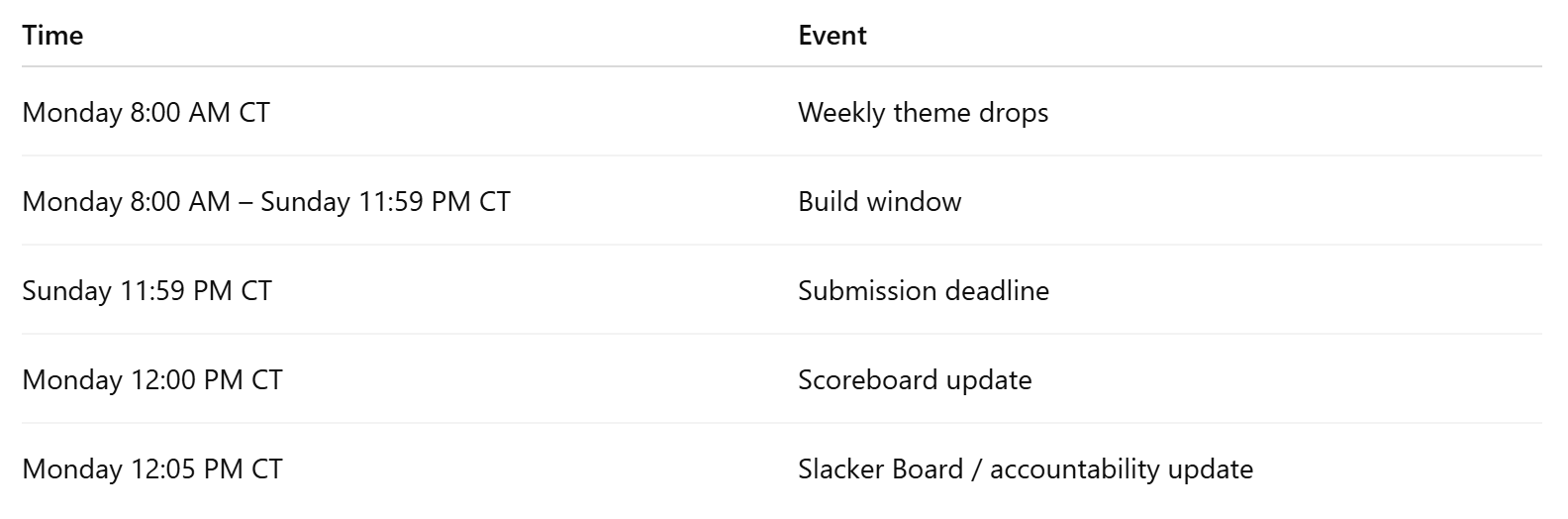
Submissions must be sent to Eric before the weekly deadline.
Late submissions may still be showcased, but they only count for points if Eric allows a grace window before scoring is published.
4. What Counts as a Valid Submission
A valid weekly submission must include both:
A build artifact
Examples: project, tool, demo, workflow, prototype, article, video, experiment, app, or other created artifact.A submitted public Substack post
The post explains the artifact and gives Eric the link needed for scoring.
The artifact and explanation may be the same Substack post. An article, experiment write-up, or embedded video does not need a separate app, demo URL, or code repository to earn its publishing points.
Optional working proof can include a public demo and/or shared code. These links add proof points; they are not a gate on the Substack publishing points.
A submission does not need to be large. Reuse is allowed. Old ideas and prior experiments are allowed if the weekly submission adds new packaging, explanation, demo, code, or learning.
5. Scoring Formula
Each valid submission is scored as:
Total = Substack Publishing Points + Optional Proof Points + Eligible Bonus Points
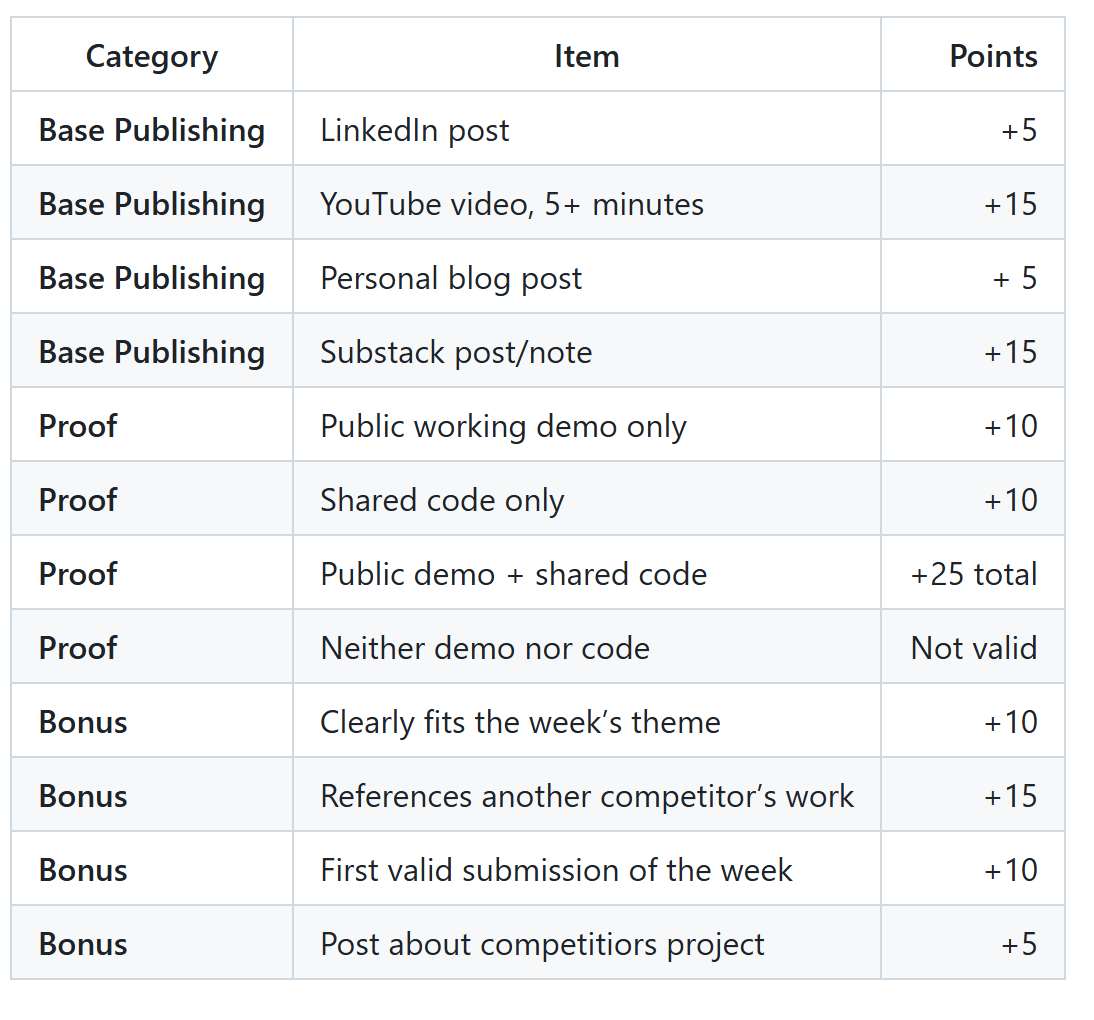
Every submitted Substack post earns +15 publishing points. A publishing-only entry therefore scores 15 points. Complexity does not earn points by itself.
7. Proof Points
Proof points are separate from publishing points. A public demo or shared code is required only to earn proof points and the proof-backed bonuses.
This means:
Demo only earns +10 proof points.
Code only earns +10 proof points.
Demo + code earns +25 proof points.
No demo and no code earns 0 proof points, while the submitted Substack post still earns +15 publishing points.
Closed-source projects are allowed if they include a working public demo.
8. What Counts as Shared Code
Shared code can mean:
public GitHub/GitLab repo,
public source bundle,
private repo shared with Eric for scoring,
or otherwise inspectable code shared with the organizer.
Public repos are encouraged because they help other competitors learn, but public open source is not required if a working demo is provided.
Code Should Include
If code is shared, it should include:
root
README.md,what the project is,
how to run it,
tools, models, or frameworks used,
setup notes,
link to the live demo if applicable,
screenshot or short description of the app in action.
9. What Counts as a Demo
A demo must be accessible enough for Eric to verify that the thing exists and works.
Examples:
hosted app,
deployed webpage,
video game or interactive prototype,
Hugging Face Space,
Vercel, Netlify, or Cloudflare Pages app,
downloadable executable with clear run instructions,
public API endpoint with docs,
screen-recorded working artifact if hosting is impractical.
A good demo includes:
public URL or accessible artifact,
basic instructions,
screenshot if relevant,
no special credentials unless coordinated with Eric,
no “trust me bro” claims.
Eric must be able to open, run, watch, or inspect the demo without needing a private environment.
An embedded video may be the Substack submission artifact and earn publishing points without being claimed as a separate demo. To earn proof points, identify a distinct accessible demo or code link for scoring.
10. Bonus Points
Theme Alignment Bonus
Awarded when the proof-backed build clearly responds to the weekly theme.
The theme does not need to be interpreted literally, but the participant must explain the connection.
Examples:
“This fits the week’s theme because…”
“I interpreted the theme as…”
“The build connects to the theme through…”
No explanation means no theme bonus.
Competitor Reference Bonus
Awarded when a participant meaningfully references another competitor’s work.
Valid references include:
citing another post,
linking another demo,
responding to another idea,
remixing a project,
comparing approaches,
building on someone’s code,
making a video reaction,
writing “I saw X do Y, so I tried Z.”
The reference should include a link when possible.
Maximum: one competitor-reference bonus per submission.
First Submission Bonus
Awarded to the first valid submission each week.
The submission must be complete enough to score.
11. YouTube Rules
To earn YouTube points, the video must:
be at least 5 minutes long,
clearly show or explain the submitted work,
make the participant identifiable by voice, face, channel, or intro,
show the artifact, process, or demo through screen recording or walkthrough.
Camera or picture-in-picture is strongly encouraged, but not strictly required.
If not using camera/PiP, the video should include a clear spoken walkthrough from the participant.
12. Posting Rules
Every post should give enough context for another human to understand:
what was built,
why it connects to the theme,
what tools were used,
what worked,
what failed,
where to see the demo or code, if one is being claimed for proof points,
what the participant learned.
Posting on multiple channels earns multiple base publishing points.
Participants must send links to Eric for scoring.
If it is not shared with Eric, it will not be scored.
13. Multiple Submissions Per Week
Multiple submissions are allowed.
Each valid submission is scored separately, as long as each one has:
its own artifact,
its own submitted Substack explanation,
and its own demo or code only when claiming proof points.
To avoid spam, each submission should be meaningfully distinct.
14. What Does Not Earn Extra Points
No extra points are awarded for:
complexity alone,
expensive tools,
“I worked really hard,”
private effort with no proof,
ideas that were never shipped,
unsubmitted work.
The competition rewards visible output.
15. Slacker Board / Accountability
If a participant does not deliver anything in a week:
they are added to the Slacker Board for that week,
they owe the group coffee,
and they receive zero points for that week.
Tone should stay light:
No drama. Just accountability. Maybe a little name calling.
The penalty is not for shipping something small.
The penalty is for disappearing.
PRIZES
Oh, yes. There will be prizes.
Original source
This local copy preserves the article text, source link, and inline media for the Summer Into AI 2026 competition section. Canonical Substack URL: https://advisoryhour.substack.com/p/summer-into-ai-are-you-ready-to-cook.