Source note: Originally published on Eric's Advisory Hour Substack. Read the canonical post.
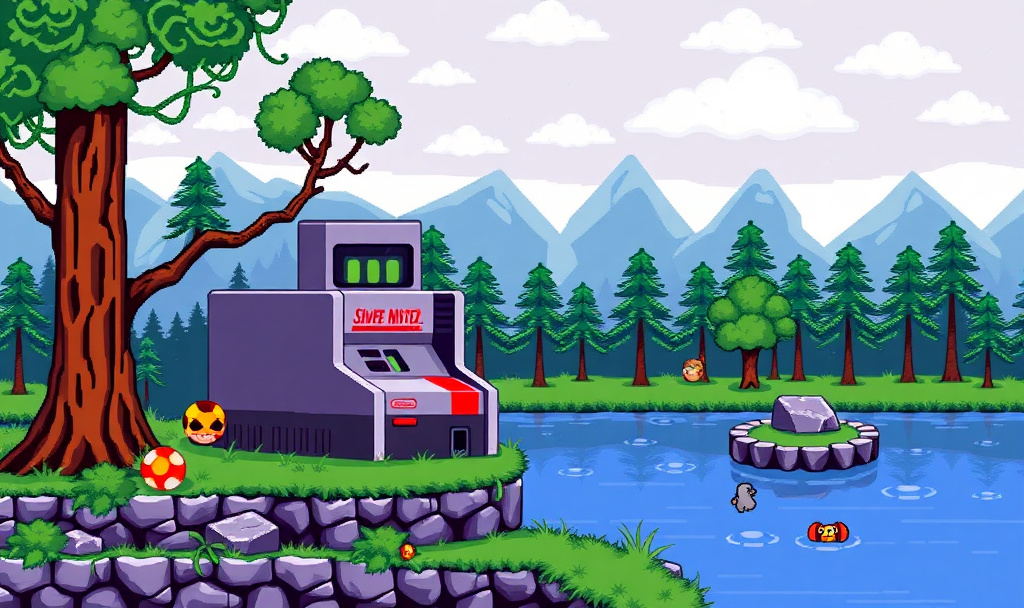
8-bit America
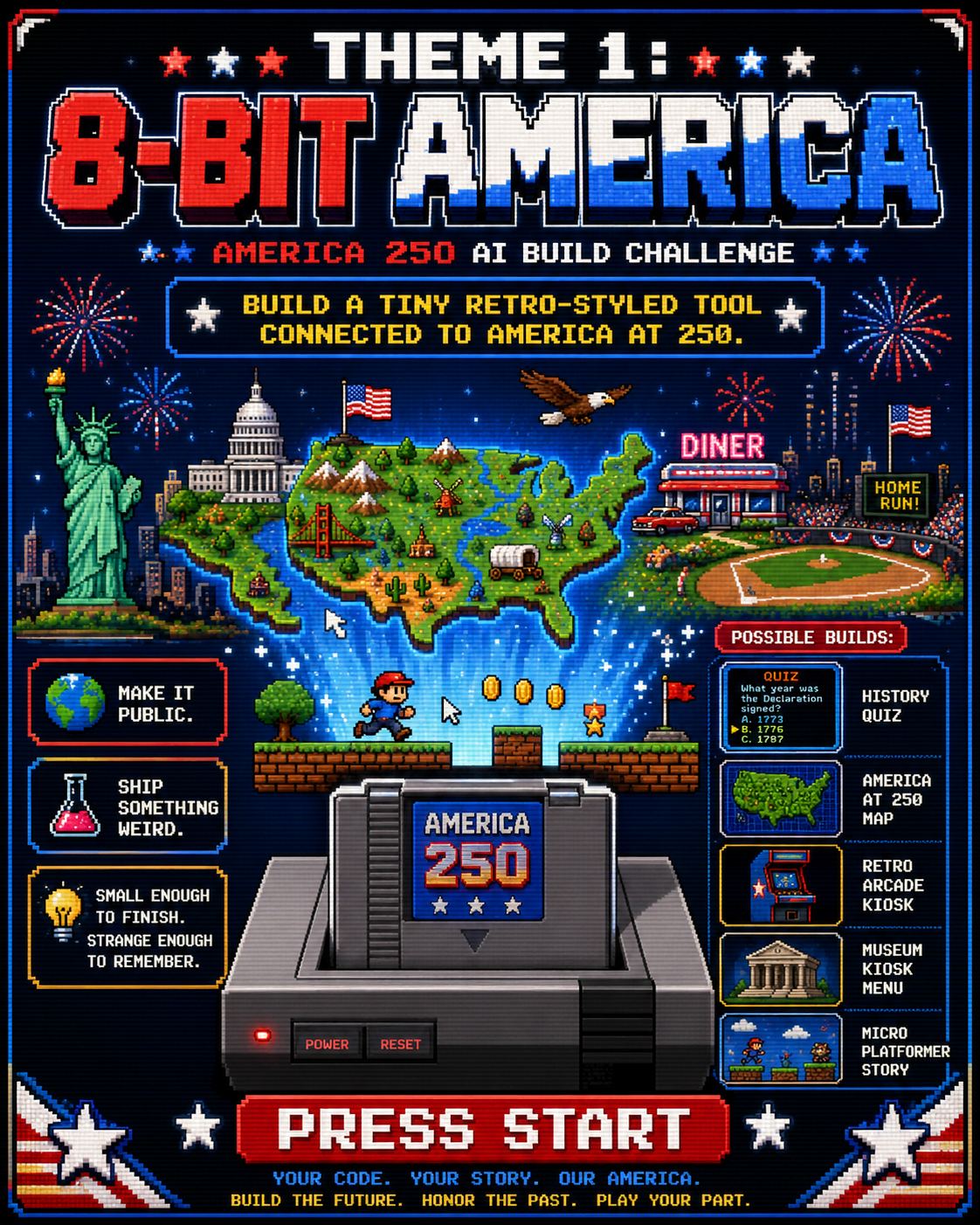
Build a tiny retro-styled tool connected to America at 250. Examples:
a pixel-art map of American memories,
a retro civic quiz,
a Declaration of Independence side-scroller,
an 8-bit “choose your own republic” game,
a museum kiosk that looks like an NES menu,
a “founding fathers arcade cabinet” concept.
Please do not make this boring. The NES did not survive all these years so we could make a beige dashboard.
Theme 1: 8-Bit America
America is turning 250.
That is a big number.
A marble number. Even the original pokemon only had 151 of the little buggars.
Chat tells me it is a number that sounds like it belongs on a commemorative coin, a museum banner, or a very expensive panel discussion with bottled water.
So for Theme 1 of the America 250 AI Build Challenge, we are not starting with a monument.
We are starting with an NES.
More specifically, we are starting with:
8-Bit America
Build a tiny retro-styled tool connected to America at 250.
Not a dashboard. Oh lord, please no more dashboards.
Not a comprehensive civic engagement platform. We are not re-inventing Aristotle’s Politics.
Not a beige webpage with six tabs, three mission statements, and a stock photo of fireworks. Nope. You can totally do fireworks though. PBR can that shoots fireworks? Sounds like a fun entry.
The NES did not survive all these years so we could make a beige dashboard.
Why 8-Bit?
Because constraints are good for the soul.
Old games could not do everything. They had tiny palettes, tiny sprites, tiny memory budgets, and music that sounded like a very determined calculator trying to form a marching band.
And yet they made worlds.
That is the spirit of this challenge.
Do not build the whole republic.
Build one weird little playable piece of it.
A button.
A quiz.
A map.
A kiosk.
A mini-game.
A fake cartridge.
A civic toy.
A founding document rendered as a side-scroller.
Something small enough to finish, strange enough to remember, and public enough that someone else can click it.
America at 250 does not need another solemn PDF.
It needs weird 8-bit retro flavor.
The Challenge
Build an AI-assisted project connected to 8-Bit America.
Your project should use retro game aesthetics, old interfaces, pixel art, arcade logic, NES-era constraints, or game-like interaction to explore America at 250.
That can mean history.
It can mean civic life.
It can mean local memory.
It can mean absurdity.
It can mean the strange things we remember together.
You do not need to make a literal video game, though you absolutely can.
You need to make something that feels like it belongs on an old screen.
Need inspiration? How about this.
What would America at 250 look like if it booted from a cartridge?
Possible Builds
Here are a few directions.
Steal one. Remix one. Make one worse in a funny way and then make it work.
Pixel-Art Map of American Memories
Build a map where people can drop tiny pixel memories.
A baseball field.
A diner.
A courthouse.
A roller rink.
A family farm.
A mall that no longer exists.
A church basement.
A video store.
A highway rest stop.
A porch.
A protest.
A county fair.
A Fourth of July fireworks spot.
Use AI to classify, summarize, or turn submitted memories into pixel-style captions.
Make the map feel like an overworld.
America as a walkable memory cartridge.
Retro Civic Quiz
Build a civic quiz that feels like an NES game show.
Not a school worksheet.
A real retro interface.
Ask questions about American history, government, rights, weird state facts, founding contradictions, local institutions, or America at 250.
Declaration of Independence Side-Scroller
Turn the Declaration of Independence into a side-scrolling experience.
Move through phrases, grievances, signatures, historical context, and modern reflections.
Jump over tyranny.
Collect unalienable rights.
Dodge bad footnotes.
Fight King George as the final boss if you must.
Would this be ridiculous?
Yes.
That is why it might work.
8-Bit Choose Your Own Republic
Create a branching civic adventure.
The player is founding, repairing, or reimagining a tiny republic.
Every decision has tradeoffs.
Do you invest in roads or schools?
Free speech or public order?
Local control or national standards?
Speed or checks and balances?
A strong executive or a lot of committees that somehow meet forever?
Make it funny, but not stupid.
The best version would teach something real while looking like a game your cousin found in a shoebox.
Museum Kiosk That Looks Like an NES Menu
Imagine a museum exhibit that forgot it was supposed to be boring.
Build a retro menu interface for America 250.
Options might include:
Menu ItemStartLocal MemoriesFounding GlitchesHidden CharactersPatch Notes: 1776–2026Bosses DefeatedBosses Still ActiveCredits
Each menu item could open a tiny artifact, story, generated image, timeline, quiz, or interactive moment.
This could be a web app, a static page, or even a fake kiosk prototype.
Founding Fathers Arcade Cabinet
Design a fictional arcade cabinet for America at 250.
Maybe it has games like… well, ask your favorite AI. Drop in this article and get back ideas.
This could be an image, a playable menu, a mock commercial, a pitch deck, a fake manual, or a tiny interactive arcade.
If someone looks at it and says, “This is dumb,” followed five seconds later by, “Wait, I want to click that,” you are on the right track.
The AI Part
This is an AI build challenge, so use AI somewhere.
But do not let AI sand off the weirdness.
AI can help you:
The point is not to prove that AI can make bland content faster.
We already know it can.
The point is to use AI like a power-up.
Something that helps you make a weirder, sharper, more public artifact than you could have made alone in a week.
What Counts
A valid submission can be almost anything, as long as it makes 8-Bit America real.
Small is fine.
A single excellent retro button that teaches one civic idea is better than a giant unfinished platform that claims it will one day reimagine democratic participation.
Do not reimagine democratic participation.
Make the button.
The Proof Rule
Every scored submission needs proof.
You need either:
Required Proofa public working demoshared code
Closed source is allowed.
If you post a public demo, you do not have to share the code.
If you do not post a demo, you need to share the code.
If you do both, you get extra points.
This matters because the challenge is about public work.
Not private vibes.
Not “I had a cool idea.”
Not “my chatbot said this would be amazing.”
Ship something people can see.
Scoring
Your weekly score is:
Publishing Points + Proof Points + Bonus Points = Weekly Score
Deadline
Theme 1 starts now.
Submission deadline:
Sunday at 11:59 PM CT
Scoreboard update:
Monday at noon CT
If you do not submit anything, you land on the Slacker Board and owe the group coffee.
There is no cheat code for the Slacker Board.
Actually, there probably is, but I am not telling you. It wouldn’t be a cheat code if I told you.
Prize Reminder
This competition is connected to America at 250.
First place wins an American inspired BBQ Box.
This is a serious prize for a serious competition about public work, AI, national memory, retro interfaces, civic imagination, and whether brisket counts as infrastructure.
Obviously, brisket counts as infrastructure.
Final Prompt
Build something that looks like it booted from a cartridge.
A map.
A quiz.
A tiny republic.
A side-scroller.
A fake arcade cabinet.
A museum kiosk that got possessed by 1987.
Use AI as your power-up.
Make it public.
Make it playable, clickable, watchable, readable, or remixable.
Make it small enough to finish and strange enough to remember.
Theme 1 is:
8-Bit America
Press Start.
Original source
This local copy preserves the article text, source link, and inline media for the Summer Into AI 2026 competition section. Canonical Substack URL: https://advisoryhour.substack.com/p/summer-into-ai-theme-1.