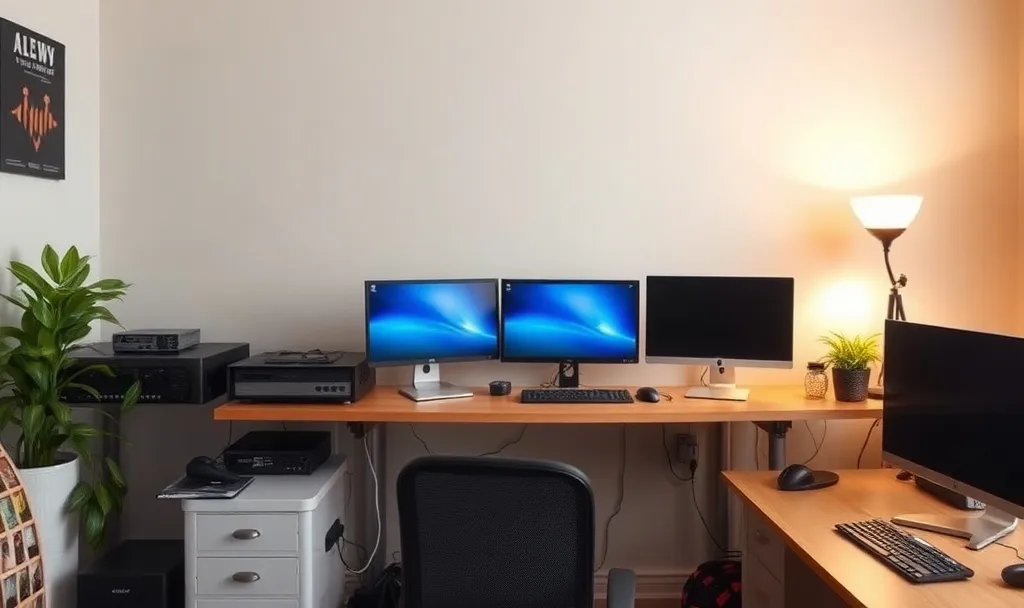
Why do we need the home office?
The benefit of age is the gift of time in assembling a robust home office that speaks to my lived needs. It’s part library, part rec-lunge, 10% guitar, and the remainder is a rat’s nest of wires, monitors, computers and oddball laboratory electronic experiments. It’s the place where I could be comfortable even during an active pandemic. There’s no problem with the home-office. Really. I enjoy it.
I realized after going heavy into Agentic AI, with systems like Hermes, OpenClaw, Codex and others that… well, how to say this. I wasn’t even in the office. I wasn’t even home. I was out in the world. But work was still getting done.
This is the part that is difficult to explain until you experience it.
The old model of work assumed that attention and location were coupled. If I was working, I was seated at the desk, facing the monitors, managing the windows, reading the logs, pushing the buttons. Agentic AI loosens that coupling. The work still needs intent, direction, taste, review, and accountability, but it no longer requires me to be physically planted in the command chair for every intermediate step.
That changes the emotional… texture? of the day. A walk is no longer an absence from progress. An errand is not necessarily a pause. A coffee shop, a park bench, or the passenger seat of a car can become a place where I check direction, refine the next instruction, or review what came back. It’s all right there in telegram or whatsapp. Just waiting on me to offer a few words on what the next project should be.

The Conversation
The entire home office situation percolated in my mind for a while. It was not a single, sharp realization so much as a slow accumulation of little observations. I would walk past the office and notice the monitors glowing, the machines humming, the cables doing their usual impression of invasive vines, and yet I was not really using the room in the way I used to. The office was still there. The computers were still there. The work was still happening. But the relationship between those things had started to change.
Eventually, I brought it up with my wife.
We often go for long walks together. If you do not go on long walks with your significant other, you are missing out on life. There is something about moving through the world side by side that changes the quality of a conversation. You are not staring each other down across a table. You are not competing with a screen. You are just walking, noticing things, letting the rhythm of your feet pull the next thought forward. We have had many of our best and most insightful conversations that way.
On one of those walks, I said, “I’m giving some thought to moving all the computers and redoing my home office.”
She looked over at me. “Why? Where would you put them?”
“I was thinking maybe in the HVAC room. We have some room there. Definitely not the garage. I’m not sure yet. It’s not really a plan. It’s just something I noticed.”
“What’s that?”
“It’s rare that I actually need to be in the office anymore.”
She gave me the look that says she is listening, but also that I had better keep going.
“A lot of the time, I’m outside walking the dog, or I’m at the gym, or I’m somewhere else entirely, and I just ask the agents to build something, test something, or advance a project from there.”
“Oh,” she said. “That’s strange.”
“Right? That’s what I mean. It is strange. I don’t even need to watch the agents work. There’s nothing to watch, really. It’s boring. It’s just a scroll of text moving impossibly fast, far too fast to read in any meaningful way. And since the agents hand off to other agents, including testing agents, I don’t need to hover over every step. I mostly get a summary of what worked, what failed, what changed, and what needs a decision.”
“So what do you actually need the office for?”
“That’s the weird part. Mostly exceptions. A broken upgrade. A machine that needs physical attention. A renewed authorization token. Something involving hardware. Something involving a cable. The stuff that still requires hands.”
She thought about that for a moment.
“It really changes the meaning of a computer in the office.”
“Yes,” I said. “Exactly. That’s what I’m trying to get at.”
For most of my life, the computer was a place I went. Not physically, of course, but functionally. The computer was where the work happened, and the office was the room built around that fact. The chair, the desk, the monitors, the keyboard, the network gear, the shelves, the cables, the power strips, the little tools and adapters, all of it existed because the computer was the center of gravity. If I wanted to work, I went to the computer. If I wanted to make progress, I sat down. If something was going to happen, it was going to happen there.
But agentic AI changes that. The computer is no longer simply a machine I operate directly. Increasingly, it is infrastructure. It is a place where agents run. It is a small private data center with a guitar nearby. I still own the machines, configure them, supervise them, and intervene when needed, but I am no longer driving every action with my own hands. I am setting direction. I am reviewing outcomes. I am making judgment calls. The work is distributed across systems that continue moving while I am somewhere else.
I said to her, “It’s like the computer isn’t really driven by me anymore. Not in the old way. It’s just agents running, all day long.”
That sentence stayed with me after I said it. Felt like sipping from the future. Maybe it was vodka, maybe not.
Because it was not just about the computers. It was about the room. It was about the old assumption that serious work required a fixed station, a dedicated place, a cockpit. The office had been designed around presence. My presence. My hands on the keyboard. My eyes on the monitors. My attention pinned to the center screen. But now the work had begun to separate itself from that posture.
Is this what happens next?
The office was still useful, but it was no longer the entire world. It was becoming more like a server room with books. A workshop. A dock. A place where I could return to inspect, repair, reconfigure, and occasionally take direct control. But much of the actual motion had moved elsewhere, into prompts, plans, reviews, and asynchronous loops of work performed by agents I did not need to babysit.
And that was the part that felt new.
Not that I could work from anywhere. We have been saying that for years, usually meaning email on a phone or a laptop at a coffee shop. This was different. This was not just remote work. It was delegated work. It was work that could continue while I walked through the neighborhood, or lifted weights, or stood in line somewhere, or threw the ball for the dog.
The computer had not become less important. In some ways, it had become more important. But it had become less like a desk and more like a furnace. Less like an instrument and more like a… plant? Less like something I played every minute and more like something I tended. Really gives my article on planting seeds a new view.
Week3: Growing your Software from Seeds
“You must first unlearn what you have learned.” -Wise Talking Puppet…
Read more on SubstackThat is why moving the computers to the HVAC room suddenly made a strange kind of sense. Not because I disliked the office-but maybe it’d make more sense as a music room or library. It’s just what’s changing: the machines are now simply noisy, warm, blinking infrastructure. They did not necessarily need to sit at the center of the room like an altar. They could hum somewhere else. They could run their processes, compile their code, execute their tests, and wait for my next instruction.
The human part of the work could move back into the world.