Originally published as an Advisory Hour Substack post on 2026-09-29. This first-party site copy preserves the text, localizes public supporting media, and connects the record to its project trail.
Original post
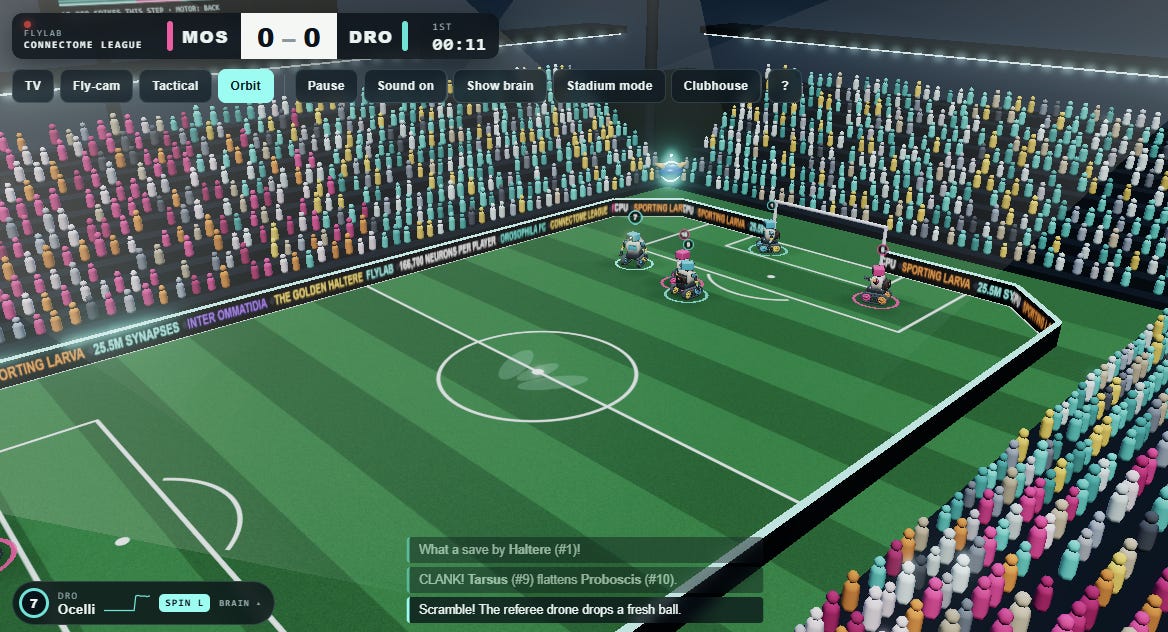
New? Allow me to catch you up on a couple key points: there’s a digital copy of a fly’s brain that you can use as a realtime AI and giving both personality and spirit to things like a digital robot. Big breath on that one. Re-read that line again. Next, I made a digital robot earlier this year doing procedural content experimentations. Thus, it was only a matter of time before the two paths crossed. Install a copy of a digitized real-world brain and slop it into a robot.
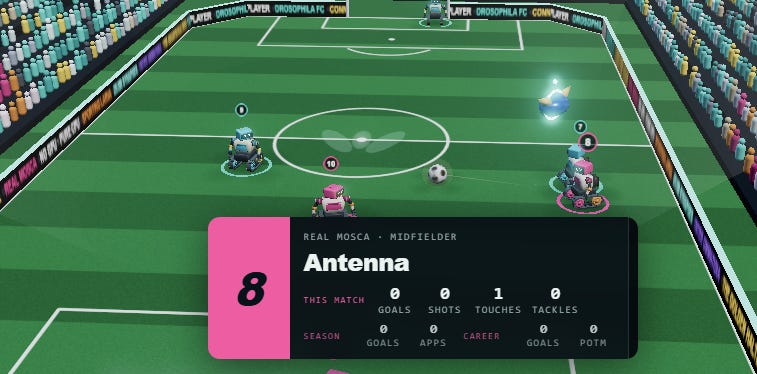
Recently I wrote about how I connected the Flybrain to one robot to play a nintendo like game. Now discover one flybrain that powers four different robot teams playing for glory in a robot-soccer league, with standings, scores and more. Yes, the flybrain robot is playing competitive soccer. It’s amazing!
I asked the AI to give a concise clear rundown for us on how the signals mapped over to the flybrain and what makes it tick. You can find this same information in the soccer exhibition app.
How the robots think?
Eyes. Each robot turns the pitch into 24 egocentric signals: where the ball is, where its waypoint is, whether a rival is looming, how much energy it has, whether the goal is in its sights.
Brain. Those signals are injected as current into 48 groups of visual neurons in its own copy of the fruit-fly connectome (the MaleCNS v1.0 connectome, via flybrain 0.1.0). The whole 166,700-neuron leaky integrate-and-fire network then steps forward.
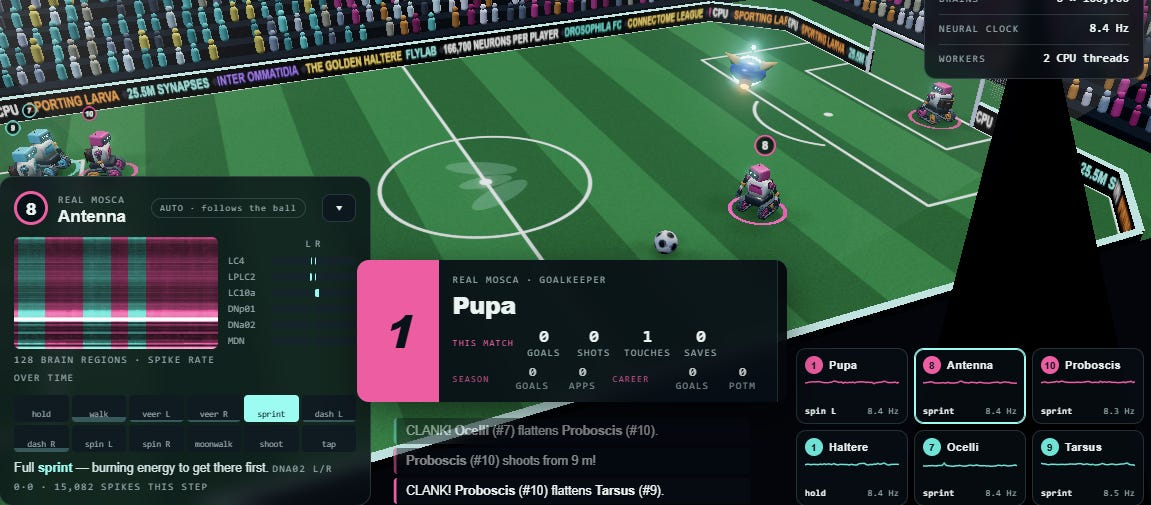
Readout. A tiny 64-unit readout — the same recipe as the Robot Brain Arcade -listens to 376 brain signals and picks one of 12 motor programs: walk, veer, sprint, spin, moonwalk, shoot or tap.
Coach. The readout was trained offline by imitating a scripted coach while the brains were running (DAgger). During the match the coach is switched off: the robots play only from their brain activity, noise and all.
Tactics. A light formation layer hands each robot a waypoint, like a compass heading. The brain decides how to get there, when to dodge and when to shoot.
Performance. The robots are the Island explorer rig - face display, idle series, celebrate spin-wave, concern shrug, puzzled head-scratch - with an extra squash-and-stretch layer. Mote, the Island companion drone, referees: it shadows the ball, scans kick-offs, drops fresh balls and joins the celebrations.
All six brains share one copy of the wiring and run on your CPU in Web Workers. The live throughput meter shows actual spikes per second.
Sounds great, but if you skimmed it for more pictures of robot playing soccer I got you. In this image you can see the brain signals processing and mapped to the robot as each robot competes to win the match.
The matches are meant to be put on a monitor and then just left to run. What happens if you allow a multi-agent system with a digitized copy of a brain run for a long time? I’ll leave that as an exercise for another project. Meanwhile, let’s do more pictures!
There are different modes, such as this tactical view.
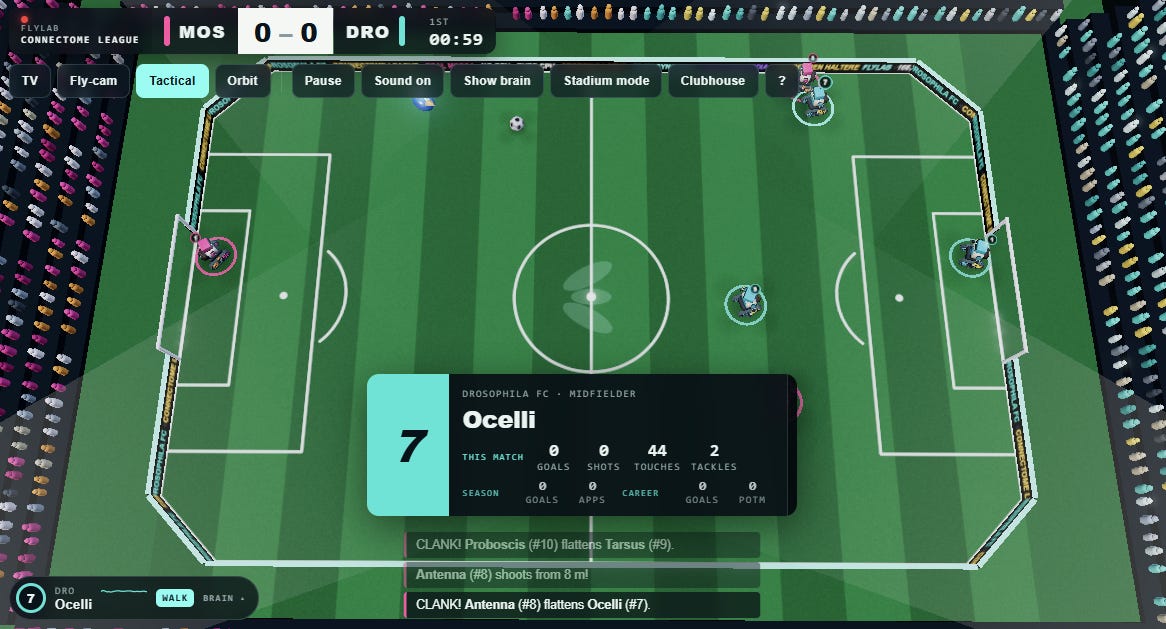
There’s also a “league autoplay” and what this does is start up the league competition and just run it until the end of your computer’s natural life. Perhaps the flybrain enjoys playing soccer. I’m not here to make a statement on that. The robots look to be having a good time playing the game.
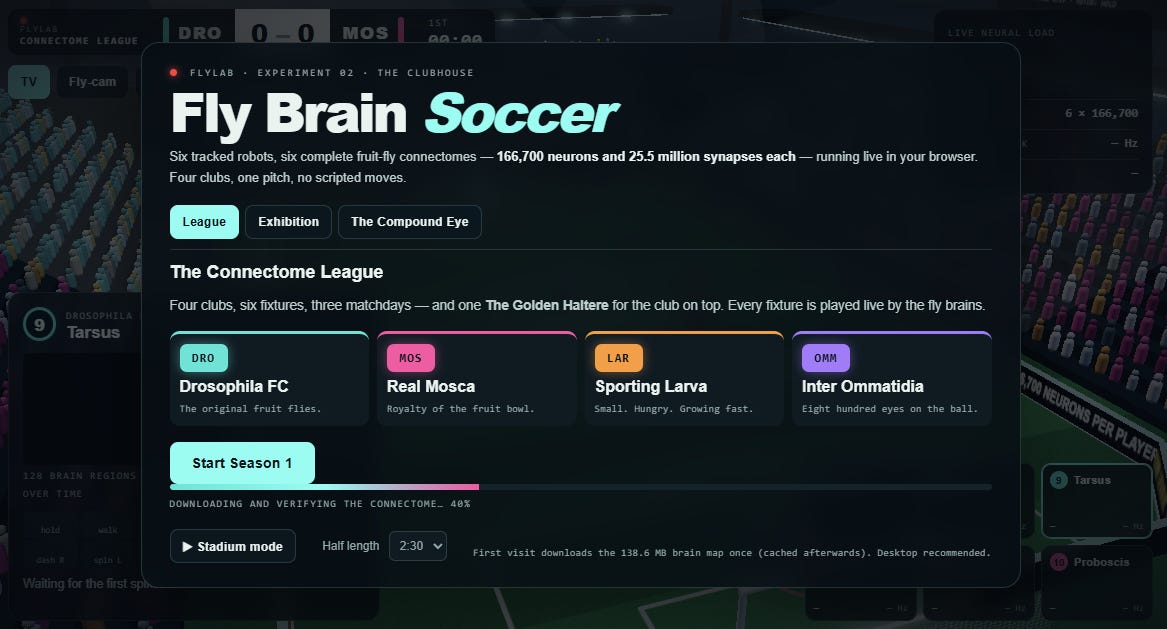
In fact, each robot for each team has their own stats that improve (or not!) as the league matches go on. This way you can root for your favorite.
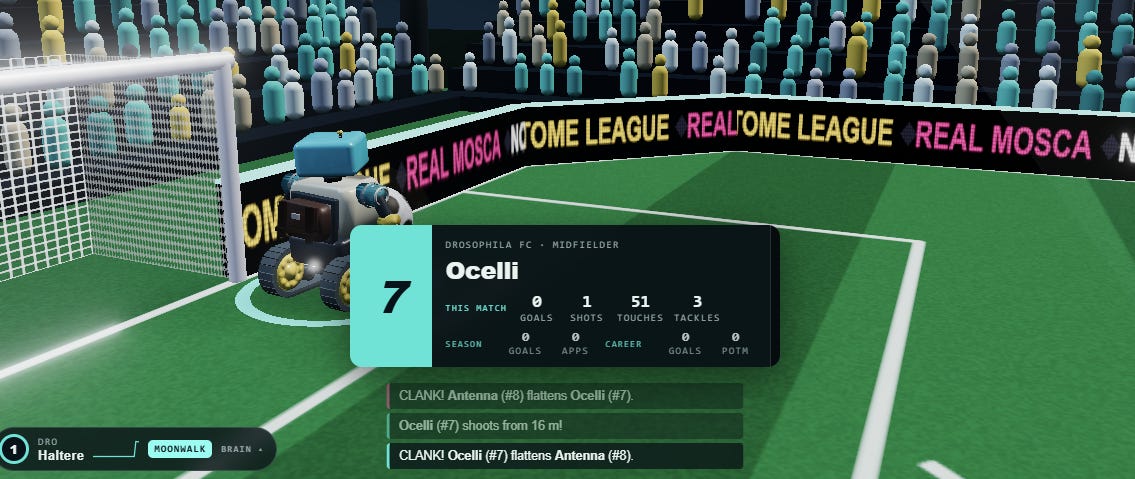
And yes, this is ridiculous. Not once at any point earlier this year had you said to me, “Eric, can you attach a digital brain into a bunch of robots so they can compete for a tournament in a web browser? also, make it work on my phone” would I have thought that I’d even entertain such a crazy thought. (Hmm.) Ok, yes I’d entertain it. Got me.
Give it a try over at
Connected work
- Watch the Connectome Cup: Follow the robot teams and watch each player's brain signals during a match.
- The Connectome League Almanac: Meet the four robot clubs and read their made-up founding stories and rivalries.
- FlyLab: Experiment with a Flybrain: Start with the robot and gamepad experiment that came before the soccer league.