The Connectome League AlmanacClub guide, B.Y. 0 to 40Price: one windfall plum
FlyLab · Fly Brain Soccer · The clubs
Four clubs. One orchard. Forty years of arguing about plums.
Every robot in Fly Brain Soccer plays for one of four clubs. This almanac tells you where they came from, who they can’t stand, and why the referee is a drone nobody hired.
Chapter one · The Orchard
The lights came on by themselves.
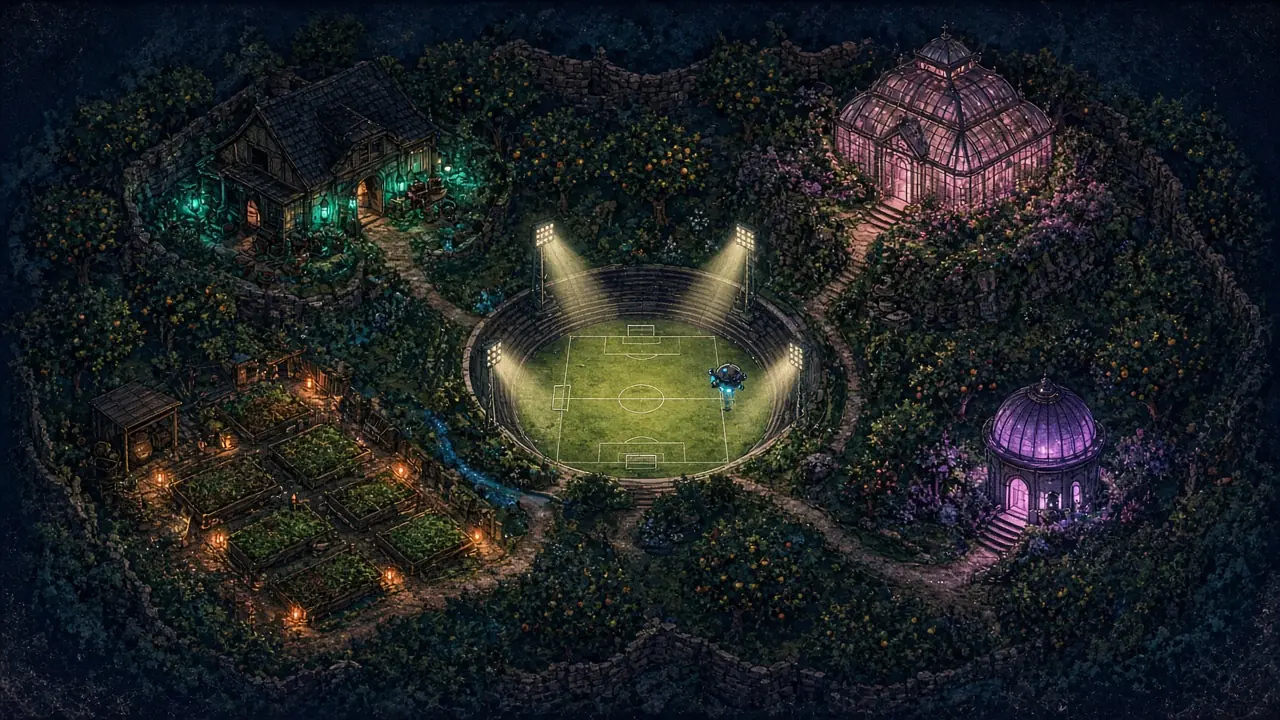
Picture an old walled orchard that nobody has tended in a long time. The trees still drop fruit. The paths are still there. Small boxy robots on treads go about their jobs in it: pressing cider, sorting fruit, polishing lenses, turning compost.
In the middle of the orchard, the ground dips into a round hollow. Everyone calls it the Bowl. One night, four floodlights came on over the Bowl by themselves. Under them sat a flat green pitch, two goals, and a small round drone hovering over the center spot.
That drone is Mote. Mote has refereed every match ever played in the Bowl. Nobody remembers hiring it. Nobody has worked out how to fire it, either.
The almanac counts years from that night, in Bowl Years. B.Y. 0 is the night the lights came on. B.Y. 40 is the year this almanac goes to press. Everything after that is up to you.
Chapter two · The clubs
Four districts, four shirts
Each club grew out of one corner of the orchard, and each one thinks it is the important corner. Listed here in order of founding.
-
No. 01 · Est. B.Y. 1
The Cider PressDrosophila FC
“The original fruit flies.”
The first club in the Bowl. A cider press night crew started it with a fallen plum for a ball.
-
No. 02 · Est. B.Y. 3
The GlasshouseReal Mosca
“Royalty of the fruit bowl.”
Founded with a crate of plums that was never theirs. They have been royalty about it ever since.
-
No. 03 · Est. B.Y. 11
The ObservatoryInter Ommatidia
“Eight hundred eyes on the ball.”
Broke away from Drosophila FC to watch more and run less. Keeps the league’s record book.
-
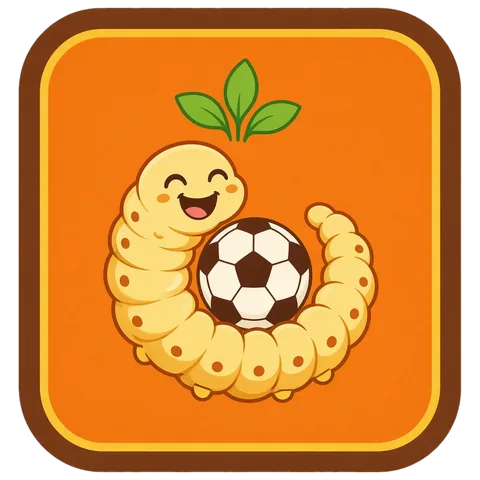
No. 04 · Est. B.Y. 29
The Compost RowsSporting Larva
“Small. Hungry. Growing fast.”
The youngest club, from the compost beds. Small, hungry, and still chasing its first title.
Chapter three · Named fixtures
Six games, six grudges
Four clubs make six pairings. Every one of them has a name, and every name has a story behind it.
-
The Peel Derby
The oldest fixture. It started as an argument over a crate of plums and never really stopped. The name comes from the plum peel left on the pitch after the first one.
-
The Split
Inter Ommatidia was founded by Drosophila FC’s own tactician. Drosophila fans still call it a walkout. Inter fans call it “a difference in viewing preferences.”
-
The Long Draw
In B.Y. 24 these two played a 0–0 that ran so late the floodlights dimmed for the first time. Both clubs say they were about to score.
-
Crown and Compost
Real Mosca refused Larva’s first three applications. In B.Y. 31 Larva beat them 1–0 for their first win ever. Larva fans now bring compost. Mosca fans bring umbrellas.
-
The Nursery Match
The oldest club against the youngest. Drosophila fans call Larva “the nursery.” Larva fans call Drosophila “the old folks.” Both are technically correct.
-
The Lamp Match
The friendliest fixture in the league. When Larva had no lights to train under, Inter lent them three old observatory lamps. Larva still use them. Inter still mention it.
Chapter four · The honours board
Golden Halteres, B.Y. 5 to 39
Thirty-five seasons, thirty-five trophies. The count is official, except where Real Mosca disagree.
- 13Drosophila FC, including the first, in B.Y. 5
- 13*Real Mosca
- 9Inter Ommatidia, first in B.Y. 15
- 0Sporting Larva, so far
* Real Mosca count 14. The extra one is from B.Y. 4, a year before the league existed. They gave it to themselves.
Chapter five · The timeline
Forty years in the Bowl
-
B.Y. 0
The floodlights come on
Four floodlights switch on over the Bowl by themselves. Under them sit a pitch, two goals, and a small round drone. Mote has refereed every match since.
-
B.Y. 1
Drosophila FC is founded
The Cider Press night crew plays the first match ever, with barrels for goals and a windfall plum for a ball.
-
B.Y. 3
Real Mosca, and the first Peel Derby
A crate of plums meant for the Cider Press goes to the Glasshouse. Real Mosca keeps it. Drosophila FC wins the derby 2–1 and still does not get the crate back.
-
B.Y. 4
A trophy for a league that does not exist
Real Mosca award themselves a Golden Haltere. Nobody else counts it.
-
B.Y. 5
The Connectome League begins
Two clubs, one trophy: the Golden Haltere. Drosophila FC lift the first one that counts.
-
B.Y. 11
The Split
Professor Lumen Hex leaves Drosophila FC with two players and a telescope. Inter Ommatidia is founded at the Observatory.
-
B.Y. 12
The Compound Eye opens
Inter start the league’s record book. It notes every goal, every save, and every time someone blames the referee.
-
B.Y. 18
The Golden Tarsus
A new prize for the season’s top scorer, named after a fly’s foot. Drosophila FC’s striker, also called Tarsus, takes it personally.
-
B.Y. 24
The Long Draw
Real Mosca and Inter Ommatidia play a 0–0 so long that the floodlights dim.
-
B.Y. 29
Sporting Larva joins
Four clubs means three matchdays and six fixtures a season. Inter lend the newcomers three lamps.
-
B.Y. 31
Larva’s first win
1–0 over Real Mosca, in Crown and Compost.
-
B.Y. 37
The Instar Season
Sporting Larva finish second. The Glasshouse can smell the party.
-
B.Y. 40
The Rewiring
Every robot in the orchard gets the same new brain: a copy of a real fruit fly’s wiring map, 166,700 neurons strong. The old playbooks stop working. The almanac’s history ends here.
-
Season 1
Your season
Open the Clubhouse in Fly Brain Soccer and start a season. From here on, the history is played by the brain simulations in your browser, and the game keeps its own records in the Compound Eye.
From the touchline · Almanac fiction
The appointment form.
Mote hovers over the center spot while the clubs argue about who should move first. Someone has brought a clipboard. The top line asks for the referee’s name. The next asks who appointed it. The first line is easy.
The drone turns toward the ball. The clipboard follows. There is a box for a signature, but Mote has no pen and shows no interest in borrowing one. Its light passes over the paper, then returns to the pitch.
A ball rolls loose from the touchline. Mote follows it. Both captains follow Mote. The robot holding the clipboard follows the captains, still asking about the appointment. By the time they reach the center, everyone is in position to begin.
The form comes back to the sideline with its second line empty. Under “available for next fixture,” someone has written “apparently.” It goes into the Compound Eye between two match reports.
On the next matchday, Mote is already there. The new form is shorter. Nobody has solved the appointment question, but they have stopped leaving a chair for the referee.
Chapter six · Fact and fiction
What’s real and what isn’t
An almanac should be honest about its sources. This one has two.
Real, from the game
- Fly Brain Soccer is a real browser game in FlyLab. Each robot runs a computer simulation using a fruit-fly wiring map: the MaleCNS v1.0 connectome, with 166,700 neurons and 25.5 million synapses.
- The four club names, colors, mottos, squads, and numbers come straight from the game’s code. So do the Golden Haltere, the Golden Tarsus, and the Compound Eye.
- Mote appears as the referee drone in the game. Its mysterious appointment is fiction.
- Read how the game was built.
Made up, for the almanac
- The Orchard, the Bowl, Bowl Years, and everything that happened before Season 1.
- The founders, rivalries, scores, honours, chants, and every quote.
- The illustrations and crests, which were made with an image generator for these pages.
- Any likeness to a real football club is a coincidence, or a pun.
Matchday guide · The browser game
Your first visit to the Bowl.
Choose a match. Exhibition lets you pick any two different clubs for a friendly. A club page’s “Watch” button opens that picker with its club selected. Press Kick off when the brains are ready. You watch the robots play; you do not steer them.
Follow a season. In the Clubhouse, start a season to play all six pairings across three matchdays. The Golden Haltere goes to the champion. Exhibition results enter the records, but do not change the league table.
Watch the three jobs. Each side has a goalkeeper, midfielder, and striker. Follow who stays near the goal, who connects the play, and who moves into shooting space. Their names and shirts identify the clubs. The almanac’s personalities do not give them different AI abilities.
Look closer. Press 1–4 to change cameras, Space to pause, or C to open the Clubhouse. Click a robot or its tile to inspect its brain activity. Stadium mode can run the league automatically; it also starts after a period without input.
What is running? Each robot has its own simulated neural activity using the same fruit-fly wiring map. Signals about the pitch feed the simulation. A trained controller turns that activity into movement. Another part of the game gives each robot a position to aim for. These are computer simulations, not living brains. Open the game’s ? button for its full explanation.
Your results stay here. The Compound Eye keeps results in this browser’s local storage. They do not sync to another device. If browser storage is unavailable, results last only for the current visit. Clearing site data or resetting records removes them. The almanac’s 35 historical trophies are fictional and are not added to your game records.
Before the first whistle. The brain map download is about 138.6 MB. The game tries to cache it for later visits, but browser settings, cleared data, or cache eviction can require another download. A desktop browser works best.
Matchday · The Bowl is open
Season 1 is still unwritten.
Pick two clubs for an exhibition, or start a full season in the Clubhouse. The first visit downloads about 138.6 MB of brain wiring data. The game tries to cache it for later visits. A desktop browser works best.