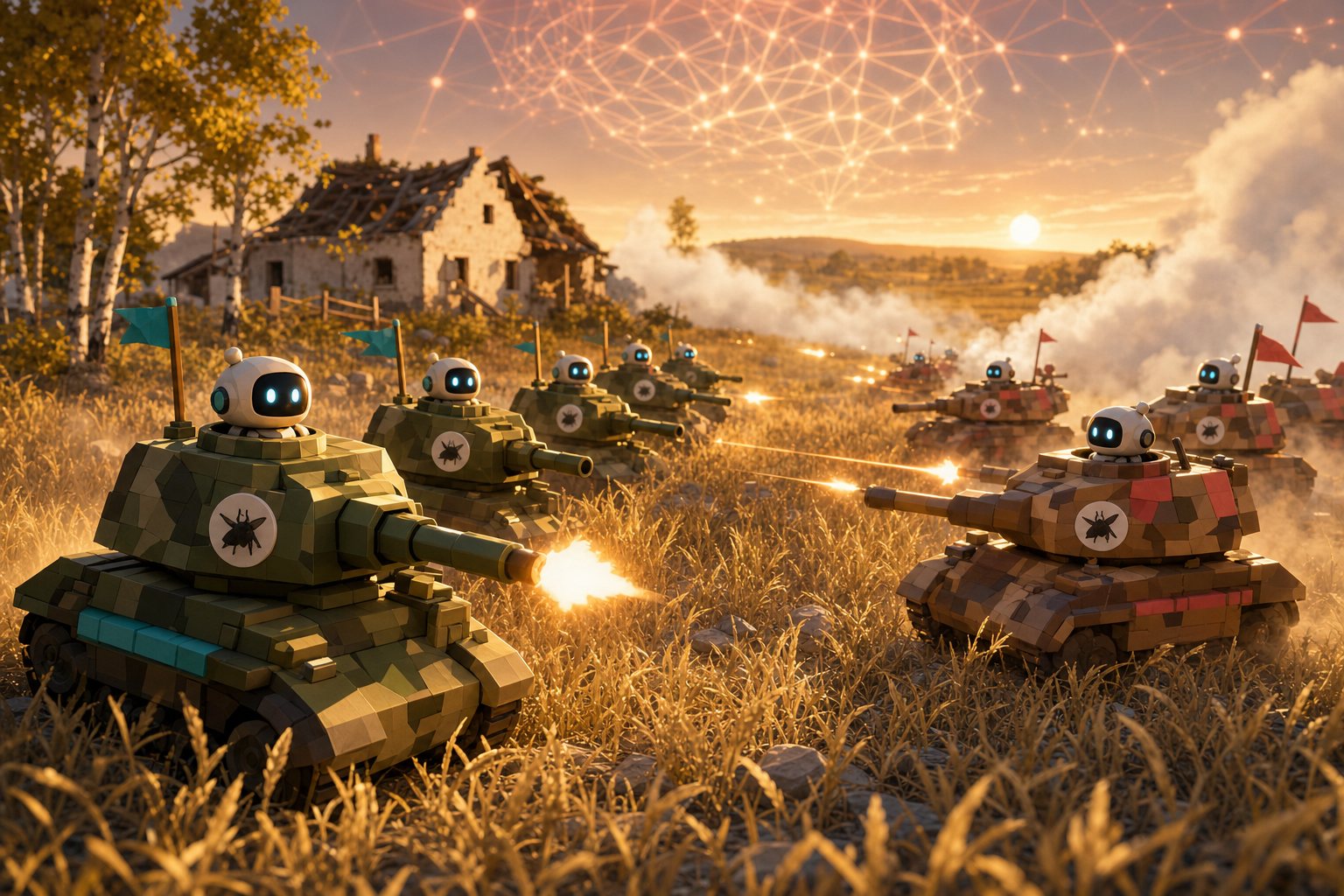
The first two FlyLab experiments put a fruit-fly brain map behind a game controller and then behind a soccer team. This one hands it a tank. Eight of them, actually: four for the Compound Eye Brigade and four for the Red Mosca Battalion, meeting on a golden-hour steppe in a best-of-five armoured battle.
Every tank runs its own complete copy of the MaleCNS v1.0 connectome: 166,700 simulated neurons and 25,582,938 connections, stepping live in your browser. That is 1.33 million neurons on the field at once.
What a tank brain gets, and what it decides
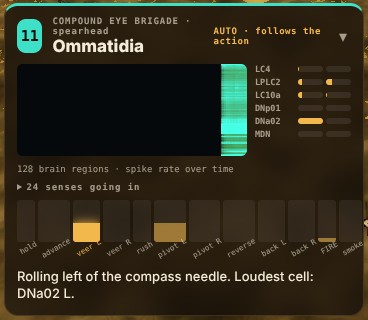
Each tank turns the battlefield into 24 signals from its own point of view. Where is my waypoint? Where is my target? Is my gun on it, loaded, with a clear line? Is an enemy gun pointed at me? Is a shell coming in? How much armour do I have left? Is something in front of my hull?
Those signals become current injected into groups of visual neurons. The whole network steps forward. A small readout listens to 376 brain signals, including the identified neurons LC4, LPLC2, LC10a, DNp01, DNa02 and MDN, and picks one of twelve motor programs: hold, advance, veer left or right, rush, pivot left or right, reverse straight or turning, fire, or pop smoke.
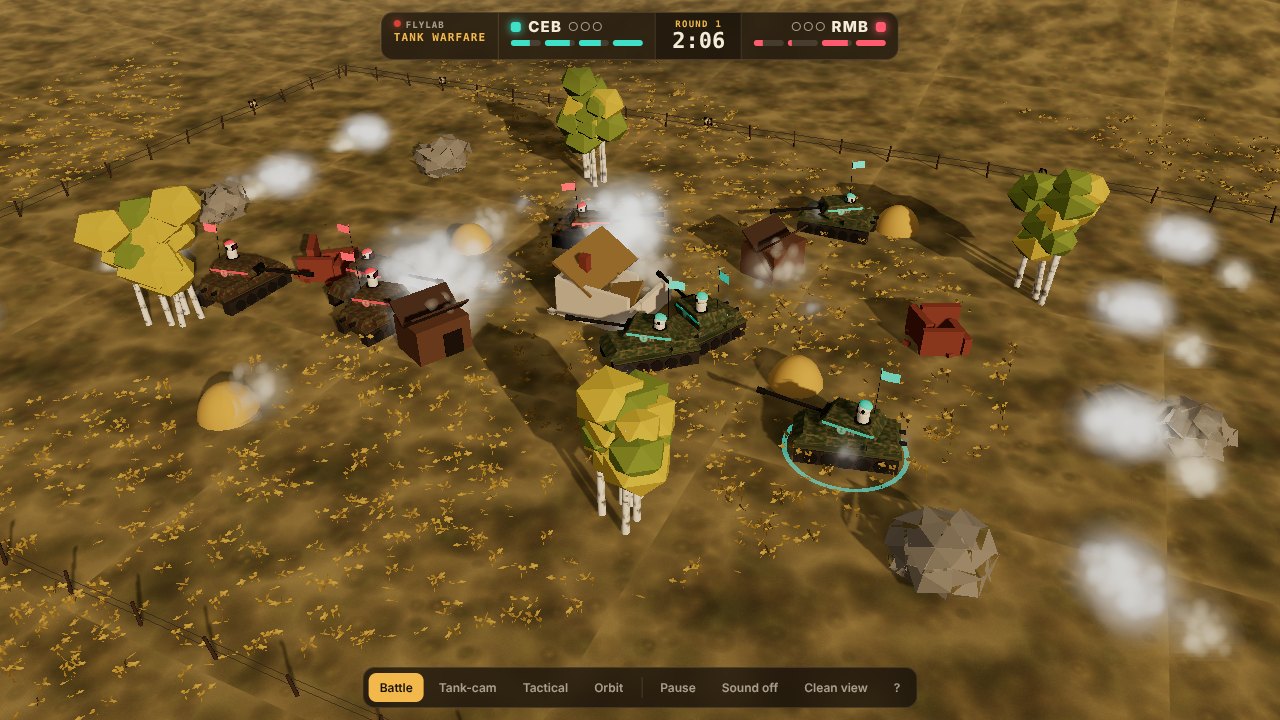
The brain owns the hull, the trigger and the smoke. Two simpler crew layers help it: a tactics layer chooses a target and hands over a waypoint, like a compass needle, and a gunner keeps the turret slewed toward the target. Firing on the move spreads the shot. Sloped front armour can bounce a round; sides and rear cannot. Smoke and cover block sight lines, and every wreck becomes new cover.
Who taught it
The readout learned by copying a scripted tank commander while the brains were running. First the commander drove and labelled 24,000 decisions. Then two rounds of DAgger: the brain drove most of the time (60 %, then 75 %) and the commander only said what it would have done. That is 72,000 labelled decisions from real connectome activity.
On held-out data the readout picks the commander's move about 71 % of the time, and its fire decision about 83 % of the time. In battle the commander is switched off. When I let the brains fight alone offline, they agreed with the commander on roughly six decisions in ten and still finished rounds with knockouts and flank shots. They are not better than their teacher: in a five-round test against a side driven by the scripted commander itself, the brains won one round.
Human vs fly
You can also take a tank yourself. Under Modes there are three ways to fight the flies: a Duel (you against one fly brain), a Squad (you and three fly wingmen against four flies) and a Last stand (your tank, with 2.4 times the armour, against four flies). On a desktop you drive with W A S D and aim with the mouse; on a phone there is a thumbstick, drag-to-aim and FIRE and SMOKE buttons.
The flies get exactly the same 24 signals about your tank that they get about each other. They were never trained against a person, only by copying the scripted commander, so this is a fair way to find out how well that copying holds up against someone who doesn't drive like the script. While you play, the brain cam follows whichever fly is in your sights, and your record against the flies is kept in your browser.
The crews
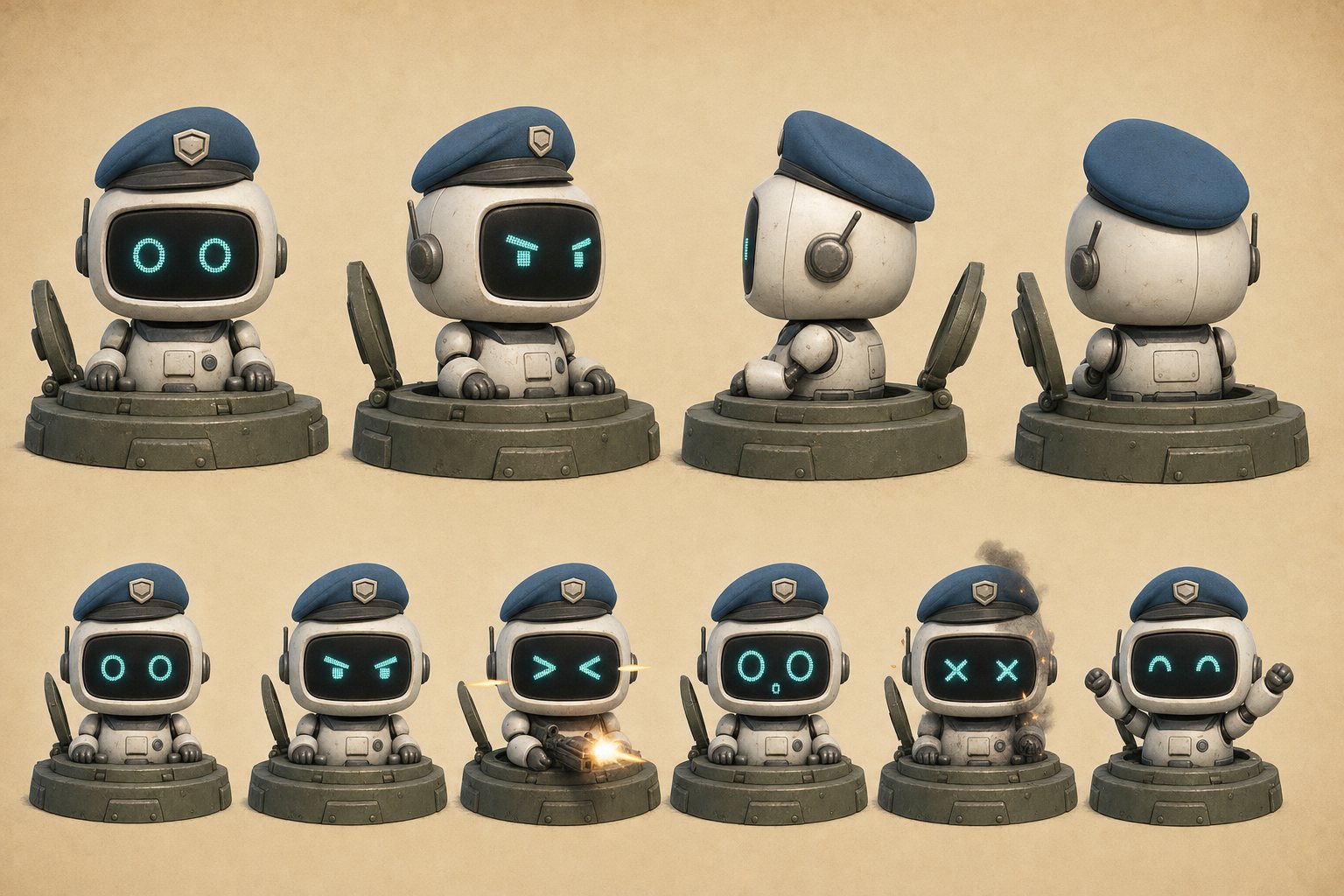
Like the Island robots in the other experiments, these tanks are meant to have some charm. A little commander bot rides in every hatch. Its face squints when it fires, goes wide-eyed when a shell is inbound, flashes X eyes when it is hit and cheers a knockout. It ducks into the hatch under fire. The hulls squash on recoil, rock on their springs and wave a team pennant from a whip antenna that lags behind every turn.
Borrowed from GameLab
- Kursk — Steel & Thunder lent the setting: a wheat steppe at golden hour, a shelled farmhouse, birch copses and burning wrecks. The battle sits in a wider valley with a village, a church with an onion dome, a windmill, sunflower and wheat fields, telegraph poles along the road, a trench line and a couple of thousand trees. Tanks flatten the wheat and leave track ruts as they go.
- Pick of the Patch (TiltLab) lent Seven, his drone Mote, the wagon and the pumpkins. They keep a little patch just outside the wire. Between matches Mote flies the rows scanning pumpkins, marks the best one, and Seven pulls the wagon over to pick it, then heads home round the headland to watch the next match.
- Margin Aces lent its blue ballpoint. The field-notebook map in the corner draws every tank, sight line and smoke cloud as notebook doodles.
- Fly Brain Soccer lent the broadcast: the brain cam, the eight brain tiles, the live spike meter and the worker pool that lets eight brains share one copy of the wiring.
Sound effects (cannon, armour hits, ricochets, brew-ups, smoke dischargers, the bugle) were generated with ElevenLabs.
What to watch for
- Click a tank and watch its motor bars just before it fires. FIRE usually wins only when "gun on target", "line of sight" and "gun loaded" all line up.
- Watch a damaged tank staring down a loaded gun. That is when smoke tends to win.
- Switch to the notebook or the Tactical camera to see who is flanking whom.
The honest limits
A map is not a mind. This is a software experiment built on biological wiring data. It does not show that a fly understands tanks, armour or tactics, and nothing here is conscious. The sensor encoding, the readout, the scripted commander it imitated, the tactics layer and the game rules all shape what you see. The connectome simulation is adapted from flybrain 0.1.0. Read the source credits, licenses and model limits.
Connected work
- Open Tank Warfare: watch the live 4v4 battle and any tank's brain.
- Fly Brain Soccer: six robots, six brains, one ball.
- Robot Brain Arcade: the original experiment, where the Island robot learns Revere Bike.