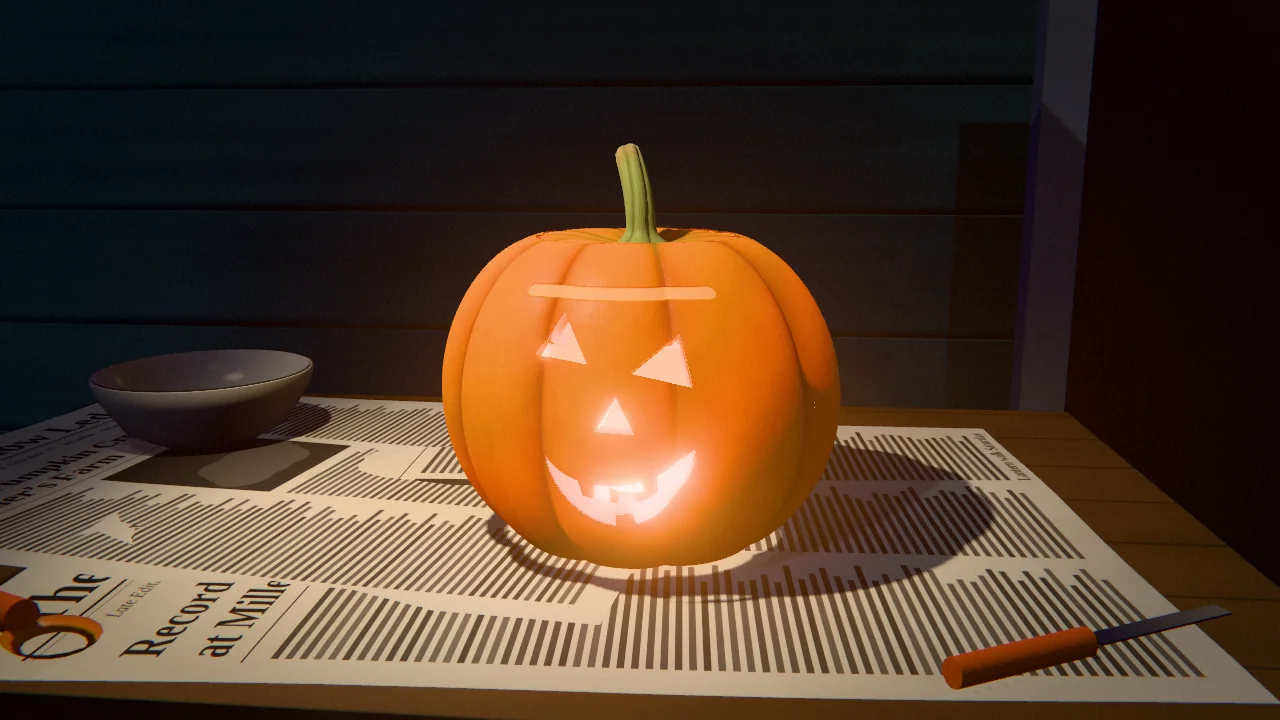
- Pumpkins
- Seven varieties, no two alike
- Tools
- Lid, scoop, knife, gouge, drill, etch
- Stencils
- 23 eyes, noses, mouths and extras
- Places
- The porch, and four borrowed from other GameLab games
- Company
- Seven, who copies everything you do, wrong
The table is ready
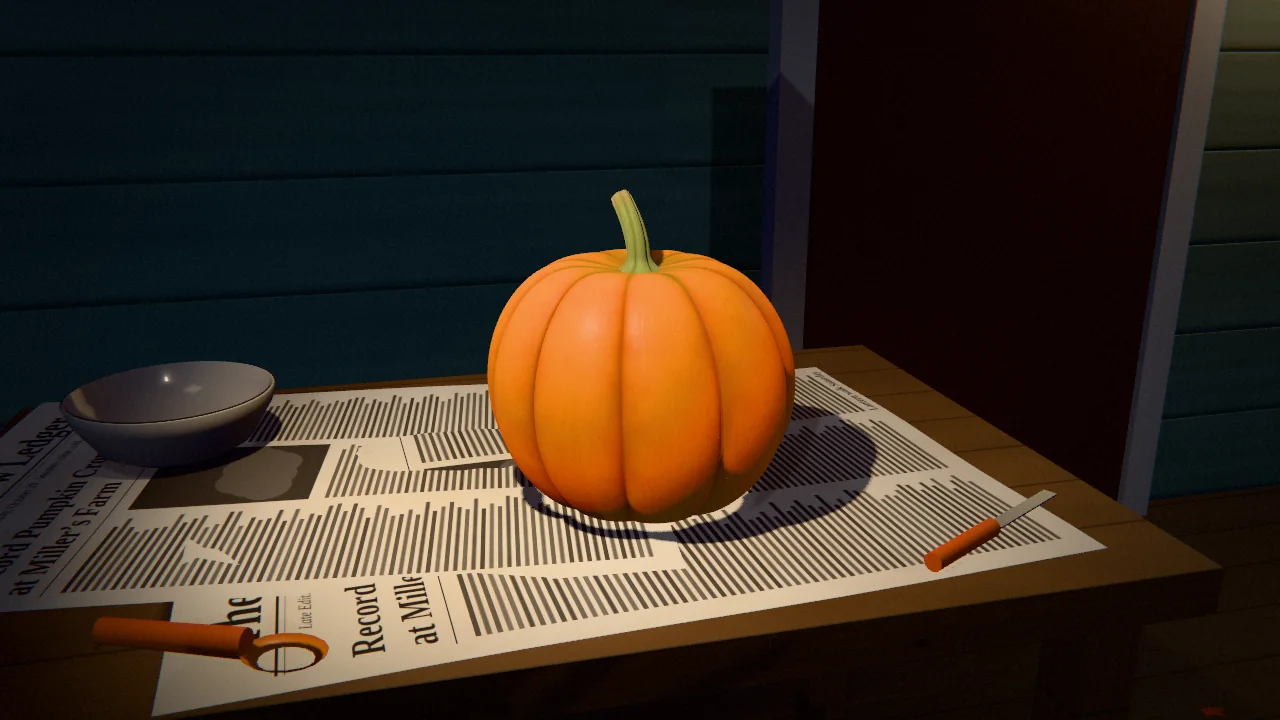
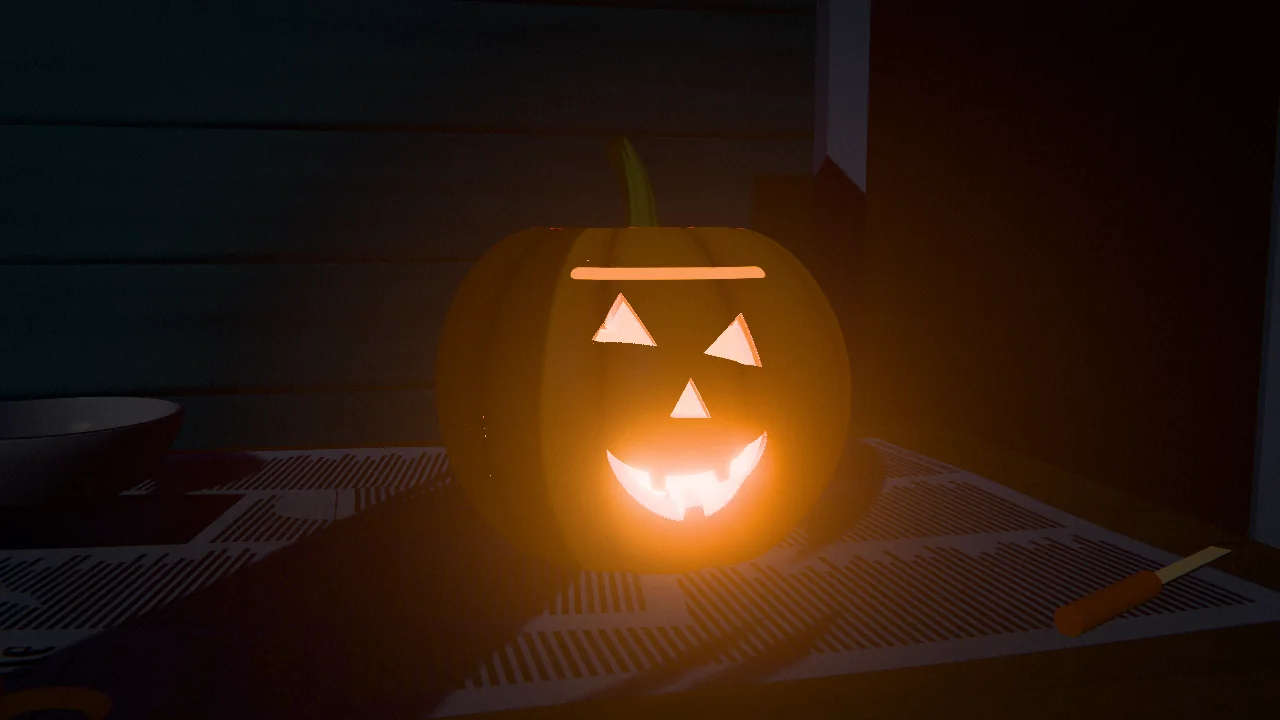
It is the last week of October. A pumpkin sits on a table on the front porch, on two sheets of yesterday's paper, under a clamp lamp. There is a bowl for the guts and a knife with an orange handle.
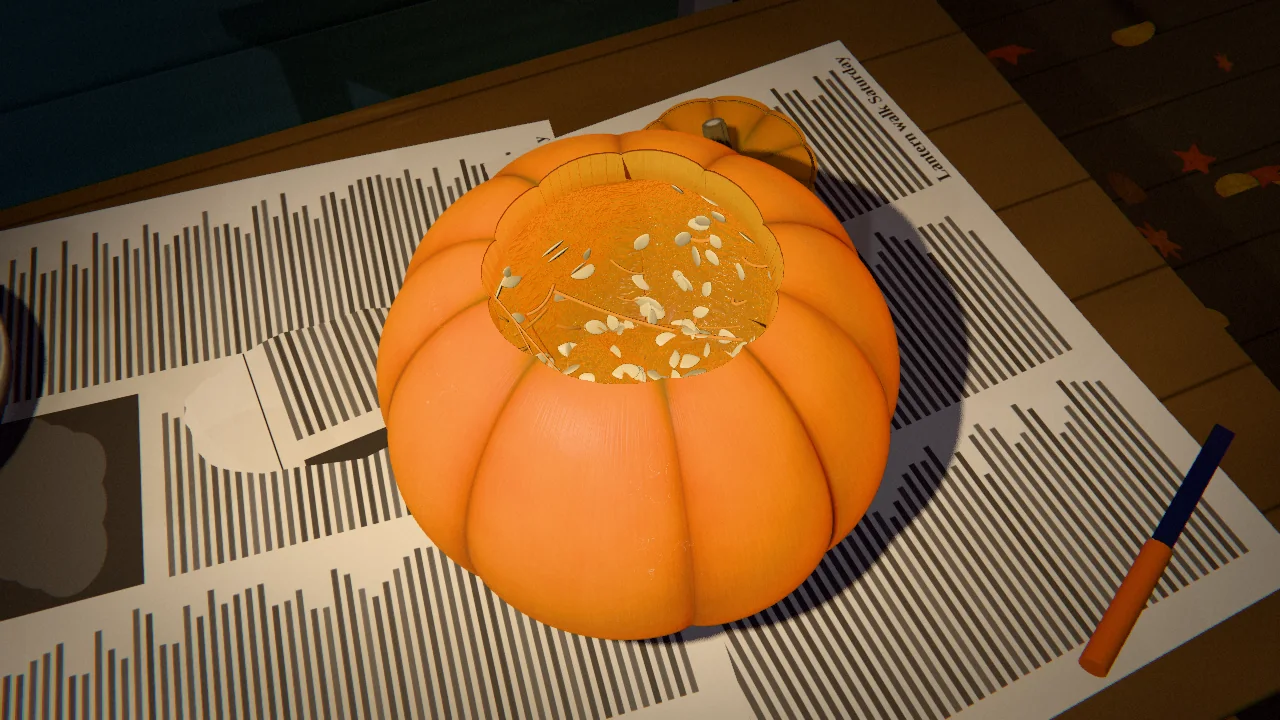
First you cut the lid. Pick a shape and the knife goes round the stem, or trace your own loop. When the lid comes off, strings of goop stretch up with it and snap. Then you reach in with the scoop. The pulp comes away in wet handfuls, seeds and all, and every scoopful lands in the bowl.
Then the face. Press a stencil onto the skin, drag the knife for a thin slit, close a loop to pop a piece out, drill a row of holes or shave the skin with the etching loop so it glows instead of blazing. Set a tea light inside, put the lid back on and turn the porch lights out.
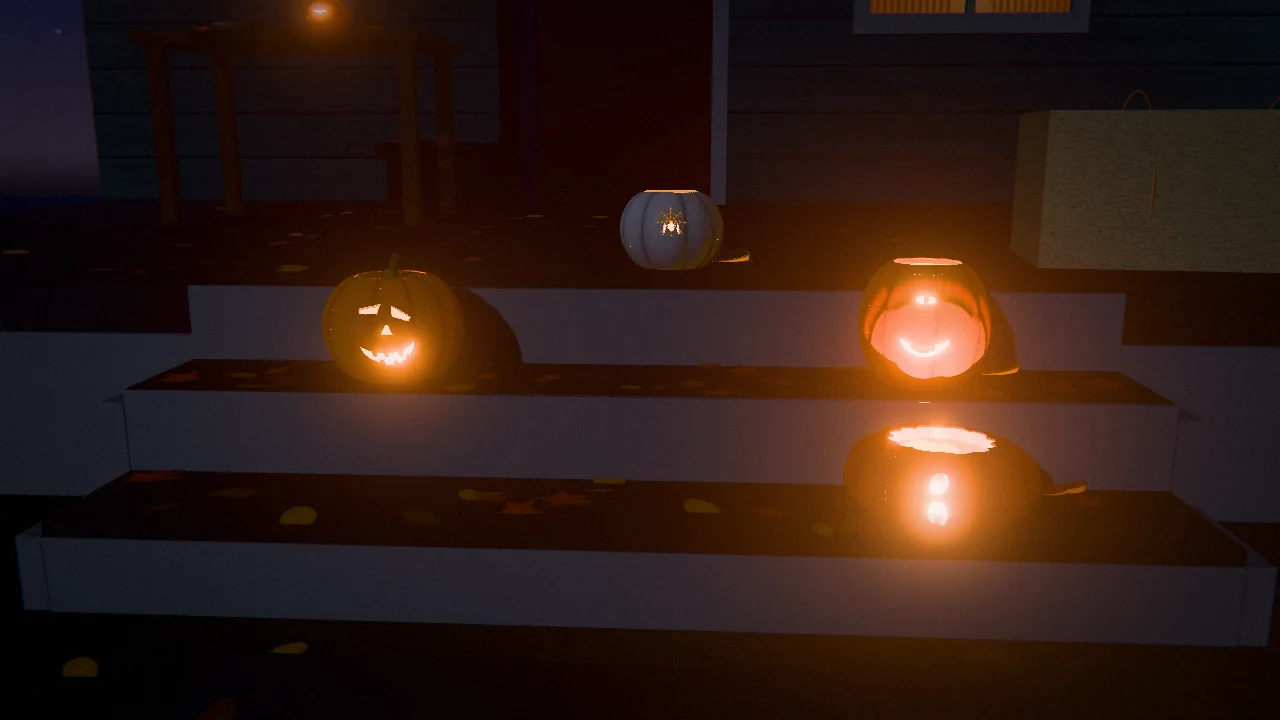
One pumpkin is never enough. Start another and the first one goes out to the steps. Line them up, move them around and light them all.
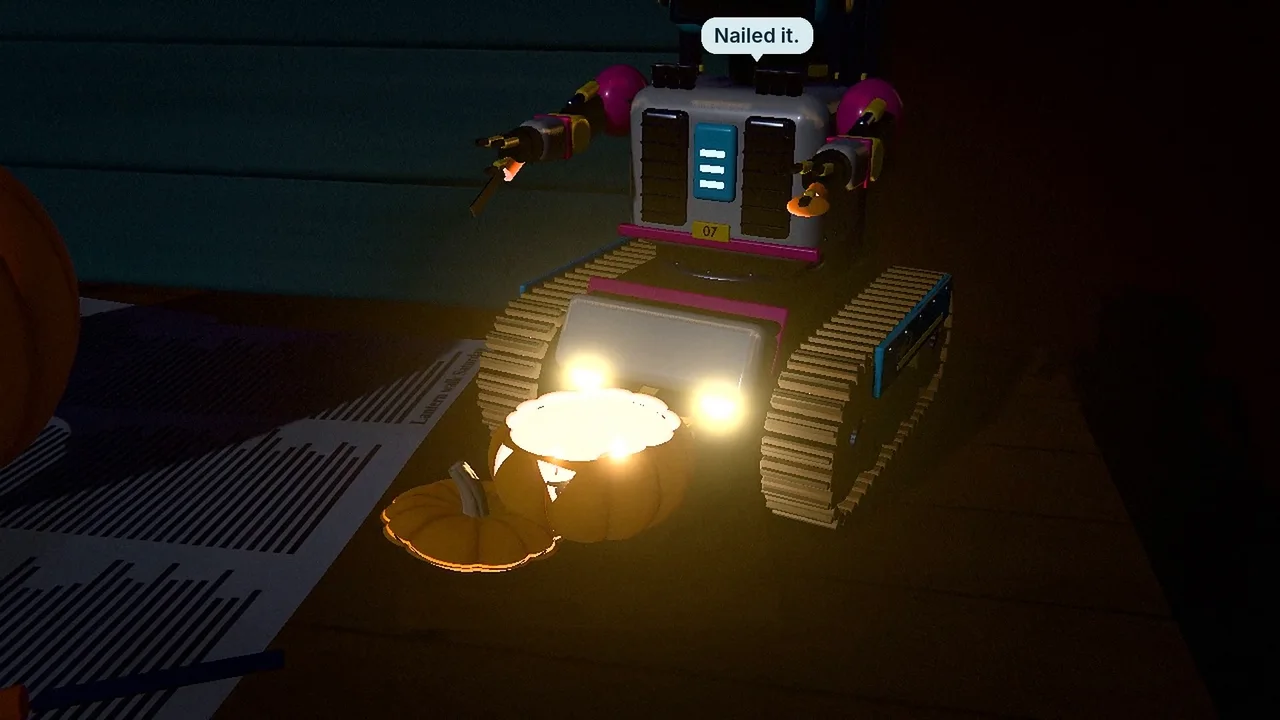
You are not carving alone. Seven, the little field robot from Starlight Menagerie, has a mini pumpkin at the end of the table, and he is copying you. Badly. Cut a lid and he leans over, scans yours with his visor and cuts his own, crooked. Stamp a pair of eyes and his come out upside down, or enormous, or on the back. Catch him looking and he whistles at the moon.
Want to see what he's up to? Switch to the Seven cam, a hidden camera at his end of the table. He doesn't know it's there.
And the display does not have to stay on the porch. Set your pumpkins out on the rocks under the lighthouse at Kelda Head, on the basalt columns of Lumen Reach, on the crates of the zoo station's garden deck, or up a brownstone stoop in Firehawk City.
The trailer
Ninety seconds, rendered frame by frame from the game itself, with Seven trying his very best. Watch the trailer.
Why build it
The question was how close a browser can get to the real thing: a pumpkin you would believe in a photo. Not a smooth orange ball with a face painted on, but ribs and streaks and a pale spot where it lay in the field, a cut wall you can see the thickness of, wet pulp that clings, and a candle that throws the face onto the boards.
Nothing is downloaded to make the pumpkins. Every pumpkin's skin is painted by a shader when it is grown, from the same formula that shapes its ribs. Every cut is paint on a hidden map of the pumpkin, and the walls of the cut are rebuilt from that map as you drag.
The pumpkins
| Variety | Size | What it is like to carve |
|---|---|---|
| Howden Field | Medium | The classic. Even ribs and an easy wall. |
| Cinderella | Wide and squat | Deep ribs and a thick wall. Faces sit low and wide. |
| Lumina | Medium | White skin over orange flesh. Etching shows up like moonlight. |
| Knucklehead | Tall | Covered in warts. Ugly in the best way. |
| Jarrahdale | Wide | Slate blue skin, bright orange inside. |
| Sugar Pie | Small | A pie pumpkin. Tight ribs, little room for a face. |
| Big Max | Giant | Pale and lumpy, with a lot of wall and a lot of goop. |
Design notes
- One shape, two skins. Each pumpkin is one formula for its skin. The inside wall is the same shape with shallower ribs, pulled in by the wall thickness. A hole cut in one is a hole in both.
- Carving is painting. Every pumpkin keeps three hidden maps of itself: where the shell is still there, where the skin has been peeled, and where goop still clings. The knife, the stencils and the drill paint the first one. The etching loop paints the second. The scoop paints the third.
- Real cut walls. After every stroke, the outline of each hole is traced to a fraction of a pixel and rebuilt as a wall between the skin and the inside. The wall is coloured through its depth: a thin rind, pale flesh, then the stringy orange of the inside.
- Pieces fall out. Close a knife loop or press a stencil and the piece inside pops out of the hole and drops to the table, with its own cut edges. The lid is the same kind of piece, cut a hair small, so a line of light shows round it.
- Etching glows. Peeled skin lets the candle through in proportion to how deep it goes. A shallow peel leaves flecks of rind. A deep shave glows nearly as bright as a cut.
- The goop. Pulp, seeds and fibres cling to the inside wall, thickest at the bottom. Scraping thins it back to the wall. Up to two hundred seeds ride the surface, and stringy fibres cross the hollow until you scrape their ends away.
- Candlelight. Each candle is a real light that casts shadows, so a carved face is thrown onto the porch. Shadows are only redrawn when something moves, which keeps a porch full of candles smooth.
How to play
A loader fetches and checks every file, bakes the porch and the first pumpkin, and compiles every shader before the start screen. Press Start carving. The bar along the top tracks the four jobs: lid, goop, carve, light.
| Action | Mouse and keyboard | Touch |
|---|---|---|
| Use a tool | Left button, or 1 to 8 to pick one | One finger |
| Look round | Right-drag, or drag off the pumpkin; wheel to zoom | Two fingers; pinch to zoom |
| Turn the pumpkin | Q and E | The turn buttons |
| Undo a cut | Ctrl+Z | The undo button |
| Display and lights | P for the display, L for lights out | The buttons along the top |
| Choose a place | The place button, on the display | The same |
| Say hello to Seven | Click him | Tap him |
| Watch Seven on the hidden camera | C, or Seven cam | The Seven cam button |
| Hide the controls | H, then Photo to save a picture | The Photo button |
Your porch is saved in this browser, carvings and all. Clear the porch in the menu starts again.
On the porch
Build notes
Read the original build story, first published on October 23, 2026.
Baked, not downloaded. The skin colour, roughness and fine bumps of every pumpkin are painted by a shader into a texture when it is grown. The shader repeats the rib formula, so the dark grooves fall in the grooves of the mesh. It adds streaks from stem to blossom, a green-gold collar round the stem, the pale spot where it sat in the field, cork scars, pinprick pores, warts for the Knucklehead and a little dirt. The porch boards, the siding, the straw, the inside flesh and the goop are baked the same way.
Light under the skin. A pumpkin's rind is a thin wax over a layer of orange pigment. Very little light bounces straight off it. Most goes in, the pigment soaks up the blues and greens, and the rest comes back out a few millimetres away. So the skin shader wraps its light past the shadow line, red furthest and blue least, and lets small bumps melt in the diffuse light while they still show in the soft highlight. Cut flesh is more translucent again. The inside of the hollow only gets the light that comes in through the holes and from the candle, which is what gives a carving its depth.
Stems with an age. A stem dries from the cut tip down: green, then yellow-green, then tan, beige or woody brown. Every pumpkin gets its own age. Cinderella, Jarrahdale and Big Max grow fat, spongy stems that dry to grey or beige cork.
The walls of a cut. Marching squares runs over the cut map in small tiles after every stroke and finds each outline. Each outline point becomes two vertices, one on the skin and one on the inside wall. Only the tiles a stroke touched are redone.
The candle's glow. Every surface of a pumpkin knows where its candles are. Cut walls, peeled skin, the inside wall and the goop add light in proportion to how much candlelight reaches them, softened so nothing blows out next to the flame.
Seven copies you. Every step you finish is sent to Seven as an event: the lid, the scoop, a stencil with its size, tilt and position, a knife or etch stroke with its whole path, a candle. He peeks, then repeats it on his own pumpkin with one thing wrong, never the same mistake twice running, and turns it round to show you. His pumpkin is a real one, built by the same code as yours, so his botched cuts have walls, his plugs pop out and his candles glow through the shell. The robot is the same model, clips and tread rig as in Starlight Menagerie and Island V5, at a sixth of the size.
Borrowed places. Each place is built from another game's models: Prism Light's lighthouse, reef rocks and wreck; the basalt, glassblooms and lumen pylon of Island V5's Lumen Reach; the Starlight Menagerie station's deck plating, crates and lamp posts; Firehawk's brick, sidewalk, street lamp and cab. They all use the same set of lights as the porch, so moving the display never makes the GPU recompile the pumpkins, and each place is only downloaded the first time you pick it.
Prism Forge. The effects pack from Prism Light adds a spark of fire as each candle catches, and a breath of fire through every lit pumpkin when the porch lights go out.
Sound. Almost all of it is synthesised in the browser: crickets, wind and an owl outside; the wet crunch of the knife, the scrape of the etching loop, the squelch of the scoop and the plop of pulp in the bowl. Seven's chirp and chatter are his recordings from Starlight Menagerie.
The full notes are in notes.md, and every release is in the changelog.