- Nights
- Five, then the Endless Watch
- Lens
- Six facets, six jobs
- Fleet
- Seven hulls remodelled in Blender
- Hazards
- Fog, rogue waves, waterspouts, kelp, wreckers
You hold the light
Ships come in from the horizon after dark. Each one has a ring over it. The ring is the crew's bearing: how sure they are of where they are. It empties in the dark and fills while your beam is on them. When it runs out, the ship is lost and drifts with the tide toward the nearest reef.
That would be enough for one keeper. But the lens on Kelda Head was cut into six facets, and the sea brings six kinds of trouble. A fog bank swallows your beam, so you turn the lens to Ember and burn it off. A rogue wave stands up out of the swell and runs at a hull, so you turn to Rime and freeze it. Waterspouts take Volt. Kelp takes Venom. When wreckers hang a false light on the shore, you put Halo on it and the whole coast sees them.
Then the thrushes come. On migration nights, flocks of songbirds cross the cape in the dark, and a steady light holds them. They circle the lantern until they drop. The only answer is Void: shutter the lamp and hold it dark while the ships go blind, until the birds find the stars again.
Why build it
The question was whether one beam could be the whole interface. You never move. You aim, you focus and you choose a colour. Every choice costs something somewhere else: the ship you are lighting is not the ship drifting toward the Teeth, and the light that saves the brig is the light that kills the flock.
The birds are the honest part. Real lighthouses did kill migrating birds, sometimes by the hundred in one foggy night, and some keepers sent records of the strikes to scientists studying migration. Many cities now dim their lights in migration season. A lighthouse game that ignored that would be telling half the story.
The six facets
Each facet is one element of the Prism Forge effects pack. The beam takes the facet's colour, and so does everything it touches.
| Facet | Key | Job |
|---|---|---|
| Halo | 1 | Guides every ship fastest. Exposes the wreckers' false lights. |
| Ember | 2 | Burns off fog banks. |
| Rime | 3 | Freezes rogue waves before they break on a hull. |
| Volt | 4 | Splits waterspouts. |
| Venom | 5 | Rots the kelp rafts that snare hulls. |
| Void | 6 | Shutters the lamp so trapped birds can go. |
Design notes
- The ring is the whole game. Every ship's bearing drains in 30 to 38 seconds of darkness, faster in fog and storm. Halo fills it in about a second. The coloured facets still guide, at half strength, so fixing a hazard is never a total loss. Void guides nobody.
- Lost is not dead. A ship with no bearing drifts slowly toward the nearest reef. Light her again and she takes a new bearing and plans a fresh lane. Wrecks put lifeboats in the water, and lifeboats row only while the beam is on them.
- Real lanes. Every ship plans its route with A* on a 12 m grid of the bay, where land and the water close to each reef are walls. The lanes thread between the Teeth, the Sisters and Widow's Shelf because that is where the water is.
- Focus. Holding focus narrows the beam and nearly doubles its reach, so the far horizon is in range, and it charges hazards faster. It also makes it easier to miss everything else.
- The Kraken. On the last night, every hazard you clear lights one band on the Glassmire Kraken. When all six are lit she wakes, shows herself off the Kelda Ledges, and catches the next hull that touches a reef.
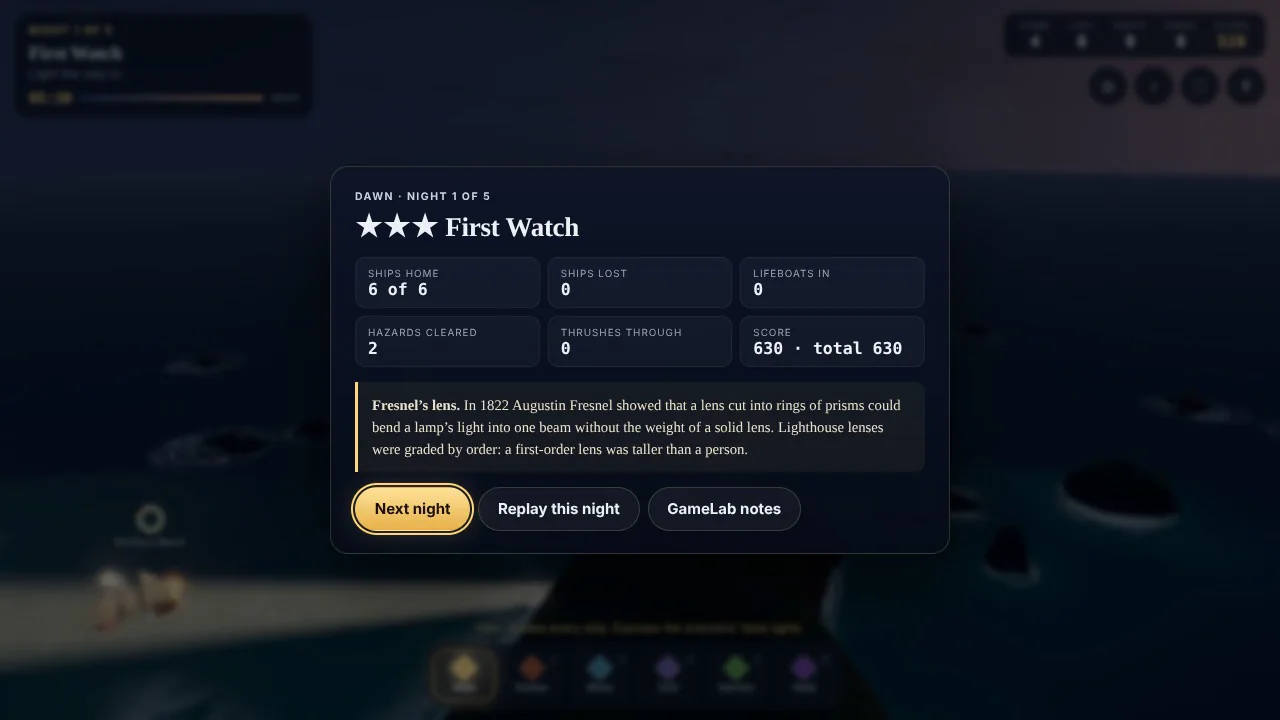
- Dawn. At 05:30 every ship still afloat can see the coast and counts as home. Lose three ships in a night and the light has failed. Each dawn ends with one true note from lighthouse history: Fresnel's lens, the Draupner wave, birds and lights, the wreckers legend and sector lights.
How to play
A loader fetches and checks every file, shows each one landing, and compiles every shader the night can need before the start screen. Press Light the lamp. Nights unlock as you finish them.
| Action | Keyboard and mouse | Gamepad |
|---|---|---|
| Aim the beam | Point at the sea, or A/D and the arrows | Left stick |
| Focus | Hold the mouse button, Shift or F | Right trigger |
| Facets | 1 to 6, Q/E or the mouse wheel | Bumpers |
| Foghorn | Space steadies ships inside fog | A |
| Gallery view | V | Y |
| Pause | Esc | Start |
Touch: drag on the sea to swing the beam. Tap the facet wheel to turn the lens, and hold the Focus button by your right thumb. The layout rearranges itself for portrait and landscape.
A full playthrough
The game's built-in autopilot, recorded headless from the title screen through all five nights at four times speed.
On the cape
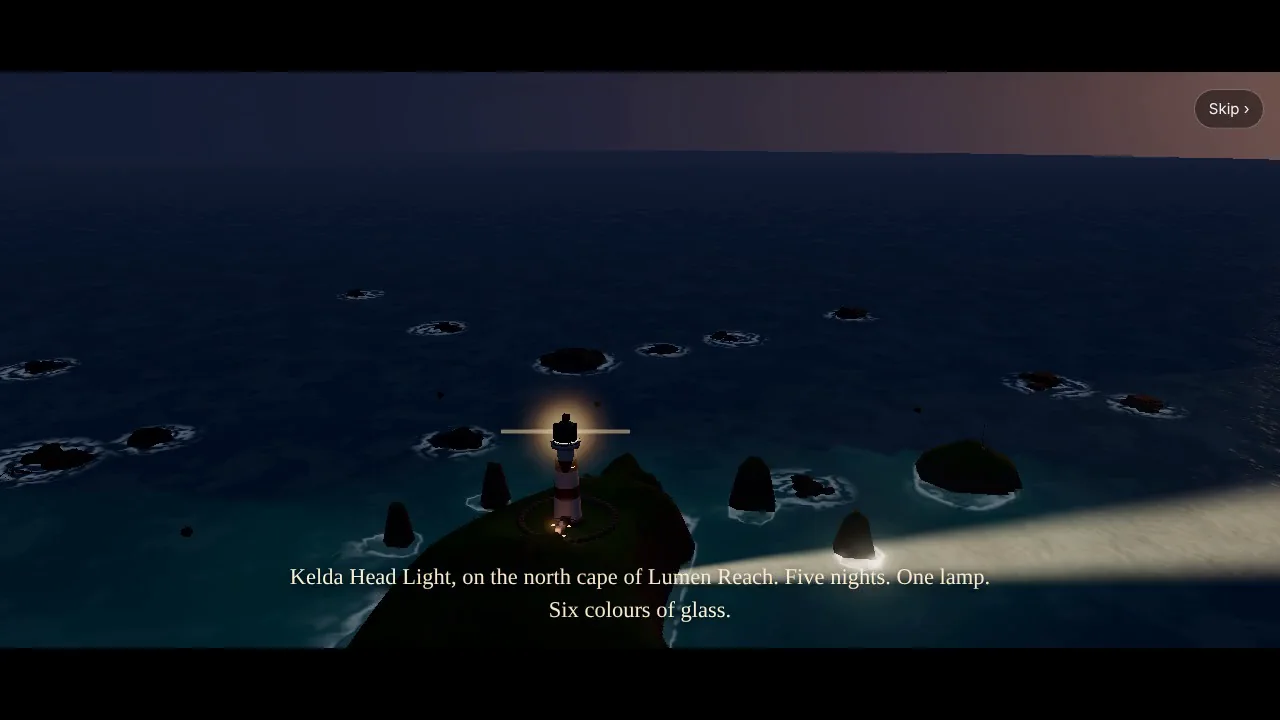
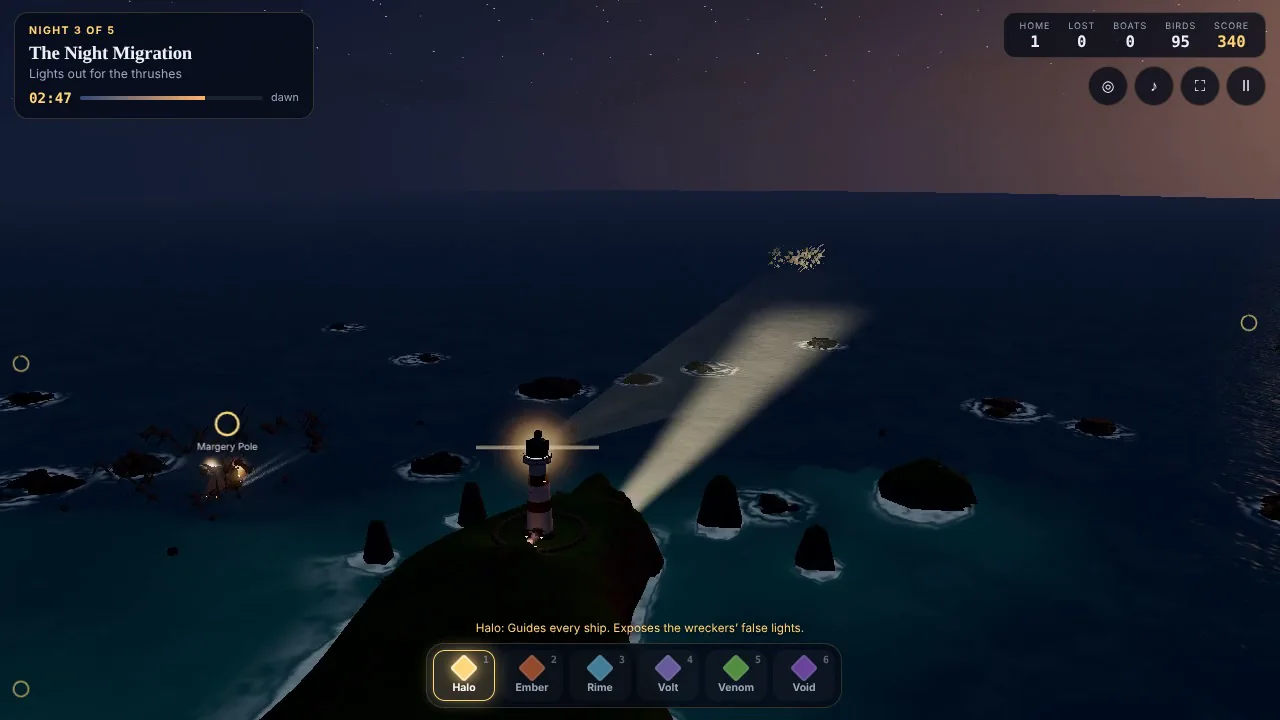
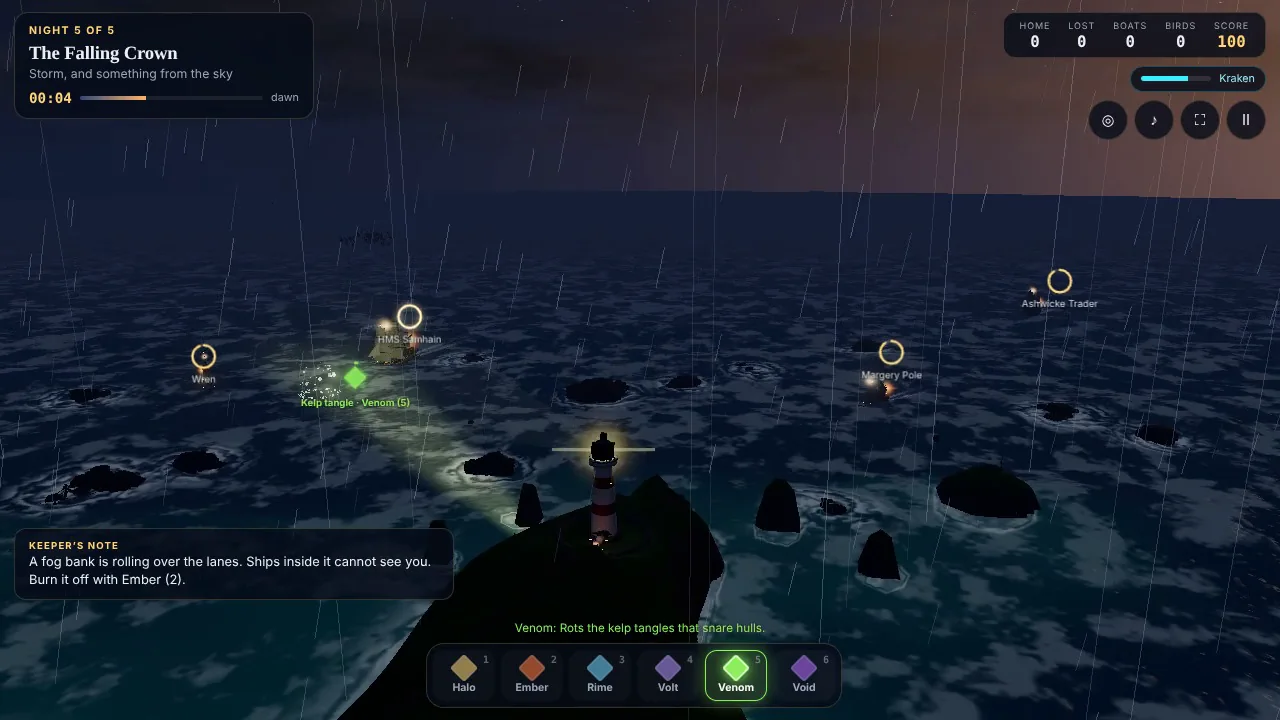
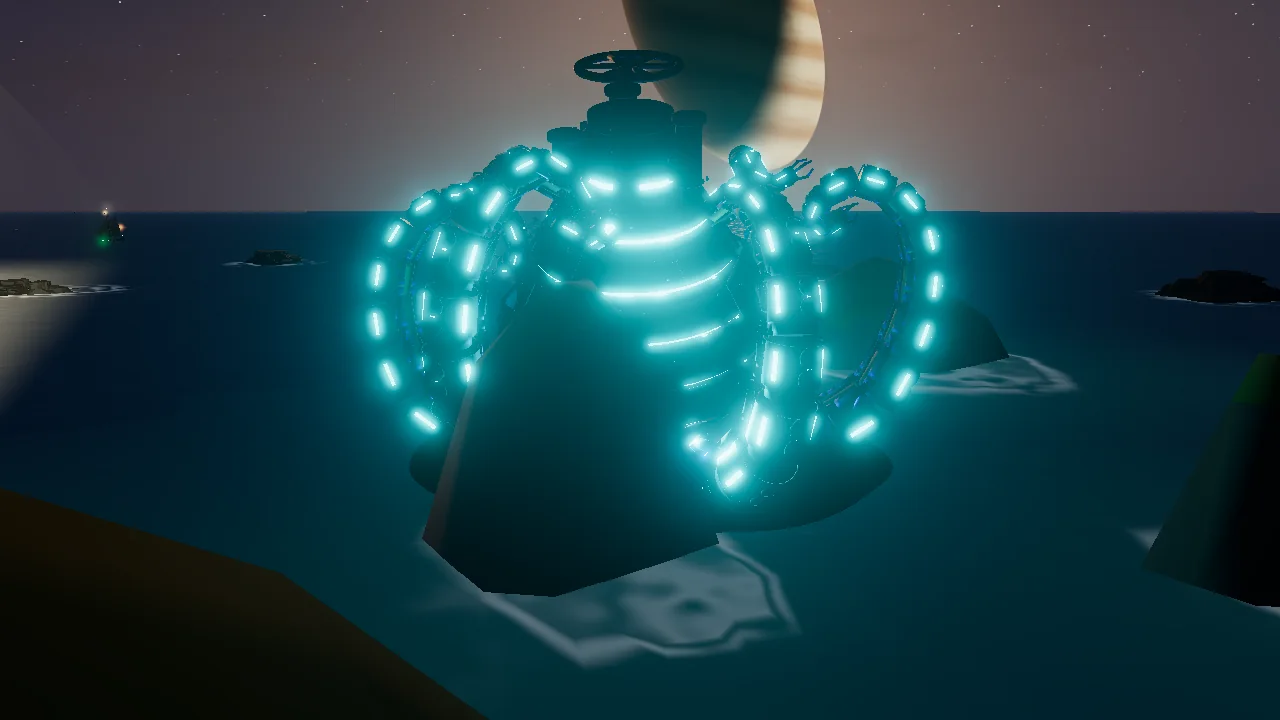
Borrowed from other GameLab projects
- From Island V5The island. Island V5 points Seven north "toward a lighthouse that only matters after dark". This is that lighthouse. Also the loader recipe: a manifest of every file, cache-busting, timed build steps and a shader warm-up before play.
- From Starlight MenagerieThe glass. The lens is cut from a shard of Doorly Orbital's glass crown, which fell on the cape the night the station broke up. On the last night more of it falls. Also the mixer, the build clock and the GLB packer.
- From LodestarThe thrush. Lodestar flies a Swainson's thrush south by the stars. Here the same bird meets a lamp that is too bright, and the keeper has to choose the dark.
- From FIELDWORKThe Kraken, FIELDWORK's rigged machine, tamed in Island V5 and now keeping the reefs. Its tentacles are posed the Island V5 way, bone by bone.
Build notes
Read the design notes and the changelog.
Read the original Prism Light post, published October 19, 2026, on how a piece of IslandLab scenery became the main character.
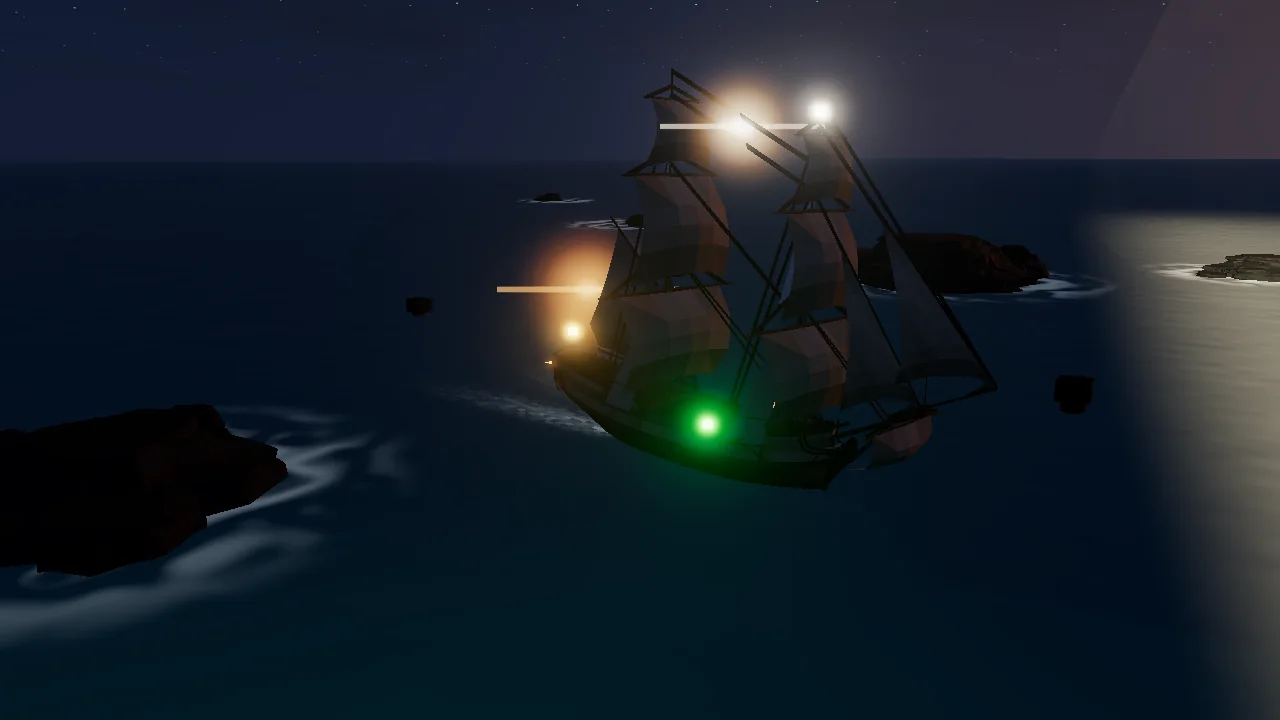
The fleet, remodelled. A Blender script takes Synty POLYGON Pirate hulls (a sloop, a schooner, a frigate, a rowing boat and a skiff) and Wolf Pack Games' Merchant Brig and Naval Snow. It drops the furled-sail and collision variants, bakes each face's palette colour into the vertices, scales every hull to a real length and sets it on its waterline. Then it adds the night fittings none of the packs had: a stern lantern on a pole, a masthead light, red and green sidelights at the fore shrouds and lit stern windows. Each ship draws in four calls.
The light, modelled. The tower is built from scratch in fourteen tapered courses with two red day-mark bands, sixteen corbels, a gallery and railing, a glazed lantern with diagonal astragals (so no single bearing is shadowed), and a copper dome with a ventilator ball and a vane. The lens is six bullseye panels with concentric prism rings and stacked catadioptric prisms, in a brass frame on a geared pedestal. It really turns: the drum rotates to put the chosen facet in front of the beam.
The cape. The coast is drawn from signed distances: a tapered headland, a west horn that shelters Kelda Cove, four sea stacks and Gull Rock. Cliffs rise 24 m within a few metres of the water. The cove's village is built from Synty docks and shanties. The same map file feeds the game, so the reefs in the water are the reefs in the lanes.
One cone. A single test decides what the beam lights, and the same numbers drive the lit water, the fog and waterspouts glowing in the beam, the visible shaft, the spotlight on the hulls and the turn of the drum. What you see lit is what the crews can see.
Prism Forge. The effects pack plays natively in Three.js through a pooled adapter. Ember breath burns the fog, a Rime fault line runs along a frozen crest, a Volt sky lance splits a waterspout, a Venom vortex rots the kelp and a Halo nova blows a false light. A Halo mend lands with every ship that docks.
Sound. Every sound comes from the SFX library, inspected for level, offset and silence before use, then trimmed, levelled and encoded as MP3. The library had no gulls or wingbeats, so those two are honest stand-ins built from other recordings. The two music loops are synthesized.
Tested by playing it. The game has an autopilot. A headless browser drives it through all five nights in fixed time steps, logging every spawn, wreck, clear and dock. That run tuned the nights, and its frames became the playthrough video above.
The trailer. Every shot was rendered in the game itself: a script takes over the camera, stages each beat (a fog bank, a rising wave, a waterspout, a false light, a trapped flock, the Kraken) and saves the frames headless. The narration and the score were made with ElevenLabs, and the cuts land on the words and the music's hits.