- Steering
- Turn your body. North is north.
- Wingbeats
- A wave of your hand, heard by sonar
- Save file
- Only in your browser
Three ideas, one night sky
Lodestar is a mash-up. From Black Budget Bird and the first Blackbird Recon it takes long navigation at night over a whole planet. The real SR-71 steered by a star tracker that could see stars in daylight. From Ephemeris Lens II it takes the Earth's magnetic field as real physics, including the storms that shake it.
The third idea is new to the site: songbird migration. A first-year Swainson's thrush has never been south. It flies at night, about 5,700 km by this route, with an inborn heading and three ways to hold it: the stars, the sunset and the magnetic field. Each one fails sometimes. Clouds hide the stars. The sunset only lasts so long. Geomagnetic storms jumble the field.
Your phone has a sense for most of that, and two of them are ones games almost never use.
The sensors games skip
| Sensor | What it does here | Without it |
|---|---|---|
| Magnetometer | A compass you stand inside. The night sky in the game is lined up with the real one. To fly south-south-east, you turn your whole body to face south-south-east. Hold the phone up like a window and the stars on screen sit where the real ones are. | Drag to turn, or A/D and the arrow keys |
| Magnetometer, again | A magnet detector. Phones report two orientations: one from the gyroscope alone and one that adds the magnetometer. Normally they agree. Bring a fridge magnet or a laptop speaker near the phone and only the magnetic one swings. That gap becomes magnetic noise, and your bird's magnetic sense shivers. | Off |
| Speaker and microphone | Sonar. The speaker plays a steady tone near 19 kHz, too high for most adults to hear. The microphone hears the tone plus faint echoes. A hand moving toward the phone bounces the echo back slightly higher, and a hand moving away sends it back lower. Each wave of your hand is a wingbeat. Laptops can do this too. | Tap the Flap button, or Space |
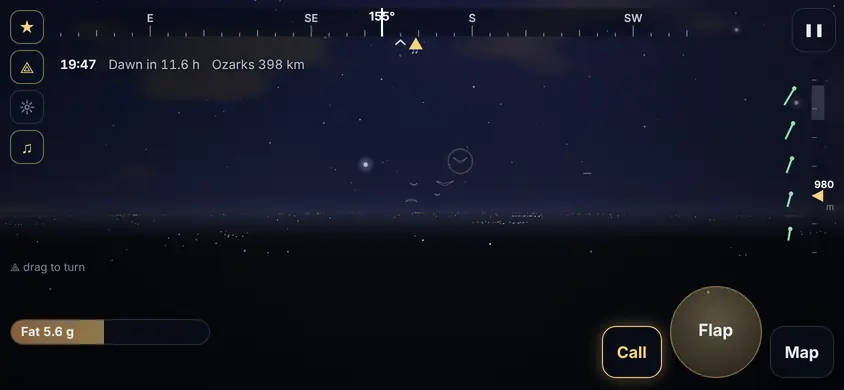
| Orientation | Tilt up to look at the sky overhead and down to see the farm lights below. Roll the phone and the horizon stays level, the way it would through a window. | Drag up and down, or W/S |
Each sensor is asked for on its own tap. Sonar tries four frequencies, and if your phone's microphone filters them all out, it says so and you tap instead. Dogs can hear 19 kHz. If yours starts staring at you, turn sonar off in Settings.
How to play
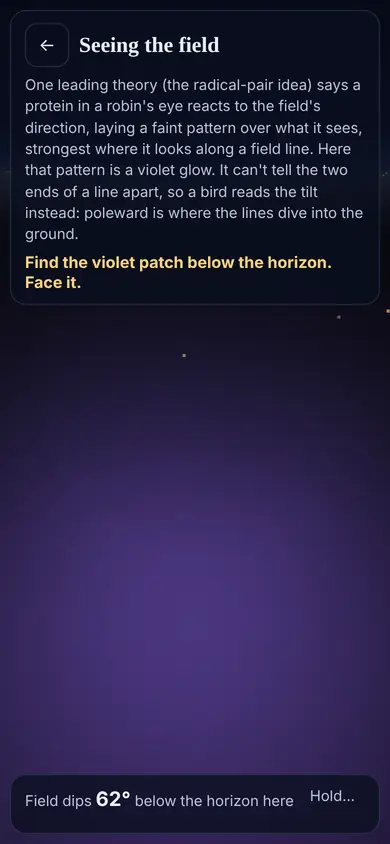
- New to it? Open the Field kit first. Five short exercises: find north, flap with sonar, find a magnet in the room, find the still point of the sky, and see the field the way one theory says a robin does.
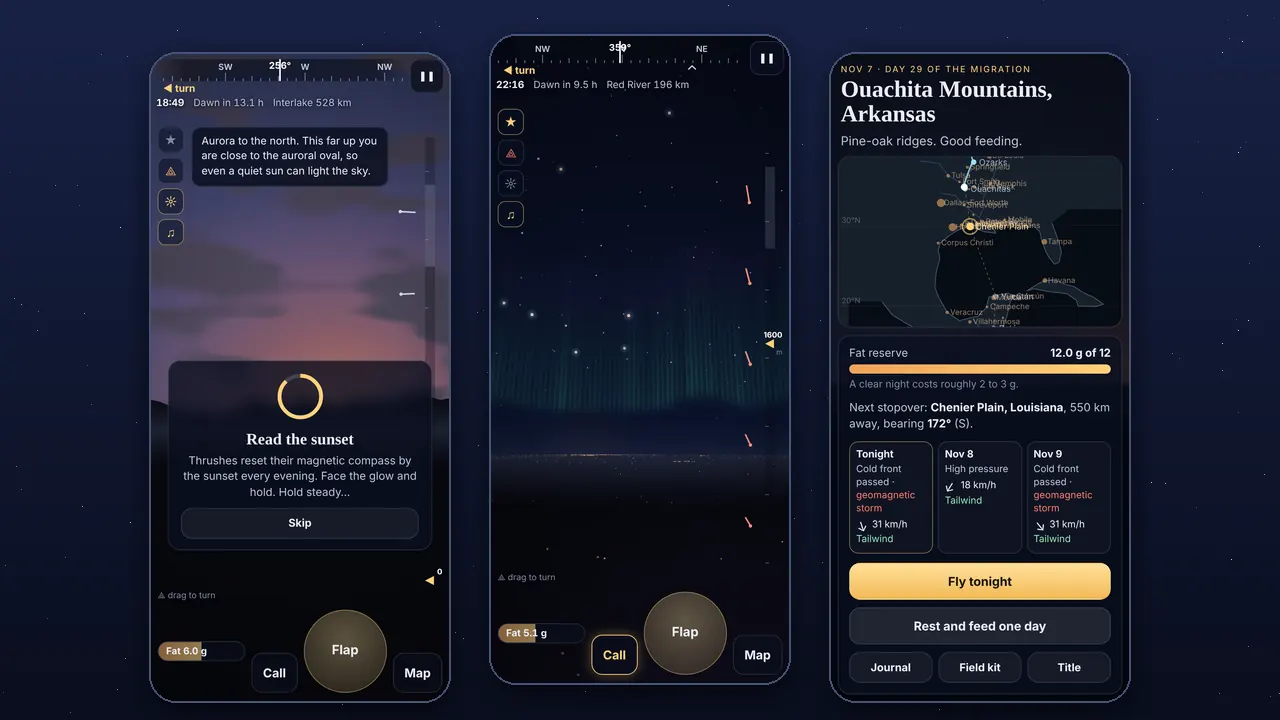
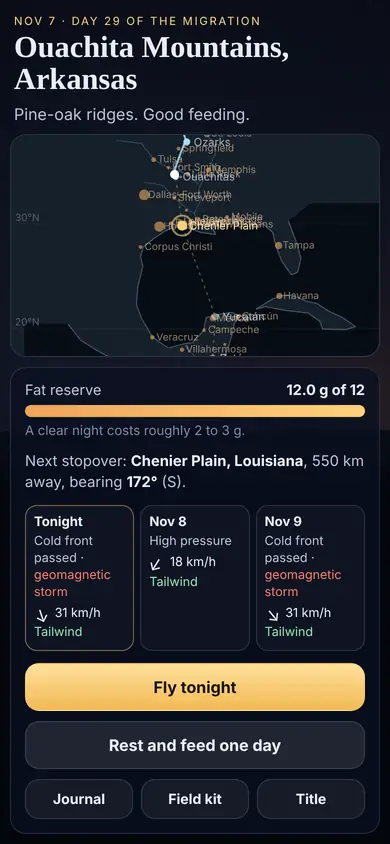
- Start a migration. Each stopover shows your fat, the bearing to the next stop and a three-night wind forecast. Fly tonight, or rest a day and feed.
- Read the sunset. At dusk, face the glow and hold still. Radio-tracked thrushes reset their magnetic compass from the sunset every evening, and so do you. Skip it and the compass is less sure all night.
- Flap to take off, then climb. Each wingbeat lifts you about 24 m. A steady rhythm costs less fat than frantic flapping.
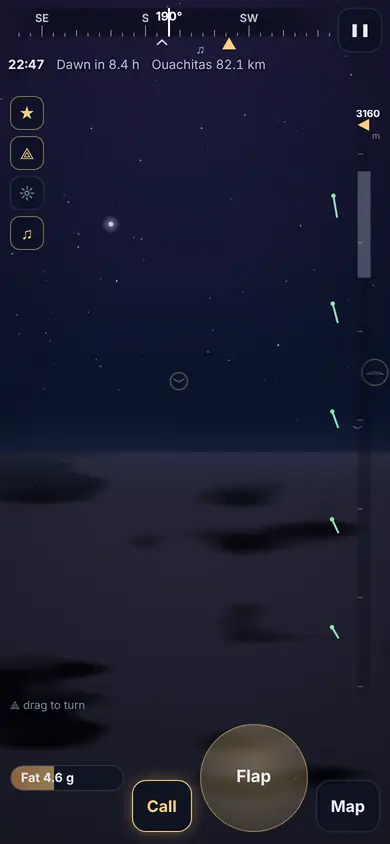
- Turn to the gold mark on the compass tape. That tape is your bird's inner compass, and it's only as good as your cues. The ★ ⟁ ☼ ♫ icons show which ones are working: stars, the magnetic field, the twilight glow and the flock.
- Watch the wind. The bar on the right shows wind at five heights. Green arrows help, red ones fight you. Climb into a tailwind, drop under a headwind, and aim a little into any crosswind.
- Answer the flock. Other thrushes call as they fly. Tap Call after you hear one and the flock closes in. Together, everyone's small errors average out.
- Land at dawn. Pick forest over a city park if you can. Over the Gulf of Mexico there's nowhere to land, so you keep flying into the morning.
On a computer? Drag or use the arrow keys to turn and look, Space flaps, C calls, M opens the map, Enter skips the sunset reading and Esc pauses.
The field, the sky and the veil
The field comes from the first part of the International Geomagnetic Reference Field for 2025. That part alone is a tilted bar magnet through the Earth, and it gets the field's tilt right to within a few degrees over North America. The tilt is what matters. Robins don't read magnetic north and south the way a compass needle does. They read the angle the field lines make with the ground. Poleward is where the lines dive into the earth.
The violet veil shows one leading theory of how that works. Light makes pairs of molecules in the bird's eye react a little differently depending on the field's direction. The prediction is a faint pattern laid over its vision, strongest where the bird looks along a field line. Fly south toward Costa Rica and you can watch the dip get shallower.
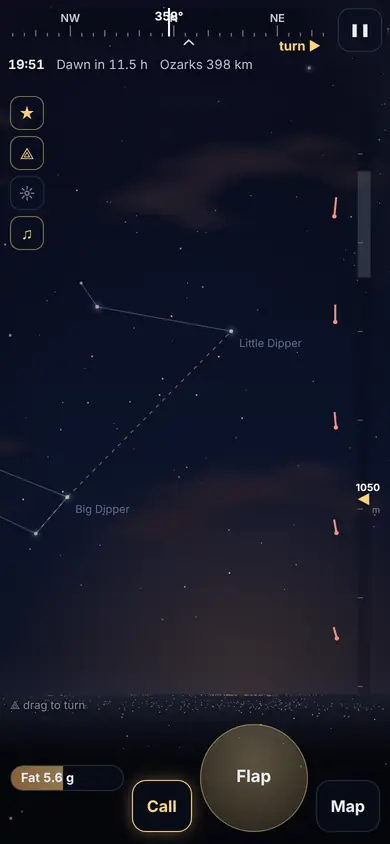
The sky is tonight's sky. Seventy named stars sit at their real positions for the date, the time and the bird's location. A generated field of fainter stars is laid along the real Milky Way. The Sun and the Moon follow the standard almanac formulas, Moon phase included. In the 1960s Stephen Emlen raised indigo buntings under a planetarium sky. They learned north as the point the stars turn around. The Field kit gives you the same test.
Six screens
Your journal stays with you
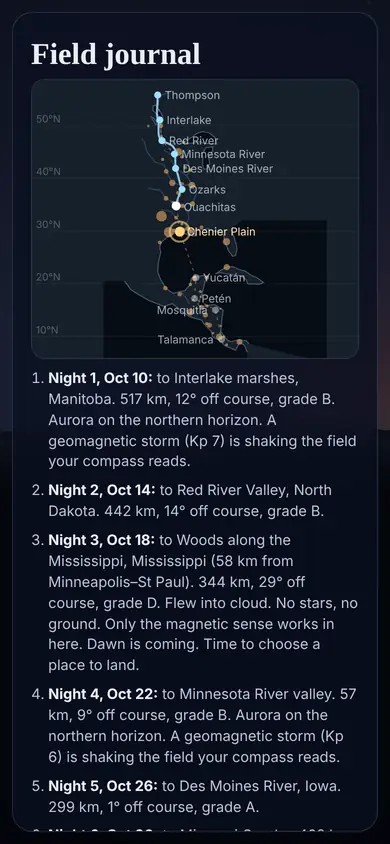
There's no server, no account and nothing loaded from anyone else. Every sound is made in the browser, and the sky and the map are drawn from numbers in the game's own files. Your migration and settings live in this browser's localStorage. The journal exports as .json and imports back. Orientation and microphone readings are used in the moment and never recorded or stored.
Build notes
It's static ES modules with no build step and no libraries. The flight model, the weather, the field, the sky, the geometry, the sonar detector and the orientation math are pure modules with Node tests. The tests check that Polaris sits at the observer's latitude, that an October sunset over Iowa falls south of west at the right hour, that the dipole pole lands at 80.8°N, that the Gulf is water and Yucatán is land, that a clear night with a tailwind reaches the next stopover, and that a Doppler shoulder counts as one wingbeat with the right direction. The renderer is plain Canvas 2D and drops to Lite graphics on slow phones.
Read the design notes and the changelog.