- Sorties
- 5 + free flight
- Envelope
- Mach 3.2 at 85,000 ft
- Seats
- Pilot and RSO
A spy plane game where the airplane is the hard part
The first SR-71 game proved that real flight procedure could drive a mission. Black Budget Bird asks for more of the airplane itself. Thrust comes from a model of the J58 against the standard atmosphere, and the jet has to dive through the transonic hump before it can climb. At Mach 2.5 an inlet can unstart and yaw the nose hard. The skin heats, and fuel burns faster than you'd like. Missions don't end at the target. You also have to get the jet home.
The sorties escalate. Article 2B is a shakedown flight to a resolution target. Long Straw meets a KC-135-style tanker before an ELINT run on a radar complex. Glass Coast starts at 70,000 ft and asks for oblique photographs of three SAM batteries that will shoot. Iron Tide images a fleet at night under a storm with side-looking radar. Black Budget refuels, then penetrates Site Zero at Mach 3.2.
Fly the numbers, then work the sensors
Each sortie opens with a briefing and a mission map. Take off with minimum burner, rotate near 180 knots, then climb and accelerate. Dive through Mach 1 to get past the drag hump. When you reach the target area, switch to the sensor seat. From there you can frame the operational objective camera, the technical objective camera or the side-looking radar, and record emitters for ELINT. SAMs guide by proportional navigation, so speed and altitude are your main defence. The jammer helps if you wait until a missile is close. If the approach gets away from you, the recovery vector puts you on a 15 km final.
| W/S, A/D, Q/E | Pitch, roll, yaw (gamepad supported) |
| R / F | Throttle up / down into afterburner |
| C | Chase, cockpit, tactical and flyby views |
| Tab | RSO sensor seat. Space takes a frame, X switches to SLR, +/- zooms |
| L / J | ELINT recorder / defensive jammer |
| U | Restart an unstarted inlet |
| Z / T / M | Autopilot, time compression, map |
| G / B / K | Gear, brakes and chute, recovery vector |
From the burner cans to the pressure-suit view
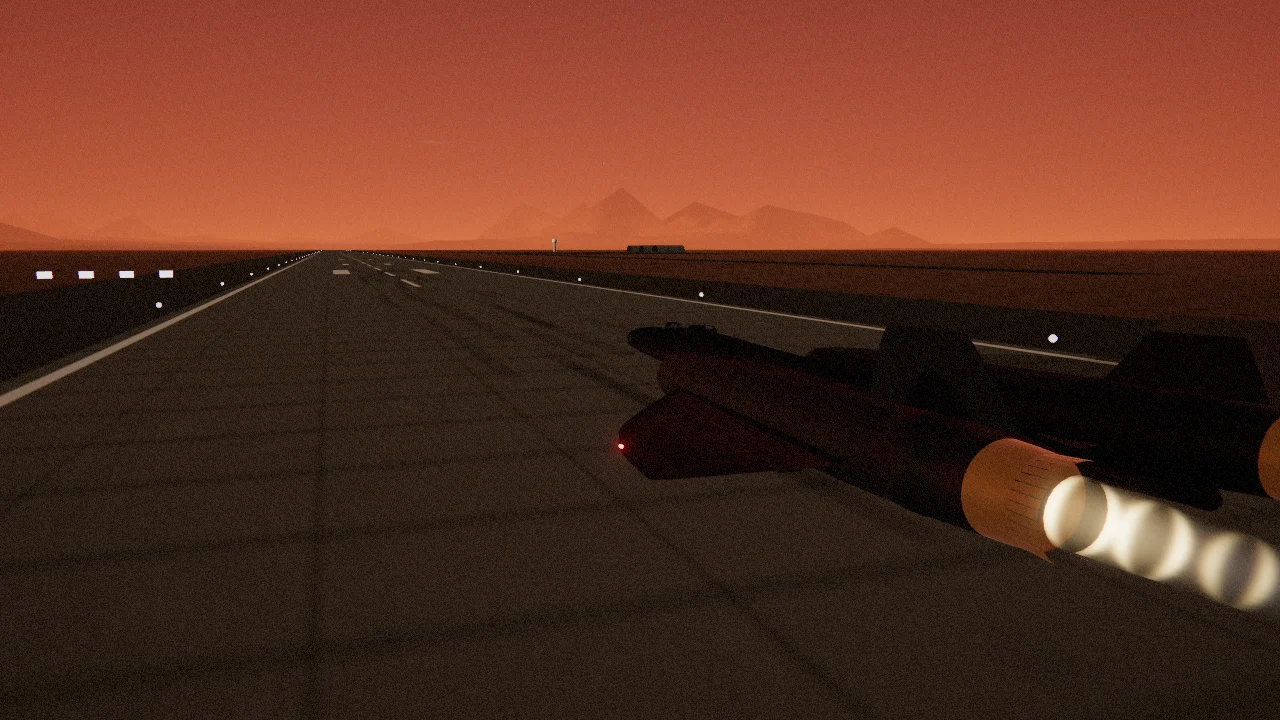
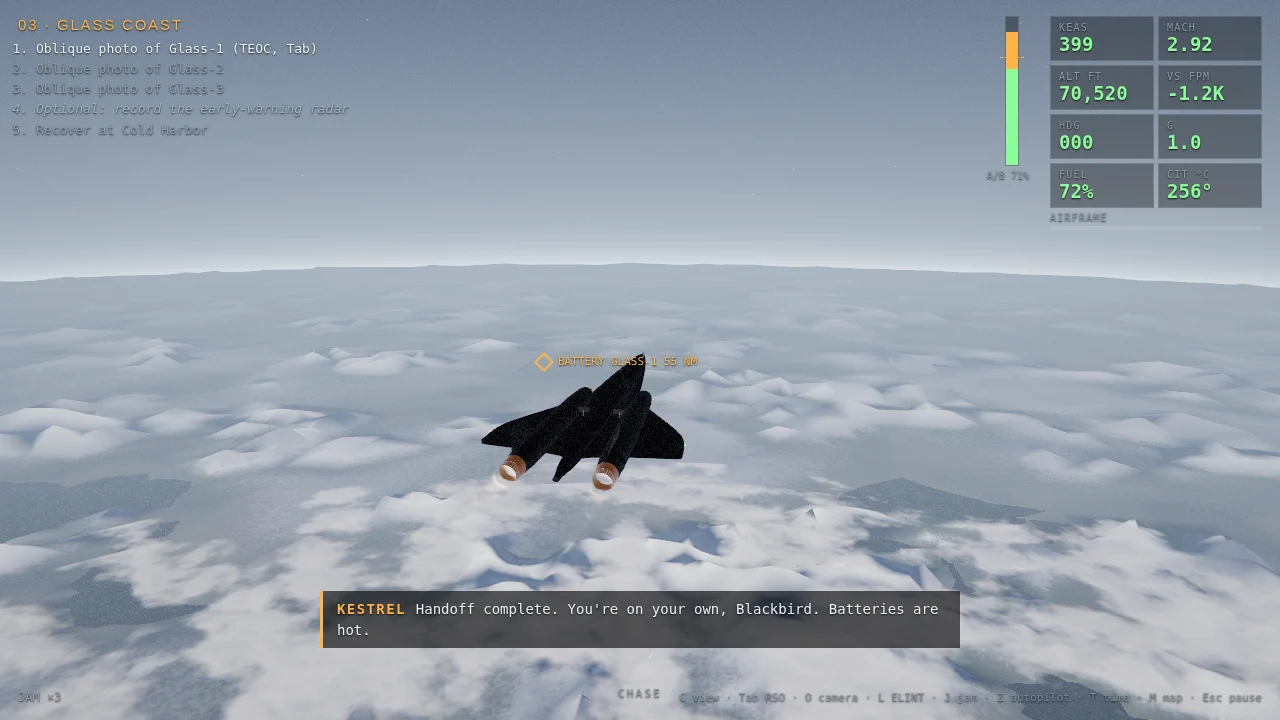
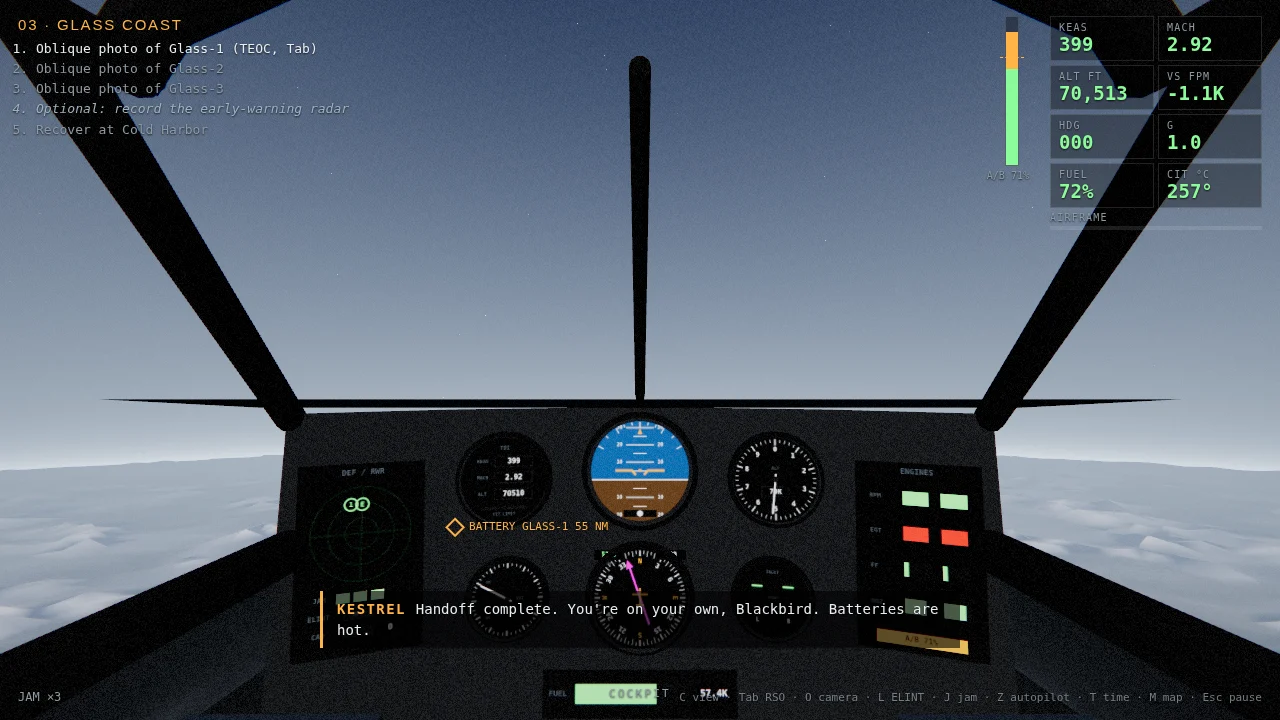
Build notes: an airframe from equations, a planet from noise
Read the original SR-71 II article, published on Advisory Hour on September 30, 2026.
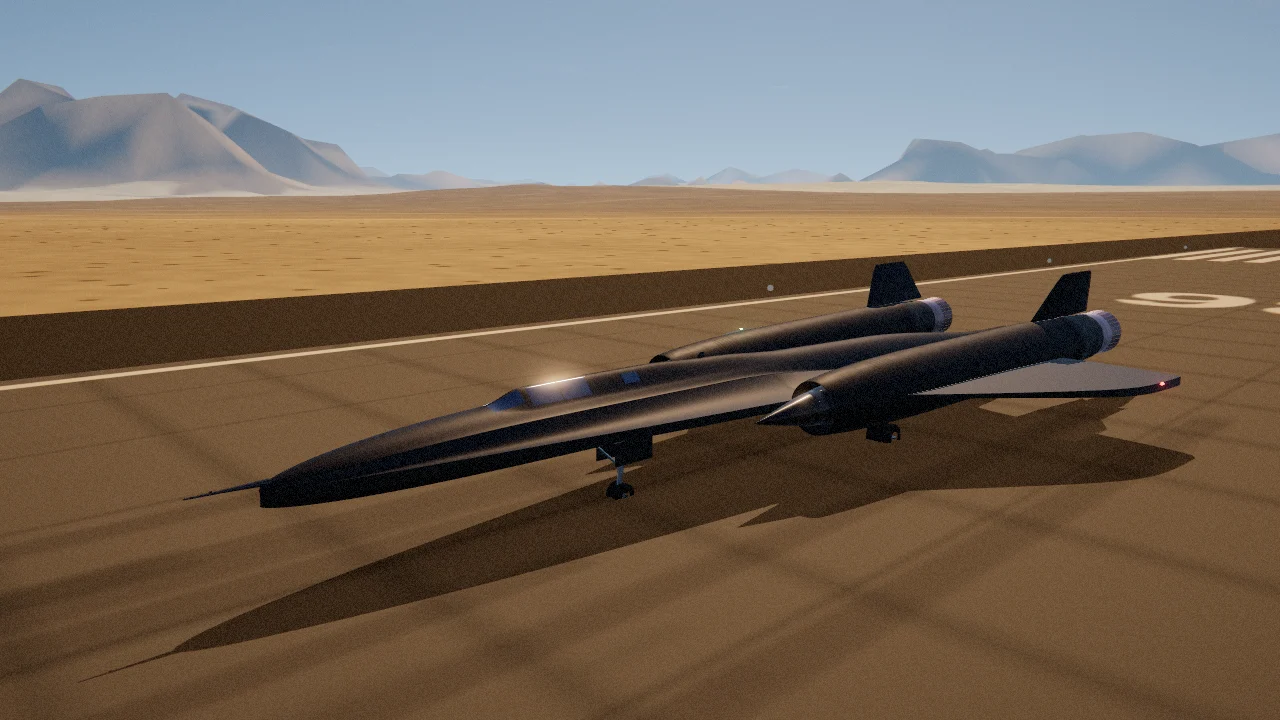
Airframe. The jet is generated in Blender by a Python script, not modelled by hand. Analytic planform and section functions set the chines, the cambered wing, the lathed nacelles with translating spikes, 32 ejector petals, the canted all-moving fins and the articulated gear. They are measured against published dimensions: 32.74 m overall, 16.94 m span, 5.64 m tall. A small exporter written for the build writes the GLB, since Blender's own glTF exporter crashed when it was driven from a background timer. A second script bakes the 4K paint, normal and roughness maps. Those maps carry corrugated wing panels, rivet rows, radar-absorbent sawtooth edges, walkway wear, stencils and JP-7 leak streaks.
World. The terrain is a GPU clipmap that reaches roughly 900 km to the horizon, with the Earth's curvature applied. The same simplex noise runs in JavaScript and GLSL, so the flight model and the renderer agree on where the ground is. The atmosphere darkens with altitude until the sky goes nearly black at cruise. Two cloud slabs, an ocean, aerial perspective and six weather presets set the mood of each sortie.
Rendering. Physically based materials, sun shadows and a planar contact shadow on the runway feed an HDR chain. That chain adds bloom, afterburner heat haze, exposure, vignette and film grain. The sensor seat renders a separate camera through its own optics.
Sound. Every effect was auditioned from a local SFX library before use. Jet idle and runway recordings became the J58 core and roar loops, and thruster flame loops became the afterburner in and out of the cockpit. A subsonic earthquake rumble sits under unstarts, and radar, alarm and jamming tones make up the defensive suite. The mix crossfades between the external and cockpit perspectives.
Changelog
v2.1: fidelity pass. I rebuilt the airframe against published dimensions and reference photographs, then re-baked the paint as near-black charcoal. This pass added 4K PBR textures, sun and contact shadows, HDR post-processing with heat haze, and a correctly proportioned concrete runway. It also fixed the cockpit instrument orientation.
v2.0: sequel release. Five sorties plus free flight, a tanker, SAM batteries and a fleet, the RSO sensor seat, a cockpit with live gauges, and a planet-scale procedural world. It is a rebuild of Blackbird Recon: SR-71 and the Black Budget Bird art study.