Originally published as an Advisory Hour Substack post on 2026-10-14. This first-party site copy preserves the text, localizes public supporting media, and connects the record to its project trail.
Original post
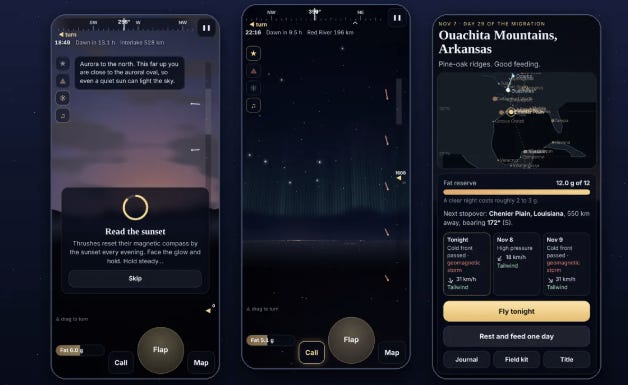
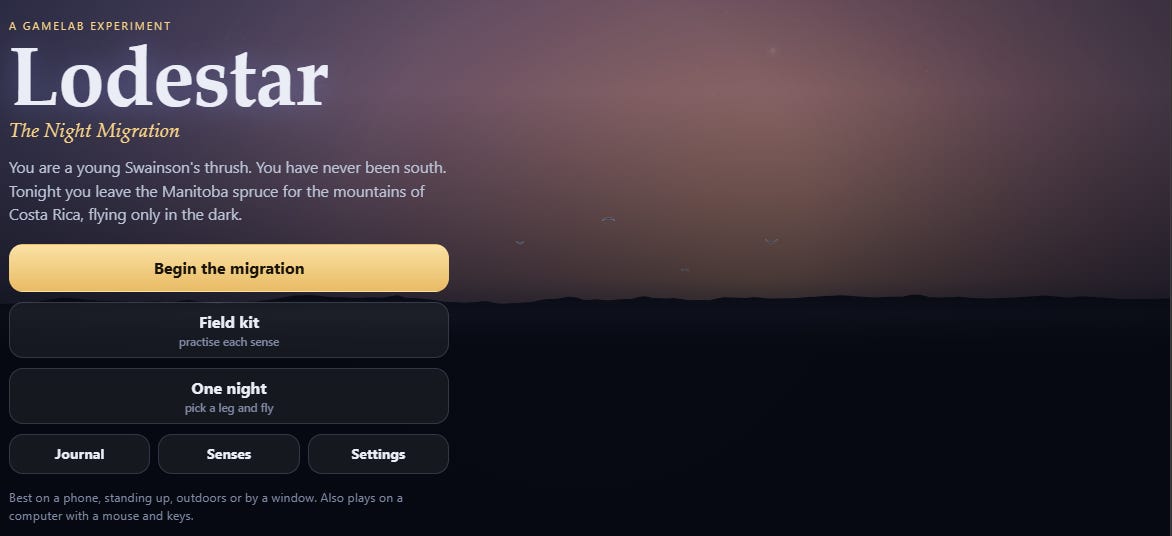
Lodestar is a continuation of my experiments with the sensors on a mobile phone and unusual ways to interact with software. This time, you’re a young Swainson’s thrush making its first night migration from Manitoba to Costa Rica. I blame a friend of mine who sent gorgeous photos from a tropical environment while I sat in a far less than tropical midwestern environment. The two, shall we say, are not the same.
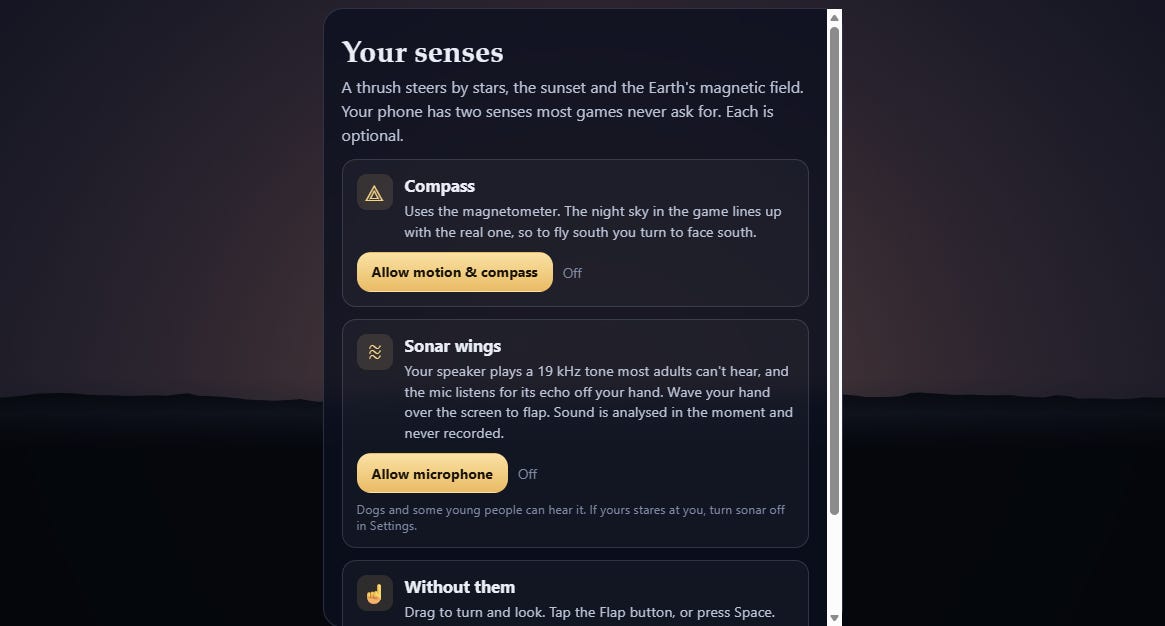
The entire app is absurd, and the wingbeats are the particularly strange part. The phone’s speaker plays a high-frequency tone, around 19 kHz, and the microphone listens for its echo. Move your hand toward the phone and the returning sound shifts slightly higher. Move it away and it shifts lower. The game detects that movement and counts a wave of your hand as a flap of the wings.
When it works, it’s a pretty magical experience. You’re waving a hand over your phone, and a bird lifts into the night. And yes, you look weird doing it.
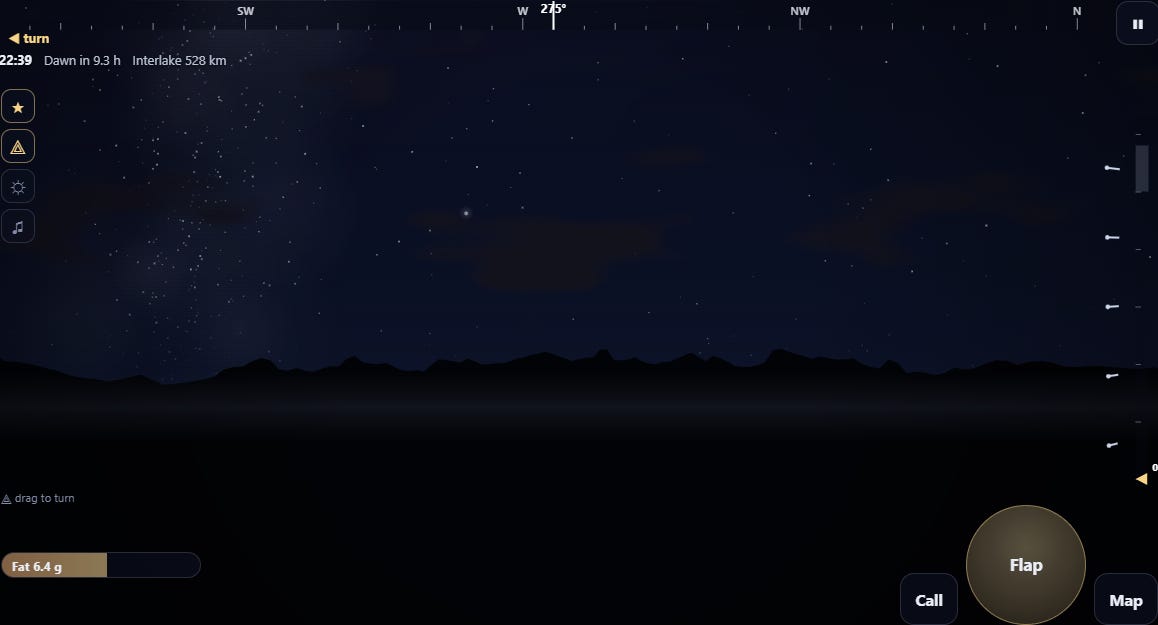
Setting that aside, one thing not to get tripped up on is the view. Hold the phone upright so you have a good view of the horizon. Its orientation matters: tilt it down and you’ll be looking toward the ground. Turn your body and you change direction. The phone becomes a little window into the flight.
There’s something very soothing about the smoothness of it as you fly across the planetary surface. The lights pass beneath you, and the sky opens up overhead. You’re navigating by the stars, the sunset, and the magnetic field, with clouds and other conditions interfering along the way.
What really unlocked this for me was continuing to explore the sensors. It’s the third project in this little run. Waymark used the camera and location to let me explore places, take photos, and leave notes for myself. Then came the absolutely ridiculous glassblowing experiment, Breathglass, where blowing into the microphone and tilting the phone helped shape a vessel.
Now I’m using the speaker and microphone together to detect a moving hand, and the compass to navigate a bird through the night. I can’t even predict where I’m going with these projects. I just wake up blessed with a new, crazier idea than the prior day.
Each project certainly has given me another idea for the next one. I’m getting a better sense of what’s already sitting there in the phone, accessible through the browser, waiting for me to try something with it.
If the sonar doesn’t cooperate with your particular phone, there’s a Flap button. But I encourage you to try the hand wave. That’s the part that made me stop and think, well, this is pretty fantastic.
By the way, be sure to grant the permissions required or the experiment won’t work to the full extent of what is possible.
Read more: https://ericrhea.com/gamelab/lodestar.html
Ready to take flight?
Play now: Lodestar: The Night Migration | GameLab
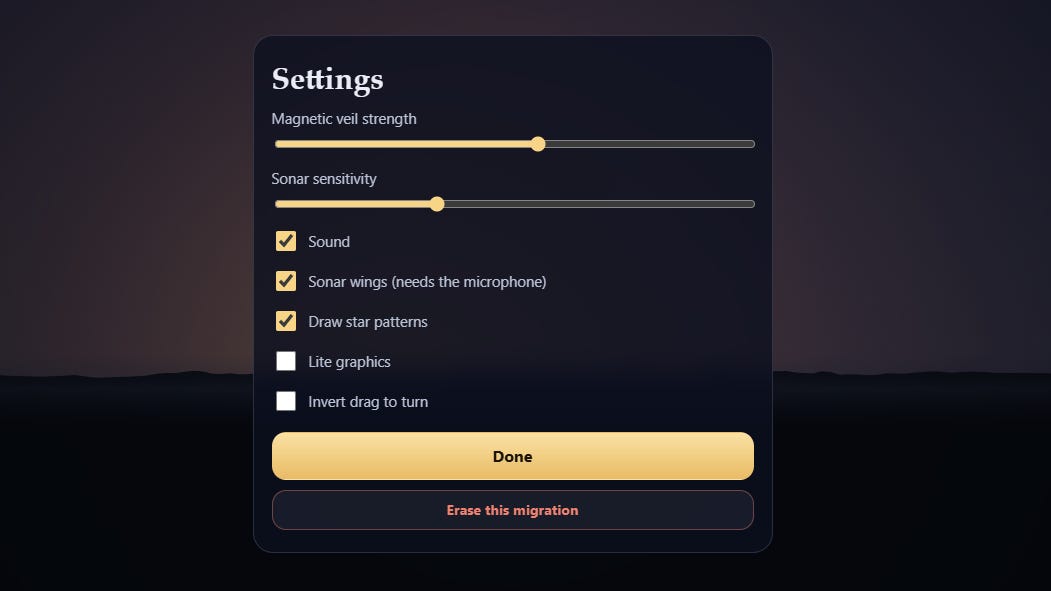
Below are more Game Photos. (I think it’s time I start building trailers for these projects.)
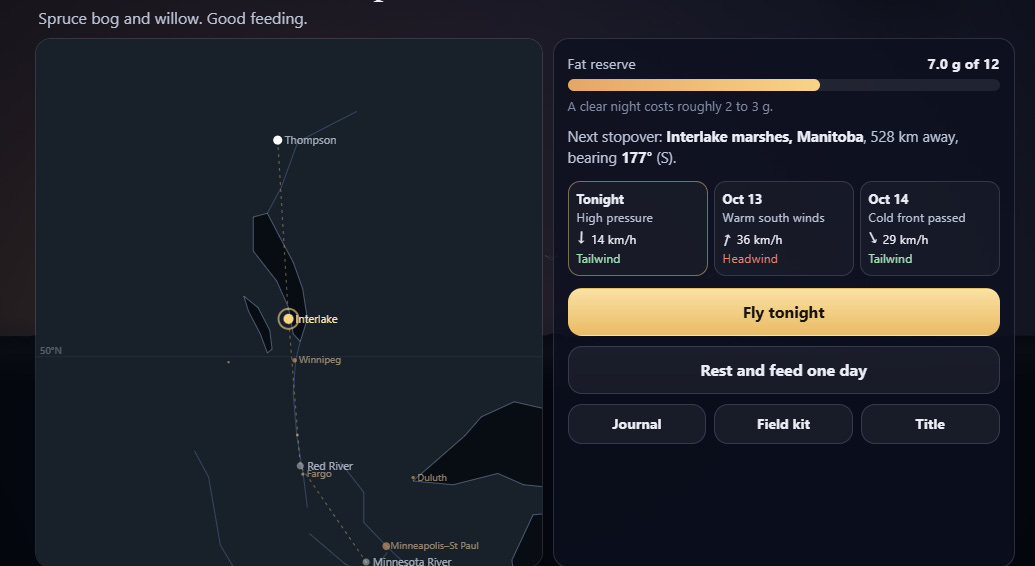
In the settings, you may enable star patterns too if you’d like to try a more star-field flight.
Connected work
- Lodestar Build Notes: Read how the compass, sonar, and migration route fit together.
- Play Lodestar: Follow the thrush through the night sky.