Originally published as an Advisory Hour Substack post on 2026-10-22. This first-party site copy preserves the text, localizes public supporting media, and connects the record to its project trail.
Original post
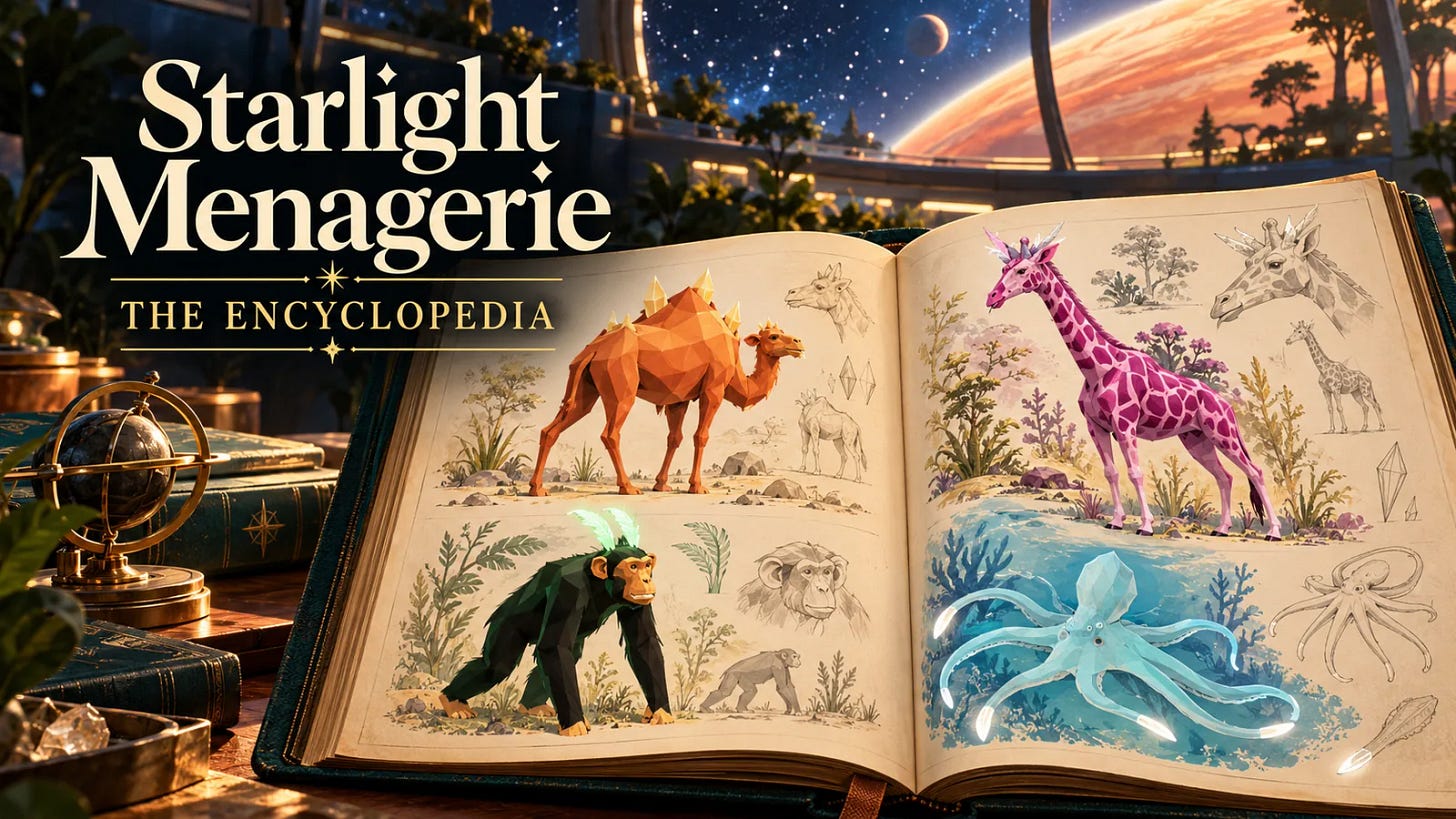
Why not a fully interactive encyclopedia based on all the creatures in the zoo? The Starlight Menagerie encyclopedia started with a fairly simple desire: I wanted a way to browse the zoo from the website.
In the previous article, I wrote about putting a zoo inside a space station. To pull that off, I needed critters. Once they were all there, a guide to the animals seemed like an obvious thing to add.
The first pass was okay. It was also pretty bland.
What I have now is an interactive book that you can open in full screen and navigate through, looking at all the different creatures. You can turn the models around, try different rendering styles, and watch some of their animation cycles.
Each animal has a clear connection to something real. The Vault Rat, for example, is based on the brown rat, Rattus norvegicus. You can read about the real animal, then see what supposedly happened to it after generations of living on another world.
You can also find out where it lives in the zoo, in case you want to rush over and meet it. There are details about how far away it will notice Seven and how much damage it can do during the Halloween escape portion of the game.
That’s useful information to have before the lights go out.
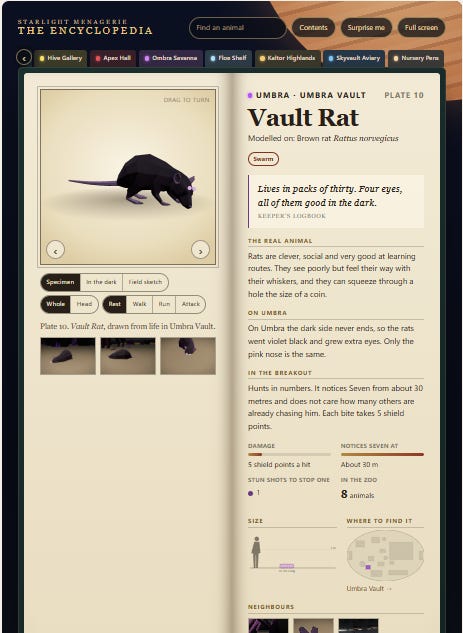
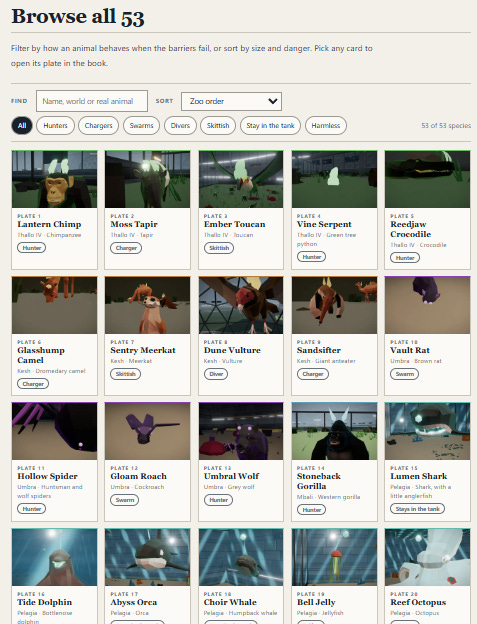
There are neighboring animals to explore from each entry, too. And if you scroll farther down the page, there’s a filterable guide to all 53 species. You can browse by behavior or sort by size and danger, then open whichever creature catches your attention.
Some are fairly ordinary. There’s a chicken, a sheep, and a goat. Others are silly modifications of familiar animals, while a few get considerably more exotic. I’ve enjoyed seeing how much variety comes out of starting with recognizable creatures and changing a few things about them.
This is the first time I’ve done quite this much worldbuilding around a single title. I also went back and touched up Margin Aces and its encyclopedia, so that project has a deeper reference to explore now, too.
There’s an interesting thing happening here. A game gets built, then it gets a trailer, and then an entire encyclopedia starts growing around its creatures, places, and lore. Starlight Menagerie has become something you can spend time browsing as well as playing.
I’m not sure how many of my titles deserve their own encyclopedia, but I think it’s an interesting approach. It helps me make sense of what’s in the world, and it gives someone visiting the site another way to explore it.
As my own capabilities grow, these projects keep getting larger. There’s more room for creatures, histories, and all these little details. Which leaves me with a question I haven’t quite answered yet: when you build a game world and fill it with this much lore, what do you do with it all?
For now, I’ve made a book you can poke around in.
Check out the encyclopedia, and if you enjoy it, let me know.
And if you’d like to just explore the zoo without the risk of getting hit by an asteroid, well, I have you covered. Click here to interact with the map.
Connected work
- Explore the Encyclopedia: Browse the animals, their models, and their stories.
- Vault Rat Entry: Meet the alien descendant of the brown rat.
- Explore the Zoo Map: Find the habitats and the animals that live there.
- The Original Build Story: Read how Seven came to explore a zoo in orbit.
- Play Starlight Menagerie: Explore the zoo and find the escape pod.