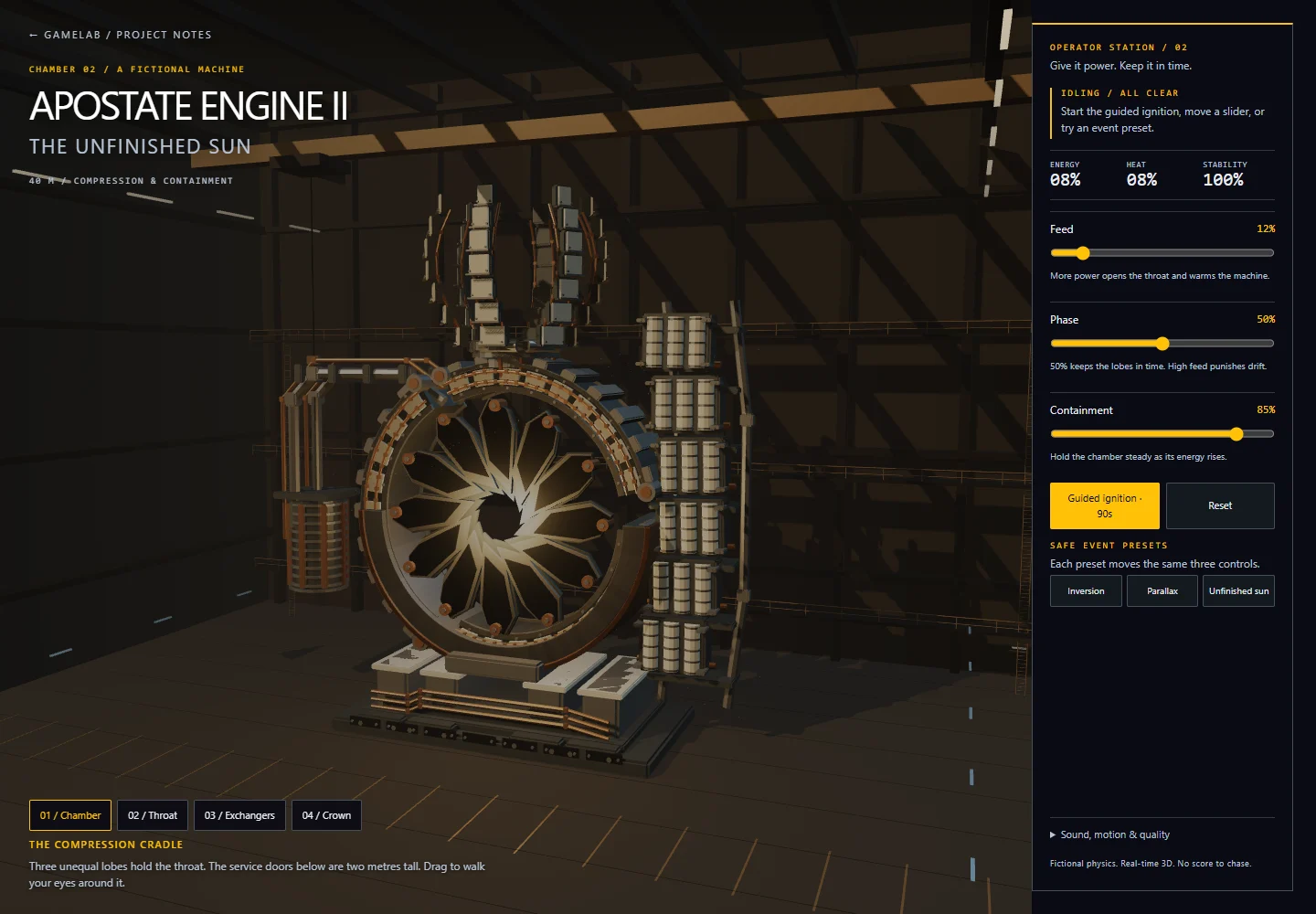
Three controls. Several bad ideas.
Feed supplies power and heat. Phase keeps the moving parts in time. Containment holds the chamber steady as the throat opens. A guided ignition introduces them over about ninety seconds. You can skip it and start pulling levers.
Push too much power through badly aligned parts and the engine breaches. The shutters close, the clamps let go, and reset becomes an excellent idea. Nothing is lost.
Inversion
The heat exchangers fold. Loose fragments rise from the floor. Gravity has stopped helping.
Parallax
The throat shows another chamber. Its machine follows this one a little late.
The unfinished sun
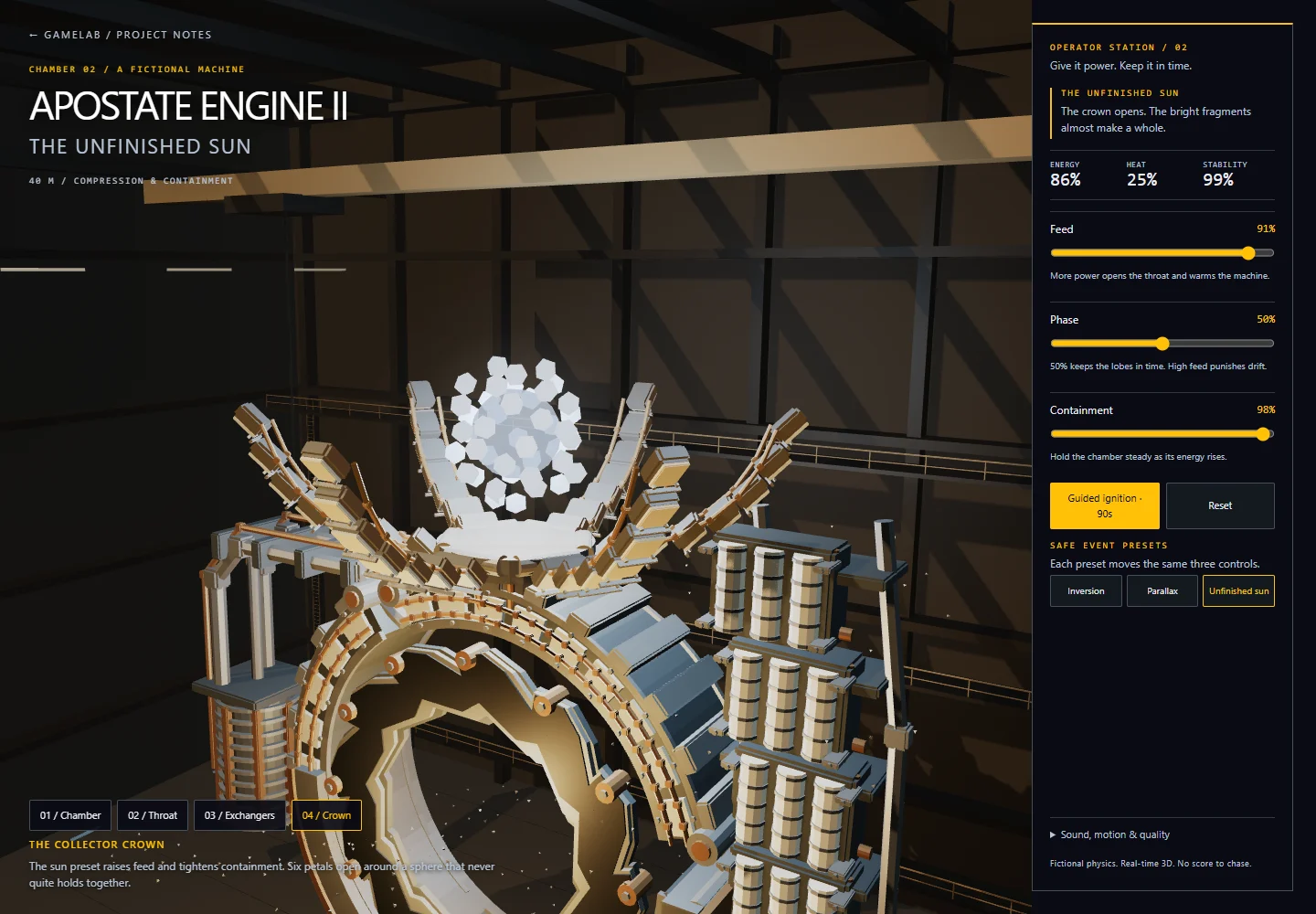
Hold the engine in time and the collector crown opens around a broken sphere of light.
Built to walk your eyes around
Drag to orbit the machine. Zoom toward the bolts and layered housings, or jump between four inspection stations. The catwalks and two-metre service doors give the fictional forty-metre structure a human scale.
The machinery was authored in Blender and exported as real 3D meshes. Three.js moves those parts in the browser. The desktop and mobile models share named hinges, so the same controls drive both.
Build record
The first public build note follows the engine from a science-fiction idea into a browser system built around feed, phase, containment, and a small artificial sun.
Read GameLab: Apostate Engine 2, Harnessing the Power of a Sun.
Before you start
This is fictional physics and interactive art, not an engineering simulator. Sound starts only when you enable it. Reduced-motion and reduced-flash controls are available, along with a lighter graphics setting. A browser with WebGL 2 is required.
AI-generated concept, assembly, and material studies guided the design. The playable scene uses modeled geometry and baked material colors. The image above comes from that scene.