- Instrument
- A body you can reshape
- Composition
- Four voices, sixteen steps
- Home
- Your browser, your device
Start with a pluck.
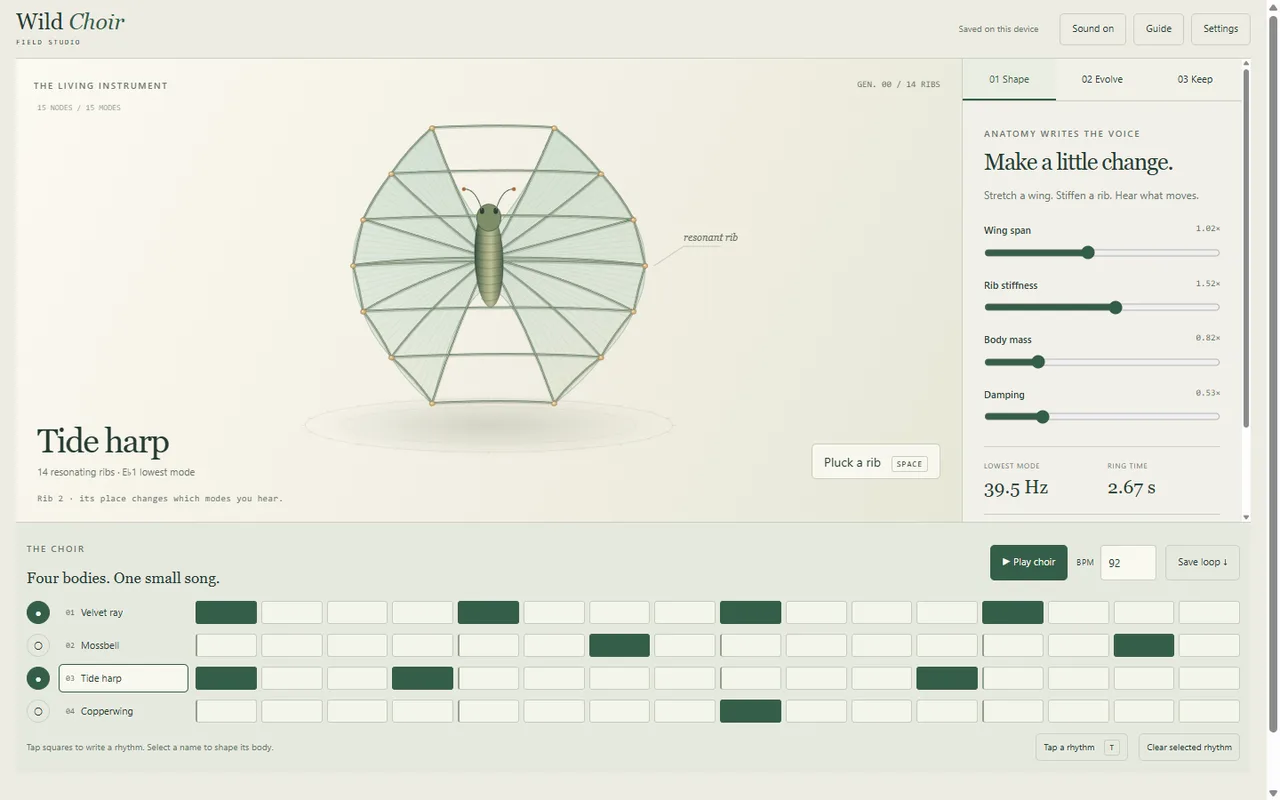
The studio opens with four specimens. Each one plays a single instrument: marimba, harp, kalimba or reed flute to start. Its ribs are the keys. The left wing climbs the scale from tail to head, the right wing sounds a third above, and the spine plays the low home note. Drag across a wing and you get a run that can only land on notes in key.
In Shape, stiffer ribs raise the creature's home note and more mass or a wider span lowers it, by whole scale steps. Damping shortens the ring. Stiffness also brightens the tone, asymmetry adds vibrato, and more ribs make it richer.
In Evolve, grow three descendants. Each carries a variation of the creature's sixteen-note melody: a nudged note, an echoed bar, a reversed figure, a phrase re-sung. Hear each one play, then keep a favourite. Sort them by smoothness, liveliness, whether they land on home, brightness or ring, and tick the box to let the rhythm evolve too. Undo restores the previous body and beat.
The four rows below the specimen are your choir. The rhythm decides when a voice sings and its melody decides what. The choir's key keeps all four in tune with each other, and pentatonic keys never clash. The small bar in each step shows where the melody sits.
Walk into the concert.
Open Concert garden to find your four creatures flying among flowers. Their voices come from their moving positions. Walk closer to one, turn away from another, or stand between them and hear the balance change.
WASD moves you along the ground. Q and E turn; dragging the view lets you look around. On a phone, hold the arrow buttons to walk and drag the garden to look. Tap a performer's name, or press 1 to 4, to sing that voice yourself. Hold Shift to hurry. Reset view takes you back to the entrance.
The concert uses your saved rhythms, tempo, and enabled voices. A creature with a resting voice still flies. Pause concert stops the music while you explore. Reduced motion in Settings holds the creatures still. Leaving the window pauses sound and animation; press Resume concert when you return.
Each performer feeds a moving Web Audio spatial sound source. Headphones help you hear its direction, while distance changes its loudness. Flight combines bounded steering, wingbeats, uneven paths, and flower perches. Butterfly flight research informed those broad traits. This is a playful movement model, not a simulation of insect aerodynamics.
The garden stays on your device. Collection files work as before; WAV export records the studio mix rather than a walk through the garden.
Win over the wild singers.
The garden has residents of its own. Each wild singer plays one instrument and sings a short call in its own key. Walk within a few steps and it listens to your choir. Every note that belongs to its key fills its harmony ring, and every note outside it scares it back into the flowers.
The listening card shows the notes of its call and whether each of your voices fits. Change the choir key right in the garden, or rest the voices that clash. Stay close long enough and the card names the key outright. Rare singers also listen for a particular instrument family, such as bells, bowed strings or voices. The night-only singer answers only its own exact key.
A full ring means the singer is befriended. It lights its flowers and sings along with you in your key. In the studio, Evolve → Wild blood crossbreeds your specimen with it. Hybrids usually take the wild instrument and splice the two melodies bar by bar. That is the only way the glass bell, bowed cello, night voice and moss organ reach your choir.
The garden now has four kinds of shrub, mossy rocks, a ring of listening stones that glow at night, and a pond with lily pads, lotus and reeds. Wind, birds, crickets and lapping water are all synthesized in the browser.
The stones keep time.
Beyond the trees, four runic monoliths, fifteen to twenty-three metres tall, rise out of the earth as the garden wakes. Each one plays a single part of the rhythm section. Deep is a warm stone bass that plays the song's chords: roots on the downbeat, a push into each new bar. Earth is a kick tuned to your key's root, Stone a flammed clap on two and four, and Ember a swung shaker. Every fourth bar gets a small fill.
Each hit lights the stone's carved runes in a wave that climbs from the ground. The kick and bass also send a shockwave across the hillside and a column of light into the sky. The drums pan as you turn your head. They follow the song: a shaker and bass under the intro, the kick for the first verse, the full kit for the choruses, a breakdown for the bridge. The mix was re-measured with them in: the rhythm section sits under the choir at about −19 LUFS while walking, peaks stay below −3 dBFS, and nothing clips.
One song, four parts.
Your creatures' melodies used to loop side by side, each on its own. Now the garden plays one 32-bar song: intro, two verses, a chorus, a bridge, the chorus again and an outro, about eighty seconds at 92 bpm. Every voice follows the same chords (I–vi–IV–V in the verses, IV–I–V–I in the chorus for a major key, with minor and modal versions for the other scales), and every creature gets a role that suits its instrument and register.
The lead, usually a flute or voice, sings its evolved phrase and lifts it for the chorus. The answer replies in the gaps of the verses, sings a counter-line under the chorus and takes the tune in the bridge. The pad (organ, cello) holds the chords, and the arpeggio (kalimba, harp, bell) spins the chord tones in the shape of its own phrase. The notes on each downbeat land on the chord, phrases end on a cadence, and the outro comes home to the tonic. The caption under the garden shows the section, chord and bar, and each performer's tag shows its role. Resting a voice reassigns the roles among the ones still singing. Befriended wild singers join the choruses. Strangers still call in their own key, in the gaps.
A collection, and a garden of any size.
The studio keeps four workbench slots for shaping and sequencing. Anything you want to keep but aren't editing goes into your collection: 03 Keep → Park this voice moves the creature there, with its rhythm, and hatches a new one in the slot. The collection holds up to 120 creatures. From it you can hear any of them, swap one back onto the workbench, release one for good, or send it to the garden.
The garden now takes up to 24 of your creatures, not just the four on the workbench. Bring them in through + Add at the start of the performer bar, and take them out with ×. They fly in from the gate and join the song at once. So they don't pile up into noise, a big choir takes turns. Every creature joins one part of the ensemble (tune, answer, chords or arpeggio), matched to its instrument and register. Each part sends one voice at a time and hands over to the next every four bars. You always hear four clear parts, and over a few sections everyone gets a turn. Each tile shows who is singing now and whose turn is next. In watch mode the camera favours whoever is singing.
Or just watch it play.
The first time you enter the garden, the camera flies in over the trees, skims the pond and lands at the gate. Any key or tap skips it. Watch ▶ (or V, or ?watch in the address) hands the camera to a director. It cuts between a dozen kinds of shot: orbiting a choir voice, trailing a wild singer, gliding across the pond, craning over the stone ring, lying in the grass, looking up from the flowers, drifting overhead. The choir plays a small arrangement that builds, peaks and thins, and the evening passes a little faster. Escape returns you to walking.
A waveform and level meter sit under the studio controls and along the bottom of the garden. They read the mix itself, not the volume slider. The mix is set by measurement: the default choir sits near −19 dBFS RMS with peaks around −6 dBFS, and a busy four-voice arrangement stays under −4 dBFS. A gentle bus compressor, a small EQ (less box at 350 Hz, a little air above 4 kHz), a high-passed hall and a safety limiter keep it comfortable.
What makes the sound?
A specimen begins as a seeded set of numbers: rib count, span, stiffness, mass, damping, asymmetry, color, an instrument, and a sixteen-note melody. Those numbers build a network of masses joined by springs. The central node anchors the body.
The first version played those vibration modes directly. They were physically honest but not harmonic, so a choir of them sounded like noise. Now each creature carries one instrument and a melody written in scale degrees, and the body shapes how that instrument sounds.
This is a simplified physical instrument. Each note is synthesized from tuned harmonic partials, so it reads as a clear pitch. The body's physics shape the sound: √(stiffness ÷ mass) sets how high it sits, damping how long it rings. When a rib sounds, the 3D body shivers in its real vibration modes, slowed so the eye can follow them. Its membranes help show the creature's shape; they are not a full membrane simulation. The creatures do not have neural brains. Breeding varies their numerical anatomy, and you decide which descendants to keep.
Can a melody evolve the way a body does?
Physical sound synthesis has a long research history. The University of Edinburgh's Next Generation Sound Synthesis project explains how models of vibrating materials can become instruments. Wild Choir explores a small, browser-friendly version through variation and listening.
Keep a voice. Carry it elsewhere.
Your collection saves in this browser when local storage is available. Export collection downloads a JSON file containing the four genomes, rhythms, and settings. Import that file on another device to continue. If browser storage is blocked, the studio still works and tells you to export your work.
Save loop downloads a WAV recording of the enabled voices. It includes one bar and a tail so the final notes can ring out. The export uses the physical voices; listening volume and mute affect your speakers rather than the downloaded recording.
The page uses static files, WebGL through Three.js (with the original Canvas drawing as a fallback), and Web Audio. It runs without an account, tracking service, hosted model, or shared database. Portrait and landscape both work. On narrow screens, the rhythm controls split into two rows so every step remains large enough to touch.
Controls at a glance
| Action | Control |
|---|---|
| Pluck | Tap or drag across ribs, or press Space with the specimen focused |
| Play different ribs | A S D F G H J K |
| Tap a rhythm | T, or the Tap a rhythm button |
| Return to menu | Escape, or the Wild Choir title |
| Sing to a wild singer | 1 2 3 4 in the garden, or tap a performer |
| Field journal | J in the garden, or Keep → Field journal |
| Quiet the room | Sound off, master volume, or reduced motion in Settings |
Playback stops when you open a menu or leave the tab. Press Play when you return. Browser audio starts after your first sound-enabled gesture.
Where the pieces came from
Read the original Garden Choir article, published on Advisory Hour on October 2, 2026. It follows the butterflies, laboratory, and stones that make up the Wild Choir garden.
Textile Alchemy made material behavior something to touch. FlyLab brought reproducible variation, local checkpoints, and expressive bodies into play. IslandLab developed the loading, settings, and input habits that help a browser world feel complete.
Wild Choir carries those lessons into a much smaller room. There is one body in front of you, one change to make, and enough silence to hear what happened.
The next voice is yours.
Pick a specimen, make a small change, and follow your ear.