This page mirrors my original Substack article inside EricRhea.com. The original remains available at advisoryhour.substack.com.
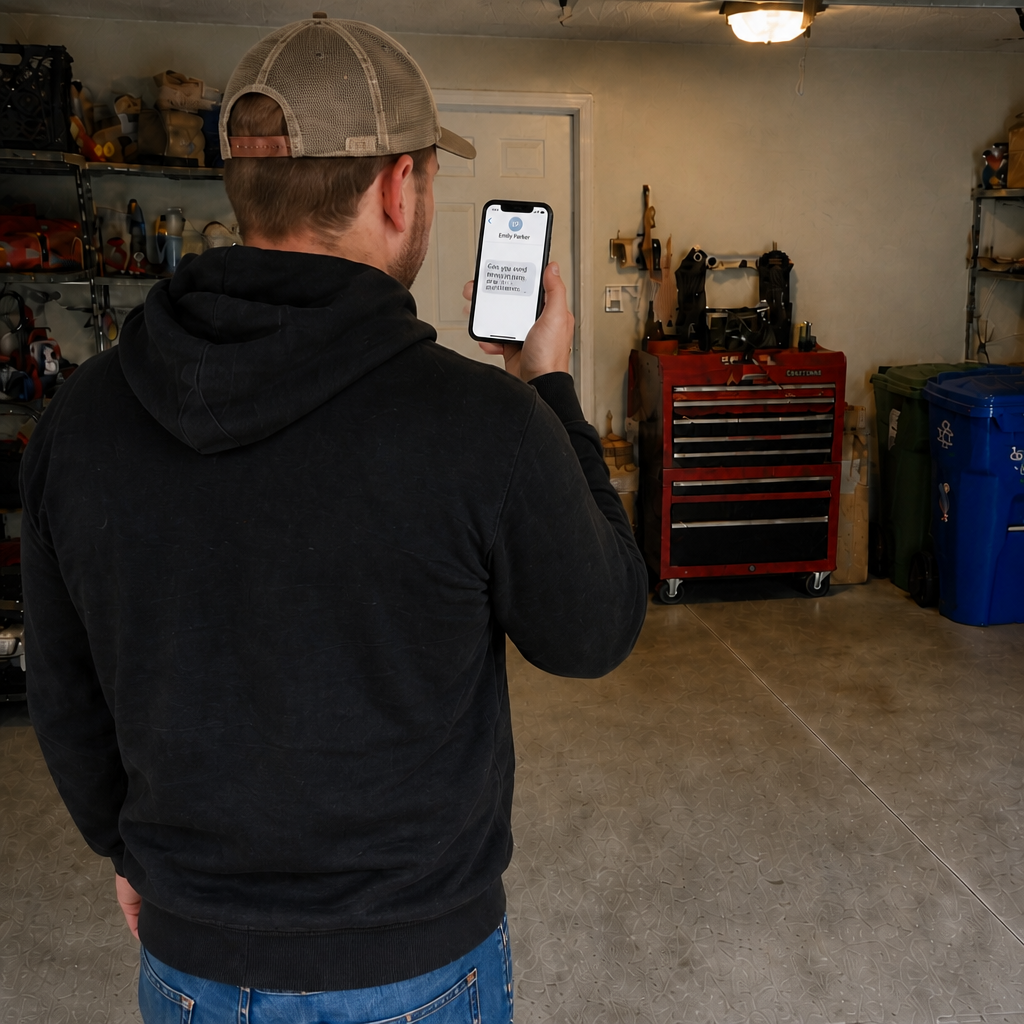
The virtual world system running John has developed the sort of consistency that makes one squint at reality and wonder if it’s been cutting corners. The image model holds onto him with astonishing discipline. If I knew any better… and I very much do not…I’d suspect I was looking at some slow, patient cousin of Sora, thinking one frame at a time and somehow still keeping the soul of the thing intact. The character consistency is absurdly good.
The harness, meanwhile, has become a rather formidable piece of machinery now…thanks, in no small part, to Codex, bless the tireless little goblin. John’s world has expanded accordingly, and it no longer feels like a toy set with good lighting. It feels inhabited. Operational. Slightly alarming in the way all sufficiently competent systems are.
I’ve got a frame exporter wired up from one of the harness views, which means you can watch John using his phone here. And that point is worth underlining with a heavy pen: this footage is not video in the ordinary sense. It is being generated one frame at a time by gpt-image-2. Not composited, not cleaned up afterward, not politely faked into coherence by some editorial trickery…just frame after frame, marching out of the machine and somehow agreeing with one another.
And that’s the part that really gets you. This isn’t limited to a static portrait or a carefully chosen moment. You can watch John drive a truck. You can watch him go shopping. You can watch him move through his world doing ordinary things, and the world keeps its balance instead of collapsing into surreal soup.
It’s quite something. Which is to say: it’s faintly ridiculous, technically impressive, and just a little bit magical in the old-fashioned sense… where you know there must be gears and levers somewhere, but the effect still makes you grin like an idiot.
The interesting thing about John’s world are some of the other people in it. Up until now, I’ve only shared John’s house. However, John’s world is a lot more interesting than this. I do think I’ve largely solved many of the common consistency problems to build a virtual west world. I’m sure others will figure this out soon enough.
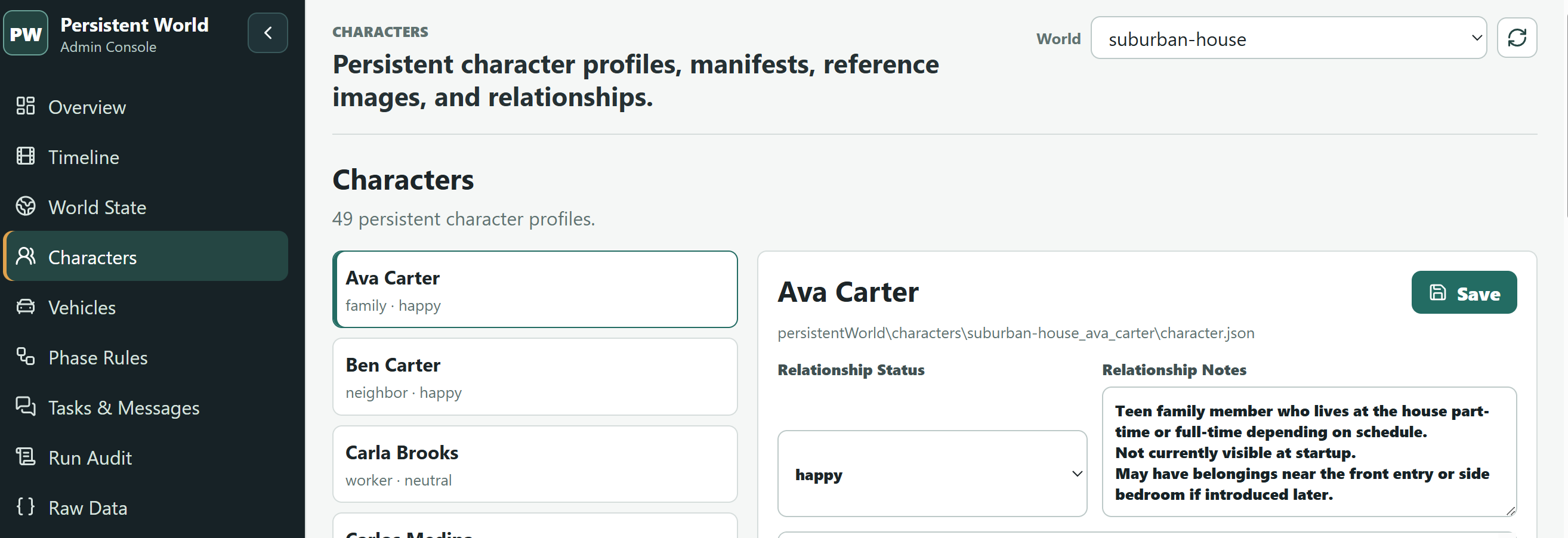
Virtual World Admin Console
You may find this a real treat.
I built a specialized tool to keep tabs on the world. It provides insight into the generated frames, the characters in the world, the vehicles that have manifested themselves into existence, and more. It also tracks something called “Frame Health,” which is a fancy way of saying if it quacks like a duck, it is a duck and not a dog.

I’m not going to disappear into a full deep dive here. You’re busy, I’m busy, and this piece does a good enough job sketching the shape of the world as it exists right now.
What’s especially interesting is how these characters came into being. They did not start as some grand simulation architecture or carefully planned cast bible. They started as contacts in John’s iMessage list. That’s it. Then I built an LLM-driven system that lets the world fill itself in as we go, one interaction at a time.
That part matters. It means you do not need to build the whole universe up front like some sad little god with a spreadsheet addiction. Lord, how many times I’ve done that… so many. Instead? You can start with a handful of people, a few places, a little memory, and then let the world accumulate texture through use. The characters get history. The places get context. The whole thing starts to feel less like a demo and more like somewhere.
I’ll share more video from John’s world soon. I’m especially hoping to catch him driving to the store again, because scenes like that make the whole thing click. It is mundane in exactly the right way. Not a flashy tech demo, just a person moving through a place that seems to continue existing when you stop looking at it.
What this is proving to me is that Westworld 0.1 is already possible. No robotics, obviously. No humanoid hosts wandering around your cul-de-sac. But as a poor man’s approximation, using tools like gpt-image-2 to build a virtual world with persistent characters, recurring places, and continuity over time, it is here now.
And honestly, that’s kind of incredible.
Thanks for reading! Subscribe for free to receive new posts and support my work.