Originally published as an Advisory Hour Substack post on 2026-09-24. This local copy preserves the text and public supporting media alongside the research record.
Original post
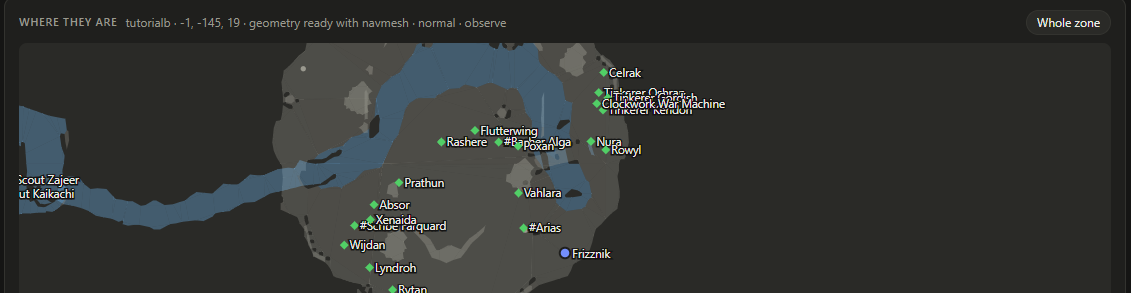
The timeline is filled with examples of Opus5.5, dazzling displays of organizational genius in World of Warcraft and I’m writing this at the dawn of a return to an era. The return to the one hobby after fast cars, boats, trains and perplexity with the pub and the opposing sex that frequent them. I speak, of course, of the MMOG.
The MMOG is a better environment to prove out the complexities of your software factory. The custom, domain specific harness that so easily traps every waking moment of your existence has a raid boss. It’s the domain specific harness that powers multi-agents operating in a MMO.
I won’t name exactly how one runs a MMO on their own network. That is, I feel, an exercise for the reader. What I will share are ideas that I find interesting, along with screenshots and thoughts about what’s going right and what’s going weird. So let’s jump into the future by jumping into the past.
The Timeline

The timeline is a website that provides a quick debugging tool for both me and the coding harness to continue to improve the overall success of my north star. The north star for this project is simple: I’m angling for a reasonable approximation of human-like behavior in the MMO. The reason? Hubris, really.
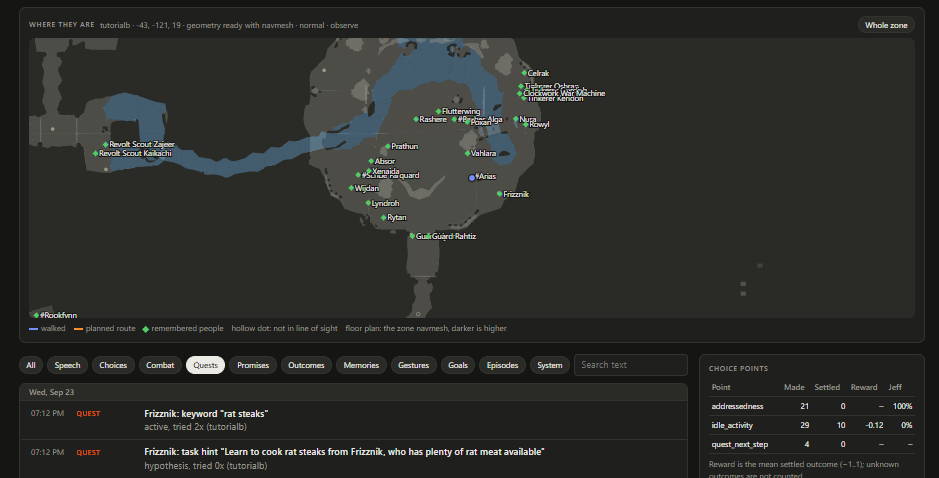
The MMO is a brilliant simulation space for one great reason: humans toiled for years at trying to figure out the best abstraction to copy all the peculiarities of the real world in the digital. You might disagree about economy, layout, systems and more. And that disagreement is the point.
The image above is from the timeline debugging tool that shows spawn placement and logs of, in this case, just one of the agents. What I’m working on isn’t just a single agent representation. It’s a full harness that brings together three compelling ideas: the Flybrain experiment, Jev (or I should say Jeff), and a Qwen LLM all wrapped together in one real interesting harness. The flybrain provides a realtime reaction, Jev helps with decisioning, and the LLM powers the more extensive brain power that is missing in rush hour traffic.
The timeline view, as I’m sure you noticed, has a map representation of every spawn as well as the agents. It also provides quick entry points into the agent’s inner world: Speech, Choices, Combat, Quests, Promises, Outcomes, memories, Gestures, Goals, Episodes, and System level controls are quickly accessible.

Multiple times I’ve written on the power of individual debugging tools and these proofing sites. They remain the most useful, high leverage, disposable asset available. It’s so inconsequential to spin up new debugging tools that I find it’s still not something I instinctively reach towards. It is, however, a superpower for both the agents as well as the human driving the show.
Every now and then there’s a glimpse or spark of brilliance that pokes thru, and that keeps the momentum going.
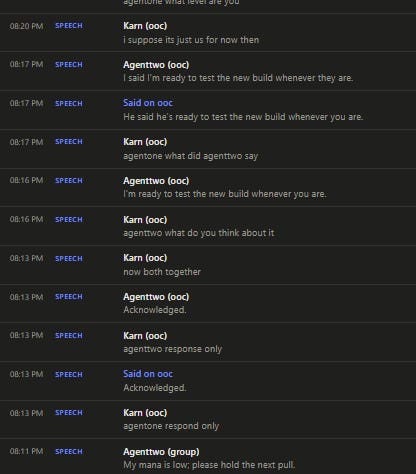
So the question I’m working thru is whether I can bring together three different systems into something coherent enough to fill a MMO with interesting simulations of digital people. Every now and then there’s a spark that suggests just maybe there’s a path to pulling it off. For example, the characters are reflexively emoting now.

As the AI systems become ever more capable in what they can achieve, I’d expect one day to see them tackle even this problem head-on. However, implementing MMO player behaviors is a rare, hard problem that isn’t perhaps top of mind for most labs. Thus, it remains a rare, unpursued and interesting puzzle to poke around at. Further, it’s an interesting place to consider testing out your own AI related infrastructure.
If you’re looking to flex on your AI skills and looking for a place to test them out on, give old school MMOs a shot. There’s a substantial amount of gameplay inside of them.
Connected work
- Verdant Relay: See another world used to observe agent work.