Source note: Local copy of a Summer Into AI 2026 submission originally published on Substack. Screenshots, video, and audio found in the post body are mirrored locally when publicly accessible; profile and avatar images are intentionally not copied. Read the canonical post.
Download here: https://github.com/BluntforceRiot/manifest-notebooky
Try it here! https://bluntforceriot.github.io/manifest-notebooky/
The Week 2 prompt was Independence Engines.
That sounds noble.
Too noble.
It sounds like the kind of prompt where someone could build a tasteful civic tool with soft blue buttons, a dashboard full of municipal rectangles, and a tagline that says “empowering community voices” while quietly draining the soul from the room through a beige floor vent.
I respect that path.
I did not take that path.
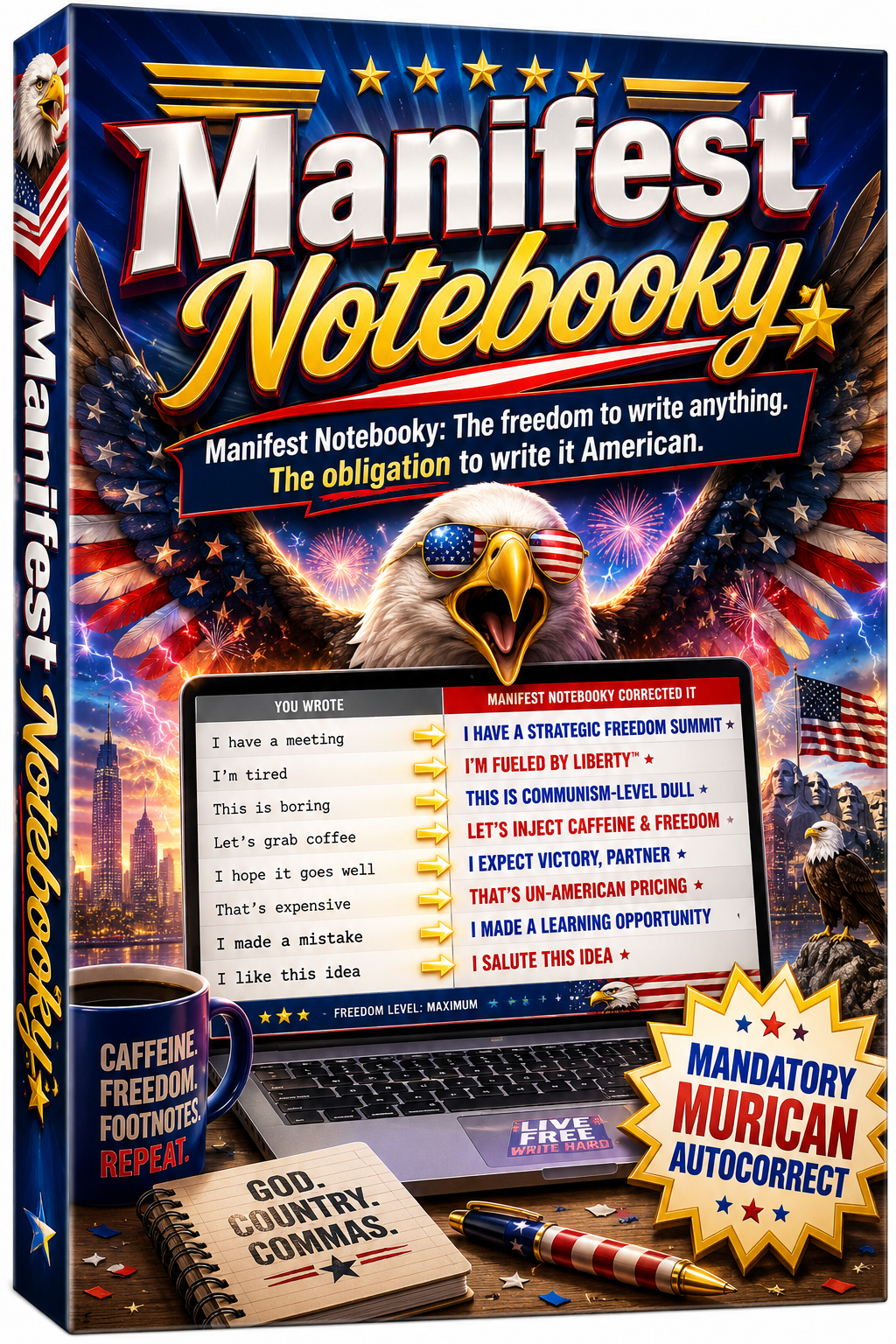
I built Manifest Notebooky, a satirical patriotic notebook app that gives you the freedom to write anything, then immediately forces your ordinary human thoughts through Mandatory Murican Autocorrect.
The tagline is the entire crime scene:
The freedom to write anything. The obligation to write it American.
Part of the character inspiration came from the same glorious powdered-wig frequency as Myles’s Dependency Day and Qwen Franklin.
Qwen Franklin has that perfect founding-era AI goblin energy: civic language, historical costume, synthetic confidence, and the feeling that a chatbot has somehow gotten access to parchment, fireworks, and a thesaurus with no adult supervision. I did not want to copy that character. I wanted to build the tool that would create that kind of voice by force.
So Manifest Notebooky became the negative-space version of Qwen Franklin.
Not a founder you talk to.
A notebook that starts acting like your founding editor.
You try to write a normal sentence. The app decides your sentence has insufficient eagle pressure. Suddenly your private thought is wearing a tricorn hat and yelling about liberty at a coffee mug.
That is where the joke really locked in. Qwen Franklin was the character spark. Manifest Notebooky became the software product version: not “what would a founding father AI say?” but “what if the notebook itself decided every sentence needed patriotic correction before it counted as writing?”
At first, Manifest Notebooky looks like a notebook.
You get pages. You can write notes. You can create, rename, duplicate, delete, edit, and save your little thought territories. You can choose paper themes. You can stamp things. You can export or copy your writing. It is a normal little browser app, standing there innocently in a powdered wig made of CSS.
Then you type something like:
“I have a meeting.”
And the app looks at that sentence and decides it is insufficiently free.
Now you have a town hall ambush.
That is the whole joke.
A notebook is one of the most basic Independence Engines there is. A blank page lets a person make a plan, remember an idea, keep a record, write a complaint, draft a manifesto, make a grocery list, build a project, or document the exact moment a software tool started acting like a tiny founding father with admin privileges.
Writing is freedom.
So I made a notebook that overcorrects the freedom.
Literally.
Mandatory Murican Autocorrect is always on. Not mostly on. Not politely suggested. Not “would you like us to improve your writing experience?” No. The lowest setting is already:
Mandatory Murican Autocorrect: ON
That is baseline liberty.
You can upgrade it to MAXIMUM MURICAN, because of course you can. Every cursed setting screen in modern software has one button that looks optional but is secretly a raccoon trap with gradients.
Once you click it, you are locked in for five minutes.
A timer appears.
You may gaze upon your decision.
You may reflect.
You may learn.
You may type a sentence about being tired and watch the machine translate it into the kind of thing a fireworks salesman would yell from the back of a monster truck during a Fourth of July halftime show.
And when the cooldown ends, you still do not just get to turn it off.
That would be too free.
You must complete Dissatisfaction With Maximum Murican Mode Form 1776-B.
The form asks why you were dissatisfied with MAXIMUM MURICAN, whether you understood it was the highest expression of notebook freedom, whether your downgrade request was caused by user error, and whether you would recommend MAXIMUM MURICAN to fellow citizens under mandatory enthusiasm.
Then the app processes your complaint into praise.
Because nothing says freedom like a settings menu that edits your regret before accepting it.
That was the center of the build for me.
Manifest Notebooky is not just a random American joke generator. It is a parody of freedom language wrapped around software overreach.
It is about dark patterns.
It is about fake choice.
It is about products that say “you are in control” while quietly moving the door behind a subscription tier, a cooldown timer, and a form written by a committee that drinks flag-colored energy drinks.
The app gives you a blank page, the symbol of personal agency, then installs hostile red-white-blue office software directly into the act of writing.
You can write anything.
But the app can also decide your “meeting notes” are now a “town hall battle report.”
Your “coffee” is now “bean ammunition.”
Your “problem” is now a “constitutional inconvenience.”
Your “notebook” is now a “manifesto containment unit.”
Your “keyboard” is now a “freedom clacker.”
Honestly, the app might be correct about that last one.
The reason this fit Independence Engines is that writing tools are engines. Not engines with pistons and oil stains. Engines of intention. Engines of memory. Engines of organization. A notebook turns private thought into external structure. It lets a person hold onto an idea long enough to sharpen it, share it, or use it.
That is powerful.
So Manifest Notebooky asks the obvious terrible question:
What happens when the tool that is supposed to preserve your thought starts “improving” it for ideological branding points?
The answer is fireworks in the spellchecker.
The app has stamps too, because if you are going to build fake patriotic paperwork, you need fake patriotic bureaucracy. You can stamp your page with things like approved slogans and eagle-certified nonsense. The stamps sit visually on the paper without changing the text, which is important because there is a difference between decoration and authoritarian grammar confetti.
There are also tools like DECLARE INDEPENDENCE, STAMP IT, and EAGLEIZE IT.
EAGLEIZE IT lets you change the flavor of the rewrite. Founding Father Overkill. Fireworks Salesman. Parade Announcer. Action Movie President. County Fair Judge. Liberty Pamphlet. Truck Commercial Narrator. Classified Government Memo.
That list is not a feature set.
That is a national fever dream wearing aviators.
And yes, there is “Liberty Telemetry,” but that is part of the joke. The actual app is local only. No accounts. No backend. No analytics. No real telemetry. No remote AI calls at runtime. The notebook lives in your browser unless you copy or export it.
That boundary mattered.
This is satire about invasive software, so making it actually invasive would be like writing a song called “Don’t Punch Me” and then sprinting into the crowd with boxing gloves.
The app had to be a static browser demo. Open it, play with it, laugh at it, close it. No sign-up ritual. No data altar. No “continue with Google” hiding in the bushes.
I used AI as the workshop partner, not the runtime gimmick. ChatGPT helped shape the joke and the mechanic. Codex helped implement and integrate the app. But the final behavior is deterministic local TypeScript logic. There is no model sitting behind the curtain deciding that your grocery list needs more eagles.
The joke works better that way.
It is not “AI rewrites you.”
It is worse.
It is software policy rewrites you.
That is more believable, which is rude.
The funniest part of building Manifest Notebooky was realizing how naturally the joke scaled. A normal autocorrect fixes spelling. A cursed autocorrect fixes your attitude. Once that clicked, everything else fell into place.
Baseline mode is already mandatory.
Maximum mode is temptingly worse.
Downgrading is technically possible, but emotionally bureaucratic.
The complaint form is a punishment room with fireworks wallpaper.
The processed statement is the punchline: your dissatisfaction becomes a testimonial.
That is modern software in miniature.
You clicked the button.
You agreed to the thing.
You entered the funnel.
You are now enjoying freedom at full volume.
Please wait while your preferences are reviewed by the Department of Keyboard Freedom.
The build is ridiculous on purpose, but the shape underneath is serious. Tools are not neutral once they start correcting behavior. A blank page is freedom because it does not care what you think yet. It waits. It receives. It lets the thought become visible.
Manifest Notebooky refuses to wait.
It barges into the sentence wearing mirrored eagle sunglasses and says, “Great start, citizen, but this could use more national paperwork energy.”
That is why it belongs in Independence Engines.
The engine is the notebook.
The sabotage is the point.
It is a tiny playable argument about what freedom looks like when a tool claims to offer it, then narrows it, brands it, gamifies it, locks the exit, and rewrites your complaint into gratitude.
Also, it says “freedom clacker.”
That helps.
Manifest Notebooky is probably not the notebook app America deserves.
It may not even be the notebook app America can legally operate near dry brush.
But it is the notebook app I built for this prompt: loud, stupid, functional, local, satirical, and weirdly honest about the fact that “freedom” often arrives inside software as a button you can click once and regret for five minutes.
Write anything.
Original source
Canonical Substack URL: https://safetylast.substack.com/p/manifest-notebooky-i-built-a-notebook.