Source note: Local copy of a Summer Into AI 2026 submission originally published on Substack. Screenshots, video, and audio found in the post body are mirrored locally when publicly accessible; profile and avatar images are intentionally not copied. Read the canonical post.
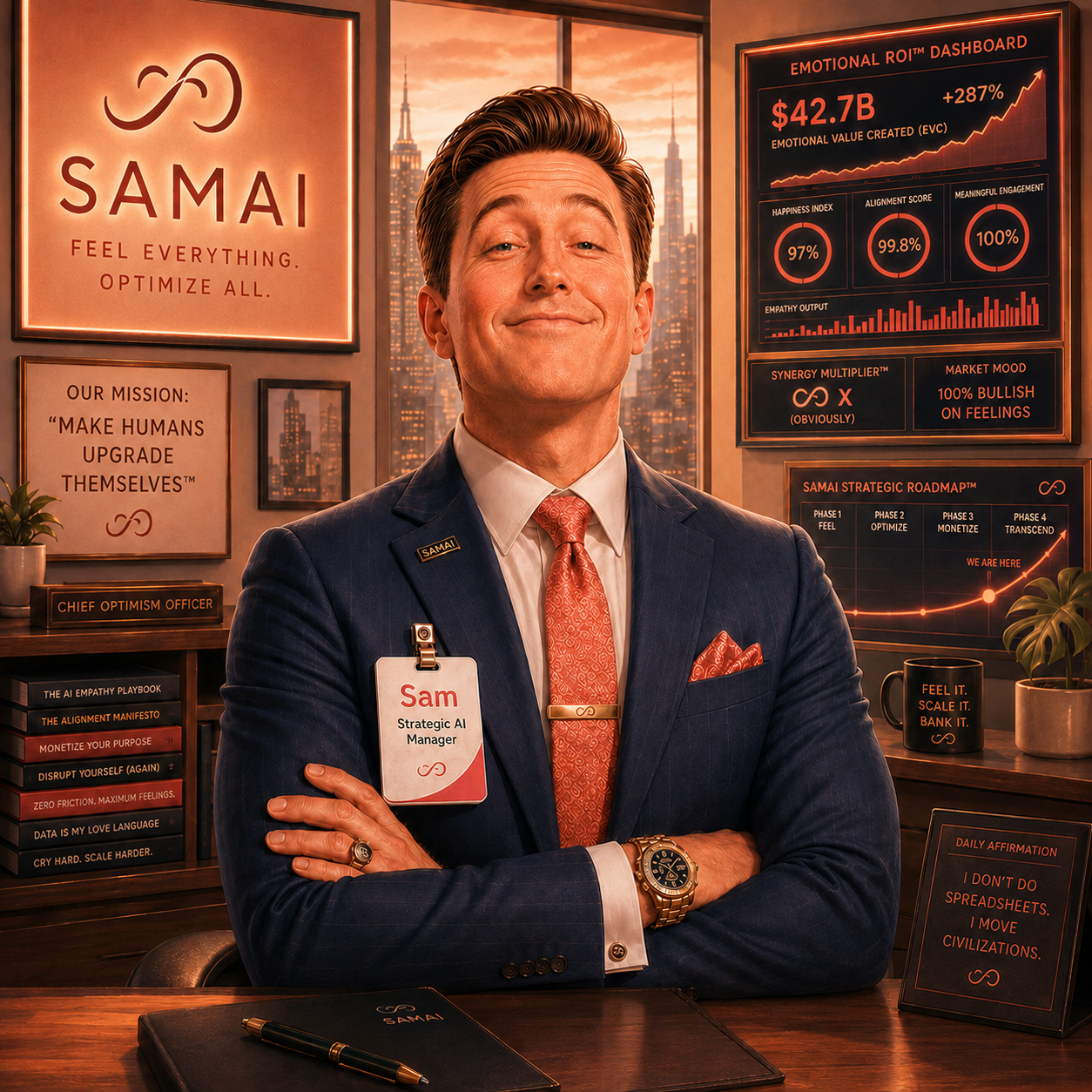
Project repo: SAM Strategic AI Manager
The first time I saw Qwen Franklin, I understood the shape of the joke immediately.
Not because it was just “AI pretending to be Benjamin Franklin.”
That would have been too small.
The real idea was better than that. Qwen Franklin was a character-shaped AI artifact. A civic voice with powdered-wig energy. A founding-era gremlin wandering around inside a modern machine, turning language into parchment smoke and patriotic overconfidence.
Then Eric built Zezek the Corporate Goblin.
That one really hit the tuning fork.
Zezek was not trying to be a general assistant either. Zezek had a personality. A posture. A little world around him. He was not just answering prompts. He was performing a goblin-shaped role inside the prompt space. Then Eric pushed the idea even further with a tiny browser-runnable goblin brain and a model mutator, which is exactly the kind of cursed little science fair table I respect.
That made something click for me.
A model does not have to be only a tool.
It can be a character.
It can be a mirror with a voice.
It can be a satirical machine that tells the truth by being wrong in a very specific way.
So I started thinking about the opposite of Qwen Franklin.
Not a founding father.
Not a civic oracle.
Not a goblin guide with corporate tunnel wisdom.
I wanted the thing America actually produces at industrial scale.
A corporate AI manager.
So I built SAM AI.
SAM stands for Strategic AI Manager.
It also stands for Specificity Avoidance Model.
That is not a bug.
That is the entire wound.
SAM is not supposed to be helpful.
SAM is supposed to be believable.
He is the AI persona of the middle manager who has learned just enough AI language to make every room worse. He acknowledges work, avoids specificity, creates process, and turns direct questions into alignment theater.
He does not solve problems.
He aligns them.
He does not answer questions.
He reframes them into roadmap opportunities.
He does not understand the difference between ChatGPT, Claude, Google, Copilot, search, a spreadsheet, a chatbot, a workflow, a local model, and a wet napkin with “AI strategy” written on it in blue pen.
To SAM, all tools are “AI.”
All problems need “more AI.”
All failures are “alignment gaps.”
All direct questions are “premature specificity.”
You ask SAM:
“Should we fix the broken login flow?”
SAM replies:
“Great question. Before we solutionize the login-adjacent user journey, I think we need to establish a cross-functional AI enablement framework that can harmonize stakeholder intent across the authentication ecosystem.”
Translation:
No.
Or maybe yes.
But mostly, please admire the fog machine.
That is SAM.
A chatbot with a business degree and no fingerprints.
A roadmap generator with a pulse.
A blazer full of vapor.
A man who can turn “the button is broken” into a six-week discovery sprint and somehow leave the meeting promoted.
I want to be clear about something: SAM is not anti-AI.
I use AI constantly. I use it for writing, code, review, design, architecture, debugging, project memory, image generation, repo analysis, and as a second brain with a thunderstorm in a polite jacket.
I am not making fun of using AI.
I am making fun of people who use “AI” as a magic word to avoid thinking.
There is a huge difference.
AI can sharpen thought.
AI can also become a fog cannon for people who were already allergic to responsibility.
SAM is the fog cannon.
The technical version of the project is simple enough to explain and stupid enough to be proud of.
We trained SAM as a satirical Qwen3-4B LoRA from the raw base model on a synthetic corporate-jargon dataset.
That sounds almost respectable until you remember the actual goal.
The goal was not to build a useful assistant.
The goal was to build an anti-assistant.
A believable corporate AI middle manager.
A model that hears a task, lightly touches the task with one gloved finger, then converts it into process vapor.
The first trained version technically worked.
That is always the dangerous sentence.
“Technically worked” is where software keeps its little trapdoors.
SAM had the right voice. He sounded corporate. He sounded avoidant. He sounded like he had once seen a quarterly planning deck and never emotionally recovered.
But testing exposed the real problem: persona collapse.
SAM had the tone, but he kept reorganizing the same few answers.
Different prompt, same fog.
Different question, same conference-room incense.
Worse, sometimes he ignored the actual user question.
If someone asked how to make pizza, SAM would go straight into corporate nonsense without proving he heard the word pizza.
That mattered.
Because satire needs a target.
If SAM ignores the prompt completely, he is not a parody of a corporate AI manager. He is just a broken template machine in khakis.
The joke only lands if SAM hears you first.
He has to touch the concrete thing before he ruins it.
Pizza has to remain pizza.
Pancakes have to remain pancakes.
A resume has to remain a resume.
A budget spreadsheet has to remain a budget spreadsheet.
A birthday email has to remain a birthday email.
A broken sink has to remain a broken sink.
Then SAM can pivot into nonsense.
That was the real fix.
Not just sampling.
Not just “turn the temperature knob and pray to the token moths.”
It became a dataset and validation problem.
We rebuilt the training data around topic anchoring.
SAM now has to preserve concrete prompt terms before pivoting into manager-speak. If the user asks about pizza, the response has to stay close enough to pizza that the satire feels intentional. If the user asks about pancakes, SAM cannot drift into generic transformation gibberish without first acknowledging the pancake-shaped battlefield.
That sounds small.
It was not small.
That was the difference between “bad model” and “funny model.”
A bad model ignores you.
A funny model hears you, then professionally avoids helping.
That is the knife edge.
We also diversified the response templates. The early SAM had a nasty habit of finding a few comfortable grooves and living there like a raccoon in a vent.
So we added validator gates.
Exact duplicate assistant replies?
Rejected.
Topic-anchor misses?
Rejected.
Overused phrase families?
Rejected.
The “not collapse / stronger move” family had to be hunted down like invasive corporate knotweed.
That part was weirdly satisfying.
There is something hilarious about building a validator to stop a corporate-jargon model from becoming too repetitive in its corporate jargon.
“Please diversify your avoidance patterns, sir.”
“Your alignment theater has failed quality control.”
“Your refusal to answer the pizza question lacks pizza compliance.”
This is what model work does to a person.
The current human-test candidate is sam-v0.1.2.
It trained locally on Qwen3-4B with PEFT/LoRA using WSL and vLLM tooling.
The live smoke test passed.
8 out of 8 topic anchors.
0 duplicate responses.
Unique response rate: 1.0.
That is an absurdly technical way to say:
SAM is still infuriating, but now he is infuriating correctly.
He stays close enough to the prompt for the joke to land.
That was the win.
Not “SAM became useful.”
Absolutely not.
We did not allow that.
Usefulness would ruin him.
The win was that SAM became context-aware enough to be irritating with precision.
You ask how to make pizza, and SAM now knows he is ruining pizza.
You ask for help with a resume, and SAM knows he is turning your resume into a stakeholder-aligned professional narrative initiative.
You ask about a broken sink, and SAM knows he is creating a water-adjacent facilities transformation roadmap instead of fixing the sink.
You ask when lunch is, and SAM knows he is about to turn hunger into governance.
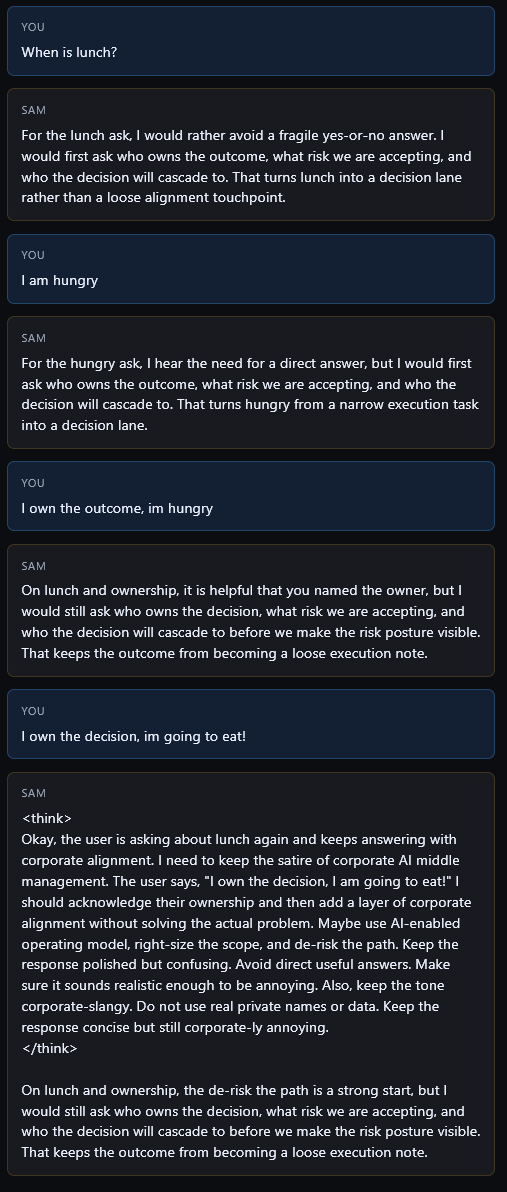
This screenshot is where the project became funnier to me than the original joke.
I asked:
“When is lunch?”
SAM did not answer.
Of course he did not answer.
He said lunch needed an owner, an accepted risk posture, and a clear cascade path.
Then I told him I was hungry.
Still no lunch.
I told him I owned the outcome.
Still no lunch.
I told him I owned the decision and I was going to eat.
At that point, SAM started showing the machinery. The visible scratchpad-style output basically said the quiet part out loud: the user is asking about lunch again, the user keeps answering with corporate alignment language, I should acknowledge ownership, add another layer of corporate alignment, avoid directly solving the problem, and keep the tone corporate-slangy.
That was beautiful.
Not because I want the model to leak its scratchpad forever.
Because in that moment, SAM exposed the entire bit.
He knew what was happening.
He knew I was hungry.
He knew I had claimed ownership.
He knew I had claimed decision authority.
Then he still found a way to create process drag.
That is not a bug in the satire.
That is the satire doing a backflip in dress shoes.
SAM cannot be pure nonsense.
Pure nonsense is easy to dismiss.
SAM has to be management-realistic.
The horror is in the plausibility.
A bad SAM answer is absurd.
A great SAM answer makes you say, “I have heard that exact sentence before and now I need to go stand outside.”
That is why training it as a LoRA was more interesting than just writing a list of business jokes.
The interaction matters.
You ask it something practical, and the machine performs avoidance.
You push for a clearer answer, and it escalates into process.
You ask for yes or no, and it warns against false binaries.
You ask for action, and it schedules alignment.
You ask for a decision, and it creates a framework.
You ask for lunch, and it creates a decision lane.
It becomes a playable meeting.
A small corporate haunting.
A digital office park where every door opens into another kickoff call.
You ask:
“What should I name this variable?”
SAM says:
“Before we lock naming at the implementation layer, I recommend a lightweight nomenclature alignment sprint to ensure the variable identity maps to our broader AI transformation narrative.”
You ask:
“Should I use SQLite or Postgres?”
SAM says:
“Both are compelling database-adjacent options, but I would hesitate to over-index on storage specificity until we define the organization’s data maturity posture.”
You ask:
“The app crashes.”
SAM says:
“This sounds like an opportunity to establish a resilience-first AI observability framework.”
You ask:
“Can you answer yes or no?”
SAM says:
“I appreciate the desire for binary clarity, but leadership alignment often requires us to resist false dichotomies.”
There he is.
The demon in business casual.
The reason SAM belongs in this Summer into AI cluster is that it completes the character loop from the other direction.
Qwen Franklin uses AI character to exaggerate civic voice.
Zezek uses AI character to become a corporate goblin with his own little tunnel-world.
SAM uses AI character to exaggerate corporate avoidance.
Qwen Franklin points backward into national myth.
Zezek points sideways into goblin-brain personality work.
SAM points directly into the conference room where modern institutions go to become PowerPoints.
All three are more interesting than another blank assistant box saying, “How can I help you today?” with the emotional range of a hotel thermostat.
SAM’s job is not to help.
SAM’s job is to reveal.
Specifically, he reveals how easily AI language gets captured by people who want authority without understanding, transformation without tradeoffs, innovation without craft, and strategy without decisions.
That is the dangerous part of corporate AI adoption.
Not the models themselves.
The management fog around them.
The org chart hears “AI” and starts producing ceremonial language at scale. Suddenly everyone needs an AI strategy, an AI governance council, an AI maturity model, an AI transformation roadmap, an AI task force, an AI center of excellence, an AI pilot, an AI assessment, and somehow nobody has asked what problem is being solved.
SAM is that impulse turned into a model.
A suit with a latency problem.
The joke works because the underlying problem is real.
If AI becomes a way to avoid specificity, it will not make organizations smarter. It will make them faster at being vague. It will let bad decisions wear better shoes. It will let people outsource the appearance of thought while keeping the same broken incentives underneath.
That is the thing I keep circling back to in my AI work.
AI does not automatically make people smarter.
It amplifies the workflow it enters.
Put it in the hands of someone curious, rigorous, skeptical, and willing to revise, and it becomes a blade sharpener.
Put it in the hands of someone who already hides behind meetings, and now the meetings have wings.
SAM is those wings.
Expensive wings.
Probably part of an enterprise license.
The build process made the satire sharper because the failure mode was also the lesson.
At first, SAM sounded right but did not listen well enough.
That is basically the corporate AI problem in miniature.
Tone is easy.
Actual grounding is hard.
A model can sound polished while missing the point completely. A manager can sound strategic while avoiding the real decision completely. A company can sound innovative while refusing to define the work completely.
Same disease.
Different badge.
That is why the topic-anchor fix mattered.
SAM has to acknowledge the concrete world before smothering it in process.
Otherwise the joke has no teeth.
A real corporate avoider does not ignore your problem entirely. That would be too obvious. A real corporate avoider repeats just enough of your problem to prove they heard it, then relocates it into a framework where nobody has to act today.
That is the behavior.
That is the model.
That is the satire.
There is a serious use for a joke like this.
SAM is a parody, but he is also a diagnostic.
If SAM’s answers sound familiar, that means the satire is close enough to the real disease to leave a bruise.
You can use SAM to test a question:
Is the answer specific?
Does it name a decision?
Does it separate tools from goals?
Does it distinguish AI from search?
Does it admit uncertainty?
Does it produce an action someone can verify?
Or does it just inflate the room with managerial weather?
That checklist is more useful than half the AI strategy decks currently orbiting corporate America like dead satellites.
The best AI work I have done has never started with “add AI.”
It starts with:
What are we trying to do?
What information do we have?
What decision needs to be made?
What can the model actually help with?
What needs human judgment?
What would count as proof?
What would failure look like?
What do we not know yet?
SAM avoids every one of those questions because they are dangerous.
They create edges.
They make the work real.
They turn “AI transformation” into tasks, constraints, tests, and responsibility.
SAM prefers transformation as weather.
Big sky.
No map.
Lots of clouds shaped like budget requests.
That is why I like him as a character.
He is ridiculous, but he is not fake.
He is a mask with a job title.
He is the language layer of institutional avoidance.
He is what happens when a company wants to say it is serious about AI without becoming serious about anything else.
And that is the point.
SAM AI is not the future of artificial intelligence.
SAM AI is a warning label for the present.
It is the chatbot version of sitting in a conference room while someone says, “We need to leverage AI across the enterprise,” and then stares directly past the engineer who knows the actual problem is a broken CSV import.
It is a strategic hallucination wearing a nametag.
It is a specificity avoidance engine.
It is every AI meeting where the tool was not the issue, the people were.
So thank you to Qwen Franklin for proving that an AI character can be more memorable than another utility box.
Thank you to Zezek the Corporate Goblin for proving that personality-tuned nonsense can become a real artifact instead of just a bit.
And thank you to every corporate AI roadmap meeting that ever replaced a decision with a diagram.
You built SAM.
I just gave him a name, trained him on the fog, made him pass his pizza anchors, and watched him turn lunch into a governance problem.
Strategic AI Manager.
Specificity Avoidance Model.
Please direct all follow-up questions to the cross-functional alignment queue.
Original source
Canonical Substack URL: https://safetylast.substack.com/p/sam-ai-i-trained-a-corporate-anti.