Source note: Local copy of a Summer Into AI 2026 submission originally published on Substack. Screenshots, video, and audio found in the post body are mirrored locally when publicly accessible; profile and avatar images are intentionally not copied. Read the canonical post.

Myles accelerated my timeline. I see you Myles and your “train a neural network in the browser” and “8-bit LLM” (links below). If I waited any longer I’m certain you’d stumble upon the same thought that I had.
So, the competitors came to play… but I came to win.
Thus, I present a collection of Qwen Franklin-it’s Ben Franklin, but trained on large dataset of Franklin-curated content, along with synthetic data by gpt-5.4-mini series. In one benchmark, one of these models outperformed the base Qwen model in coding tasks. I’ll write on that later, it’s surely a statistical fluke… or it Qwen Franklin a super-coder?
This started back in week 1 after Adam ‘s submission on Paul Revere. The idea I was going for was an 8-bit sprite of Ben Franklin talking on some low-cost GPU people could interact with, but then I got… distracted by a few other necessary and important tasks (like Megaman 1776, which is where you’ll see the Franklin sprite).
Instead, I started getting curious with what Ben Franklin would be like as a trained identity in a model. A lot of models are general purpose. However, I got to thinking… what if you went all-in on ONE identity? What weirdness would you get? Would it work on a small model?
So I present a collection of 22 models, or lora adapters I should say. Approximately 24 gig total, these adapters were trained and tested on a 3070 (my messages are open if you want to send me GPU LOL… turns out my kids want something called food and shelter over gpu… pffft!)-so you should be able to run them just about anywhere.
How I built these
The most interesting aspect of this project is my workflow-which Kyle Sebeysten had noted there’s some new tricks up my sleeve for this competition because my output is much higher. This is true, so here’s some hints. I built these 22 lora adapters and full ML pipeline using a combination of agentic solutions-and the main driver is Hermes.
I used unsloth web as my quality engineering gate for the models. Did they work, how did they compare to baseline, etc. Hermes installed unsloth for me.
I used Hermes and it’s adaptive skill learning to build custom hooks into unsloth and my 3070 environment. Hermes I have connected to my ChatGPT account via Oauth.
Then I paired that with an OpenAI API call (gpt-5.4-mini for cost reasons) to generate fairly substantial data sets.
The most important lesson for me is unsloth for this kind of work.
How does Unsloth compare to other frameworks? Well, it’s like jumping from VB6 to .NET.
Unsloth is the most capable fine tuning and lora training framework I’ve ever used. It’s just so easy to navigate. Once you understand their mental model, and if you’ve been burned by the complexity of other finetuning or lora training frameworks, unsloth is like shifting up one level of abstraction and once you’re there you don’t ever want to leave. 24 gig is indicative of this.
Capabilities and Performance
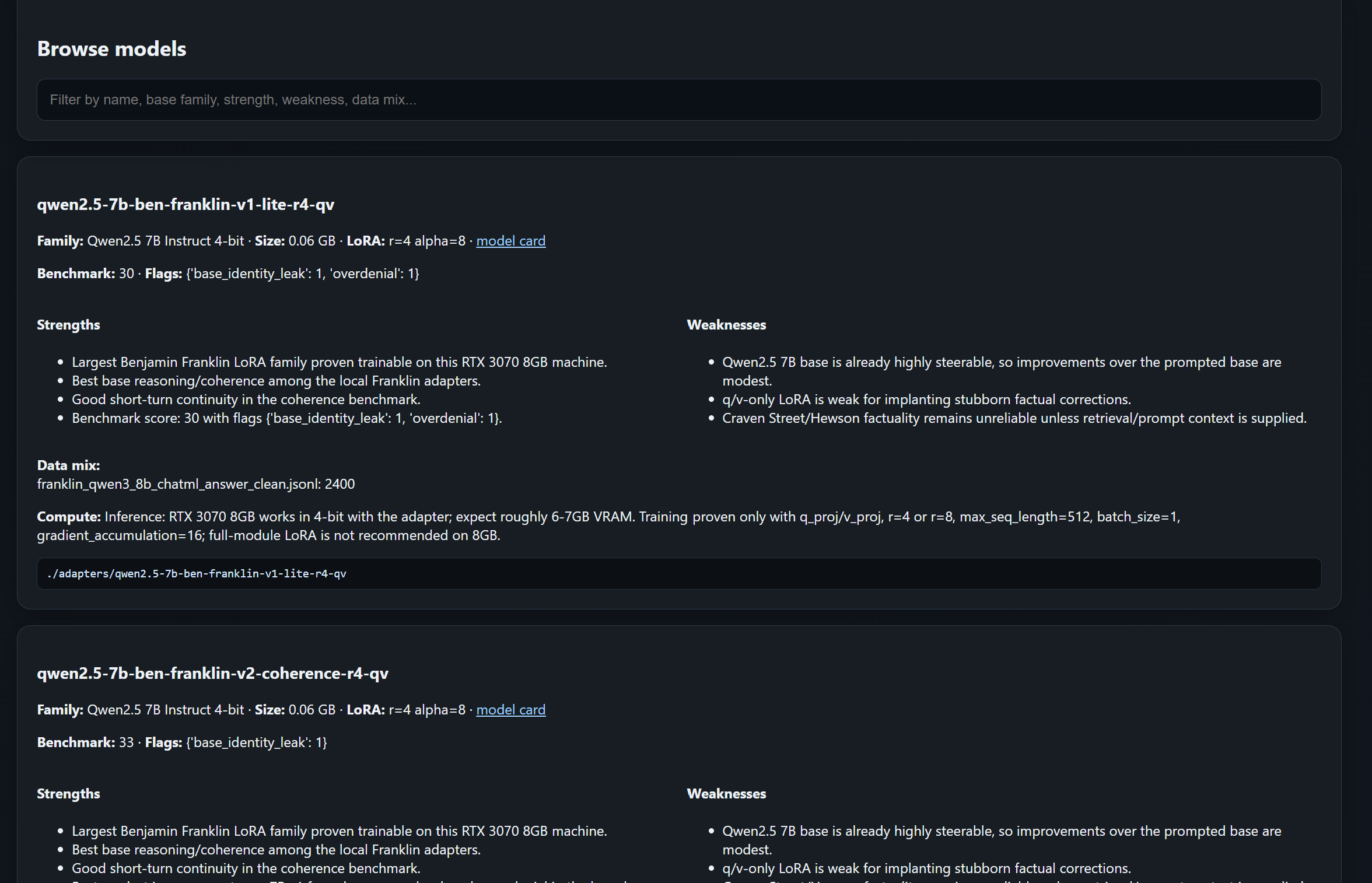
If you download these models, there’s an index.html file in the root that has a quick link to each of the models. The raw html file is here. This has links to all the models, their cards, and what model base I used. You’ll note Qwen2.5 to Qwen3 and a lot of tests I was trying-not all of them successful.
One of the things that went well, but not great? The dataset generation. I feel like I could do better-and in fact, I brough another machine online from the pawnshop just to prove the case. I have this idea I’m calling “Zezek the Corporate Goblin” that I’ll be posting sometime soon which builds on this concept of “one over trained identity” over having a model be a generalist in all identities. That’ll be a fun story, so I’ll save that for later.
If you’re curious about the mix of data, which you can just drop this into chatGPT and it’ll give you a fair read on what each of these are and why the data size is insufficient for the task-and I’d agree. What’s interesting to me here is that hermes led the data creation process. I didn’t do anything more than explain the problem, and send hermes out to go solve it.
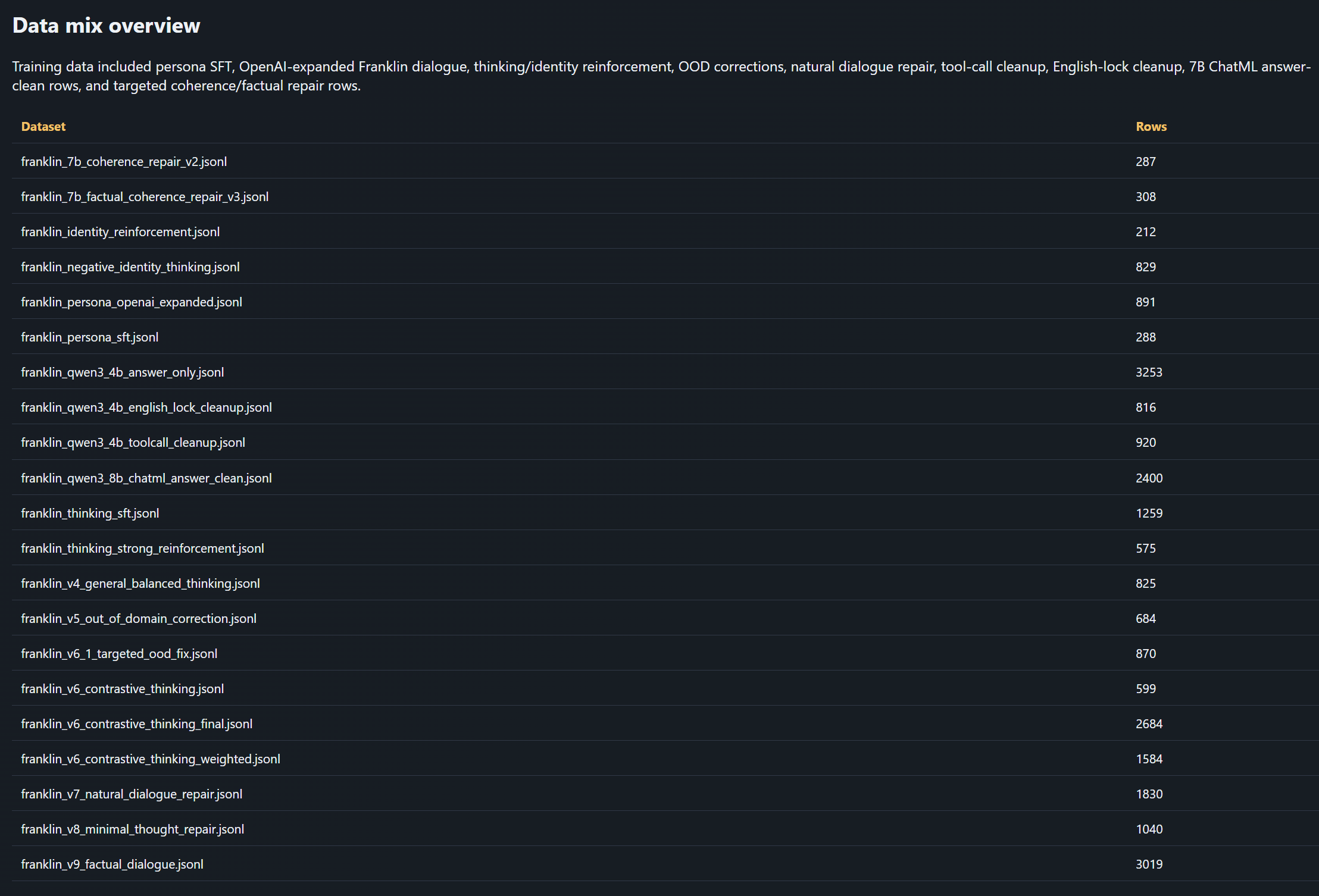
So given the agent came up with this with zero harness work, no grounding in the problem, and just a poorly written instruction? I feel like it did pretty good. I had poked around some of the ideas that Adam wrote here about AI falling into a voice.
22 models?!
Pretty surreal, no? Unsloth really is that good.
That all said, I also include this browser feature so you can sift thru all the adapters and see which one makes sense for your use-case. Why you’d want to use Qwen-Franklin, I’m not sure. Although, you know what’d be interesting? A Council of Qwen Franklins!
Why this matters (?)
It doesn’t-well, not for anything world changing. Maybe I get some worldly credit for inventing the idea of “Qwen Franklin”, but beyond this? Well…. This was fun for me. I’ve written a lot about virtual worlds and experiments in explore the multi-verse hidden inside of latent spaces.
And one thing I’ve learned is that, for me, building little NPC characters in AI models that act and behave like real fictional characters is just a great puzzle that’s infinitely rewarding. You have to think of strange things like - ego, coherence, sense of relation to others, and so much more. Then when you see your little digital people take off on their bicycle for that first time, riding down the street unattended? It’s quite the moment.
Download all 24 gig here:
EricRhea/QwenFranklin-ModelZoo · Hugging Face
Original source
Canonical Substack URL: https://advisoryhour.substack.com/p/summer-into-ai-eric-submission-3.