Source note: Local copy of a Summer Into AI 2026 submission originally published on Substack. Screenshots, video, and audio found in the post body are mirrored locally when publicly accessible; profile and avatar images are intentionally not copied. Read the canonical post.
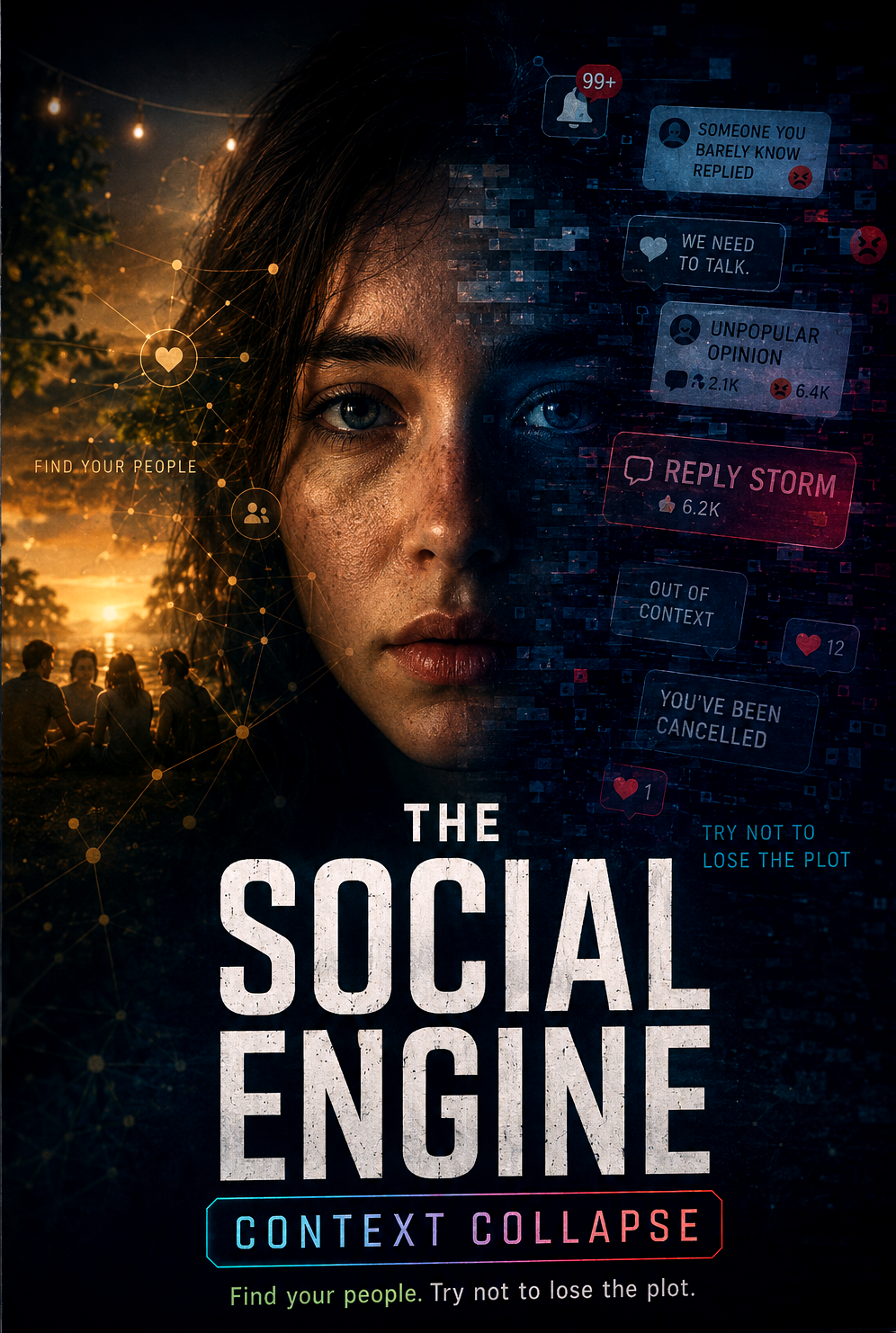
The internet was supposed to make geography less bossy.
You could be the only person in your town trying to repair a vintage computer, learn Linux, organize a niche hobby night, or understand why your golf swing had suddenly developed a personal vendetta. Somewhere online, there was probably another person who knew exactly what you were talking about.
That was the old magic: finding your people without asking permission from geography, institutions, or the local gatekeepers of what counted as a reasonable interest.
Then the feed arrived.
The same machinery that helped us discover one another also began merging every audience into one room. Friends, coworkers, relatives, hobbyists, strangers, mentors, and people who arrived solely because they smelled an argument were suddenly reading the same post.
That collision is called context collapse, and I decided to turn it into a game.
Welcome to The Social Engine
The Social Engine: Context Collapse is a browser strategy game set inside SignalBarn, a fictional social platform with the combined energy of an old internet forum, a small-town bulletin board, and a control room operated by someone who has read too many comment threads.
A run lasts 30 days.
You begin by choosing a few interests. Technology, local life, weird internet, relationships, retro computing, community organizing, and other interests influence the cards that appear in your daily hand.
Each day, you make one choice.
You might:
Post a Tiny Build Log
Ask for Linux Help
Correct a Fake AI Image
Host a Small-Town Meetup
Private Message a Friend
Moderate a Fight
Touch Grass
Turn a Viral Thread Into a Project
Take the Community Independent
The game then shows what happened.
Sometimes your tutorial genuinely helps someone. Sometimes a respected expert cites your guide. Sometimes seven people attend your real-world event and one of them brings donuts.
Sometimes Aunt JPEG shares an image of a six-fingered historical figure and calls the extra fingers “symbolic.”
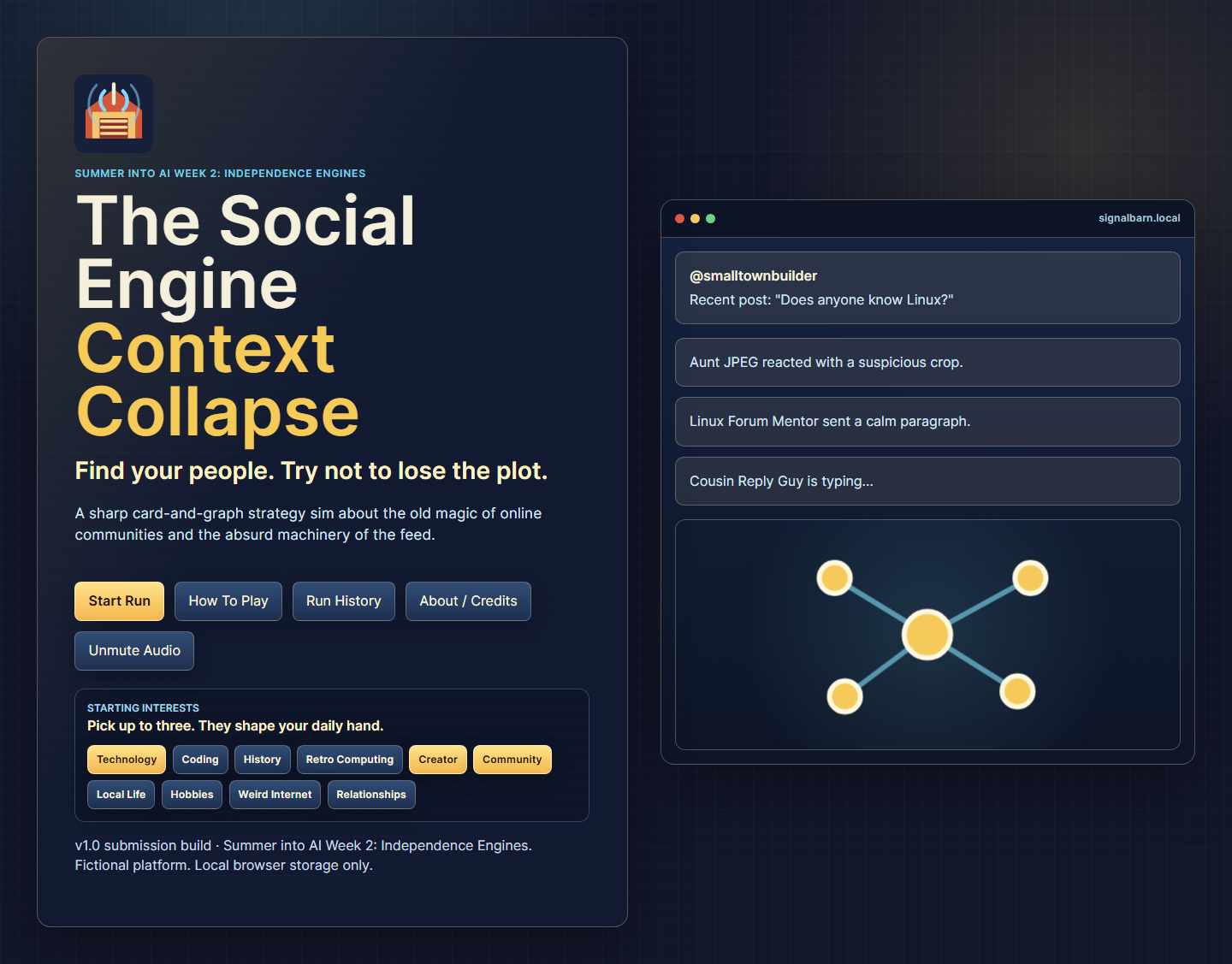
The dashboard tracks more than reach. It also follows Trust, Agency, Belonging, Drama, Burnout, Algorithm Heat, Reality Drift, and Skill Cred.
That distinction matters because raw attention is not automatically useful.
In many games, followers are coins wearing profile pictures. In The Social Engine, they come in different varieties. Close friends, niche members, opportunity contacts, casual followers, drama followers, and reality relatives do not contribute equally to your life.
A thousand people waiting for you to produce a villain are not the same as a dozen people who would help you organize an event.
The game’s social graph also tracks recurring people instead of treating relationships as a single popularity bar. Old Friend Nate, Coworker Maya, Local Admin Carol, Aunt JPEG, Cousin Reply Guy, and the Linux Forum Mentor can each become steadier, more strained, or quietly absent.
One of the harsher events contains no public fight at all. A quiet friend simply leaves the thread.
That can matter more than going viral.
The real opponent is audience collision
Context collapse is not just one failure screen. It is the central pressure running underneath the entire game.
You post something intended for one group, but it escapes.
A joke for friends reaches your coworkers.
A careful tutorial becomes an argument about keyboard brands.
A relative treats a synthetic image as documentary evidence.
A niche community adopts your phrase, removes its original meaning, and introduces it to several thousand people who would like to know whom they should be angry at.
The feed does not understand context. It understands activity.
That creates a strange strategic tension. Reach can create real opportunities, but it also raises Algorithm Heat. High engagement can introduce useful people, but it can also invite drama followers who never read the original post. Public clarification may restore trust, or it may give the controversy a fresh meal.
Sometimes the best move is to apologize. Sometimes it is to moderate. Sometimes it is to send a private message. Sometimes the winning move is to stop arguing and go outside.
[Image: Context Collapse result screen]
I wanted the game to be funny without treating every online problem as trivial. The absurdity comes from recognition. Many of us have watched a conversation develop a spreadsheet, a faction, and an enemy before lunch.
The humor gives the player room to examine the machinery without turning the game into a lecture.
Seven ways to win
There are seven major victory paths: Community, Viral, Knowledge, Relationship, Creator, Organizer, and Escape.
They are not cosmetic labels attached to the same generic high score. Each path has its own milestones.
A Knowledge victory requires useful work, expertise, and evidence that other people actually benefited.
An Organizer victory requires real events, attendance, recurring participants, and community activity that continues beyond a single post.
A Relationship victory asks whether the people closest to you survived the month.
A Viral victory is possible, but it requires more than accumulating heat. You must convert attention into useful outcomes and recover from the pressure it creates.
The Escape path is particularly important to the theme. It is not simply “delete your account.” You need boundaries, offline time, direct contacts, reduced dependence on the platform, and eventually an explicit decision to take the community independent.
That is the version of digital independence I find most interesting.
Independence does not mean isolation. It means the platform is no longer the only bridge connecting you to other people.
Hybrid victories are also possible. You might become a Knowledge and Community builder, or an Organizer whose relationships survived the process. The game looks for the combination your choices actually earned rather than handing out a cheerful ribbon for filling every meter.
There are less triumphant endings too: Context Collapse, Feed Rot, Burnout Spiral, Reply Guy Singularity, Algorithm Dependent, Survivor, Feed Veteran, and Offline but Intact.
Some of those are failures. Some are warnings. Some are simply what remains when 30 days inside the machine do not produce a clean heroic arc.
Why this is an “Independence Engine”
I built the game for Summer into AI Week 2: Independence Engines, a friendly competition about tools and systems that create independence.
The internet is one of the greatest independence engines ever built.
It lets people escape geographic isolation, learn outside formal institutions, publish without traditional permission, find collaborators, build small communities, and turn obscure knowledge into real opportunity.
But an engine can create a new dependency while dismantling an old one.
The feed gives us access to people, then charges rent in attention. It offers reach, then makes reach feel mandatory. It helps us form communities while quietly ensuring that those communities remain dependent on its infrastructure.
That contradiction became the heart of the game.
The objective is not to reject the internet. Some of the best outcomes happen because patient strangers answer a question, regular members help a newcomer, a niche expert shares your work, or an online group successfully meets in the physical world.
The question is whether you are using the engine, or whether the engine has started using you.
AI was in the workshop, not behind the curtain
This is an AI competition project, but there is no runtime language model inside the game.
The Social Engine is a static TypeScript browser application. It has no backend, no login, no analytics, no tracking, and no network-dependent game logic. Finished runs are stored locally in the browser.
ChatGPT helped with design support, analysis, and review prompts. Codex helped with implementation and integration. AI was part of the workshop crew, but the finished game does not quietly send your choices to a model and wait for improvised results.
Every card, event, relationship, milestone, ending, and absurd relative is scripted into the game.
I liked that boundary. It made the project an experiment in building with AI rather than disguising an API call as the entire product.
A guest signal from across the competition
The game also includes a small, credited crossover with Myles’s Founding Father A.I. project.
A scripted guest called Qwen Franklin can appear during certain runs and invite the player into the Founders & Future Society. It is an affectionate reference to another project in the competition, complete with original dialogue and artwork rather than copied code or assets.
Naturally, the arrival of a synthetic historical guest creates a new opportunity for Aunt JPEG to misunderstand what she is looking at.
This felt appropriate. Friendly competitions are more interesting when projects acknowledge one another instead of behaving like sealed lunar colonies.
Balancing a machine that rewards the wrong things
The difficult part was not creating a button that made Reach increase.
The difficult part was making sure Reach did not become the only rational answer.
A game about social media becomes very boring if the winning strategy is simply “post the loudest thing every day.” It also becomes dishonest if repairing relationships, sharing useful knowledge, organizing people, or building an exit route are treated as decorative side quests.
The final version uses explicit milestones, targeted meter decay, action fatigue, relationship state, differentiated followers, and path-specific requirements. Repeating the same successful action eventually produces diminishing returns. Harmful pressure does not become magically safer just because a meter is already high.
I also ran thousands of simulated strategies and browser tests to pressure-test the paths. Knowledge-focused play needed to feel meaningfully different from community building. An organizer needed to be able to win through events and recurring participation. Skilled viral play needed a route to victory, while reckless heat-chasing needed to remain dangerous.
The build passed its production compile, audit, regression suite, balance matrix, package verification, and browser playtests. That does not mean every run is mathematically serene. It means the chaos is now mostly coming from SignalBarn rather than the source code.
What I hope happens after a run
The score is useful, especially for a competition among friends. But the part I care about most is the story players tell afterward.
Did you find a useful community and then accidentally introduce it to Cousin Reply Guy?
Did you become a respected creator while every close relationship quietly turned red?
Did you chase virality, recover, and turn the attention into something durable?
Did your local group begin answering questions without you?
Did you reach Day 30 with a smaller audience, intact relationships, and a way to contact everyone outside the platform?
Did Aunt JPEG win?
A good strategy game produces decisions. A good social simulation produces arguments about what those decisions meant.
The Social Engine: Context Collapse is my attempt to do both.
Find your people.
Try not to lose the plot.
Play the game: The Social Engine: Context Collapse
View the source: GitHub repository
Built for Summer into AI Week 2: Independence Engines.
Original source
Canonical Substack URL: https://safetylast.substack.com/p/the-internet-gave-us-independence.