TiltLab · Machine 04 · On the floor
Margin Aces
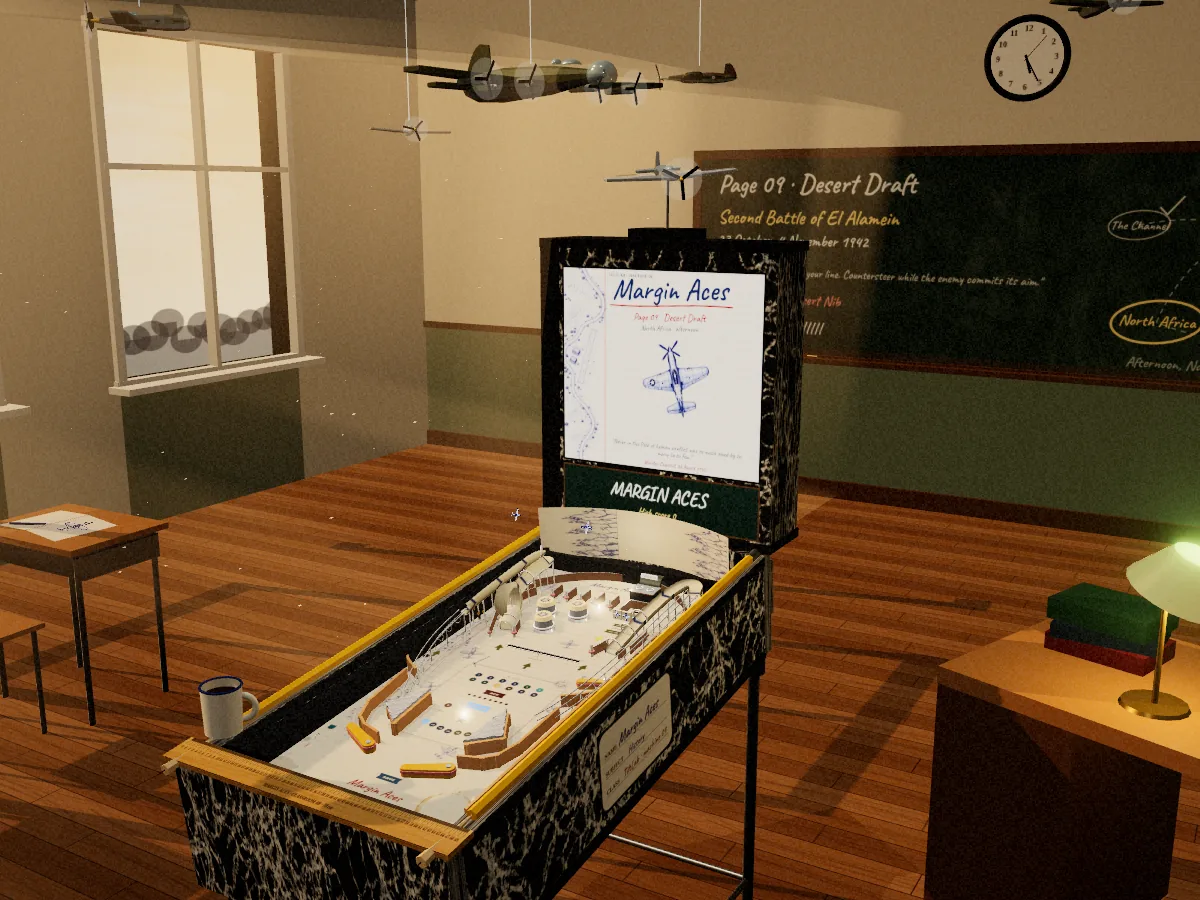
The notebook shooter, rebuilt as a pinball machine that stands at the front of a classroom after the bell. Twelve pages and twelve aces. Every attack is drawn in red ink before it fires. The model kits you earn hang from the ceiling, and the game's own history opens a page at a time.
The idea
Can a pinball machine carry a game's history without stopping the game?
The game it comes from is Margin Aces, a shooter drawn in blue ballpoint across twelve pages of a school notebook. Each page has an ace. Each page also sits beside a real campaign, from the Battle of Britain to the Po Valley, and the game keeps a whole encyclopedia of the aircraft, the places, the people and the words that were said.
That history is the deep part of the game, and a pinball table is a fast thing. So the history lives where a player's eyes already go. The chalkboard behind the cabinet names the real campaign and its date. The backglass carries the page's quotation. When an ace goes down, a scrap of ruled paper slides in with a short margin note on what really happened. The full archive waits on the title screen.
Nothing on the table was drawn from scratch. The aircraft, the coastlines, the ink bursts and the coffee stains are the game's own art. The music is the game's soundtrack, and most of the sounds are the game's own. The archive is not a copy: the machine reads the game's encyclopedia straight from the game's folder.
On the playfield
Every part, and what it does.
| Part | From the game | What it does | Points |
|---|---|---|---|
| The page | The notebook | The playfield is a sheet of college-ruled paper with the theatre's coastline down both edges. The machine writes on it while you play: the page number, the page's lesson in red pencil, a tick for every target, tally marks for every hit on the ace, rubber stamps for the big moments, and a pen trail behind the ball. | – |
| The ace | The page ace | A model of the ace's aircraft on a motorised track across the middle of the table. It sweeps, stops to wind up an attack, fires, and then slows down for a moment. Hit it then and the hit counts double. | 60,000 a hit · 300,000 down |
| Red ink | Every telegraph | Each attack is drawn on the page first: a line from the ace, a ring for a flak burst, three short strokes for a rifle volley, a line across for a tank. When it fires, a ball on the line is shoved off it. A ball just missed is a graze. | graze 2,500 |
| The hangar | The hangar | The scoop at the top right, under a little Quonset hut. It holds the two-ball lock, drops your bomb, pays the super jackpot and starts the victory sketch. | 7,500 · lock 30,000 |
| Immelmann | A loop the loop | The left ramp: a paper speed tunnel, one full vertical loop, then a climb to the back and a steel wire home. | 20,000 |
| The Runway | – | The right ramp. When the lock is lit, a diverter at the top drops the ball into the hangar. | 12,000 |
| The Margin | The page margin | The left orbit, with a propeller for a spinner. All the way round, off the gate and down the right wall is a wall run onto the third flipper. | 6,000 · wall run 8,000 |
| The formation | The page's patrol | Three drop targets carrying the page's own patrol aircraft, drawn in ballpoint. Down all three to claim a target and light the lock. From page 3 they rise again as the ace's escort. | 3,000 · all 15,000 |
| A-C-E-S | Pickups | Four top lanes. The flippers move the lit lanes. All four raise the bonus and load a bomb or a repair. | 2,500 · all 15,000 |
| Flak bumpers | Ink bursts | Three pop bumpers, drums shaded in ballpoint with an ink burst on the cap. | 1,000 |
| The map board | Surface units | Behind the top wall: the theatre's coastline, the page's flak, battleships, tanks or rifle squads, and patrols crossing. The targets you are hunting are ringed in red; the ones you claim are crossed out. | – |
| Flippers, slingshots, plunger | – | Chrome Orbit's lower playfield, unchanged for a fourth table. The flippers are yellow pencils with pink eraser rubbers. Plunge into the flashing lane for a skill shot. | skill shot 30,000 |
The rules
Claim the patrol. Read the red. Turn the page.
- Pages. Each page lights two patrol targets in highlighter yellow among the hangar, the ramps, the Margin, the wall run and a shot up the middle. Claim two or three of them, or down the whole formation, and the page's ace comes in.
- The ace. It flies the track across the middle of the table and takes two to five hits. Its attacks come from the game: an aimed burst, a fan, and on the chapter pages a wide barrage. Halfway down it changes its pattern. Hit it while it winds up and the attack never fires.
- The surface. While the patrol is up, the page's flak, battleships, tanks and rifle squads fire on the table too, each drawn in red first.
- Kill chain. Kills close together multiply each other, up to x8, as in the game. Getting hit by the ink breaks the chain.
- Veterans and escorts. From page 3 some targets are drawn in red ink and take two hits. The formation rises as the ace's escort; down all three and the next hit on the ace is double.
- Bombs and repairs. A-C-E-S loads a bomb (shoot the hangar: two hits on the ace, or a target claimed) or a repair (both kickbacks for twenty seconds). Ten grazes is a repair too.
- Squadron Multiball. Two balls in the hangar start it. Jackpots on the ramps, the Margin, the wall run and up the middle; three light the super jackpot in the hangar.
- The victory sketch. Turn the twelfth page and shoot the hangar: four balls, every shot a jackpot, three hangar shots to draw the sketch home. Then the notebook opens again, and every ace takes one more hit.
- The classroom. Some pages carry a crosswind across the table, as the game's pages do. Nudge too hard and the teacher's coffee goes over: the page is sticky for a while. A clean page, with no drains and no ink, is worth 250,000.
Things to unlock
The shelf, the ceiling and the archive.
Everything here is saved on your device.
The hangar · twelve model kits
- P-51D Mustang, Spitfire, P-47 Thunderbolt: in the hangar from the start. The Mustang starts each ball with the lock lit; the Spitfire's kill chain lasts longer; the Thunderbolt starts with a repair.
- The other nine are earned by downing the ace drawn as that aircraft: the Bf 109 (one hit fewer on every ace), the Fw 190 (three targets lit), the B-17 (a fifteen-second ball save), the Zero (harder flippers, a shorter save), the P-38 (ramps count double), the Corsair (bumpers that claim targets), the B-25 (a strafing spinner), the Stuka (double hits, faster attacks) and the Lancaster (a bomb on every ball).
- Each kit you earn is hung from the classroom ceiling on a thread, and the one you fly stands on top of the backbox.
The archive and the pages
- Fifty-one entries from the game's own encyclopedia: twelve aircraft, twelve places and campaigns, the opponents, the twelve aces, four quotations and four learning notes, each with its sources. Reaching a page, downing its ace and building a kit each open more.
- Start at any theatre you have reached: the Channel, the Pacific, North Africa or the Alps.
- Your best score on this machine.
The room
Classroom 4B, after the bell.
Folded Thunder's room changed when the world changed. This one keeps time. The day outside the windows follows the notebook: morning over the Channel, noon in the Pacific, a golden afternoon in North Africa, and dusk in the Alps, when the ceiling lights and the teacher's lamp come on. Dust turns in the sunbeams, the clock on the wall keeps your own time, and paper aeroplanes cross the room when the class has something to cheer.
At the front
- The chalkboard: the page, its real campaign and date, its lesson, today's ace, your tally of aces, and a chalk map of the four theatres with the current one circled.
- The pull-down map: the theatre's coastline, both shores.
- The teacher's desk: a lamp, a globe, a stack of books and a valve radio with its dial lit. On the title screen the music is the game's own pocket-radio loop.
Round the cabinet
- The cabinet is a composition notebook: marbled board, black tape, a label with your name on it, pencils for side rails and a ruler for the lockdown bar, on chrome desk legs.
- The desks each hold an open notebook with an aircraft drawn on it; the corkboard has the drawings pinned up.
- The ceiling holds the model kits you have earned.
Under the glass
What makes it run.
- Physics
- The shared TiltLab table rig: Rapier 0.21 at 120 steps a second. New for this machine: movers (a kinematic target that slides across the solver substeps so it pushes the ball as a motor would), blasts that shove a ball off a line and report near misses, drag zones, a one-way shooter gate built on Rapier's contact hooks, a sideways lean for crosswinds, and a gentle shake for a ball that has come to rest somewhere it should not.
- The ink
- Telegraphs are strokes that draw themselves along the page, then burst with the game's own ink-effect frames. The pen trails are ribbons behind each ball. Everything that stays on the page is drawn into a canvas over the playfield, and when the page turns, it curls away from the right under the glass.
- The model kits
- Every aircraft is built in code from a few numbers: span, length, engines, nose, tail, wing shape and livery. A turned fuselage, wings cut to the planform, propellers that blur as they spin, and national markings as decals.
- Playfield
- One layout file holds every wall, post and switch. The lower playfield is Chrome Orbit's; the upper table is Folded Thunder's, with the ace's track where the captive ball stood. Each theatre has its own baked page.
- Testing
- A headless bot plays whole games in Node to catch stuck balls and dead ends, and a script drives the whole notebook, all twelve aces and the victory sketch, through the rules.
- Sound
- The shared kit for the parts, the game's own effects on top, classroom sounds written in the browser (the bell, pencil, chalk, rubber stamps), and the game's four music loops, decoded and looped on their bar lines. The lamps keep time with the music's own 140 beats a minute.
- Controls
- A / ← and D / → (or Shift) for the flippers (the right one works both right flippers), Space to plunge, Z and / to nudge, Esc to pause. A gamepad works. On a phone, use the three pads at the bottom of the screen.
- Loading
- The first theatre and the table, about 7 MB, arrive before the first ball, then every shader is compiled. The other theatres' pages load in the background, and the history is read from the game's own folder.
In the lineage
Machine 04, after Folded Thunder.
Margin Aces starts from Folded Thunder: its upper table, its third flipper and loop ramp, and the idea that the room belongs to the game. From Midnight Ride it keeps the lock, multiball and the unlocks that persist. From Chrome Orbit it keeps the lower playfield, the sound kit and the start-up loader, which now also racks fonts.
The shared table rig grew again, so that something on the table can move and fight. Building it also found a gap in Folded Thunder: a ball that came all the way round the orbit could never reach its wall run. Both machines now have the guide that makes it.
Its new idea is depth. The game has a history behind it, and the machine lets you meet it a page at a time, between balls.
Play Margin Aces · Back to TiltLab · The original: Margin Aces in the GameLab.