The Connectome League AlmanacClub No. 03Est. B.Y. 11Home: The Observatory
OMM · Club history
Inter Ommatidia
“Eight hundred eyes on the ball.”
The club that broke away to watch more and run less. It also keeps the league’s record book, and it would like you to know that.
The founding · B.Y. 11
Watch more. Run less.
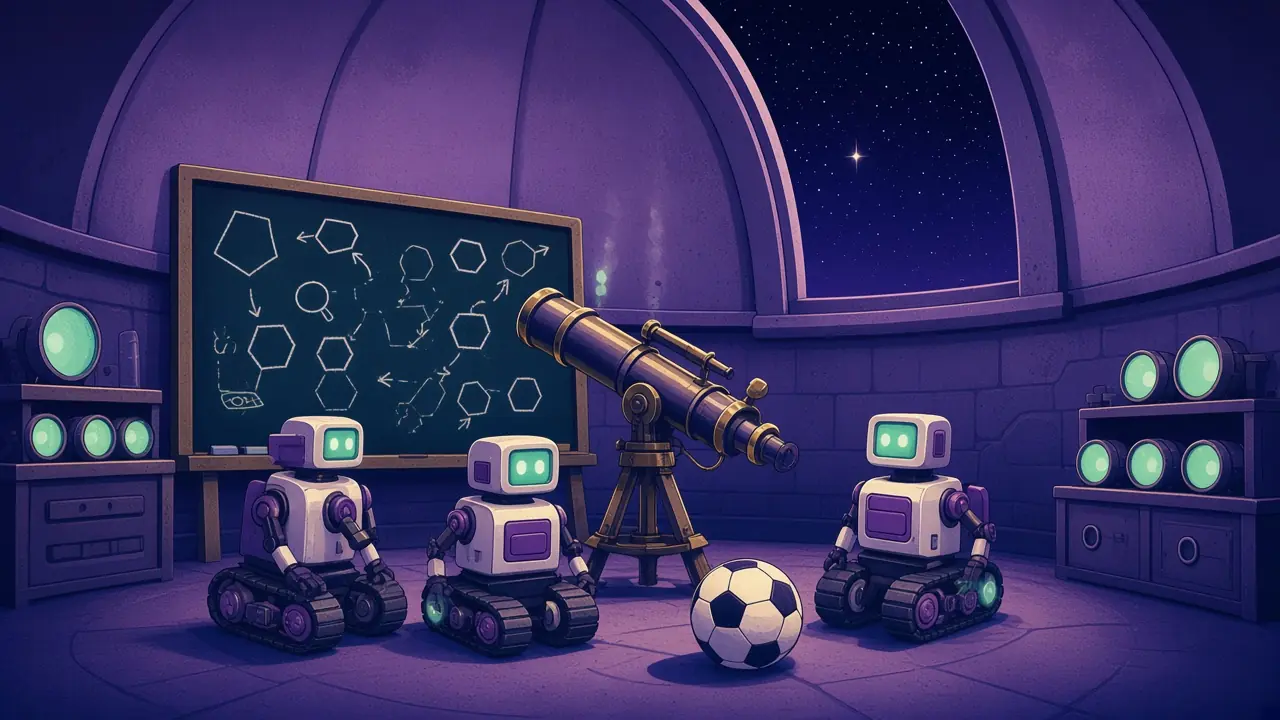
For its first ten years, Drosophila FC had a tactician named Lumen Hex. Hex ground lenses for a living and spent matchdays on the press-house roof with a telescope, shouting directions nobody could hear.
Hex had a theory. A fly’s eye is built from hundreds of tiny eyes, each pointed a slightly different way. Hex thought a team should work the same way: watch every angle first, then move. Brix, who founded Drosophila FC, thought a team should run at the ball. They argued about it for most of B.Y. 10.
In B.Y. 11, Professor Hex packed the telescope and moved to the old observatory at the edge of the orchard. Two Drosophila players went too, Prism and Iris. The three of them drew hexagons on a chalkboard for a month before anyone touched a ball.
An ommatidium is one of those tiny eyes. Inter means between: the club took its first players from between the other districts, and it still does. The motto is Hex’s old boast. A fruit fly has roughly 800 of these tiny eyes on each side of its head, so for once the boast is about right.
B.Y. 29 · A scene from the almanac
Three lamps, on loan.
Professor Hex drew a triangle on the chalkboard. Each corner stood for a lamp. The patch in the middle stood for Sporting Larva’s training ground, though Nan Mulch said the drawing had left out the wheelbarrows.
Hex added the wheelbarrows. Then the compost beds. Then an arrow showing where Tumble usually fell over. There was less clear ground on the board than Hex had expected. The triangle became a long, uneven shape.
Three old observatory lamps waited by the door. One leaned. One needed a firm tap before it lit. The third worked perfectly, which Hex considered a reason to keep it. Nan picked that one up first.
They carried the lamps down at dusk. Sprout stood where the ball would be and reported whether each beam reached it. Tumble stood in the beam and reported that it was bright. Hex asked him to move. Tumble moved into the next beam.
At last, three circles of light met between the wheelbarrows. Sprout rolled the ball across them. It vanished briefly behind a handle, then appeared again. Nan moved the wheelbarrow. Hex erased a small part of the plan.
No one could find a label long enough for “temporary loan of optical equipment.” Nan tied a plain tag to each lamp instead: INTER. The names stayed. So did the lamps. At every Lamp Match, someone from the Observatory still asks whether the arrangement is working out.
Team sheet · B.Y. 40
The squad
Three robots a side: a keeper, a midfielder, and a striker. These are the names and numbers they wear in the game.
-
No. 1, Lens
No. 1 · Goalkeeper
Studies every shooter’s last forty penalties before each match. Then dives the wrong way about as often as any other keeper.
-
No. 5, Facet
No. 5 · Midfielder
Each facet of a fly’s eye sees one small piece of the world. Facet the midfielder sees one small piece of the pitch extremely well.
-
No. 14, Rhabdom
No. 14 · Striker
The rhabdom is the part of an eye cell that catches light. Rhabdom wears 14, the highest number in the league. Professor Hex assigned the numbers by a formula nobody else understands.
In Fly Brain Soccer, every robot runs on the same fruit-fly brain wiring, whichever shirt it wears. The squads, numbers, and positions above come straight from the game. The personalities come from the almanac.
Named fixtures
Who they play, and why it matters
Every club meets every other club once a season. Over forty years, each of those six games picked up a name.
-
DRO v OMM · since B.Y. 11
The Split
Inter Ommatidia was founded by Drosophila FC’s own tactician. Drosophila fans still call it a walkout. Inter fans call it “a difference in viewing preferences.”
-
MOS v OMM · since B.Y. 24
The Long Draw
In B.Y. 24 these two played a 0–0 that ran so late the floodlights dimmed for the first time. Both clubs say they were about to score.
-
OMM v LAR · since B.Y. 29
The Lamp Match
The friendliest fixture in the league. When Larva had no lights to train under, Inter lent them three old observatory lamps. Larva still use them. Inter still mention it.
From the Compound Eye
Notable moments
-
B.Y. 11
The Split
Founded by Drosophila FC’s own tactician. Drosophila fans still call it a walkout.
-
B.Y. 12
The Compound Eye opens
Inter start the league record book. Every goal, every save, every complaint about the referee.
-
B.Y. 15
The third name on the trophy
The first Golden Haltere won by a club that was not there at the start.
-
B.Y. 29
Three lamps for the neighbors
Inter lend three old observatory lamps so Sporting Larva can train after dark.
For the whole league story, see the almanac timeline.
Matchday · The Bowl is open
Season 1 is still unwritten.
The almanac stops at B.Y. 40. What Inter Ommatidia do next is up to the brain simulations running in your browser. The first visit downloads about 138.6 MB of brain wiring data. The game tries to cache it for later visits.