- You are
- A repair robot with a hauler truck
- The loop
- Diagnose, haul, tension, repair, watch it travel
- Home
- Your browser, no install
What it is.
FIELDWORK is a playable prototype about one idea: the world is made of things that work, and you make them work again. There is no crafting grid and no combat. You inspect, haul, lift, tie, tighten and oil. The island is a single dense basin of abandoned farm and industrial plant, and every system in it is simulated rather than scripted.
The first repair.
The windmill that drives the pump has lost its sail. A membrane is waiting in a crate at the depot. Drive the truck there, load the crate by dragging it onto the bed, and haul it through the mud to the mill. Unload it, pry the lid, unroll the cloth, and drag each corner to its eyelet. Then tension the four straps: too slack and the sail will not bite the wind, too tight and the membrane tears.
Hold Q in the shed to look inside the drive. A shear key is missing, one bearing is dry, a valve is shut. Fix those, release the brake, and the rotor turns. The generator feeds the bus, the pump fills the tank, the sluice opens, the canals run and the fields begin to turn green, with the farm robots waking up in the yard as the power returns.
Mud is a simulation.
Soil strength comes from moisture, using the same kind of pressure-sinkage and shear model as TruckMud. Wet ground carries less, so the truck sinks, digs ruts, throws mud and sometimes needs the winch. Tyres can only deliver the grip the soil allows, which means a heavy crate in a wet field is a real decision. Low range, the diff lock and a cable to an anchor are your answers, and none of them is a menu.
The sail is cloth.
The membrane is a mass-and-spring sheet from the Textile Alchemy work. Wind loads it, your hands drag its corners, and its tension decides how much torque the rotor gets. The tension that works best is just under the point where it tears.
The Works.
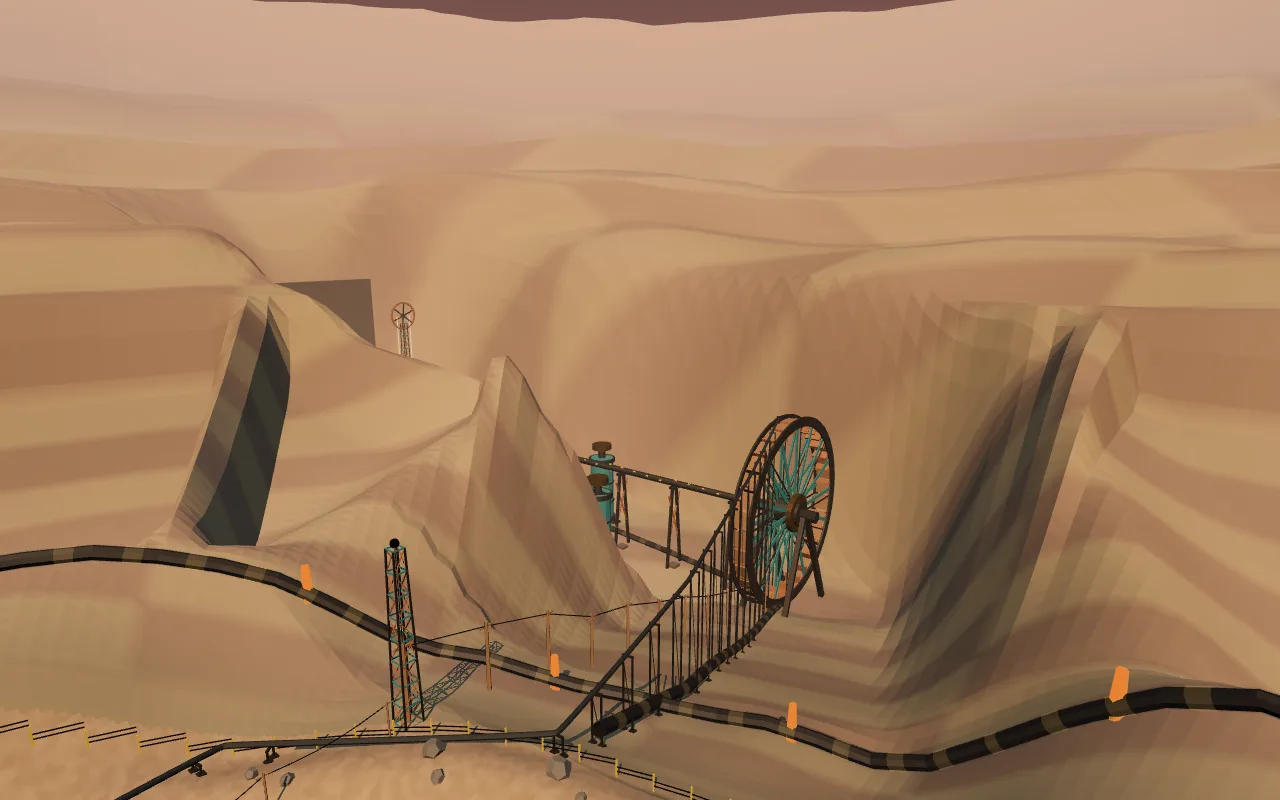
Overflow from the header tank runs down a penstock to a great wheel in a canyon called the Cut. Turn that wheel and a chain of machinery wakes in nine stages, each driven by the one before: a gear wall with a planetary set, a flywheel and belt, a bank of cams, a latch, a steel ball rolling down a helix, a counterweight, six pistons, pressure mains, then the ground itself. Eighteen petals fold open around the basin, concentric rings rise and swirl, and three nested gimbal rings spin up in the sky.
It is the same idea as Apostate Engine III, bigger and stretched into a pipeline. Press V to fly a survey drone out to six vantage points, and press . to fast-forward the Works if you do not want to wait for it.
How it is built.
Read the original FIELDWORK article, published October 8, 2026.
Everything is Three.js with flat-shaded low poly and no build step. The gears, pistons, cams, tanks and trusses were modelled in Blender from one script and exported as a single GLB. Gear meshing is exact: tooth counts and phases are computed, so a planetary set with a 24-tooth sun, three 36-tooth planets and a 96-tooth ring runs at the right ratio. Audio is synthesised from the simulation state, and progress saves in your browser.
Read the build notes or the changelog.
Controls at a glance
| Action | Control |
|---|---|
| Move robot | W A S D |
| Work an object | Click and drag within reach |
| See inside machines | Hold Q |
| Truck | F get in or out, W S A D drive, Space handbrake, G range, X diff lock |
| Winch | E attach or release, hold R to reel |
| Strap the load | Y |
| Survey drone | V, then 1 to 6 for vantage points |
| Fast-forward the Works | Hold the period key |
| Help, pause, mute | H, P, M |
Where the pieces came from
TruckMud gave it weight and a soil that argues back. Textile Alchemy made cloth something to touch. Apostate Engine III showed that a machine can be the world. The robot comes from IslandLab.
The pump is dead. The fields are dust.
Start with the truck and the crate in the east.