- Pages
- Twelve, from the Channel to the Alps
- Every attack
- Draws a red warning first
- Made of
- Ballpoint, red pencil and coffee
Two minutes on the back page
A dogfight in the back of a notebook
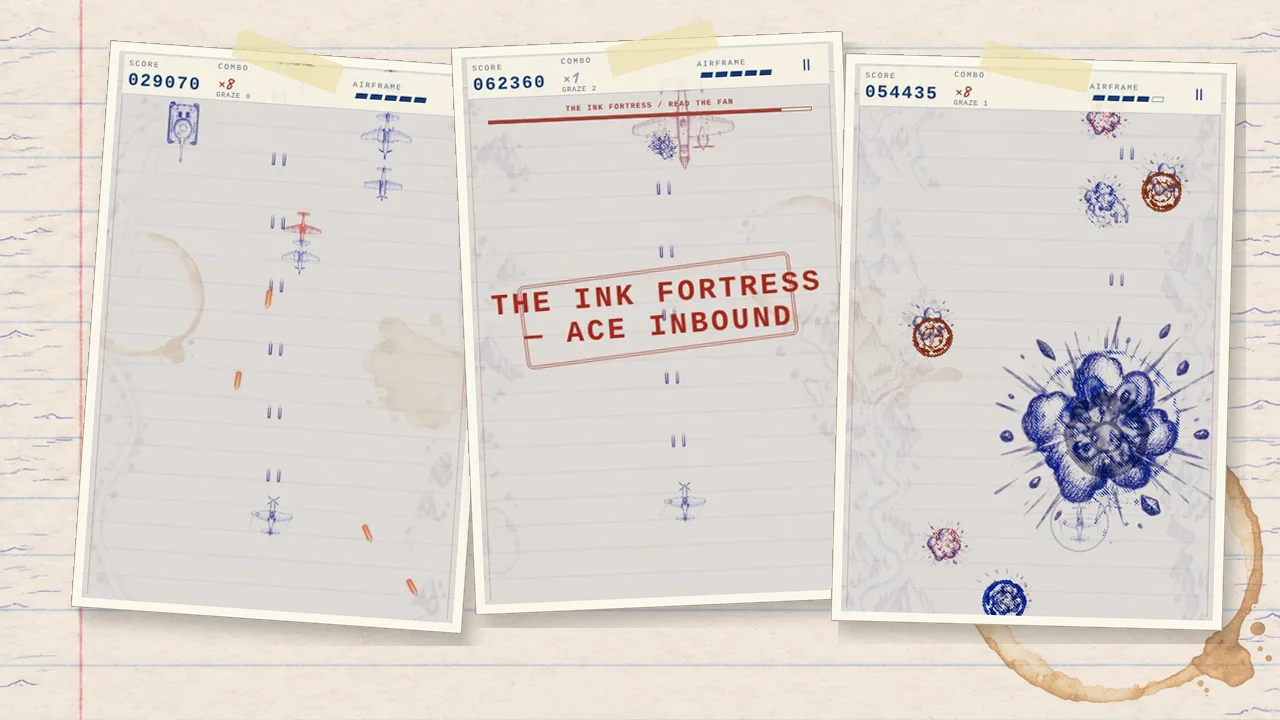
Margin Aces is the game you drew during class, if the drawing fought back. Every plane, ship and tank is a blue ballpoint sketch. The sea and mountains scroll past as faint map lines. A coffee ring sometimes spreads across the page while you fly.
You pick one of twelve WWII aircraft and fly twelve pages. Each page sends patrols, then a page ace with a name like The Red Underline or The Ink Fortress. Between shots, the margins tell you about the real battle the page is set in, with sources.
The rules are simple. Every enemy attack draws a red windup before it fires. Move off the line and return fire. When the sky gets crowded, spend an ink bomb.
The page from the back of the notebook
This polish pass started as a list on actual notebook paper. Here it is, more or less as written. The red pen is the second pass.
Margin Aces — polish pass pg. 1 of 1 (hopefully)
Problem: page 1 and page 12 were the SAME page.
3 planes a wave, every wave, forever. test pilot basically never got hit.
- formations:
3 planes3 → 5 planes, 6 on "heavy" waves - waves come faster:
every 5 sec5.0 → 3.9 sec - enemies re-arm faster too (cooldowns × 0.72 by pg 12)
- veterans! drawn in RED PEN. ~2× the ink to knock down
- the ace calls escorts every 11 sec → 6 sec
- ace goes down = escorts go down. (big boom. very fair.)
- graze = let a shot pass close. +25 each. brave or dumb?
- combo actually means combo now. get hit → back to ×1
- no hits all page = CLEAN PAGE +2500
still fair? the attack budget decides who's allowed to shoot,
so more planes = more targets, not a wall of bullets. ✓ checked
ink FX: borrow the Prism Forge spells, glowy draw them in pen
→ hatch them like a bored kid would. yes. exactly that.
Explosions you could draw with a pen
The old effects were a single strip of three ink blots: a star, a puff and a smoke ring. Every hit, kill and bomb used the same three frames at different sizes. The pass replaced that with ten animated effects.
They come from Prism Forge, a pack of glowing spell effects built for dark fantasy screens. Glow doesn't work on paper, so each effect was re-filmed from straight above and stored as a mask: where the ink goes, and where the hot center is. The game then draws the mask as ballpoint cross-hatching. The hatch lines are measured in screen pixels, so a gun hit and a full-page bomb are shaded with the same pen.
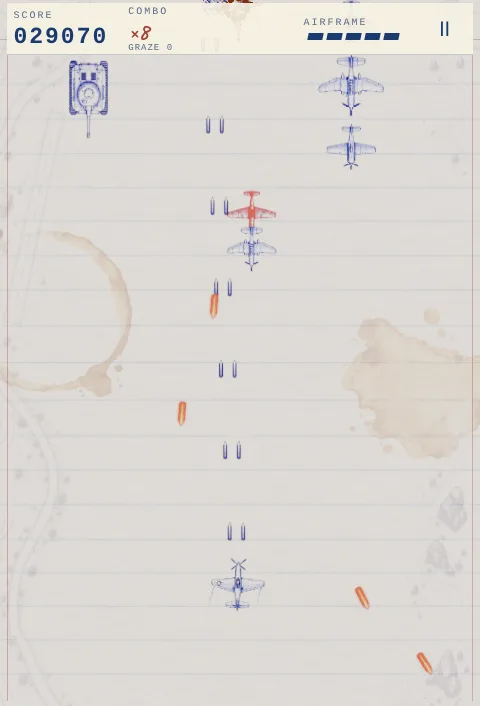
Page 9: a red-pen veteran in a five-plane formation. 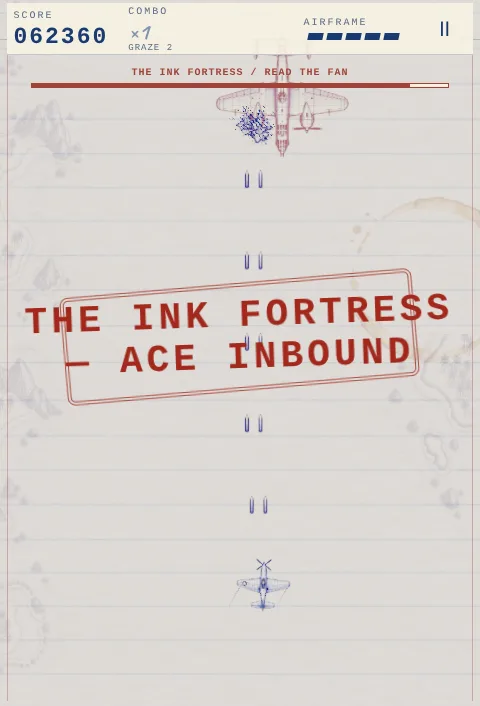
The ace arrives with a rubber stamp and a siren. 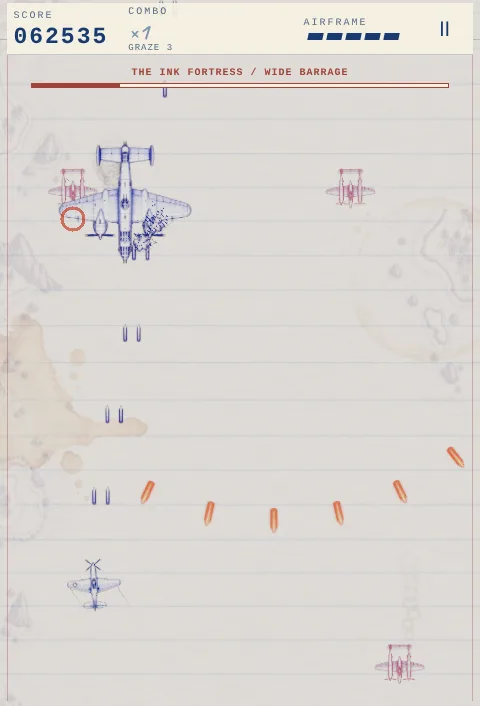
Escorts fly in red pencil beside the ace. 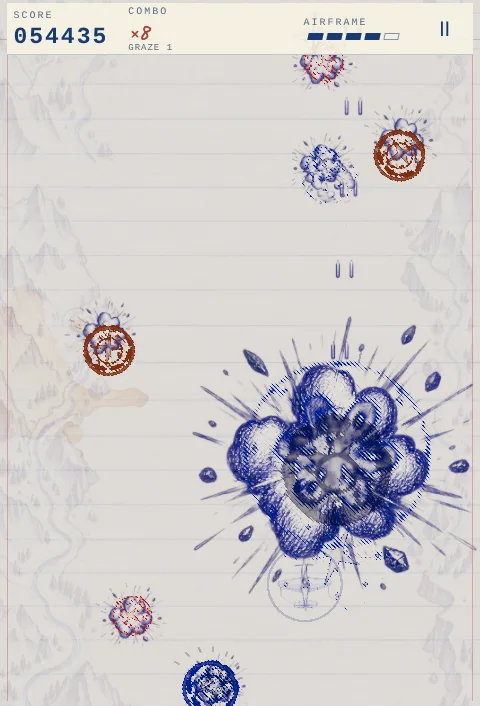
An ink bomb: six petals, a shockwave and a lot of hatching.
- Gun hits a four-point star, sometimes with a few flicked pen strokes. The plane you hit flashes highlighter yellow.
- Fighters shatter into splinters and a scribble of pencil smoke.
- Bombers and ships get a full detonation, sepia for anything on the ground.
- Wounded planes trail graphite smoke. Under a quarter health it turns dark.
- Flak marks land with a forked strike where the red circle was.
- Your plane leaves two thin contrails, and a red shield flare when it's hit.
- Pickups bloom in green or yellow highlighter.
- The page shakes on big hits, and the margin rules pulse red on your last airframe.
Score notes rise off the page in handwriting: +300, combo ×4, last airframe!. Reduced effects in Settings turns the extra ink off. Reduced motion keeps the ink but stops the shaking.
A harder notebook, one page at a time
Before this pass, every page sent the same three-plane formations every five seconds. A test pilot bot flew all twelve pages with all twelve aircraft and almost never got hit: about once in every twenty flights on the worst page. That bot is very good, but it shouldn't be bored.
Now one difficulty curve runs through the whole notebook. Pages 1 and 2 stay gentle so new pilots can learn the red windup. After that, each page adds a little.
| Page | Planes per formation | Targets | Attack budget | Escorts | Veterans |
|---|---|---|---|---|---|
| 1 · Channel Sweep | 3 | 36 | 4 | none | none |
| 4 · Ace of Spades | 4 | 45 | 6 | every 10 s | 1 in 6 |
| 8 · Fortress in Ink | 4–5 | 55 | 6 | every 8 s | 1 in 4 |
| 12 · The Last Margin | 5–6 | 73 | 8 | every 6 s | 1 in 3 |
The attack budget is the important part. Each attacker costs points to fire: a fighter's aimed shot costs 1, a battleship's broadside costs 3. If a new attack would go over budget, it waits. So page 12 can have twenty planes on screen and still never fire more than the budget allows at once. Busy to shoot at, still readable to dodge.
After the change, the pilot bot still clears all 288 test flights (12 pages × 12 aircraft × 2 strategies). But now the later pages land hits on it, more often the deeper it goes. All 190 encounter checks in the game's test contract still pass.
How to play
- Move with WASD, the arrow keys or the on-screen stick. Fire with Space or FIRE. Auto-fire is in Settings.
- Watch for red. A ring means a plane is winding up. A red line means a gun on the ground has aimed. A red circle on the ground means flak is coming down there.
- Leave the line, then shoot back while the attacker recovers.
- Let shots pass close for graze points, and keep killing to build your combo. Getting hit resets it.
- Press X or BOMB to clear every enemy shot on the page. Save one for the ace's second phase.
How it sounds
Margin Aces already had engine beds, sea and wind, pen clicks and page turns. The pass took the moments that were still synth beeps and gave them real recordings from the sound library, trimmed short and mixed quiet.
There's music now, too. One 90-second ElevenLabs score at 140 beats per minute is cut on the bar lines into three flight loops. Odd pages fly to one order, even pages to a re-shuffled order, and the ace fight gets the climax. In the hangar and menus, a PowerPillGo instrumental plays through a crackly pocket-radio filter, as if someone left it on in the classroom. Music has its own switch in Settings.
The ace arrives with a wailing siren. Your airframe takes a hit with a cartoon sheet-metal wobble. Bombers and tanks go down with a debris blast, and the ace with a long demolition rumble. Grazes are a quick whoosh. Each step up the combo plays a chime a little higher than the last. On your last airframe, a low drum keeps time like a heartbeat. A snare roll and a cymbal crash finish the page, and a sad trombone says you didn't.
A loading screen you can watch
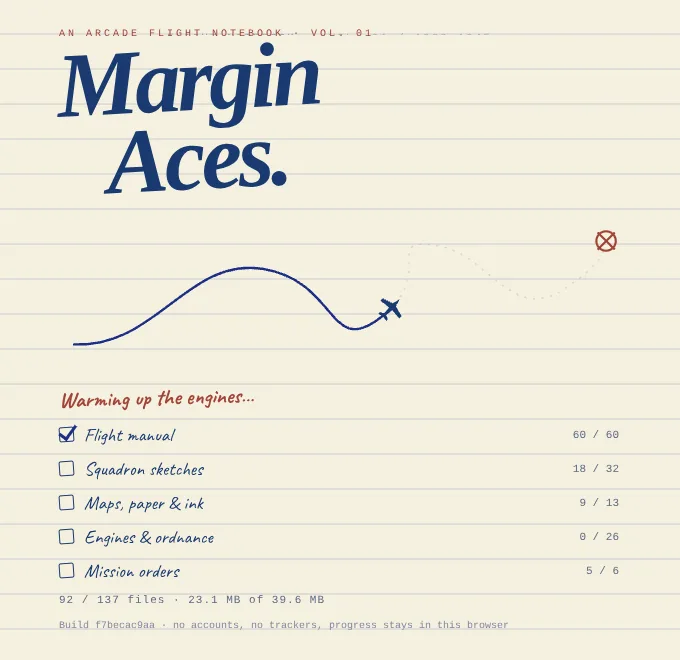
The game is about 40 MB of drawings and sounds, so the first visit takes a moment on a phone. The new loader makes that part of the notebook.
A pencil plane flies a dashed route toward home as files arrive. A checklist ticks off the flight manual, squadron sketches, maps, engines and mission orders.
Like JustDig! and Breathglass, it fetches a few files at a time, retries server hiccups, names any file that fails and offers to reset the app cache.
Build notes
The rules run as a plain simulation at 60 steps a second, with no drawing code inside. Three.js draws the result as flat sprites, and the ink effects only read what the simulation reports. Pausing, retrying and testing stay exactly repeatable.
Every module is stamped with a build code made from the contents of every file, so a phone can't mix an old cached script with a new one.
Read the design notes and the changelog.
Read the original Advisory Hour post, published October 17, 2026, with the game trailer.