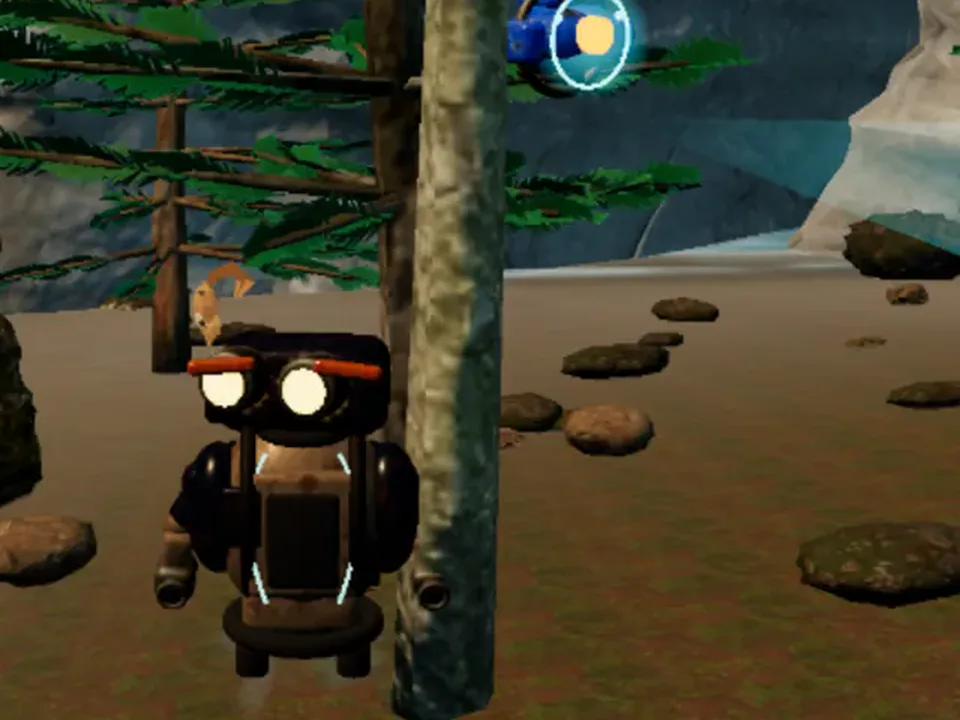
The squirrels do not give quests. They do not carry coins. They live a small loop in the background while the robot handles the storm.
That is exactly why they matter. Turn through the forest and one may be crossing the ground, another reaching a trunk, and a third sitting above the path. The island feels occupied by lives that are not waiting for the player.
How a generated tree becomes a home
The forest did not come with hand-picked squirrel trees. The code filters real tree records, chooses valid positions inside the island, and spreads the habitats across the map. Each squirrel receives a tree and a slightly different starting point in the climb cycle, so the group does not move like a tiny marching band.
The same island data makes the same choices. That predictability turns a charming background moment into something that can also be tested.
How the squirrel cycle works
The selector rejects invalid and out-of-radius tree positions. It picks an early habitat near the starting coast, then favors later trees that are far from already selected habitats. A coast penalty keeps the population away from the extreme edge.
Each squirrel stores its assigned tree, cycle timing and offset, approach angle, roam and trunk radii, climb height, scale, coat shade, and gait phase.
High, medium, and low quality use ten, seven, and four squirrels. The lower tiers keep the first deterministic habitat choices, so changing quality reduces the population without moving the whole species to a different forest.