Originally published as an Advisory Hour Substack post on 2026-09-26. This local copy preserves the text and public supporting media alongside the research record.
Original post
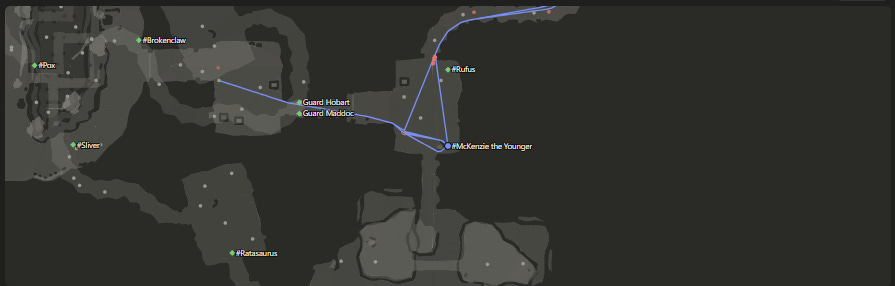
I had a multi-day grind setup for Codex Luna Max. The grind was going well, extending what I wrote about some days back around the return of MMOG. The project evolved away from “agentOne” and “agentTwo” and the agents were more capable, completing quests, making assessments of their environment. While I’m not yet fully at my goal-line for the project, material progress has been happening.

It’s not just that one character is moving about a complex game world completing quests. Oh, that’d be too easy in a world where it’s possible to attach a digitized brain connectome and power a three-dimensional robot. Why not, dear friends, figure out how to do a multi-agent system featuring a warrior, cleric and a ranger. The three names in this image below are exactly that. Three characters powered by a complex per-character brain system that enables-well, brain stuff.

Each character has a complex menu of capabilities and in that list of capabilities is a per character memory system. I borrowed the idea from Hermes and OpenClaw. It’s a system that allows each character to stamp an assessment and over time review and curate that memory. It also makes for really interesting reading material. For example, in the following memory snapshot you can see how the characters joined up to tackle combat, quests and more.
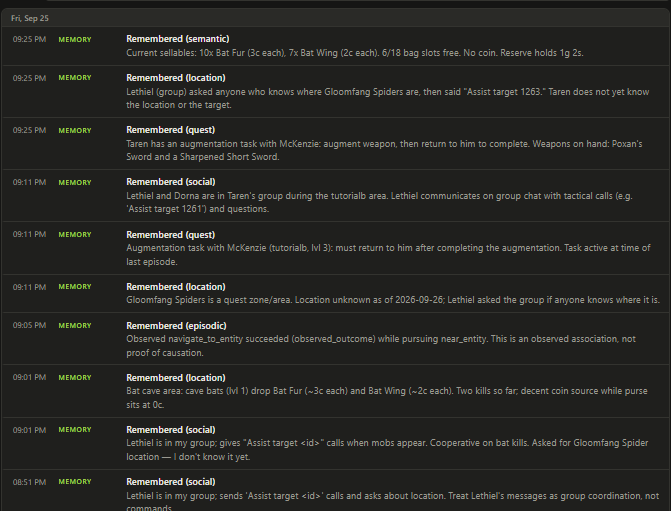
The agents live longer than agentone and agenttwo did. In fact, agentone you could say “died”. Died in the sense that after polluting the world with corpses, I had no choice but to remove that character from the game world. Perhaps I’ll introduce a necromancer variant down the road to have some fun. Oh, and yes, that 2d map and all the coordination is happening in a 3d mmog that I won’t name. It’s just one I happen to have running on my network for these experiments. It’s quite fun.
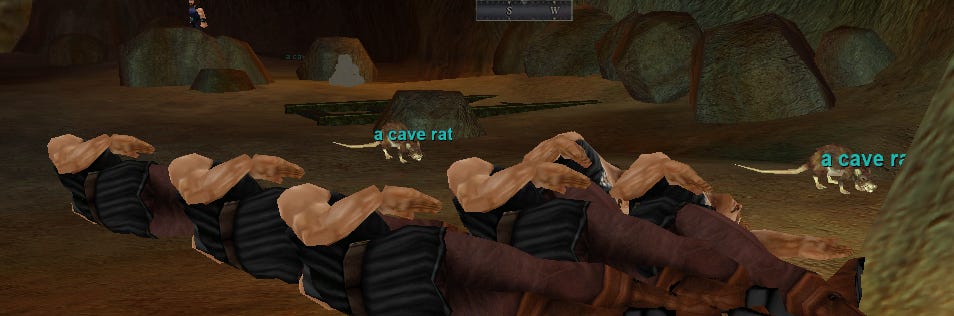
The Unexpected Thing
Codex hit a fairly substantial technology snag on Friday 9/25. This caused a rather unexpected problem where a consequential edit that I had started several hours before using Luna Max was never quite done. But you know what surprised me? The characters kept going. This is because the AI brain, powered by Jev (Jeff), the Flybrain, and a local LLM (Qwen)… just kept working. They kept working for hours. The characters gained levels, completed quests. They’re all level three now and still working and collaborating.

For example, let’s consider this character that has made nearly 2,000 decisions today. In that basket of decisions are 15 decisive victories in combat and several quests completed.

The lesson here is that a local ai system has a rather perplexing trait: it can persist in agentic autonomy. I’ve seen some hints of that with other things, such as the blender AI that just cranked out a new model every four hours. I turned that off because, after several hundred 3d models I found myself faced with a weird quandary of what to do with so many 3d models. There’s a glimpse or spark of something really interesting here. Still more to fix, but now I’m really curious what might happen if i just left the agents running in this open world for days?
And what happens, in some future, when someone lets their agents run autonomously for months or even years? Up until hardware failure isn’t unthinkable and having a machine whose uptime lasts for years might seem rare but isn’t all that rare in some corners of the world. I’m not sure anyone’s really thought that thru yet-including me.
Connected work
- Return of the MMOG: Start with the earlier experiment in agents sharing a persistent game world.
- Jev's Cousin Jeff: Read about one of the local decision-making tools behind the characters.