TiltLab · Machine 07 · On the floor
FIREHAWK
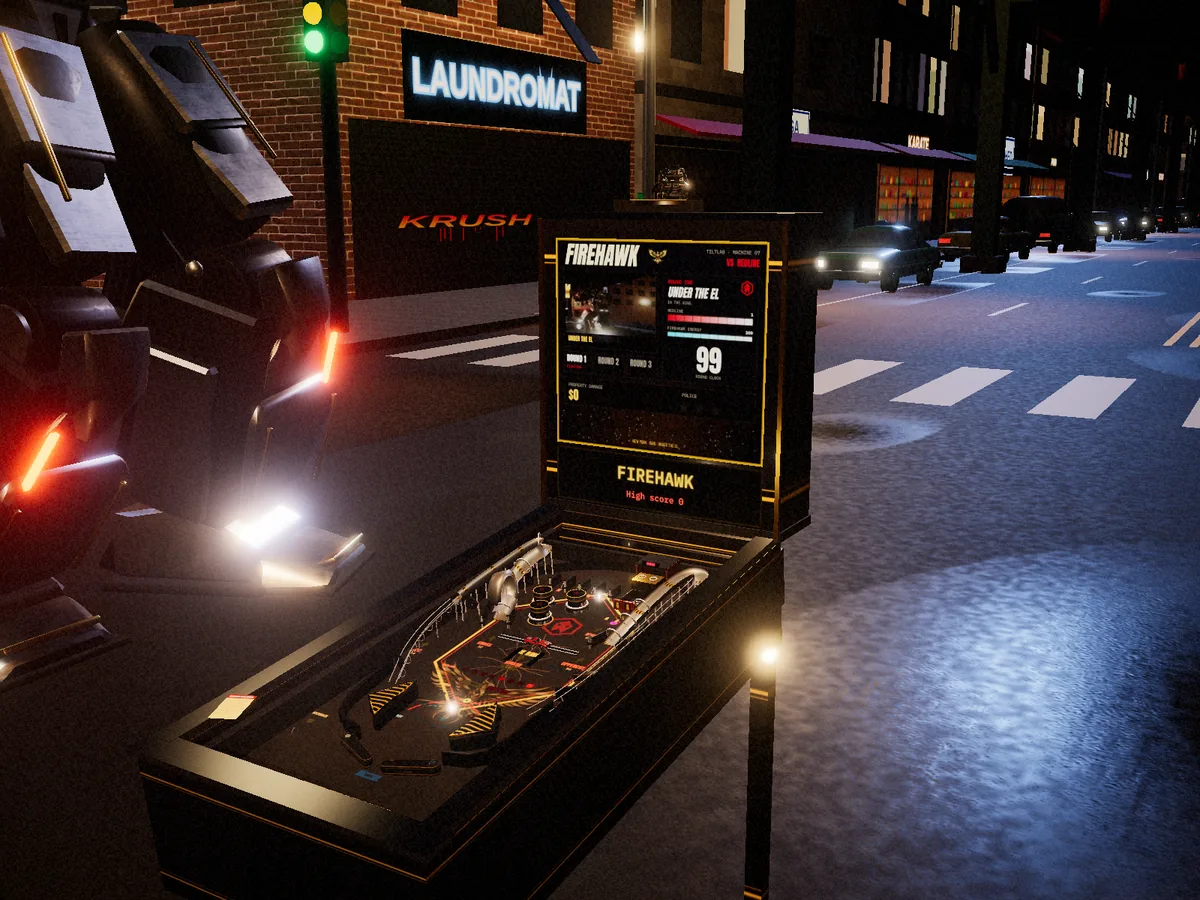
The Firehawk street fight, rebuilt as a pinball machine that changes shape while you play it. The cabinet stands in the middle of the intersection under the El in New York, 1986, in the game's own street, with both robots in it at full size. In the street, Redline crosses the table as a car. Build speed, ram it, and at 52 km/h take the jump. While the ball is in the air the table stands up into a ring, and the ball comes down in a hero landing.
The idea
Can the playfield change shape while you play it?
Firehawk in the GameLab is a street fight between two cars that are also robots. Firehawk is black and gold, with a phoenix on the hood. Redline is red. They race under the elevated line, transform at the crosswalk and fight in the street, and every hit runs up a bill for the city.
The game's best moment is the transform: a car at speed comes apart into panels, the wheels fold away and a robot lands on its feet. Pinball tables are fixed things. The parts are bolted down, and the playfield art is printed once. This table asks what happens if it is not.
So FIREHAWK has two forms, and it changes between them in front of you. In the street, it is a racing table: a speedometer, ramps that build speed and Redline's car crossing the middle to be rammed. In the ring, it is a fight: the girders of the El rise as medians, two bumpers sink into the floor, Redline stands up as a robot, and the playfield itself flips over, strip by strip, to its ring face. Every shot becomes one of Firehawk's moves.
The flippers, the slingshots and the plunger stay the same through all of it, so your hands always know where they are. Everything above them moves.
On the playfield
Every part, and what it does.
| Part | From the game | What it does | Points |
|---|---|---|---|
| The two faces | The street, the fight | The playfield has a street face, El Avenue at night with a crosswalk, manholes and the phoenix, and a ring face, a gold hexagon with every move and its damage at its shot. When the table changes form, the face flips over in sixteen strips, top to bottom. | – |
| Redline | The red rival | A small Redline on a track across the middle, the game's own model. In the street it is a car going back and forth: ram it for points and speed. In the ring it is a robot that steps in front of the ball, guards, and swings. It takes a hit squarely only when its guard is open. | ram 25,000 |
| The speedometer | The car's speed | In the street, every shot adds speed and the needle bleeds off when you stop. At 52 km/h, the speed the game lets a car leave the road, the jump lights and the needle holds for a while so you can line it up. | – |
| The jump | The aerial transform | The Avenue with the jump lit. The ball leaves the table and rides up under the glass; the table becomes the ring beneath it, and the ball comes down in a hero landing that damages Redline and shoves every other ball away. | 100,000 · landing 150,000 |
| The medians | The El's girders | Two steel girders that rise out of the floor in the ring and sink again in the street, so the middle of the table has a different shape in each form. | – |
| The hubcaps | The wheels | Three chrome pop bumpers. In the ring, two of them sink into the floor to make room for the fight. In the street they add speed; in the ring, energy. | 1,000 |
| The El | The elevated line | The left orbit. In the ring, it is the jab. | 6,000 · Jab 34 |
| The On-Ramp | The highway ramp | The left ramp, with its loop. The biggest speed shot in the street; in the ring, the cross. | 20,000 · Cross 52 |
| The Avenue | The crosswalk | The middle, straight at Redline. In the street it takes the jump when it is lit. In the ring it is the smash, when the guard is open. | 4,000 · Smash 112 |
| The Garage | The garage on Crosstown | The scoop at the top right, behind a roll-up door. It locks balls for Rush Hour, and in the street duel it pays the super jackpot. In the ring, the hook. | 7,500 · Hook 64 |
| The Overpass | The overpass | The right ramp. In the ring, the uppercut. With a lock lit, it can carry a ball straight to the Garage. | 12,000 · Uppercut 86 |
| The Alley | The side street | All the way round the El and down the right wall onto the third flipper. In the ring, the kick. | 8,000 · Kick 72 |
| G-A-S | The gas station | Three drop targets. Down all three to light a lock at the Garage. | 3,000 · all 15,000 |
| H-A-W-K | The name on the hood | Four top lanes. The flippers move the lit lanes. All four raise the bonus multiplier and give either twenty seconds of kickbacks or a charge of energy, in turn. | 2,500 · all 15,000 |
| The roadblock | The police | A police sawhorse that drops across the right ramp when the property bill brings enough heat. Hit it three times to bust through. | 20,000 a hit · busted 300,000 |
| Flippers, slingshots, plunger | – | Chrome Orbit's lower playfield, unchanged for a seventh table, in black and gold. Plunge into the flashing lane for a skill shot. | skill shot 30,000 |
The rules
Get up to speed. Jump. Fight.
- The street. Every round starts here. Make shots to build speed, ram Redline's car while you do, and watch the needle: it bleeds off when you stop.
- The jump. At 52 km/h the Avenue lights. Shoot it with the car out of the way and the ball takes off. The table transforms while it is in the air.
- The ring. Each shot is a move, with the damage it does in the game. Redline guards, then swings, and it is open for a moment after a swing. A move into the guard does a little; into the open, all of it.
- Combos. Shots back to back inside three and a half seconds are a combo, and each hit in one does more damage, up to nearly double. The game's own combos are called by name: One-Two, Hawk Flurry, Afterburner, and at the top, Firebird Rush.
- The action button. In the street it is nitro. In the ring, when Redline marks a punch or a stomp with a red line on the table, it blocks; otherwise it is the Hawk Dive, eight seconds with no guard and double damage. All three use energy, which the shots and the bumpers fill.
- The clock. Each round has the game's 99 seconds. Run it out and Redline gets its breath back and drives off, and you are back in the street.
- Three knockouts. Three rounds, each Redline tougher than the last; the second knockout is worth an extra ball. The third starts the street duel: three balls, jackpots on every shot, and the table flipping between street and ring every twenty seconds. Then the next night, with everything worth more.
- The bill. Bumpers, rams, landings and knockouts all cost the city. The bill brings police heat, a star at a time, and the roadblock. G-A-S lights a lock at the Garage; lock two balls and the third starts Rush Hour, three balls with jackpots on every shot.
The room
The middle of the intersection, under the El.
FIELDWORK's room was a shed that got repaired. This one is the street, and it gets wrecked. The cabinet stands where El Avenue crosses Crosstown, at night after rain. The street round it is the game's own: its five blocks, its storefronts, the elevated line overhead and the trains that run on it, its parked cars and its props, built by the Firehawk game's own code and loaded straight from the GameLab.
In the street
- Firehawk and Redline are there at full size, on opposite corners. They start as cars, headlights on. They transform when the table does, and they play the game: Firehawk throws the move you just made, Redline reels, guards, swings, goes down and gets up.
- Armour comes off. At three quarters, half and a quarter of Redline's health, a panel falls off the big Redline into the street.
- Police cars pull up at the corners, one for each star of heat, lights going.
- The trains go over on the El, and you hear them.
Round the cabinet
- The cabinet is gloss black with gold pinstripes, the gold phoenix on the side, chrome rails and gold feet, and a parking ticket stuck to the corner of the apron. A small Firehawk stands on top of the backbox.
- The backglass follows the form: a speedometer in the street, the 99-second clock and the combo count in the ring, with Redline's health and your energy, the property bill and the police stars.
- The pictures: nine from the game, the build, the street, the fight and the damage, shown on the backglass as the night goes on and kept in a gallery off the title screen.
Under the glass
What makes it run.
- Physics
- The shared TiltLab table rig: Rapier 0.21 at 120 steps a second. The medians, the barricade and both of Redline's bodies are movers that rise and sink. Each one waits until no ball is in its way before it comes up, so the table never closes on a ball.
- The transform
- One step changes the form: the movers, the sinking bumpers, the lamps, the backglass and the playfield face. The face flip is a shader that shows the old face above a line and the new one below it, while sixteen strips turn over across the cut.
- The models
- Firehawk, Redline and the street props are the game's own files, loaded from the GameLab, with the game's own transform animation played forward to a car and backward to a robot. The street is the game's own City code, imported at run time.
- The faces
- Both playfield faces are baked by a script from the game's own asphalt texture, phoenix and crest, with type in the game's faces.
- Testing
- A headless bot plays whole games in Node to catch stuck balls, including balls caught by the parts that rise. A script plays a whole night through the rules: the jump, three knockouts, the street duel, the clock, a block, a dive, nitro, the roadblock and Rush Hour.
- Sound
- The shared kit for the parts, the game's own effects on top: punches, servos, tyres, the transform. Rain and an engine that follows the speedometer, sirens with the heat, and the train going over. In the street, the radio plays three songs from Mara Quell's Turn the Whole Sky On, from the MusicLab, one for each round. The ring and the street duel get the game's duel music, Rush Hour gets its opener, and winning gets its victory.
- Controls
- A / ← and D / → (or Shift) for the flippers (the right one works both right flippers), Space to plunge, E, Q, J or ↑ for nitro, block and the Hawk Dive, Z and / to nudge, Esc to pause. A gamepad works. On a phone, use the pads at the bottom of the screen. Drag to look round the street, pinch or scroll to zoom, and reset the view with the button that appears.
- Loading
- The faces, the textures and the sounds, about 7 MB, arrive before the first ball, then the robots and the street, about 9 MB, from the GameLab, then every shader is compiled. The music streams from where it already lives.
In the lineage
Machine 07, after FIELDWORK.
FIREHAWK starts from FIELDWORK: its upper table, its Garage scoop (once the Shed), and a room built from the game's own world. From Margin Aces it keeps the moving target on a track and the attacks marked on the table before they land. From Folded Thunder it keeps the speed rules and the loop. From Chrome Orbit it keeps the lower playfield, the sound kit and the start-up loader.
Its new idea is a table that is two tables. The parts rise and sink, the opponent changes body, and the art you are playing on turns over under the ball.
Play FIREHAWK · Back to TiltLab · The original: Firehawk in the GameLab. The music: Turn the Whole Sky On by Mara Quell in the MusicLab.