CityLab · Ride 02
Nine hundred metres down, the train is on time.
Five glass domes stand on the lip of a trench at the bottom of the sea. A tube of pressure glass joins them, wound with glowing coils like a particle accelerator. The Shoreline's train runs round it all day. Seven has a ticket, and Mote is coming too.
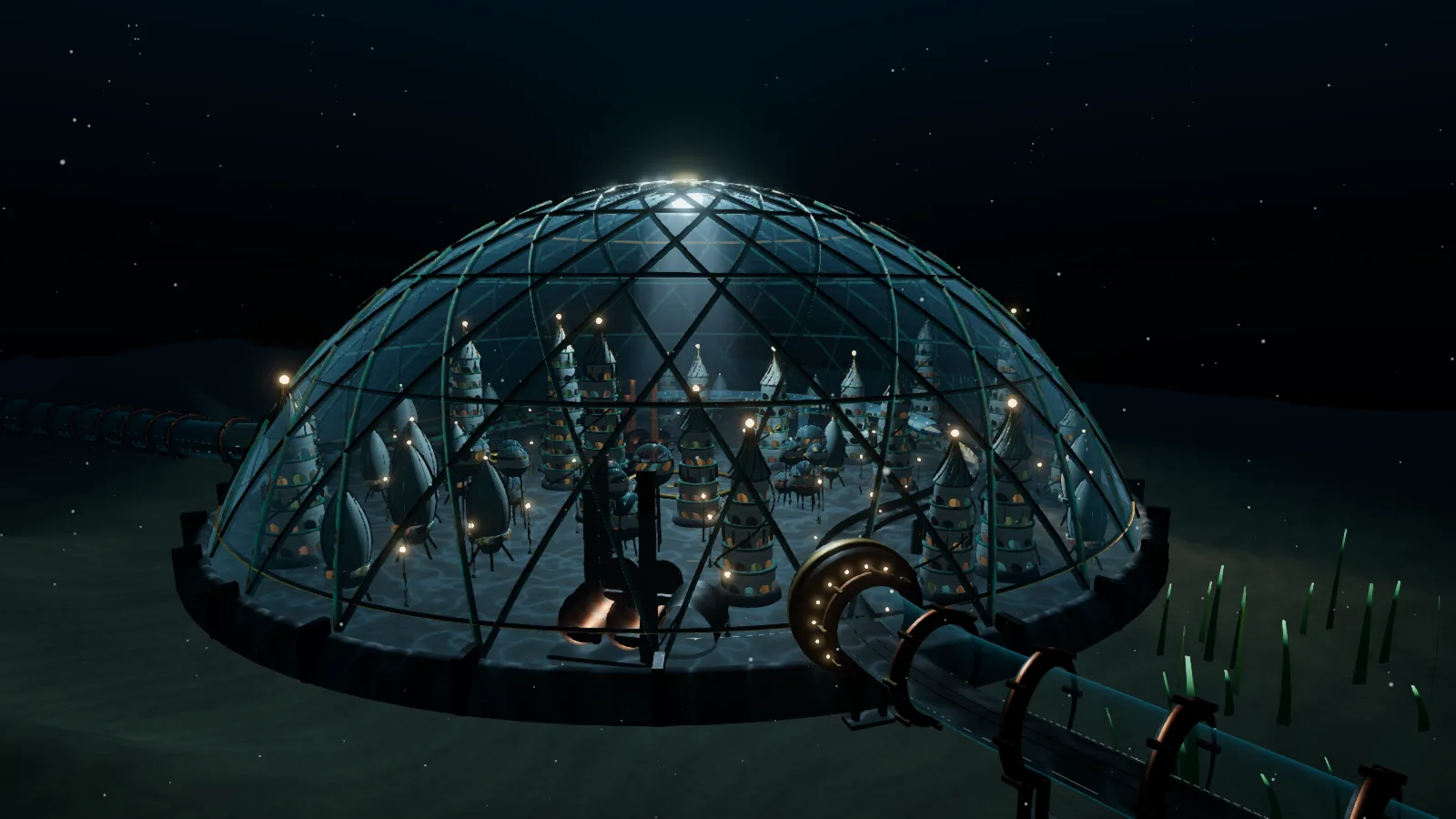
The domes
Five stops, one loop each
The train never reverses. At every dome the line leaves the ring, swings in through a pressure gate in the glass, runs round the district on a viaduct high over the streets, stops at the platform, and swings back out. From the platform, a glass lift takes Seven down to the streets.
Hollow Gate
The oldest dome, where the submarines come in. A moon pool opens straight into the sea in the middle of the floor, with a little brass sub riding in it.
Kelp Terraces
Stepped glass tanks under grow lamps, and tall seed-pod granaries. The kelp is green by day and glows faintly gold all night.
Nautilus Spire
The civic dome and the biggest. Chambered towers wind up round the Assembly Shell, a fluted vault on bronze ribs.
Lanternfold
Homes built like a bunch of glass grapes: pressure spheres on stilts, joined by short brass tubes, each with a lantern at the door.
Vent Foundry
On the edge of the trench, beside a black smoker. It drinks the vent's heat through copper drums and chimneys. The only warm place for a long way down.
The ring
A railway that looks like a particle accelerator
The line is one closed circuit, 5.5 km round. A great ring 640 m across runs over the plateau, and at each dome the track peels off into a loop that bulges out round the dome and comes back. The joins are proper reverse curves, so the train swings through them instead of jerking. There are no switches and no crossings anywhere. We checked that with a script before anything was built.
Out in the water the rails ride inside a glass pressure tube. A ring of field coils clamps round it every 14 m, and the coils pulse in a wave down the line, like a string of fish. Where the seabed rises into a rock ridge, the tube runs straight through it in a lined tunnel with lamps. Pylons carry it over the low ground.
The train is the Shoreline Limited's, brought over whole: the bullet-nosed locomotive, two coaches and the glass dome car, with the same bogies, doors and ramps. It has a new coat for the deep, navy and pale brass. Because it is always night down here, the coach lights stay on, the headlight throws a beam you can see in the water, and cyan running strips glow along the skirts.
The people
Nothing down here is a box
The Tethyans build for pressure, so their buildings are spheres, spirals and ribbed shells. Their wealth is metal: green bronze ribs, brass bands, copper chimneys. Their windows are round. Every building and every dome frame in the ride is new, modelled for it by Python scripts run in Blender.
The domes are held up by a diamond lattice of crossing bronze ribs, the way the engineer Pier Luigi Nervi built his concrete domes. Each stands on a dark basalt collar ringed with lit portholes. A lamp at the crown is the dome's sun. It throws slow shafts of light down through the air and a ripple of caustics across the paving.
Every round window is a room. The trick comes from Shoreline Limited's window shader: the view ray walks into a little box behind the glass, so you see a back wall, side walls, a floor, a lit ceiling and a shelf or a bunk, and the room shifts as you move past. It was rewritten for the new renderer, which draws with WebGPU where your browser has it.
The water
Dark, cold and full of life
The water swallows light fast, so the domes glow out of the dark long before you can make out their frames. Marine snow drifts down past the camera. Bubbles rise from the domes' scrubbers and in a column off the black smoker. Kelp beds sway round the domes with glowing tips.
On WebGPU the sea floor gets much more detail. A worker carves a fine seabed and over six hundred sculpted rocks while the ride loads: eroded spires with bands of strata, cracked boulders, stacked slabs, clusters of basalt columns along the trench, pillow lava round the black smoker, and drifts of rubble beside the line. That comes to about 53 million triangles. Three.js r187's meshlet pipeline cuts every rock into small clusters with simpler copies of each, and the graphics card picks, every frame, the copy each cluster needs and skips what is hidden or out of view. Press K to switch it off and see what it saves, and V to see the clusters in colour.
People, jobs and happenings
About three thousand people live in Tethys Hollow. Ten of them have work for Seven, two in each dome: Ossa the dockmaster and Brine the sub pilot at Hollow Gate, Marrow the kelp farmer and Pim the lamp tender on the Terraces, Quell the archivist and Sora the Assembly crier at Nautilus Spire, Nell the lantern-lighter and Tam the glassblower in Lanternfold, and Juno the pump engineer and Hal the smelter at the Vent Foundry. Each has a trade, a few things they say, and a need that slowly builds. When it is big enough they post a job, with a gold marker over their heads.
The jobs are made from a few verbs and a place: carry a canister or a letter to someone, to a door or to another dome's platform; find something lost (Brine's hermit crab gets out a lot); knock a flickering lantern back to life; read a gauge; photograph a view for the record. The places are picked to send Seven where it has not been much, so most jobs mean a ride on the ring. Mote knows the way, lift and train included. Jobs pay Hollow pearls, and three jobs for someone makes them a friend. Some friends do Seven favours: Brine lends the sub's sonar, Sora gets the train to wait longer at the platforms, Juno doubles the time on rush jobs.
Every dome also has something that happens on its own clock. The supply sub surfaces in Hollow Gate's moon pool in a burst of bubbles. Spores drift up over the Kelp Terraces at harvest. The Assembly bell sends a spiral of light up round the hall at Nautilus Spire. The lanterns go up over Lanternfold and fill the dome. A pipe at the Vent Foundry blows a seal in a jet of steam, and Juno needs it sealed before the pressure drops. Each one brings a job, the news reaches you wherever you are on the line, and walking into a dome brings its happening round sooner. This is Shoreline Limited's job engine, brought down to the deep.
Ask anyone about the Hollow and they will tell you a bit of its history, and press B for the Hollow Almanac: forty-one years since the first dome was sealed, seven factions, an economy of free air, slow pearls and brass doorframes, and a page for each dome that opens once Seven has walked its streets. The whole almanac is also on its own page.
The streets are not empty any more. A few dozen people walk each dome, dressed in their faction's colours: navy and brass caps on the dockers at Hollow Gate, green hoods on the Greenhands, red coats and crests on the Assembly's clerks, teal and goggles on the glassblowers, rust and goggles at the Foundry, little lamps on stalks for the Lampwrights. They are rigged and animated, built in Blender on the same skeleton as the people in Replacement, so they have knees and elbows, walk with a proper stride, glance up at the glass, wave when Seven comes near and talk with their hands. They wander between the buildings, stop for a rest, and step out of Seven's way. Drive up to anyone and press E for a word. They talk about their dome, their trade, whatever is happening, the job Seven is on, and how their faction feels about him lately, which depends on what he has been welding.
Seven also brought his cutting torch, the one he used on the chains in Shackled Prison. Things break round the domes and glow orange until somebody fixes them: a weeping seam in the dome glass, a split heat pipe, a buckled stilt under somebody's home. Drive up, press E, and he braces and welds it shut. Every fix pays a pearl and pleases one faction, and annoys another. Weld the Foundry's heat pipe and the Ventwrights warm to him, while the Glasshouse grumbles about cooler kilns. How each faction feels about Seven changes what its people pay for a job and how they say hello. The Assembly posts notices about it. Some of the notices are complaints about the complaints.
Before build 0.4.1 I sent Seven round the ring on autopilot for half an hour at a time, doing whatever jobs came up, to see where a player would get stuck. A lot needed fixing. The glass lift took him back down if he stood in it waiting for the train, and it left without him with no way to call it back, so now it waits for him once it has brought him, E sends it on, and standing at the shaft door calls it. At the top of a shaft he could drive off the side of the lift car into the street below; now he stops at any ledge he has not hopped over. People could be driven straight through and stood too close to the lantern masts. Searches pointed at an area and then went quiet, so now Mote sniffs the thing out once you are close. A photo of the Fathom Ring could not be taken from anywhere, and a photo of the dome you were standing in needed you to lean back further than the camera goes, so any stretch of the tube now counts, and from inside a dome so does its middle or its glass. And the train took nearly eight minutes to come round if you had just missed it. Now, while Seven waits in a dome, it hurries round the rest of the ring out of sight and comes in at its proper pace, so the wait is a couple of minutes at most. Aboard, holding F is a time-lapse.
The sea presses on every pane of the domes. From inside you can see it as a slow, shifting web of light on the glass, strongest low down. Outside, the city's light shines out through the moving water and dances on the sand round each dome, warm at the foot of the glass and blue further out. Both come from one small piece of maths: space folded into itself again and again by waves of sines, until the light gathers into thin bright threads. It is borrowed from a tiny raymarched shader called Reef, but worked out once per pixel on the glass and the sand instead of fifty times along every ray.
Nothing grows by sunlight this deep, so everything outside the domes makes its own light. Every dome has a glow garden round it: lantern quills like sea pens, anemones with lit crowns, lantern pods on bent stems, clumps of tube worms, moss spotted with light, and big branching lightcap corals. Waves of light roll slowly through each garden, and the whole garden flares as the train goes by. Jellies drift over them, pulsing as they swim. Schools of lanternfish swim past with rows of lights along their bellies, glowing rays fly slow circles over the domes, ribbon eels wind along the floor, and long chains of glowing beads drift in the dark. All of it is built in code and moves on the graphics card.
Out on the plateau by the Vent Foundry, eighty metres off the line, the Kraken from FIELDWORK lies half-sunk in the sand. The Tethyans call her the Old Lady of the Trench. She does not fight anybody down here. When the train comes by, her eyes brighten, the glow in her arms runs hot, and the arms nearest the tube rise and reach after it, then settle back once it has gone. She is one of the nine postcards.
As the train passes, its coils boil a little sea water off the outside of the tube, so a wake of bubbles comes off the glass and rises behind it. There are none inside the domes, which are full of air, or where the tube runs through rock.
Aboard, Seven rides a little smaller than in the city so he fits the aisle. Push roughly the way you want to go and he keeps to the aisle, sliding past the seats instead of catching on them. The camera rides with the car rather than chasing it through the water, so it stays steady round the curves, and it stays inside the car, behind him, looking down the aisle. The window seat finds the nearest window from the glass itself, and Up top looks along the whole train from the observation car's roof. On a tall phone screen every view widens so you see as much to the sides as on a desktop.
Switching meshlets on or off means every material and every draw has to be set up again, which can hold the page for a few seconds. A veil explains what is happening while that is done, and lifts once the new pipeline is drawing.
Schools of reef fish from Lumen Reach circle the dome lights and scatter when the train comes through. The Starlight Menagerie's whales, sharks, orca, jellyfish and squid patrol outside the glass. The sound is real: recordings of deep water, bubbles and a submarine's hum, cut into seamless loops.
How to ride
Board, ride, step off, ride the lift
| Drive Seven | W A S D or the arrow keys. On a phone, drag on the left side of the screen. A gamepad's left stick works too. |
|---|---|
| Look around | Drag with the mouse or on the right side of the screen. Wheel or pinch to zoom. |
| Board or step off | E, near an open door. The train stands at each platform for about half a minute, then runs on round the ring, with Seven or without him. On a new save it waits at Hollow Gate. |
| Leave now | G, or the Depart button, once Seven is aboard. |
| The lifts | Drive along the bridge from the middle of the platform onto the glass lift and wait a moment. It goes down to the streets, and back up the same way. Once it has brought Seven, it waits for him: press E to send it on, and stand by the shaft to call it back. |
| Cameras | C cycles six views while riding: Seven, Window seat, Up top, Chase, Nose and Out in the water. Drag, or use the right stick, to look round in any of them. |
| Postcards | P takes a photo. Frame one of the nine sights and it goes in the album (J). One of them swims, and one of them waves. |
| Ask Mote the way | Q. With a job on, Mote flies the way there, round the buildings. Otherwise it flies to the nearest open door, or the nearest lift. |
| The Hollow Almanac | B, or the Almanac chip. Ask anyone about the Hollow when you talk to them. |
| Weld | E next to anything glowing orange. Driving away stops the torch. The Jobs sheet and the almanac's Factions page show where Seven stands. |
| Hurry the ride | Hold F aboard. The train runs as a time-lapse and leaves stops your job does not need. |
| Sound, full screen | M and L. |
The ride runs in a recent Chrome, Edge, Safari or Firefox. It draws with WebGPU where it can and falls back to WebGL 2. On a phone, the Light graphics setting keeps things smooth. Your postcards are saved in this browser only.