CityLab · Ride 01
The train leaves when Seven is aboard.
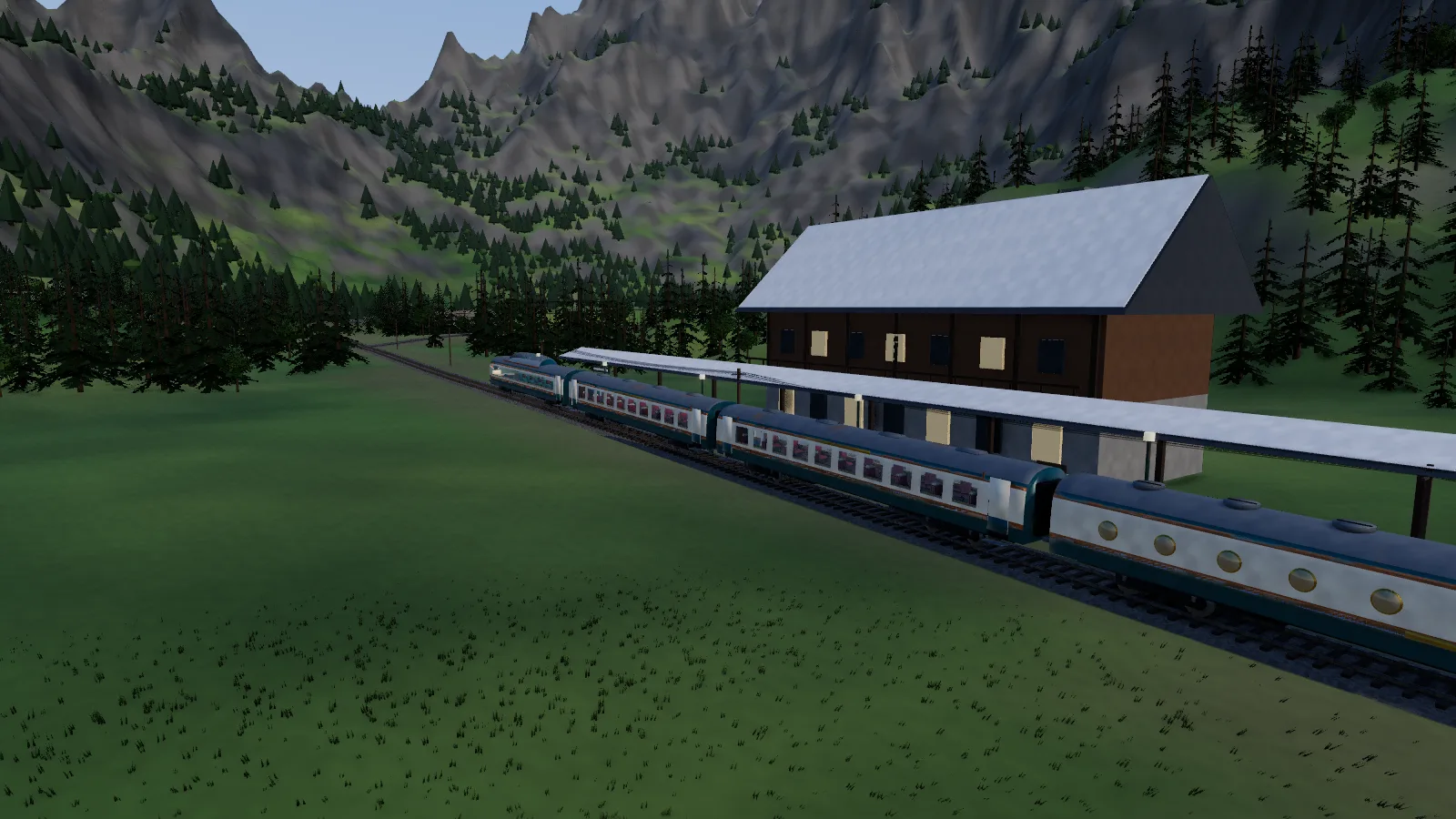
Granite Pass, early. A four-car streamliner waits at a snowy platform with its doors open. There is one passenger on the timetable, and it runs on treads. Roll aboard, find the dome car, and ride down to the sea.
The stops
Four stations, two loops, no reversing
The line is one long run from the mountains to the city, with a loop at each end. At the top, the train circles Glass Lake. At the bottom, it circles downtown Calder on an elevated track. So it never has to back up, and you get to see both ends from every side.
Granite Pass
The top of the line. A stone-and-timber chalet with snow on the roof, a long canopy and a view straight up the valley. The summit loop round Glass Lake starts just behind it.
Fernwood Halt
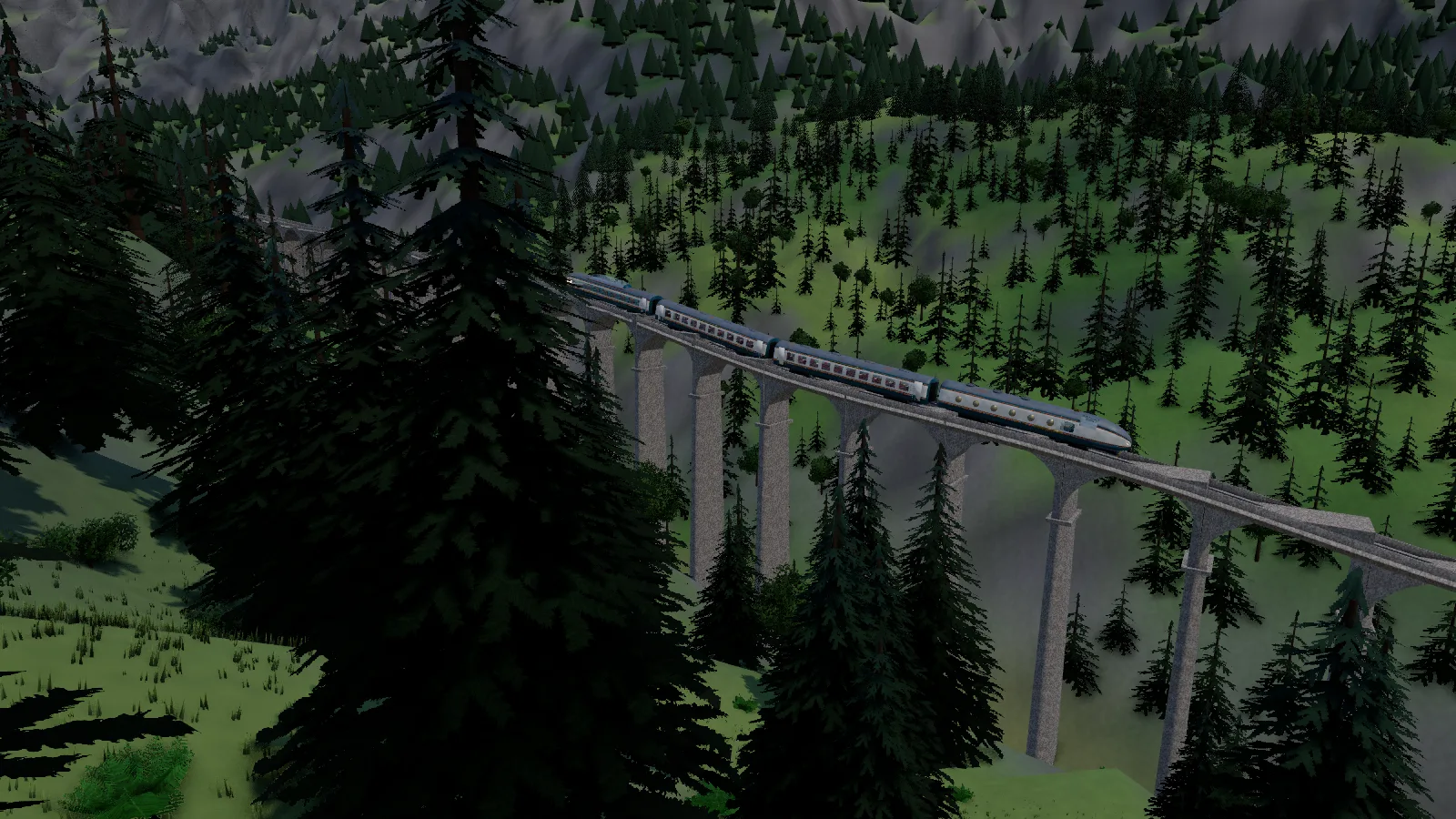
A request stop in the woods, below the stone viaduct and the spur tunnel. A wooden shelter, a bench, a signal box and a great many trees.
Gull Point
Where the line meets the sea. A small kiosk, a platform above the beach, and a red-and-white lighthouse out on the headland. Its lamp turns after dark.
Calder Union
The terminal. A limestone hall with a clock tower, a glass train shed, and a plaza that opens straight into downtown. Walk through the concourse doors to reach the city.
The train
A bullet nose, two coaches and a glass dome
The Shoreline Limited is a streamlined locomotive, two coaches and an observation car, in cream and deep teal with a copper stripe. Every car rides on two bogies that turn under it, so the train swings through curves and tilts on the grades. The doors slide open on whichever side the platform is.
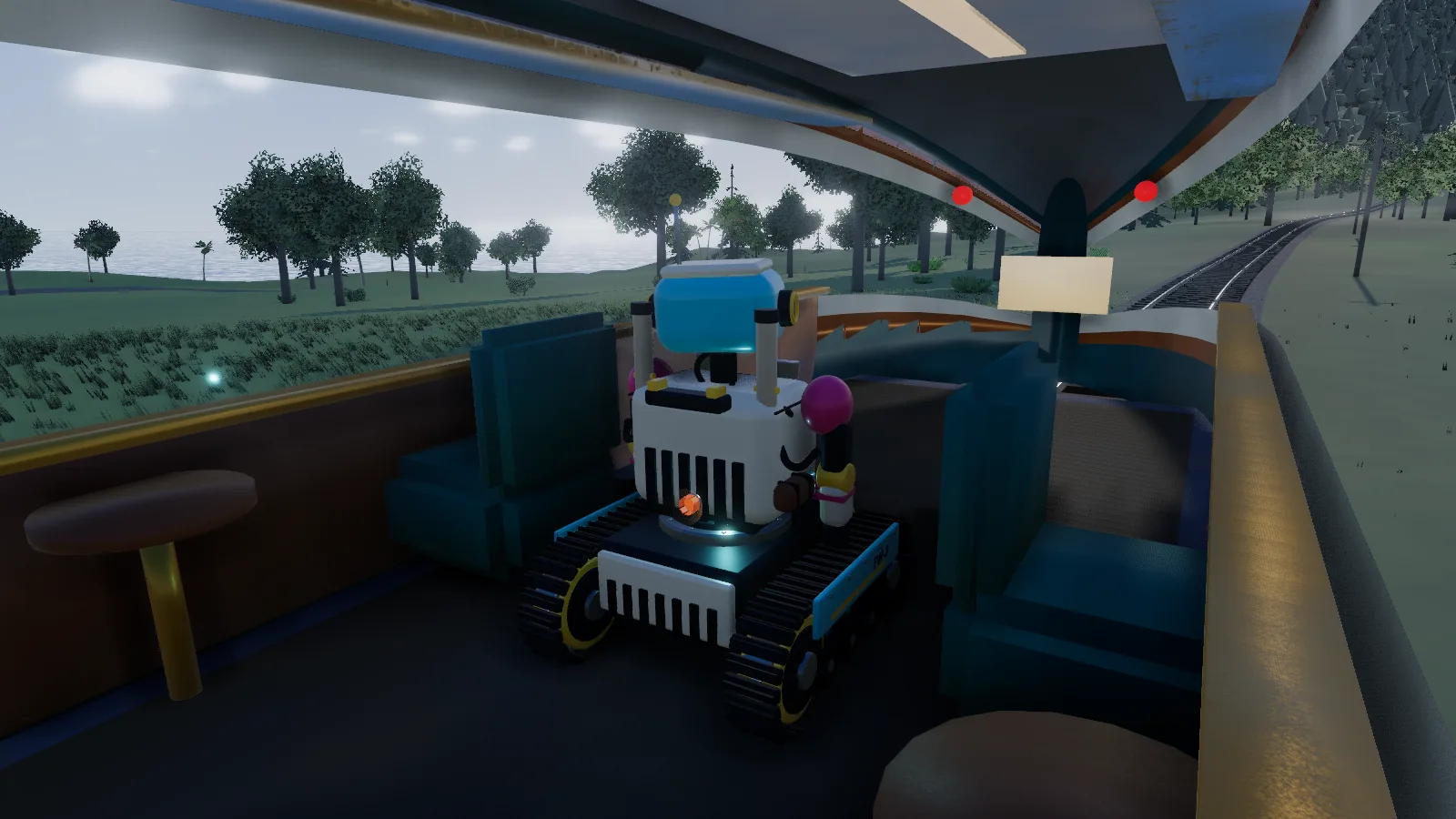
The whole train is built about a third bigger than a real one, and so are the stations and the track. That is the size a robot on treads needs: the aisle, the gangways and the doors all fit Seven with a little room to spare.
Inside, the coaches have pairs of red seats facing each other across small tables, either side of the aisle. The gangways between the cars are open, so Seven can roll from one end of the train to the other while it moves. The observation car at the back has armchairs facing the windows, a glass dome on the roof, and an all-glass tail for watching the track run away behind you.
The train and the four stations were built in Blender by Python scripts, one for the train and one for the stations and the lighthouse. Claude ran those scripts inside a live Blender session through the Blender MCP, exported them to glTF, and the game loads the result. A new car or a taller clock tower is an edit to a script and one more export.
Calder
A city with neighbourhoods, not just blocks
Calder sits on a slope above a bay. Each district builds its own way, so the skyline changes as the train comes round the coast.
- Downtown
No two towers are alike. There are glass towers with chamfered corners, art deco piles of limestone that step back like a wedding cake and end in a spire, round apartment towers ringed with balconies, concrete office blocks with a heavy top that hangs out over the street, and stone towers with arched windows and green copper roofs. Crowns light up after dark.
- Old Town
Brick, stone and stucco row houses built around courtyards. Each front is a little different: bay windows, arched or paired windows, a slate mansard or a plain cornice. Coloured awnings hang over the shops, and neon blade signs wake up at dusk.
- The harbour
Sawtooth sheds, brick warehouses with arched windows, metal boxes, stacks of containers and yellow gantry cranes along the quay.
- The hill
Painted houses with tiled roofs climbing toward a red-and-white TV mast on the ridge.
- The waterfront
A paved promenade with palms in front of the terminal, a park with a pond, a boardwalk along Calder Beach and a pier with a Ferris wheel at the end.
- The coast road
Cars run west along the shore toward Gull Point and cross the river mouth on a red suspension bridge.
Look into any window and there is a room behind it. The shader works out which room the window belongs to, then traces a short ray into a box behind the glass: a back wall, side walls, a floor and a ceiling. On the way the ray can pass a row of desks and monitors, a sofa and a lamp, shop shelves, or a person standing by the window. Walk past and the room shifts with your view, the way it does in the Spider-Man games. At night the rooms are lit from inside. Offices glow cool white from ceiling panels, whole floors at a time. Homes glow warm from a lamp, and the light fades into the corners. A few rooms flicker blue from a TV, and curtains glow when the lamp is behind them. None of those rooms exist as geometry, which is how a whole city of them fits in a browser.
The streets have their own life. Traffic lights stand at the busy junctions downtown and in Old Town, and the cars stop at red, their brake lights coming on. Stone sills, band courses and the odd air conditioner break up the brick fronts, and rain has streaked the walls under the windows. Cedar water tanks stand on the roofs. After dark the streets turn damp: low spots darken, puddles form, and they shine with the sky and the warm lamps. Several of these tricks come from Slop New York, Mr.doob's open-source Manhattan, rewritten for this ride.
The brick walls and the asphalt are baked in Blender: a script lays real bricks in mortar, and presses thousands of small stones into a dark binder, then bakes their bumps, shadows and shine into textures that repeat without a seam. A second, worn tile has block and alligator cracking, potholes with loose stones in them and patches where the binder has worn away. Here and there along the streets a stretch of road turns into it, each one turned a different way, and in between are patched repairs, lines of tar along old cracks, oil drips where cars wait at the lights and the odd skid mark. After dark, rain collects in the potholes first.
Jobs around Calder
A reason to go everywhere
Eleven people live in Calder and out along the line, and they need a hand. Rosa the baker has cakes to deliver. Pell runs the courier office and wants parcels across town fast. Sal sells fish and is always short of them. Hattie paints, and wants photos of places her knees will not take her. June fixes things on the East Side and trades parts for Calder marks. Arlo at Calder Union sends letters up the line, and Maggie at the lighthouse and Bram at Granite Pass send things back down.
Nobody's jobs are written out ahead of time. Each person slowly builds up a need, and when it is big enough they post a job, with a gold marker over their head. A job is put together from a simple action and a place: carry a parcel to a door, find a lost cat or a kite, fix a flickering street lamp, catch a certain fish, photograph a view, or bring back logs, stone or steel. The engine picks places Seven has not been much, so the jobs keep pulling you into new streets. Time of day matters too: lamps go out at night, and the eels only bite after dark.
Talk to someone with E, take the job, and Mote will point the way when you press Q. Jobs pay Calder marks. Three jobs for one person makes them a friend, and some friends do Seven a favour: a faster boat, half-price parts, or a courier map that shows exactly where lost things are. New neighbourhoods and landmarks are worth a mark the first time you find them. Press N to see your jobs, who needs a hand, and how many places you have found.
Wildlife and billboards
Somebody else lives here too
Gulls work the beach and the pier. Pigeons peck around the plazas and the station platforms. Crows cross the fields, finches flit through the woods, and squirrels nose about under the trees. Rabbits and deer graze the meadows in the morning and the evening. Trout cruise the lake, mackerel school off the beach, and butterflies drift over the grass on warm afternoons. After dark, rats come out in the city's alleys.
Every animal was modelled, rigged and animated in Blender for this ride, by a script, the same way as the train. Each one runs a small set of moods: idle, feeding, walking, alert and running away, plus flying for the birds and swimming for the fish. Roll up too close and they react. Pigeons and gulls burst into the air as a flock, a squirrel races up the nearest tree and clings to the bark until you leave, and deer lift their heads long before you reach them. The train scares them too as it passes.
Look out for billboards. Out in the country, printed boards beside the line advertise Eric's other projects, lit by two lamps at night. In Calder they are pixel boards on the rooftops. Each one shows a project's poster in chunky pixels, scrolls its name across like a station sign, with a tiny pixel Seven rolling along underneath, then sparkles over to the next one. Stand in front of a board and press E to open that project in a new tab.
Under the water there is more. The reef and its fish come from Lumen Reach: corals, sea grass, rocks and schools that scatter when Seven's boat passes over. Further out, visitors from the Starlight Menagerie swim by. Dolphins and orcas leap, a whale blows, jellyfish drift and glow after dark, crabs scuttle on the sand and seals haul out on the rocks.
Light and air
Mountains that shade the valleys
The whole landscape now has its own light. When the ride loads, the graphics card studies the mountains: how much sky each spot can see, where the gullies and ridges are, and where loose rock would fall below a cliff. As the sun moves, it works out which valleys sit in the shadow of which peaks, so late in the day the hills throw long, soft shadows across the forest and the lake.
The lake is clear water now. You can see the stones and silt on the bed in the shallows, and the colour deepens from jade to turquoise as the water gets deeper. Light ripples across the bottom, the sun leaves a golden path on the waves, and on the highest setting the lake mirrors the mountains and the trees around it. The forest grows in layers too, with young trees under tall old ones, small gaps in the stands, the odd grey dead tree, and sun that lights each crown from one side.
Far hills fade into a blue haze that rises from the valleys, and the sky glows around the sun. On the highest setting, real clouds drift over the peaks: soft piles of cloud lit by the sun, bright on top and grey underneath, with the mountains standing sharp in front of them. A new finish on the picture keeps bright skies from washing out and dark nights from going black. Several of these ideas come from Procedural Alpine Lake by Leonxlnx. We studied how it looks and wrote our own versions for this ride. Add ?oldlook to the address to see the ride the old way.
How to ride
Board, ride, step off, take pictures
| Drive Seven | W A S D or the arrow keys. On a phone, drag on the left side of the screen. A gamepad's left stick works too. |
|---|---|
| Look around | Drag with the mouse or on the right side of the screen. Wheel or pinch to zoom. |
| Board or step off | E, near an open door. The train keeps a timetable: it stands at each stop for about half a minute, then runs on, back and forth along the whole line, with Seven or without him. |
| Leave now | G, or the Depart button, once Seven is on the train. |
| Cameras | C cycles five views while riding: Seven, Window seat, Chase, Nose and Trackside. |
| Postcards | P takes a photo. Frame one of the eight sights on the line and it goes in the album (J). |
| Ask Mote the way | Q, the left shoulder button, or the Mote button. Mote flies toward the nearest open door, postcard view or platform and lights a beacon there. |
| Visit a project | E, standing in front of a billboard. It opens in a new tab. |
| Speed things up | Hold F while the train is moving. |
| Time of day | T steps through morning, noon, golden hour, dusk and night. |
| Call the cars | 1 for Firehawk, 2 for Redline, on or near a road. E at a parked car to drive it; E again when stopped to stand it up as a robot. X climbs out. |
| Cut and build | E at a tree, a rock or a street lamp. B opens the blueprints, R turns the plan, E places it, X cancels. E twice on a build takes it apart. |
| Boat, rails, fishing | Drive into deep water for the boat. E on the track to become a locomotive. E on a beach, pier or boat to cast, then hold to reel. |
| Jobs | E to talk to anyone with a gold marker. N lists your jobs. Q asks Mote the way. In a boat near the shore, E hops back onto land as a robot. |
| Full screen | L. |
Seven has two other shapes. Drive into water too deep to wade and Seven folds into a little boat, the same one from Lumen Reach. Ride the swells, stop to fish, then beach it to roll back onto the sand. Stand on the track and press E, and Seven turns into a small locomotive and runs the rails itself. Forward and back are the throttle; the rails do the steering. If the Shoreline is on the same track, both trains keep a safe gap.
On any road, Seven can call for backup. Press 1 for Firehawk and 2 for Redline, the two transforming cars from Firehawk. Firehawk drops out of the sky on a burning trail, lands in a three-point crouch that cracks the street and shakes the camera, then stands up and folds into a black-and-gold car. Redline comes down the street flat out with a cloud of tyre smoke behind it and slides to a stop. Both park beside Seven. If they are already nearby, they just drive over.
Walk up to a parked car and press E. Seven folds into a small engine, the hood pops up, and Seven drops into the bay. Now you are driving. Stop and press E again and the car stands up as a robot, with Seven still inside its chest, because the engine is mounted on the hood and the hood becomes the chest plate. Press X to climb out of either one. Drive either car, or walk either robot, into water too deep for it and the big robot heads home while Seven folds into the boat. To make that work, the Firehawk rigs gained three new mount points: one under the hood, one in the chest and one by the driver's door. The phoenix on the hood and the lines of the car are untouched.
Seven can build, too. Roll up to a tree and press E: a saw comes out, the sawdust flies, and the tree goes over away from Seven with a thud and leaves a stump. Each tree gives logs, branches and leaves. Press B to open the blueprints: a campfire, a log fence, a lean-to, a log cabin and a lookout tower are all built from tree parts. Pick one, drive to aim it, and press E. The pieces fly out of Seven and stack themselves into place. You can build anywhere outside the city where the ground is flat enough, as long as no trees are in the way.
The rocks change with the land. Gull Point has black, pitted lava boulders, wet and glossy where the surf reaches. The rocky west coast has tan sandstone and sea stacks standing in the swell, like the California coast. Glass Lake is ringed with pale granite in clusters, some half in the water. Big broken blocks lie on the high slopes, mossy boulders sit in the fields, and smooth stones line the river. Seven can break up the small, medium and large ones for stone, which the campfire, the cabin and the workshop need.
The better blueprints need parts from town. In Calder, Seven can cut down a street lamp for steel, a lamp and wire. Soon after, a crew of yellow repair drones flies in and grows the lamp back, welding as it rises. It takes them one full day of game time. With wire, Seven can build power poles. The first one has to stand within 55 m of the old telegraph poles beside the railway, and each new pole wires itself to the nearest one. A cabin, a workshop or a lamp post within 32 m of a powered pole lights up after dark. Everything Seven cuts and builds is saved in this browser.
The fishing game comes from Lumen Reach too. Cast from the beach, a pier or the boat. When the bobber dips, press E to hook it, then hold to reel. Watch the needle: too much pull and the line snaps, too little and the fish slips off.
Seven does not travel alone. Mote, the little drone from FIELDWORK, hovers off Seven's shoulder. It catches Seven's hops in a net of light, scouts ahead, lights the way after dark, and folds onto Seven's back to charge for the ride.
The ride runs in a recent Chrome, Edge, Safari or Firefox with WebGL 2. On a phone, the Light graphics setting keeps things smooth. Your postcards are saved in this browser only.