TiltLab · Machine 05 · On the floor
Black Budget Bird
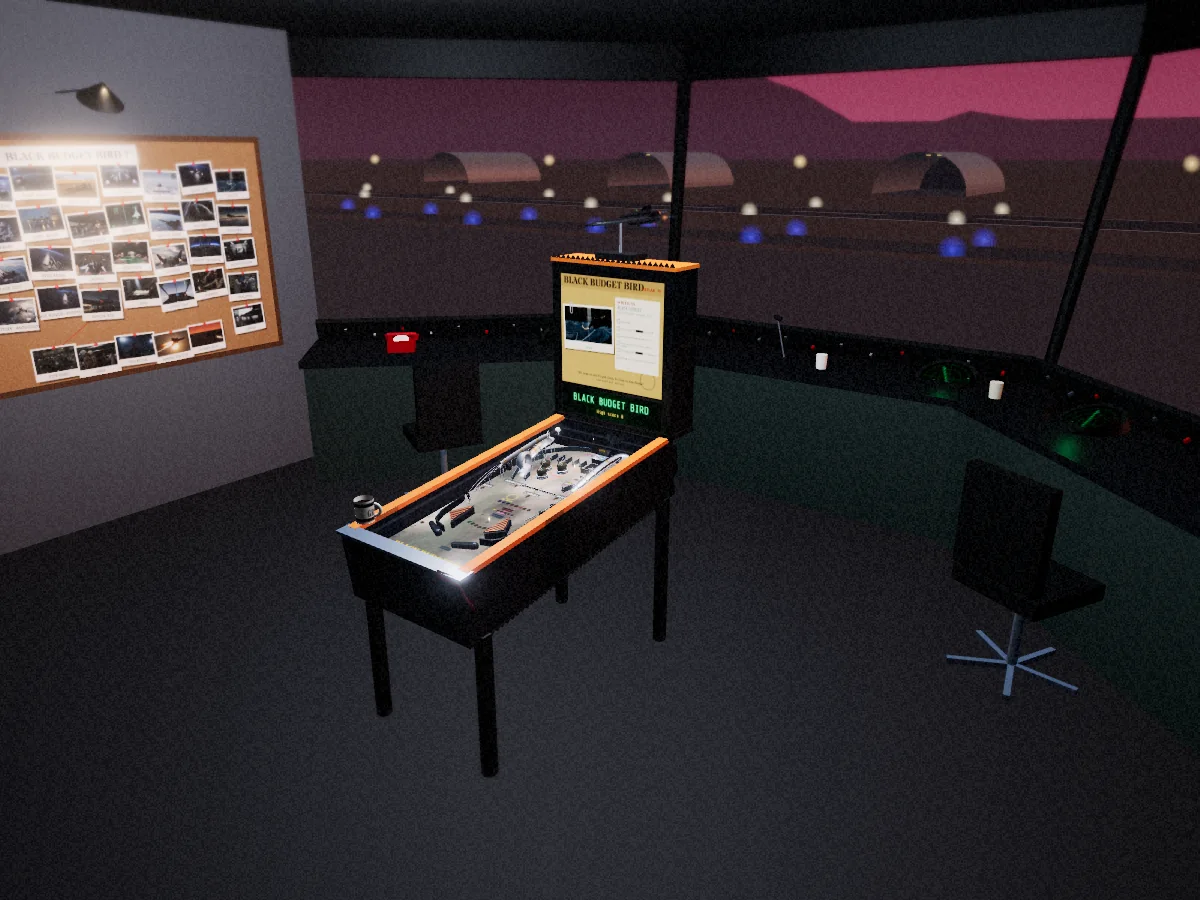
The SR-71 games, rebuilt as a pinball machine in the control tower of an air base that does not exist. Eight sorties, each with its own orders. A radar sweeps the table and the missile batteries fire along lines you can see coming. A Blackbird goes down the runway outside every time you launch, and every photograph you bring home is pinned to the board on the wall.
The idea
Can a pinball machine fly a campaign, and keep the evidence?
There are two SR-71 games in the GameLab. Blackbird Recon flies three reconnaissance runs: a checkout at dawn, a pass through a weather front and a night run over a fleet. Black Budget Bird picks the story up with an airframe that should have been scrap in 1990, a tanker called CHALICE 41, a coast lined with missile batteries and a place called Site Zero. There is a song with the same name, and a music video, and the ArtLab has a whole collection of the aircraft.
A pinball machine is good at one thing at a time, so the machine flies the games as a campaign. Each sortie hands you a short list of orders, taken from the games: take off, break Mach 1, climb, take on gas, record the radar, photograph the target, bring the film home. The shots that serve the order in hand are the ones that light. Finish the list and the chart under the glass turns to the next sortie.
The story is told by the room. You stand in the tower cab at Groom-7. The radar scopes on the consoles show your ball. The flight strips hold your orders. The red phone rings when a sortie comes in. On the wall, a board of photographs and red string fills up with what you have seen, across every game you play.
Nothing on the table was drawn from scratch. The aircraft, the tanker, the missile launchers, the radar van and the hangar are the games' own models. The photographs are the ArtLab renders and frames from the music video. The music is the games' soundtrack and the song, read straight from their own folders.
On the playfield
Every part, and what it does.
| Part | From the games | What it does | Points |
|---|---|---|---|
| The chart | The mission map | The playfield is a flight chart: relief and contours, the missile rings, the radar fan and a magenta route. There are five of them, from the desert to the arctic coast. The machine writes on it in grease pencil while you play: the sortie, its orders, a tick for every one done, and the tracks of the missiles. | – |
| The Mach tape | The airspeed | A column of lamps up the middle. Every shot pushes it up, and it bleeds away if you stop. It slows through the transonic hump just below Mach 1 and multiplies everything you score, up to x4. | – |
| The target | Each sortie's subject | A model on a wire track across the middle of the table: a resolution board, a radar van, a picket ship or a hangar. It rises when the sortie wants a photograph. Every hit is a frame. | 50,000 a frame |
| SAM bumpers | The missile batteries | Three pop bumpers with launchers on top that turn to follow the ball. A lit red ring means the battery is armed: it can fire, and it can be photographed. | 1,000 |
| The radar | The early-warning radar | A van and a radome in the top corner sweep a beam across the table. Each time it crosses a ball, the lock builds. A full lock and the nearest battery fires. | – |
| Missiles | The SAMs | Each launch is drawn on the chart first, then the missile flies the line. A ball moving fast enough outruns it, and the faster the Mach tape, the less speed it takes. A ball that is hit loses speed and the clean sortie. | outran 6,000 |
| The jammer | The ECM pod | The action button. It kills everything in the air and clears the lock. You start with two charges and hold up to five. | 5,000 a missile |
| The boom | CHALICE 41 | A ring in the middle of the table. When a sortie needs gas, the tanker comes down over it and its magnet catches the ball, holds it while the fuel gauge fills, then lets it go. | 2,000 a tick |
| Zoom Climb | The climb | The left ramp, with its vertical loop. Each time round is 18,000 ft on the altimeter. | 20,000 |
| Runway | – | The right ramp. 9,000 ft a time, and when the lock is lit a diverter drops the ball into the hangar. | 12,000 |
| ELINT orbit | The emitter recorder | The left orbit, with a tape reel for a spinner. Both put seconds on the recorder. All the way round and down the right wall is a wall run onto the third flipper. | 6,000 · wall run 8,000 |
| Hangar 7 | The recovery field | The scoop at the top right. It lands the aircraft at the end of a sortie, holds the two-ball lock and pays the super jackpot. | 7,500 · lock 30,000 |
| The picket line | The picket ships | Three drop targets. Down all three to light the lock. | 3,000 · all 15,000 |
| S-R-7-1 | Pickups | Four top lanes. The flippers move the lit lanes. All four load two jammer charges, or a drag chute (both kickbacks for twenty seconds), in turn. | 2,500 · all 15,000 |
| Flippers, slingshots, plunger | – | Chrome Orbit's lower playfield, unchanged for a fifth table. The flippers are black and stencilled NO STEP. Plunge into the flashing lane for a skill shot. | skill shot 30,000 |
The rules
Take off. Build the tape. Bring the film home.
- Sorties. Eight of them: First Light, Silent Meridian and Black Window from Blackbird Recon, then Article 2B, Long Straw, Glass Coast, Iron Tide and Black Budget from Black Budget Bird. Each has its own sky, chart, target and list of orders, and each is worth more than the last.
- Orders. They come one at a time, on the backglass and the flight strips. Mach orders want the tape built; climbs want the Zoom Climb and the Runway; photographs want the target; recordings want the ELINT orbit and the reel; gas wants the boom; landing wants the hangar. Every order done pays 40,000, more on later sorties.
- Getting shot at. Radar lock builds as the beam crosses the ball. When it fills, a battery fires. Keep the ball fast and it outruns the missile; slow, and it takes the hit. Five outruns earn a jammer charge.
- Unstart. Cross Mach 2.5 and an inlet can unstart, as it does every time on Article 2B. One side's flippers go soft and the table yaws for ten seconds. A shot on the dead side restarts the engine.
- Weather. The storm sorties throw gusts across the table, with lightning outside the tower glass.
- Glass Coast and Iron Tide start in the air, at 70,000 ft and Mach 3. On the Glass Coast there is no target: photograph each armed battery instead.
- Lock and multiball. The picket line lights the lock; two balls in the hangar start a three-ball multiball. Jackpots on the ramps, the orbit and up the middle; three light the super jackpot in the hangar.
- Site Zero. Bring home the eighth sortie and shoot the hangar. Four balls, the song, and a second airframe on the track. Four frames of it and the hangar again to bring the film home. Then the campaign starts over, faster, and worth more.
- Clean sortie. No drains and no hits, worth 250,000.
Things to unlock
The board on the wall.
Everything here is saved on your device.
The evidence · forty-one photographs
- Each sortie has its own photographs. Every order done, every frame of the target and every battery on film pins the next one, and bringing the film home pins the last. They come from the ArtLab's SR-71 collection, from Black Budget Bird and from the music video.
- Red string joins them, a column for each sortie, with Site Zero along the bottom.
- Open the board from the title screen to see every photograph you have, with a caption and where it came from, or look at it on the tower wall.
The campaign
- Start at any sortie you have reached.
- Your best score on this machine, and a count of the sorties flown and the clean ones.
The room
The tower cab at Groom-7.
Margin Aces' room kept time. This one keeps watch. The tower stands over the runway, with glass on five sides. The sky follows the sortie: dawn on the range, a storm front, a night with a moon, the arctic coast, dusk over the highlands. When you launch, a Blackbird rolls down the runway, rotates and climbs away on its burners, and when the tanker is needed it goes too. Rain and snow run down the glass in bad weather. A red beacon turns on the ceiling when a lock comes on.
On the consoles
- Three radar scopes draw the table live: the balls, the batteries, the beam and the missiles.
- The flight strips: the sortie and its orders, crossed off as you go.
- The red phone rings when a sortie comes in. Binoculars, a signal lamp, a microphone and cold coffee.
Round the cabinet
- The cabinet is corrugated titanium with sawtooth edges, like the airframe, with orange rails and a REMOVE BEFORE FLIGHT streamer on the lockdown bar. A model SR-71 sits on top of the backbox with its burners lit to match the tape.
- The backglass is a manila dossier: the photograph, the typed orders with boxes to tick, redaction bars and a line from the song.
- The board is on the wall to the left, and a Zulu clock over the lift door behind you.
Under the glass
What makes it run.
- Physics
- The shared TiltLab table rig: Rapier 0.21 at 120 steps a second. New for this machine: magnets, which pull a ball to a point, hold it and report when it settles, and flipper power that can be set for each side on its own. Both are off unless a machine asks for them, so the earlier tables play as they did.
- The models
- The SR-71 is the airframe from Blackbird Recon; the tanker, the missile launchers, the radar van, the radome, the picket ship and the hangar are from Black Budget Bird's set. The table, the tower and the base outside are built in code around them.
- The charts
- Five charts baked from a script: noise for the relief, contour lines, the missile rings and radar fans for each sortie, the route, and type in a typewriter face and a stencil. The grease pencil is a canvas over the chart, and when the sortie changes the chart turns away like a page.
- Playfield
- One layout file holds every wall, post and switch. The lower playfield is Chrome Orbit's; the upper table is Margin Aces', with the target's track where the ace flew.
- Testing
- A headless bot plays whole games in Node to catch stuck balls and dead ends, jamming when the missiles come. A script flies the whole campaign, all eight sorties and Site Zero, through the rules.
- Sound
- The shared kit for the parts, the games' own effects on top, and sounds written in the browser: sonar pings for the lanes, a teletype for each order done, the red phone's bell and a sonic boom. Under it all, the roar of the jet on the runway and the wind on the glass. The music is Blackbird Recon's four tracks and, for Site Zero, the song “Black Budget Bird” by Eric Rhea, all crossfaded, with the lamps keeping each track's own tempo.
- Controls
- A / ← and D / → (or Shift) for the flippers (the right one works both right flippers), Space to plunge, E, J or ↑ to jam, Z and / to nudge, Esc to pause. A gamepad works. On a phone, use the pads at the bottom of the screen.
- Loading
- The airframe, the props, the first chart and the sounds, about 8 MB, arrive before the first ball, then every shader is compiled. The other charts and the photographs load as they are needed, and the music streams from the games' own folders.
In the lineage
Machine 05, after Margin Aces.
Black Budget Bird starts from Margin Aces: its moving target, its attacks drawn before they fire, and the room as a place that changes with the game. From Folded Thunder it keeps the upper table, the third flipper and the loop ramp. From Midnight Ride it keeps the lock, multiball and the unlocks that persist. From Chrome Orbit it keeps the lower playfield, the sound kit and the start-up loader.
Its new ideas are orders and evidence. The table tells you what it wants, and what you bring back stays on the wall.
Play Black Budget Bird · Back to TiltLab · The originals: Blackbird Recon and Black Budget Bird in the GameLab, the SR-71 collection in the ArtLab, and the “Black Budget Bird” music video.