TiltLab · Machine 08 · On the floor
PRISM LIGHT
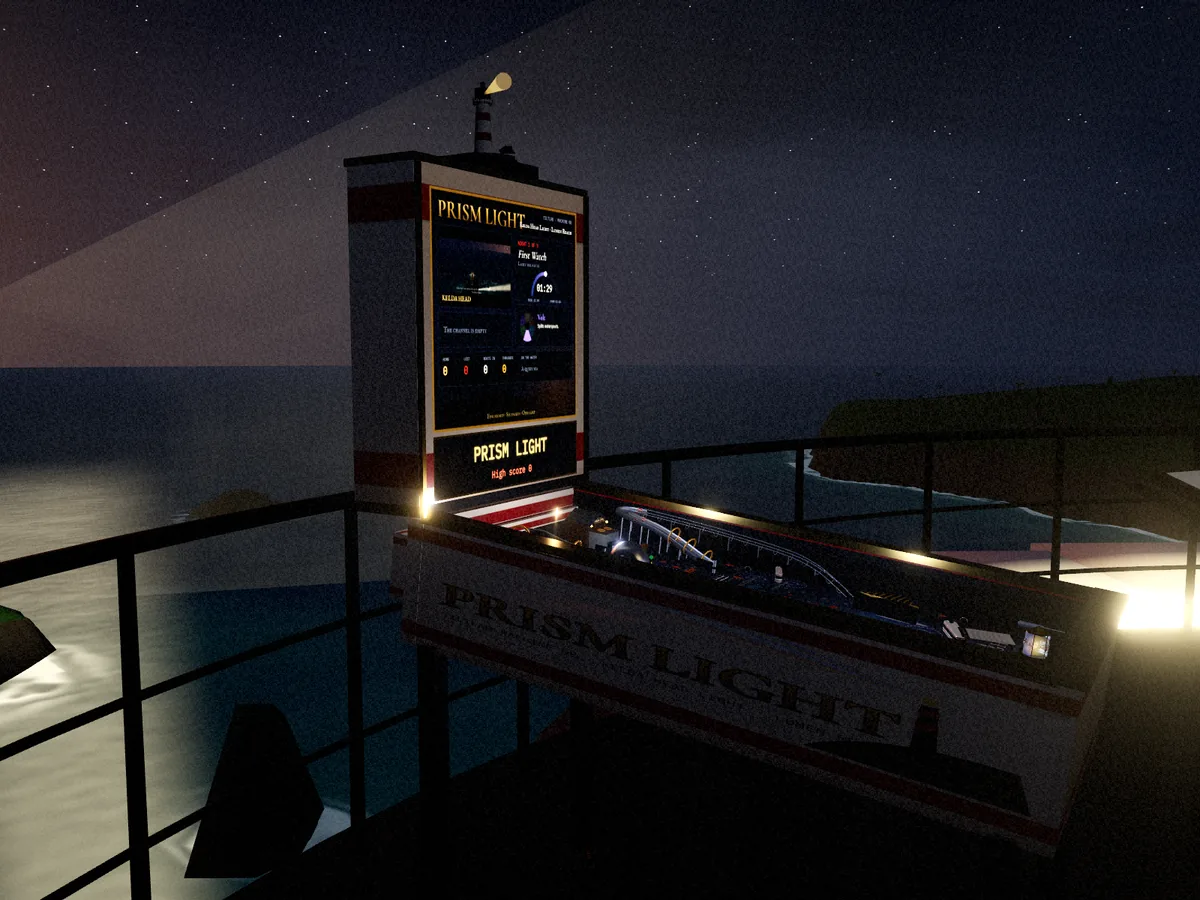
The Prism Light lighthouse game, rebuilt as a pinball machine on the gallery of Kelda Head Light, with the game's own bay below it. The beam is real. It sweeps up the playfield from a six-sided lens between the flippers, and only what it lights counts: ships take their bearing from it, and each colour of the lens clears one of the things the night sends. Keep the light for five nights to dawn.
The idea
Can the light itself be the thing you aim with?
Prism Light in the GameLab puts you in a lighthouse on the north cape of Lumen Reach. Ships come in out of the dark, and they can only find the cove while your beam is on them. The lens has six facets, each a different colour of glass with a different job, and the nights send fog, rogue waves, waterspouts, kelp, wreckers and migrating birds.
In a pinball machine the lights tell you what to shoot. Here the light is also what makes a shot count. A beam is thrown from a small copy of the game's lens on the apron, between the flippers, and it sweeps slowly up the playfield. It lights the chart, throws shadows from the posts and the ball, and colours the arrows it passes over. A shot made while the beam is on it is lit: it scores double, and it does whatever the facet in the lens does.
So every shot has two questions in it. Where is the ball going, and where is the light? You can wait for the beam to come round, or turn the lens and change what the light does when it gets there.
On the playfield
Every part, and what it does.
| Part | From the game | What it does | Points |
|---|---|---|---|
| The chart | Lumen Reach | The playfield is a night chart of the approaches to Kelda Head, printed in navy and cream. The coast and the reefs come from the game's own terrain, with the lighthouse at the apron and the sea running up the table. | – |
| The lens | The lantern's lens | The game's own lens, small, on the apron. Its beam swings slowly from side to side across the table. Two buttons turn it to the next facet or back one, a turn the game's own speed. | lit shots ×2 |
| The ship | The fleet | A sloop, schooner, brig, snow or frigate, the game's own hulls, sailing back and forth across the middle. Hit her in the beam and she takes her bearing; in the dark she loses it. | in the light 25,000 |
| The bearing ring | The ship's ring | Eight lamps across the middle of the table. Halo fills it fastest, the other facets about half as fast, Void not at all. Full, she has her bearing and the Cove lights for her. | bearing 50,000 |
| Kelda Cove | The cove and its quay | The scoop at the top right, with a boathouse. Bring a ship in here, lock balls for the Falling Crown, and collect the super jackpot. | 7,500 · home 200,000 to 440,000 |
| The Teeth | The outer reef | The left orbit, with a bell spinner in it. | 6,000 |
| The Swell | The open sea | The left ramp and its loop. A rogue wave can stand up in front of it. | 20,000 |
| The Channel | The way in | The middle, straight across the ship's course. | 4,000 |
| Cutter Rock | The reef to the east | The right ramp. It carries a ball to the Cove's lock when one is lit, and a second rogue wave can rise in front of it. | 12,000 |
| The Sisters | The twin reefs | All the way round and down the right wall onto the upper flipper. | 8,000 |
| The waterspout | The storm's spouts | A turntable in the open water that spins the ball when it crosses it, until Volt splits it. | cleared 40,000 |
| The kelp | The kelp rafts | A magnet under the chart that catches the ball and holds it a moment, until Venom rots it. | cleared 40,000 |
| B-E-A-M | The lamp | Four top lanes over three bell-buoy bumpers. The flippers move the lit lanes. All four raise the bonus multiplier and give, in turn, a focused beam or twenty seconds of kickbacks. | 2,500 · all 15,000 |
| O-I-L | The lamp's oil | Three drop targets in front of the Cove. Down all three to light a lock. | 3,000 · all 15,000 |
| Flippers, slingshots, plunger | – | Chrome Orbit's lower playfield, unchanged for an eighth table, in cream and brass. Plunge into the flashing lane for a skill shot. | skill shot 30,000 |
The rules
Keep the light. Bring them home.
- The ships. One sails at a time, with up to three more waiting on the horizon. Hit her while the beam is on her to build her bearing. In the dark it drains, and when it runs out she is lost: light her within twelve seconds or she goes on the rocks.
- Bringing her in. A full bearing lights Kelda Cove for twenty seconds. Shoot it and she comes alongside. Leave it and she finds her own way in, for less.
- Wrecks. A wreck puts a lifeboat on a side shot, two for the bigger ships. Make that shot in the light and the boat is in.
- The facets. Halo guides ships and shows up the wreckers' false lights. Ember burns off fog. Rime freezes a rogue wave before it breaks. Volt splits a waterspout. Venom rots the kelp. Void shutters the lamp, so the thrushes caught circling it can go. Each hazard clears only in its own colour.
- The Kraken. Every hazard you clear adds a band to the lamps over the apron. Six bands and the Glassmire Kraken rises off the Ledges: thirty seconds of kickbacks that it turns back itself, and a ball save.
- The Falling Crown. O-I-L lights a lock at the Cove. Two locks and a third ball start the multiball, with glass falling out of the sky. Every lit shot is a jackpot, and every third one lights a super jackpot at the Cove.
- The nights. Five, from dusk to dawn, each about two and a half minutes of live ball, each with its own script of ships and weather, as in the game. Dawn scores every ship still afloat. After the fifth comes the Endless Watch.
The room
The lighthouse gallery, and the whole bay below.
FIREHAWK stood in the game's street. This one stands on the iron gallery that runs round the lantern of Kelda Head Light, 52 metres above the sea. The lantern is behind you, the lens turning in it. Below is the game's own bay: its coast and cove, its sea and sky, its reefs and buoys, built by the Prism Light game's own code and loaded straight from the GameLab.
Out in the bay
- The real beam turns with the one on the table, so a ship you light on the playfield is lit out at sea, in the same colour.
- The ships come in on the game's own bearings as they come onto the table, sail for the cove when they have their bearing, and go on the rocks when they are wrecked. Their lifeboats row in.
- The weather follows the night: fog banks, rogue waves, waterspouts, kelp, the wreckers' lanterns, flocks of thrushes, rain and lightning. The Kraken rises out there when it rises on the table.
- Dawn comes up over the bay at the end of every night.
On the gallery
- The cabinet is cream enamel with the tower's red day-mark bands, a six-coloured beam on its side, brass rails, navy legs and a tide card under the glass. Kelda Head Light stands on top of the backbox, its lamp sweeping with the table's.
- The backglass is the keeper's log: the night and its clock from dusk to dawn, the ship and her bearing, the lens and its facet, the tally of ships home, lost, boats in and thrushes, and what is on the water.
- The pictures: six from the game, shown on the backglass as the night goes on and kept in a gallery off the title screen.
- The keeper's things: the logbook on its lectern, an oil can and a coil of rope.
Under the glass
What makes it run.
- Physics
- The shared TiltLab table rig: Rapier 0.21 at 120 steps a second. The ship and the two rogue waves are movers that rise out of the table and sink back; the waterspout is a turntable and the kelp a magnet, both new to the rig. A wave waits until no ball is in its way before it rises.
- The beam
- One test decides what is lit, as in the game: a point is in the light when it is inside the beam's angle from the lens. The same numbers drive the chart's shader, which darkens the chart and lights it in the facet's colour inside the cone, a spotlight from the lens that throws shadows up the table, the arrows' colour, and the game's own beam out in the bay.
- Two worlds
- The bay works in hundreds of metres and the table in millimetres, so the bay is drawn first with its own camera, standing where you stand, and the gallery and the cabinet are drawn over it with their own depth.
- The game's code
- The bay's world, sky, sea, beam, fleet, hazards, birds, Kraken and effects are the game's own modules, imported from the GameLab at run time. The table tells them what happens; nothing in the game's folder is changed.
- The chart
- Baked by a script from the game's own height grid and reef list, with type in the game's chart lettering (IM Fell English SC) and the machine's book face (Cormorant Garamond).
- Testing
- A headless bot plays whole games in Node, turning the lens toward whatever needs clearing, to catch stuck balls behind the waves and in the kelp. A script plays the whole story through the rules: a ship home, a wreck and its lifeboat, every hazard cleared in its own colour, the Kraken, the Falling Crown and its jackpots, dawn and the Endless Watch.
- Sound
- The shared kit for the parts, the game's own effects on top: the bell buoys and the ship's bell, the lens turning and locking, the foghorn, splashes, the wreck, the Kraken and the thrushes. The sea, the wind, rain and the storm are the game's beds; thunder rolls in a storm. The music is the game's night watch, and its storm for the Falling Crown, the Kraken and the last night.
- Controls
- A / ← and D / → (or Shift) for the flippers (the right one works both right flippers), Space to plunge, E, J or ↑ to turn the lens forward and Q or K to turn it back, Z and / to nudge, Esc to pause. A gamepad works. On a phone, use the pads at the bottom of the screen. Drag to look round the gallery, pinch or scroll to zoom, and reset the view with the button that appears.
- Loading
- The chart, the typefaces and the sounds, about 1 MB, arrive before the first ball, then the bay's models, effects and terrain from the GameLab, then every shader is compiled. The music and the weather stream from where they already live.
In the lineage
Machine 08, after FIREHAWK.
PRISM LIGHT starts from FIREHAWK: the cabinet standing in the game's own world, the camera's cuts, the moving target across the middle (now a ship) and the walls that rise in front of the ramps (now rogue waves). From FIELDWORK it borrows the Glassmire Kraken, which the game borrowed first. From Margin Aces it keeps a campaign of scripted chapters, now five nights. From Folded Thunder it keeps the ramp rides and the loop. From Chrome Orbit it keeps the lower playfield, the sound kit and the start-up loader.
Its new idea is light as a rule. The beam decides which shots count, and you choose its colour.