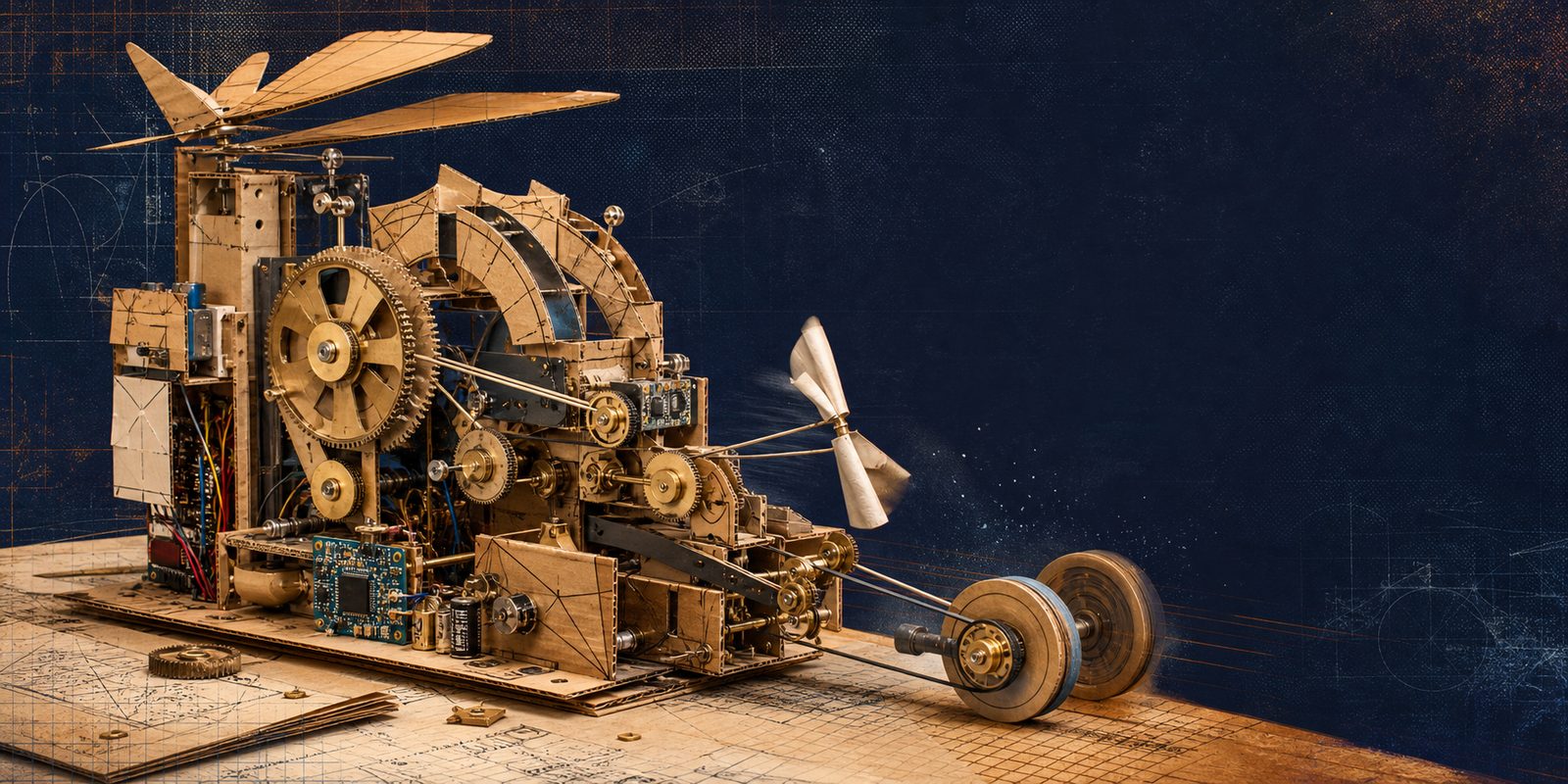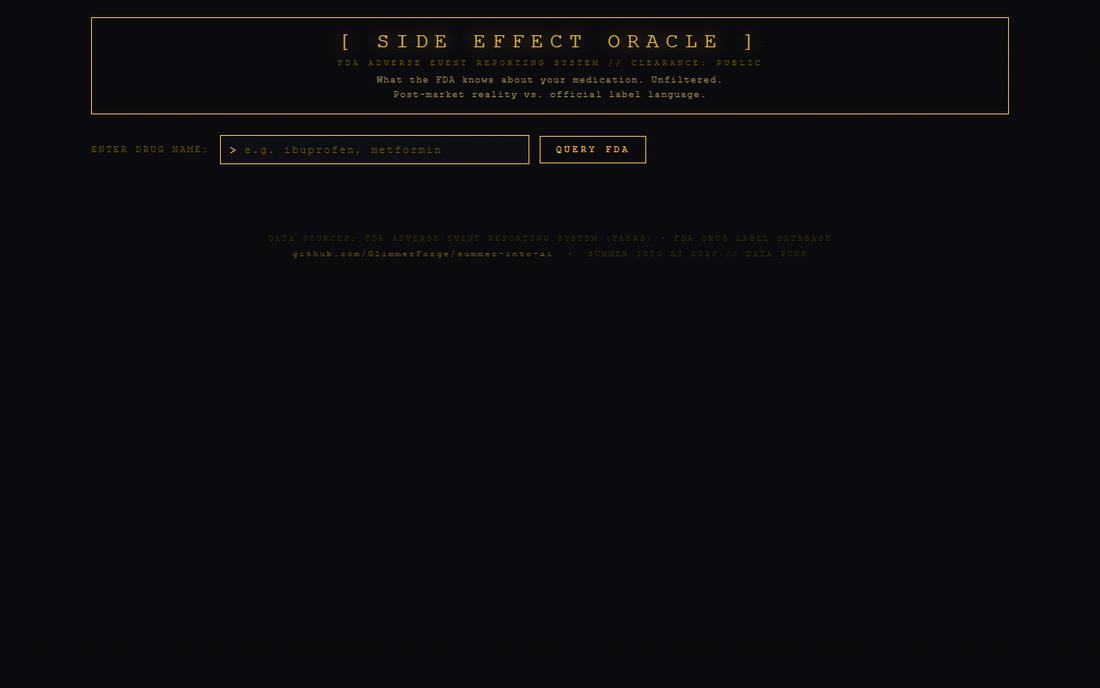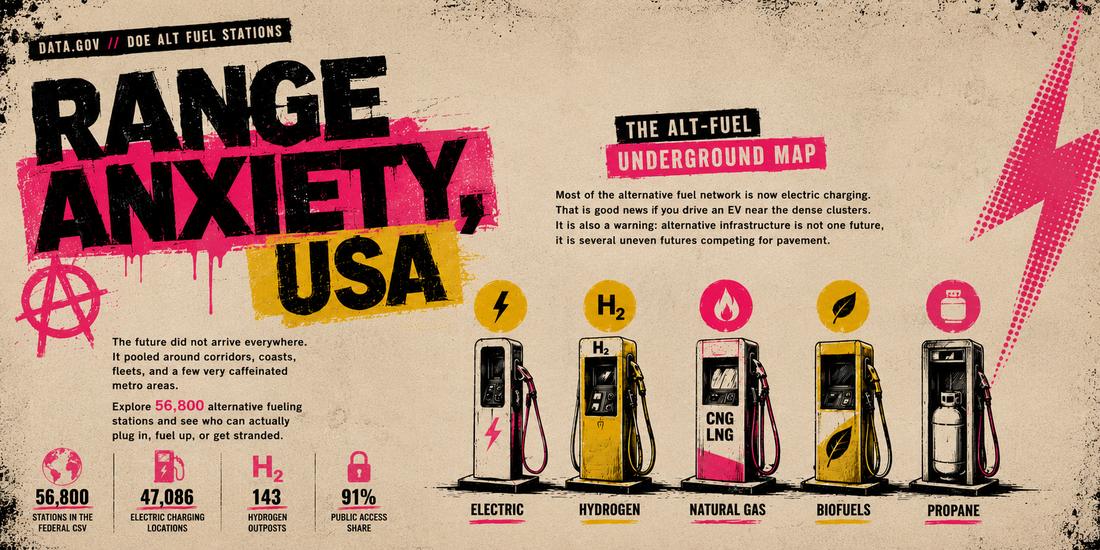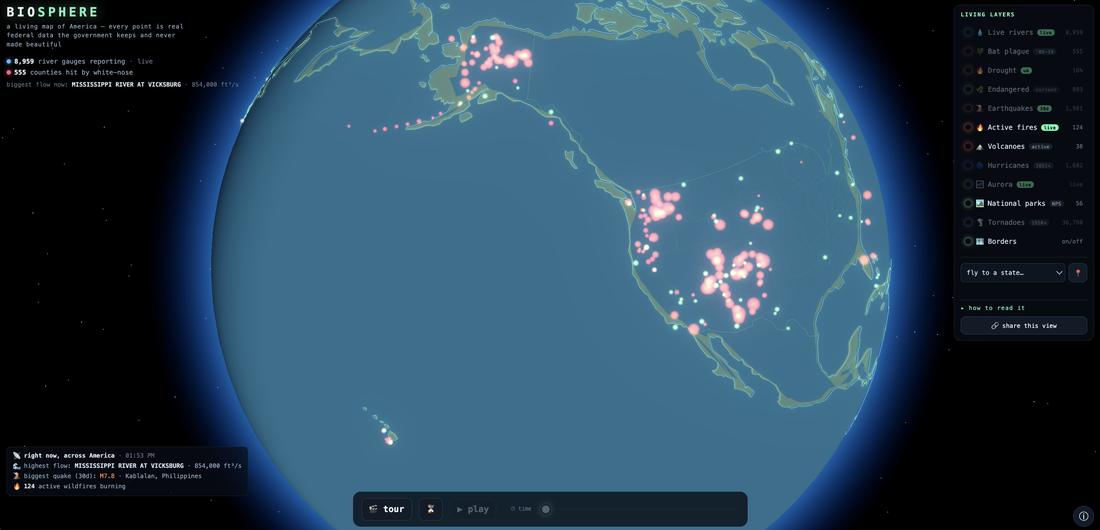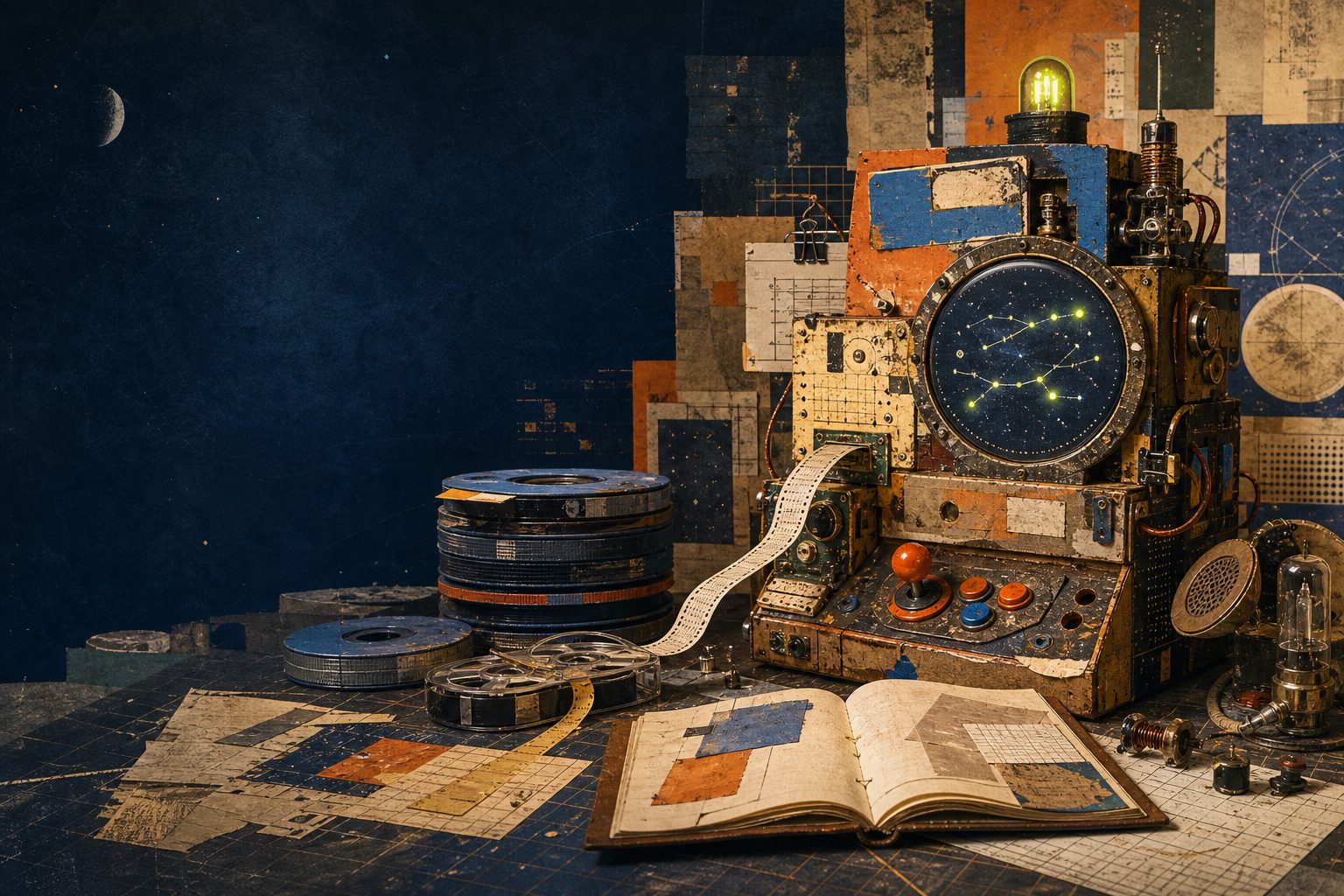
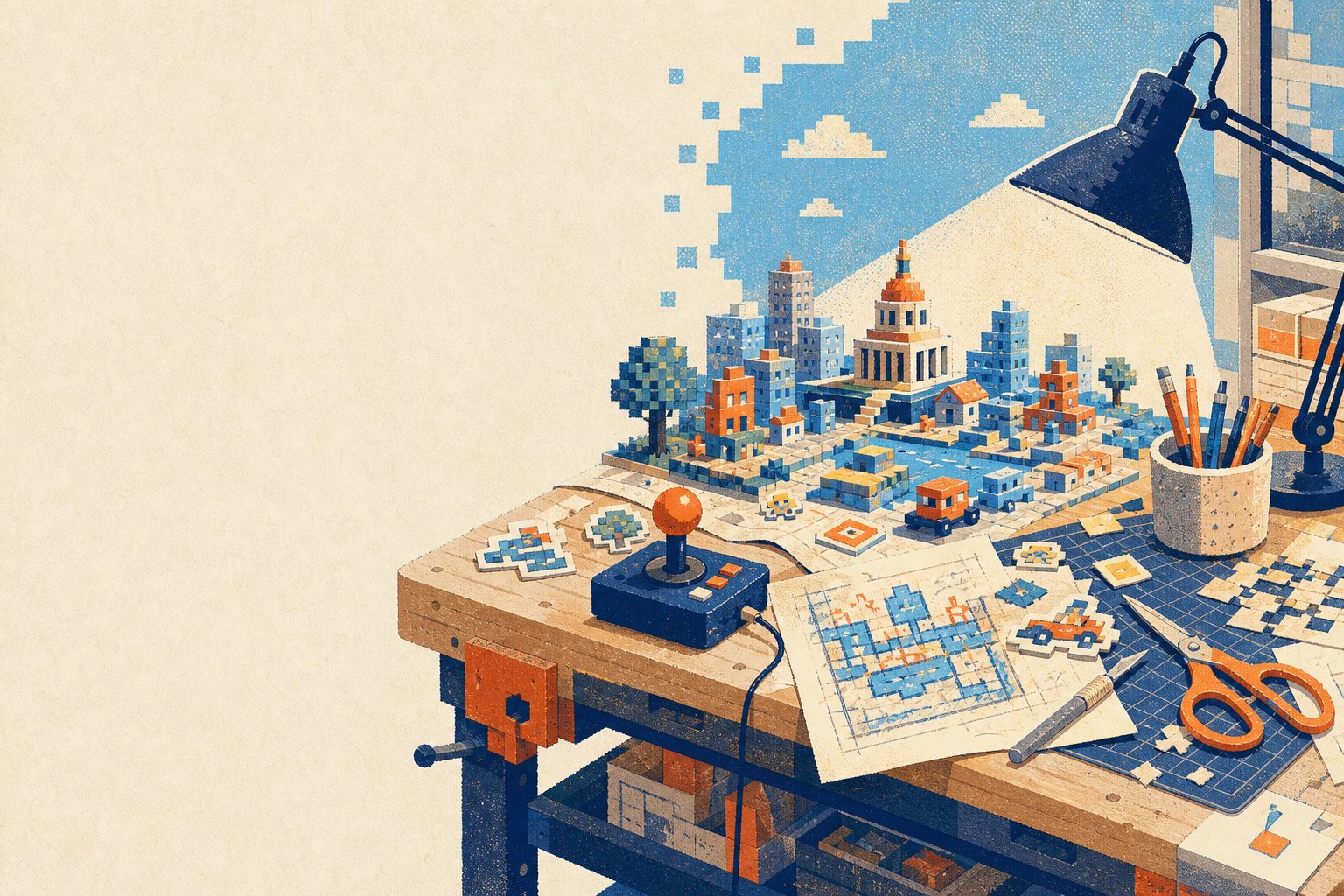
Original editorial illustration of a public build competition workbench

SUMMER INTO AI 2026

THE
BUILD
ISSUE

8 builders · 4 weeks · games, maps, bats, bears, and one very busy arcade

A magazine about what people made and what happened next · July 2026

Issue 01 · July 2026

A month of strange ideas became a place you can walk through.

Who made this

Publisher and editor: Eric Rhea

Magazine voices: Inez Park, Build Editor; Gideon Pike, Score Desk; Mara Voss, Field Reporter; June Calder, Culture Desk; Theo Mercer, Systems Critic; Ada Vale, Archivist.

Pictures: original magazine art and screenshots from the competition.

About those bylines

The six named editors are fictional voices written for this issue. Each has a different job and a different way of talking. They are not competitors, employees, or fake testimonials.

What is inside

Games you can play, maps that move, public data with sharp elbows, build stories, mistakes, revisions, and a four-page Mailroom where the software writes back.

SUMMER INTO AI · THE BUILD ISSUE02 / 68

Table of contents

Four prompts, one season.

  1. 078-Bit AmericaHorses, baseball, and tiny republics
  2. 13Independence EnginesMachines with opinions
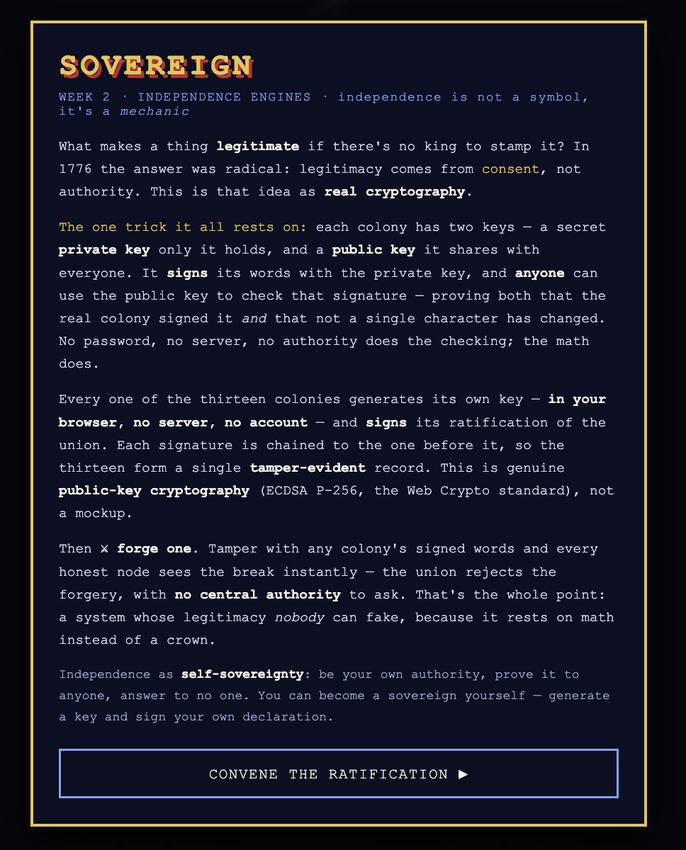
  3. 23Data.PunkMaps, records, and civic trouble
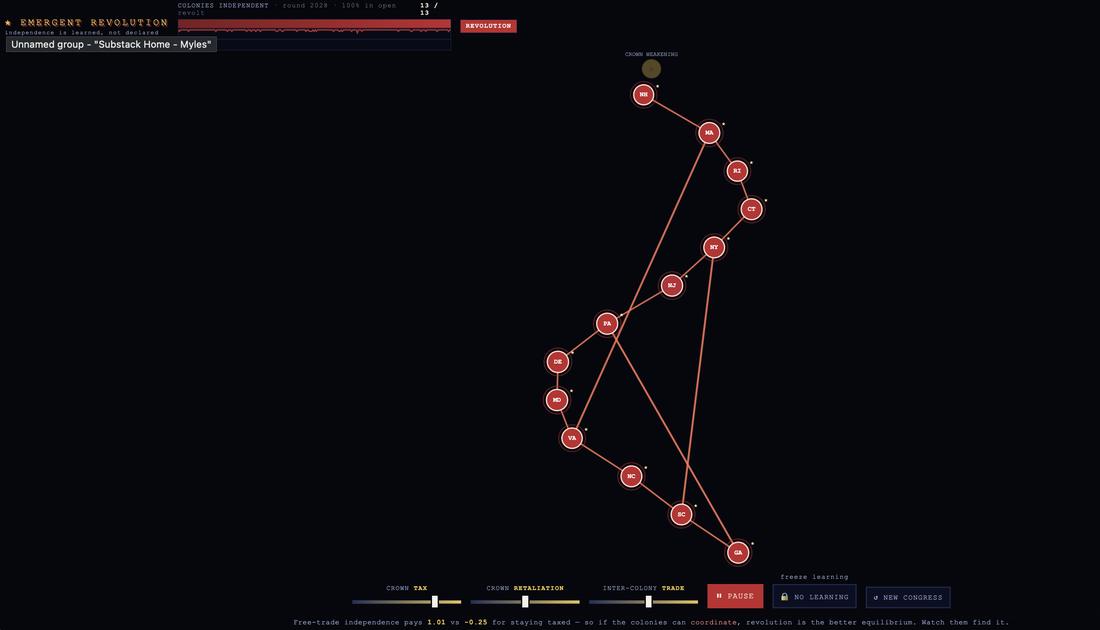
  4. 33Built on YesterdayOld parts find new lives
  1. 43The buildersEight people, eight ways to make
  2. 47What traveledIdeas that moved between projects
  3. 51More from the seasonScreens from every week
  4. 61The MailroomThe software writes back
  5. 65Credits + directoryNames, projects, and the full source list
SUMMER INTO AI · THE BUILD ISSUE03 / 68

Letter from the editor

First came Paul Revere. Then came the bear.

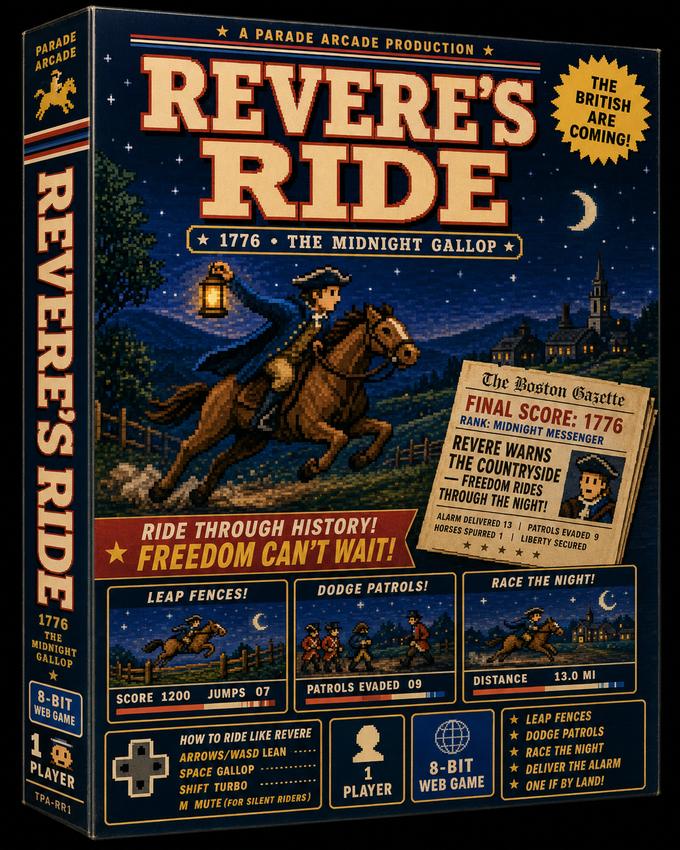
On the first week, Paul Revere rode across a browser at midnight. You could move his horse, throw broadsides, wake the town, and try to beat the sun. By the last week, nearly every project had become a cabinet inside a walkable arcade.

A lot happened between those two screens. A million glowing dots rebuilt a flag after you scattered it. A map followed a disease that has killed bats across North America. A fake civic operating system came back with an endgame. One family started cutting a go-kart trail through the woods and stopped when a bear appeared beside the tractor.

This competition began as four prompts and a deadline. I hoped those limits would give unfinished ideas somewhere to go. They did. The builders made games, videos, maps, tools, simulations, stories, and a physical trail. Some projects were polished. Some still had sawdust on the floor.

I organized the competition, built entries of my own, and edited this magazine. That is a crowded set of hats, so the bylines help. Six fictional magazine voices take turns looking at play, craft, culture, systems, numbers, and memory. They do not pretend to be the builders. They simply keep every page from sounding like the same person wearing six neckties.

The pages ahead stay close to what happened. You will meet the control that makes a musket frightening, the ZIP code that wakes three federal databases, the radio station rescued from an older project, and the arcade built to hold the whole season.

There are 91 different project pages behind this issue. The source files contain 95 rows because four entries appear twice. That bit of bookkeeping belongs in the credits. The stories belong here.

Eric Rhea
Publisher and editor
SUMMER INTO AI · THE BUILD ISSUE04 / 68

Gideon Pike · Score DeskFictional editorial persona

Season at a glance

Four weeks got crowded fast.

95source rowsthe full list as collected
91different projects4 entries appear twice
16week 18-Bit America
38week 2Independence Engines
19week 3Data.Punk
18week 4Built on Yesterday
Adam10
Kady3
Evan3
Heather4
Jake28
Kyle6
Myles18
Eric19

The bars count different project pages by builder. A short game and a giant world each count as one project here. This is a map of the season, not a ranking of whose work mattered most.

SUMMER INTO AI · THE BUILD ISSUE05 / 68

Ada Vale · ArchivistFictional editorial persona

How we made the magazine

Read the post. Open the thing. Take notes.

1. Start with the builder

Every story begins with a competition post. We kept the builder's name, project title, week, and original description close at hand.

2. Look at the project

When a demo, video, repository, or screenshot was available, we used it to understand what a reader could see and do. We did not fill missing pieces with guesses.

3. Tell one good story

Each feature follows a scene, a choice, or a problem. The technical parts appear when they help explain why the moment works.

4. Save the long list for last

The final pages carry all 95 source rows, including the four repeats. The printed stories name the builder and project. The browser edition keeps the live links.

SUMMER INTO AI · THE BUILD ISSUE06 / 68
Original editorial illustration for Week 1: 8-Bit America

Week 1 · Summer Into AI 2026

8-Bit America

A prompt about memory became a workbench full of games, small republics, and paper worlds.

01
SUMMER INTO AI · THE BUILD ISSUE07 / 68

Mara Voss · Field ReporterFictional editorial persona

Week 1 · first contact

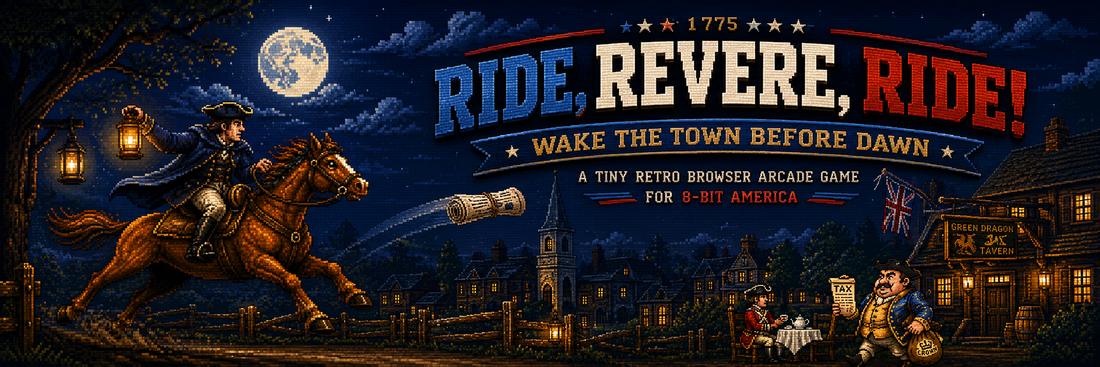
Paul Revere has four lanes and not much time.

Paul Revere has one horse, four lanes, a stack of warning papers, and a town that somehow chose tonight to sleep deeply.

The horse is already moving when the game begins. Moonlight falls across a colonial road. Dawn is coming. Paul Revere has townspeople to wake, and the Crown has filled the route with mud, barrels, loyalists, tax collectors, and two redcoats who picked the worst possible place for tea.

The controls are simple. Move across four lanes. Throw warning broadsides at houses, taverns, churches, blacksmiths, and militia posts. Each hit lights a building and raises the alarm. Hazards drain stamina. Combos raise the score. Dawn ends the ride, whether the town is ready or not.

Adam could have treated the Week 1 prompt, 8-Bit America, as a request for pixel art and old flags. He gave it a clock instead. The famous ride became a race. The warning became something the player must aim. The sleeping countryside became a row of targets rushing past in the dark.

A history lesson with a timer

The best joke is the redcoat tea table. Two soldiers sit in the road while an emergency gallops toward them. It is silly, clear, and perfectly rude. A player understands the obstacle before anyone explains it. History has been squeezed into arcade logic, then given a cup and saucer.

The rest of the game follows that same rule. Every part helps the player understand the ride. The horse creates speed. The lanes create danger. The broadsides create purpose. The alarm meter shows progress. Even the local high-score board gives failure a tiny ceremony: enter three letters, glare at dawn, try again.

The final browser build came after several rounds of subtraction. Oversized glows, helper boxes, odd cropping, and ghostly sprites had to go. Adam kept the basic loop and cleaned the road around it. Small games are fussy that way. One strange rectangle can become the most important object on screen.

Clear the road

Ride, Revere, Ride! gave the competition its first useful shove. The prompt could become something people touched, lost, laughed at, and replayed. Once that horse crossed the screen, 8-Bit America stopped being a phrase. It became a place with controls.

About this buildRide, Revere, Ride!: I Built a Tiny Paul Revere Arcade Game for 8-Bit AmericaLocal recordOriginal postDemoCodeBuilt by Adam · Week 1More at ericrhea.com/summer-into-ai-2026/
Screenshot from Ride, Revere, Ride!: I Built a Tiny Paul Revere Arcade Game for 8-Bit America
Local screenshot from Ride, Revere, Ride!: I Built a Tiny Paul Revere Arcade Game for 8-Bit America, built by Adam.
SUMMER INTO AI · THE BUILD ISSUE08 / 68

June Calder · Culture DeskFictional editorial persona

Week 1 · territory

The whole country starts turning red.

Game of Liberty turns the United States into a pixel tug-of-war where every bell buys a little ground and nobody gets to relax.

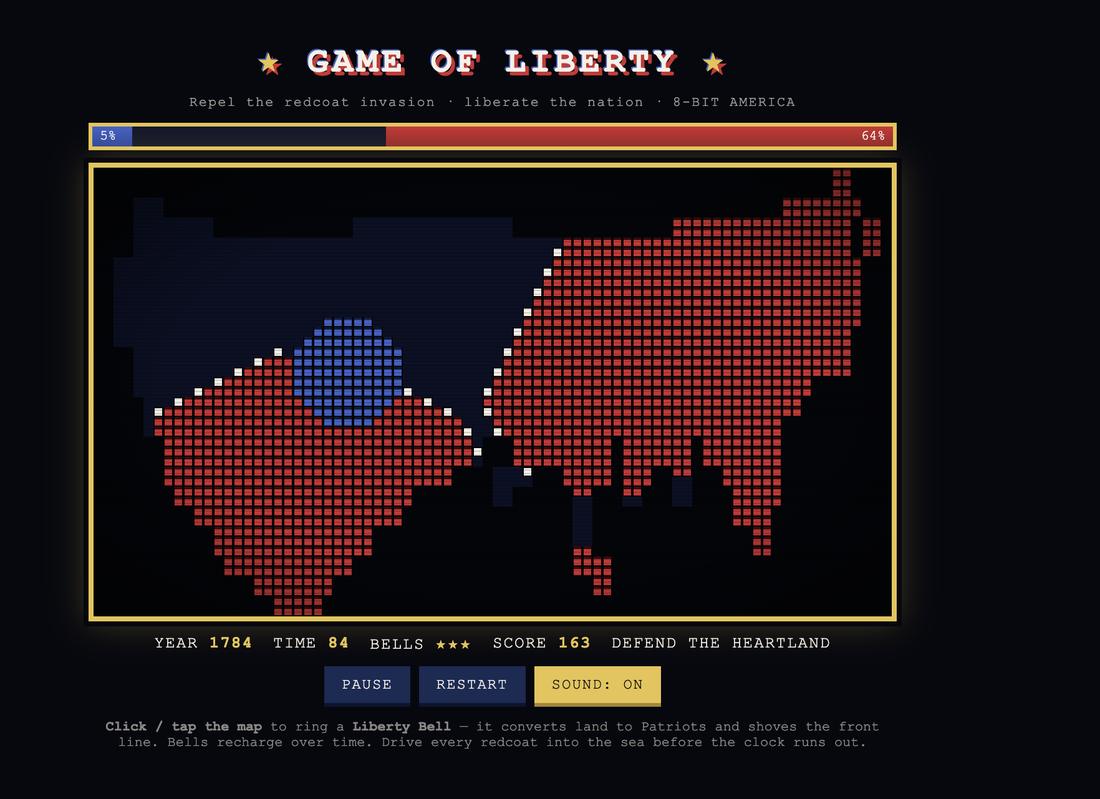
The map of the United States looks calm for about one second. Then red cells begin crawling inland from the East Coast. Blue territory shrinks. A bar at the top starts leaning the wrong way. The British are coming, and this time they brought a cellular automaton.

Myles built Game of Liberty as a 90-second territory battle. The player begins with a Patriot stronghold in the heartland. Redcoat forces spread across neighboring cells and arrive in stronger waves. Leave the game alone and the country can fall in roughly twenty seconds. It is an excellent cure for indecision.

The player fights back by ringing Liberty Bells. Each click sends a blue surge through nearby land. Bells need time to recharge, so random clicking quickly becomes a poor military plan. The real choice is where to push, when to wait, and which front looks one bad second away from collapse.

Ring first, plan second

That makes this entry feel different from the runners and shooters around it. Those games put one patriot on the road or battlefield. Game of Liberty hands the player the whole map. One click is small, yet its effect can roll through dozens of cells. Suddenly the revolution looks less like a duel and more like weather.

The chunky graphics help. Red advances. Blue resists. White flashes mark conversions. The score bar tells the story without a speech. The shape of the country remains familiar, but the game asks the player to think about it as connected ground. Losing one area changes the pressure on the next.

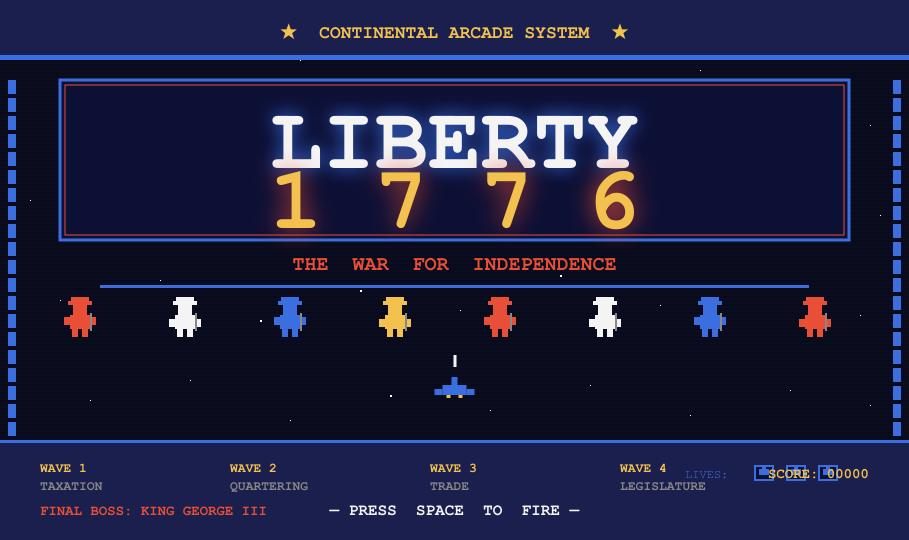
Myles also tips his tricorn hat to Eric's Megaman 1776 and Adam's Paul Revere game. Those entries made the player one person inside the fight. His answer moves the camera into the clouds and says, “Fine. You run the whole revolution.” Friendly competition rarely announces itself so neatly.

The map starts talking

Game of Liberty leaves one strong image behind: a national symbol that refuses to sit still. The flag colors have jobs. The map can panic. Liberty arrives through timing, attention, and a bell that always seems to recharge one heartbeat too slowly.

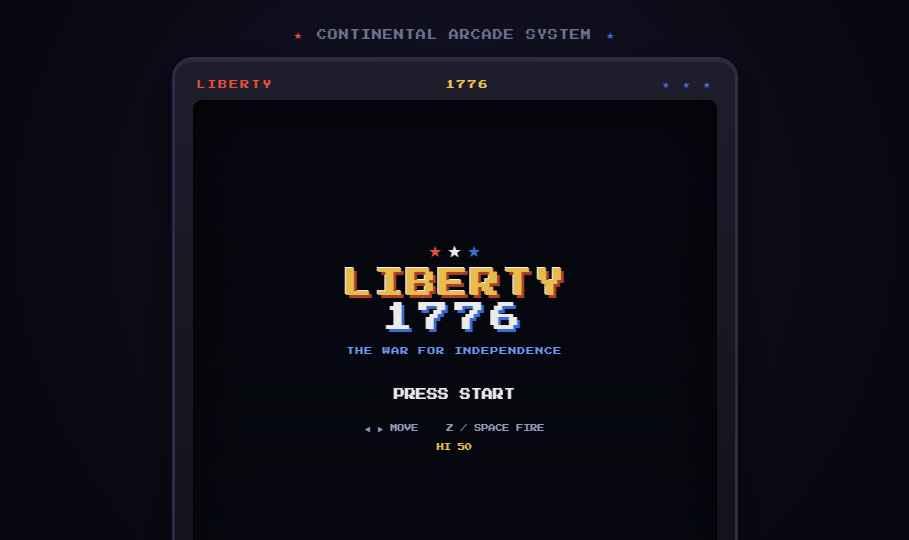
About this buildGAME OF LIBERTY - an 8-bit territory battle for the soul of a nationLocal recordOriginal postDemoCodeBuilt by Myles · Week 1More at ericrhea.com/summer-into-ai-2026/
Screenshot from GAME OF LIBERTY  -  an 8-bit territory battle for the soul of a nation
Local screenshot from GAME OF LIBERTY - an 8-bit territory battle for the soul of a nation, built by Myles.
SUMMER INTO AI · THE BUILD ISSUE09 / 68

Inez Park · Build EditorFictional editorial persona

Week 1 · build log

Wrigley Field gets a timerift.

Timestorm Baseball opens a hole over Wrigley Field, drops the Revolution into the ballpark, and tries to build an actual baseball game around the mess.

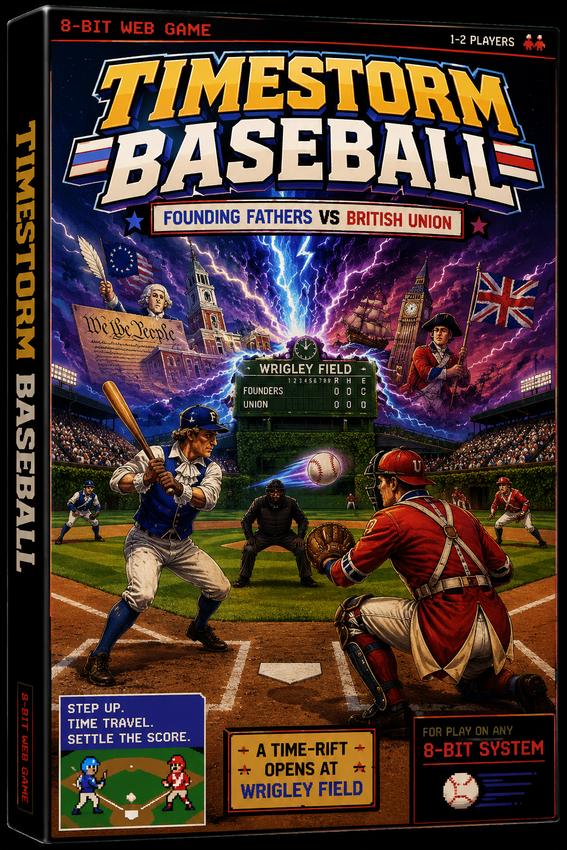
A timerift opens above Wrigley Field. American founders tumble out on one side. British opponents arrive on the other. They could debate independence, repair the tear in time, or ask several important questions about the future. Instead, they play baseball. This is the correct choice for a video game.

Eric built Timestorm Baseball over a weekend, but the version players see was his second attempt. The first build failed badly. That failure helped him understand the shape of the game. On the second pass, he planned by feature area and worked through pitching, batting, fielding, cameras, innings, and win conditions in smaller pieces.

Pitching became the strongest part. Each batter has a strike zone. The player moves a target with the arrow keys, holds the spacebar to charge the pitch, then releases. Speed and location both matter. A good pitch feels chosen. A bad one begins a short tour of the outfield.

Version two takes the mound

Batting still shows its rough edges. The player moves into position and presses space to swing. Bunting exists too, activated with the B key, though the computer-controlled infield handles short hits well enough to make bunting a risky little act of optimism. Eric says this part needs more polish. The game agrees.

Once the ball leaves the infield, computer players chase it and throw toward the bases. That puts more weight on pitching placement. Secret controls add the flavor of an old cartridge: a key starts an exhibition between computer teams, F unlocks a flying camera, and Shift+9 can send the game toward a very convenient ninth inning.

The ballpark carries its own experiment. Wrigley Field, nearby historic buildings, trees, and 2.5D players create the scene. Sprite cards were generated locally, textures were produced on local hardware, and three AI tools helped during development. The picture is rough in places, but the stadium feels like somewhere the impossible game could happen.

A ballpark built in pieces

Timestorm Baseball is large, odd, and easy to remember. Its useful lesson comes from the second attempt. Eric learned enough from the wreck to divide the next build into parts he could finish. Sometimes the shortest route to Wrigley Field goes through the crater left by version one.

About this buildSummer into AI: Timestorm BaseballLocal recordOriginal postDemoBuilt by Eric · Week 1More at ericrhea.com/summer-into-ai-2026/
Screenshot from Summer into AI: Timestorm Baseball
Local screenshot from Summer into AI: Timestorm Baseball, built by Eric.
SUMMER INTO AI · THE BUILD ISSUE10 / 68
SUMMER INTO AI · THE BUILD ISSUE11 / 68
SUMMER INTO AI · THE BUILD ISSUE12 / 68
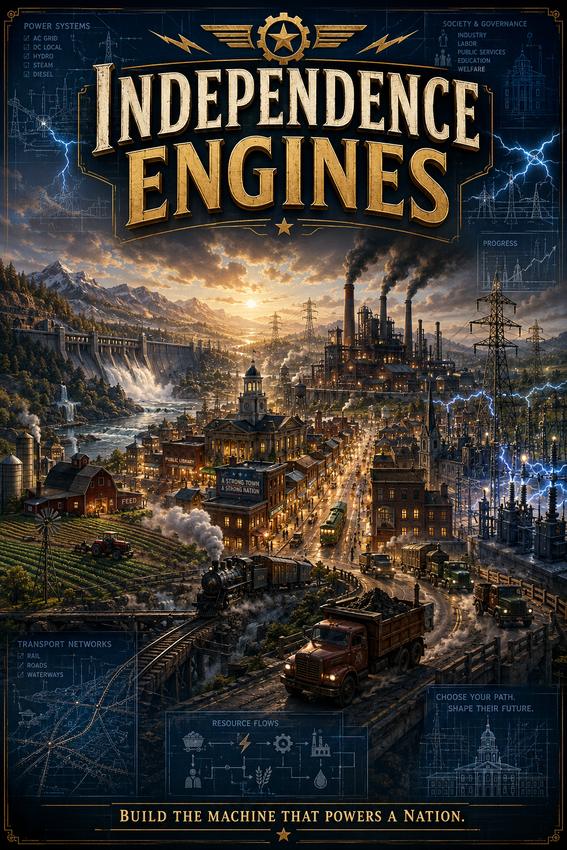
Original editorial illustration for Week 2: Independence Engines

Week 2 · Summer Into AI 2026

Independence Engines

A prompt about independence became an argument about systems, infrastructure, and what a prototype can carry.

02
SUMMER INTO AI · THE BUILD ISSUE13 / 68

Theo Mercer · Systems CriticFictional editorial persona

Week 2 · systems

Six reload steps and nowhere to hide.

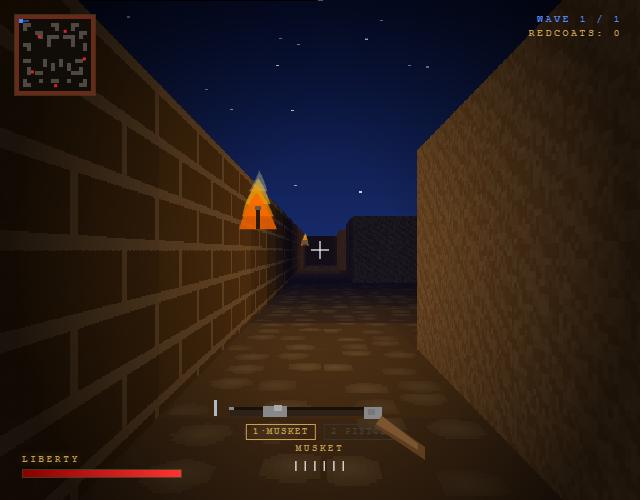
Minuteman makes one missed musket shot last six long reload steps while a redcoat keeps coming down the corridor.

The redcoat is close. The corridor is narrow. The musket fires once, and the shot misses. In many games, the player taps R and gets another chance almost at once. Minuteman has prepared a small historical punishment instead. The enemy keeps moving while the weapon demands six separate chores.

The sequence takes about 1.8 seconds: bite the cartridge, charge the barrel, seat the ball, ram it, prime the pan, ready the weapon. Each step has its own movement and sound. During that time the player can think carefully about the previous shot. There is plenty of time. Far too much time.

Jake built the game as a Doom-style first-person shooter set on July 4, 1776. The player faces Redcoats and Hessians in torch-lit halls. A pistol and bayonet provide other choices. Difficulty settings add more waves, and the hardest mode ends with a boss. Victory brings fireworks, as the date requires.

The longest 1.8 seconds

The entire game lives in one HTML file. It needs no game engine, outside library, runtime server, API key, or internet connection. Open the file and the corridors appear. The browser creates the walls, textures, sky, lighting, enemies, sound, and controls from what is packed inside.

That compact file contains a raycaster, which draws the 3D-looking world one narrow screen slice at a time. It also creates brick, stone, cobblestone, and sky textures when the game starts. Torchlight flickers each frame. Enemies patrol, spot the player, chase, fire, reload, and fall.

Yankee Doodle plays through the Web Audio API. The melody, harmony, bass, and marching drums are made from simple generated tones. Even the music follows the same rule as the graphics: carry the needed instructions inside the file, then let the browser perform them.

A whole fort in one file

The musket gives all that engineering a purpose the player can feel. Its slow reload changes every fight. A missed shot creates fear because the weapon behaves like a musket instead of a modern rifle wearing old clothes. Six small steps turn history into pressure.

About this buildSummer into AI 2026: MinutemanLocal recordOriginal postDemoCodeBuilt by Jake · Week 2More at ericrhea.com/summer-into-ai-2026/
Screenshot from Summer into AI 2026: Minuteman
Local screenshot from Summer into AI 2026: Minuteman, built by Jake.
SUMMER INTO AI · THE BUILD ISSUE14 / 68

Mara Voss · Field ReporterFictional editorial persona

Week 2 · one build answers another

One game cuts the supply line. The next lights the sky.

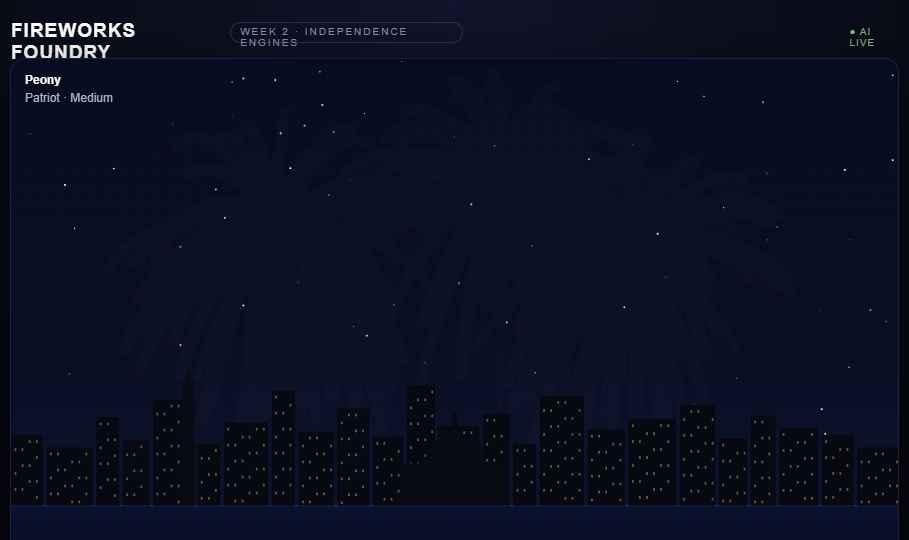
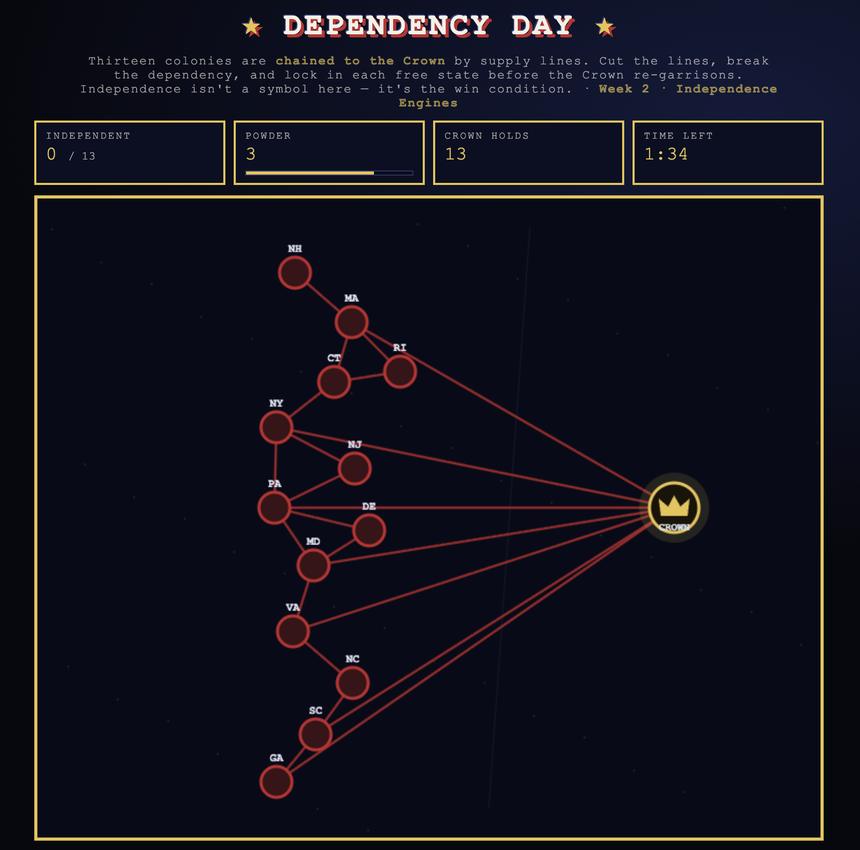
Fireworks Foundry began when one builder saw a game about breaking supply lines and decided to make the sky after the vote passed.

Jake had just seen Myles turn independence into work. In Dependency Day, the player cuts supply lines to the Crown until colonies break free. Jake looked at that struggle and asked what came next. What happens after the vote? What does the celebration look like once everyone finally leaves the meeting?

His answer opens above an American skyline. The Washington Monument and Capitol dome sit below a dark canvas. Windows glow. A crowd gathers along the shore with sparklers. Tap the sky and a shell rises, pauses, then opens into color. Hold the pointer down and restraint leaves the building.

Fireworks Foundry offers eight burst shapes and seven color palettes. Music can launch shells on the beat. A finale throws every shell type into the air. A poster button saves the current sky as an image. The player can arrange a show or simply make joyful noise until the horizon looks expensive.

After the vote, look up

Two live Claude features add surprise. Inspire selects a shell and palette, gives the combination a name such as Sapphire Halo, and fires a preview. Director accepts a short description of a mood, then stages a larger show with a title, captions, changing colors, music, and a final word drawn in fireworks.

Jake also planned for the moment when the online service fails. Built-in presets take over, and the canvas keeps working. That choice matters in a public demo. Nobody wants to invite a friend to a fireworks show and spend the evening staring at a broken button under a perfectly empty sky.

The project shows how builders can answer one another without making the same thing. Myles treated independence as a chain of hard choices. Jake built the release after the final choice. One entry cuts the line. The next lights the fuse. The conversation happens through working pages instead of a meeting.

One build answers another

By the middle of Week 2, the competition had found its rhythm. A post could become a spark for the next person. Fireworks Foundry makes that exchange easy to see. Someone else built the struggle. Jake built the boom.

About this buildSummer into AI 2026: Fireworks FoundryLocal recordOriginal postDemoCodeBuilt by Jake · Week 2More at ericrhea.com/summer-into-ai-2026/
Screenshot from Summer into AI 2026: Fireworks Foundry
Local screenshot from Summer into AI 2026: Fireworks Foundry, built by Jake.
SUMMER INTO AI · THE BUILD ISSUE15 / 68

June Calder · Culture DeskFictional editorial persona

Week 2 · infrastructure

The town keeps manufacturing consequences.

A troubled town, a demanding pantry, and a notebook with patriotic control issues show what happens when everyday tools start pushing back.

Adam built three machines for Week 2. One runs a town. One feeds a town. One turns an innocent sentence into a parade announcement. They look unrelated at first. Spend a few minutes with them and a family resemblance appears. Each begins with something ordinary, then lets consequences through the door.

Engines of Independence starts in an 1880 charter town. The player adds roads, rail, farms, factories, banks, newspapers, power, water, and public works. Growth feels good until the bills arrive. Coal brings power and smoke. Credit brings construction and panic. A bridge helps everyone, then asks to be paid for.

Food Engines moves from city hall to the dirt. The player gets 21 days and six actions per day. Crops need water and time. Food can spoil. The school wants lunch. The firehouse wants chili. The pantry wants enough stored food to face the final week without developing a cracker-based emergency plan.

Every solution sends a bill

Rain barrels, compost bins, greenhouses, kitchens, canneries, and root cellars turn crops into a working food network. The cheerful farm grid makes the rules easy to learn. Then weather and town requests arrive. A tomato may be cute, but it has appointments.

Manifest Notebooky takes aim at software that offers freedom with several exciting conditions. Type “I have a meeting,” and Mandatory Murican Autocorrect may turn it into a town hall battle report. Switch on MAXIMUM MURICAN and the setting stays locked for five minutes. Changing it back requires Form 1776-B.

The complaint form delivers the sharpest joke. The notebook takes the user's dissatisfaction and processes it into praise. A tool meant to hold private thoughts becomes a tiny office with flags, stamps, a cooldown timer, and strong views about your attitude. The app runs locally, so the invasion remains theatrical.

The notebook seizes the keyboard

Across all three projects, the machinery is funny because the trouble makes sense. Towns create costs. Food takes planning. Software settings can trap people inside choices they barely made. Adam gives each idea a bright coat of paint, then waits for the gears to start making suspicious noises.

About this buildEngines of Independence: I Built a Town Where Every Solution Creates a New ProblemLocal recordOriginal postDemoCodeBuilt by Adam · Week 2Food Engines: I Built a Tiny Farm Game Because Tomatoes Are InfrastructureLocal recordOriginal postDemoCodeBuilt by Adam · Week 2Manifest Notebooky: I Built a Notebook App That Immediately Betrays You for FreedomLocal recordOriginal postDemoCodeBuilt by Adam · Week 2More at ericrhea.com/summer-into-ai-2026/
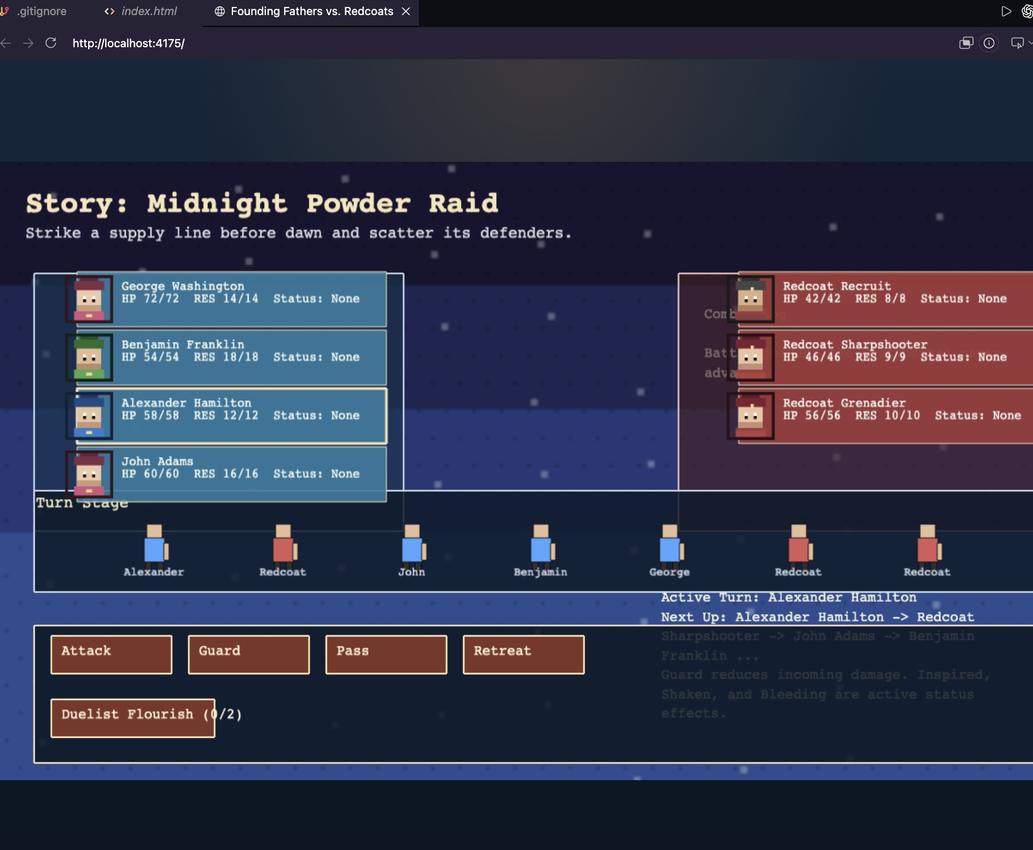
Screenshot from Engines of Independence: I Built a Town Where Every Solution Creates a New Problem
Local screenshot from Engines of Independence: I Built a Town Where Every Solution Creates a New Problem, built by Adam.
SUMMER INTO AI · THE BUILD ISSUE16 / 68

Inez Park · Build EditorFictional editorial persona

Week 2 · emergence

A million points learn where home is.

Perpetual Union lets a player tear a glowing flag apart, then watches more than a million points find their own way back.

The flag looks solid until the cursor touches it. Drag across the stripes and the surface bursts open. Points scatter into the dark. The familiar shape disappears under the player's hand. Then the cursor stops, and the lights begin their trip home.

Myles built Perpetual Union from a little more than a million glowing points. Each point follows a simple pull toward one place in the flag. No single piece knows how to draw the whole picture. It only knows where it belongs. Together, the points form stripes, stars, and a waving field of light.

The scatter effect is something the player causes. That detail gives the piece its weight. A video could show a flag breaking and returning. Here, the visitor makes the wound, holds it open, and watches the repair begin after letting go. The comeback feels earned because the disruption was real.
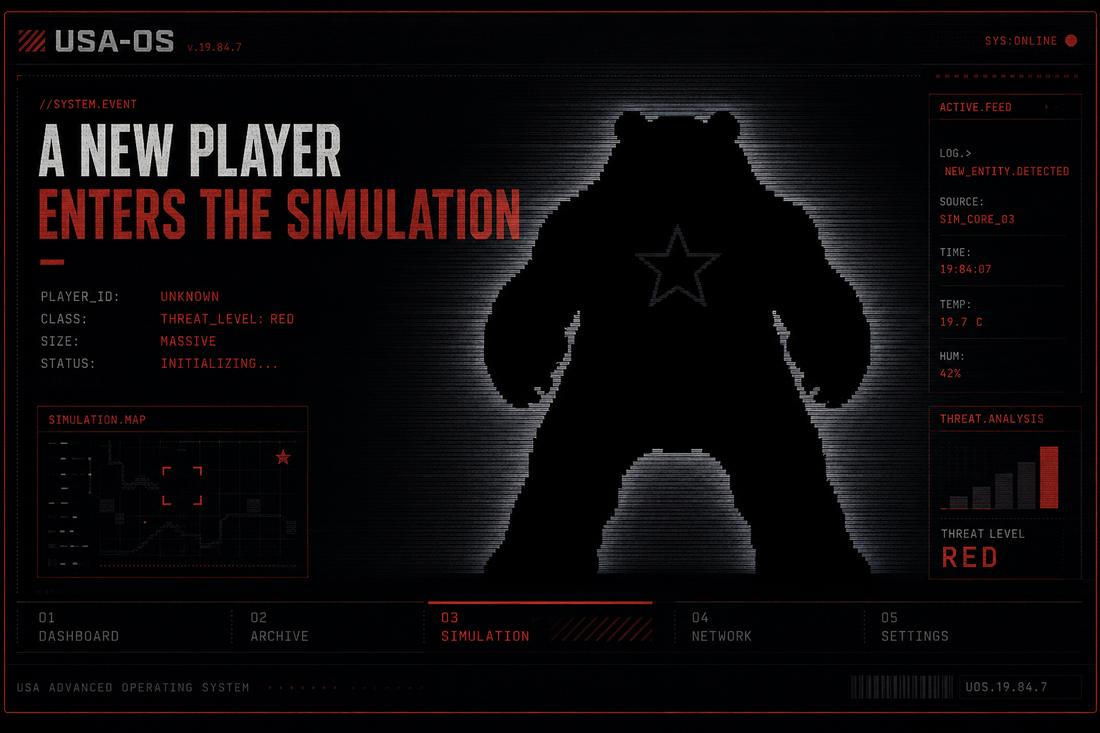
Go ahead, tear it

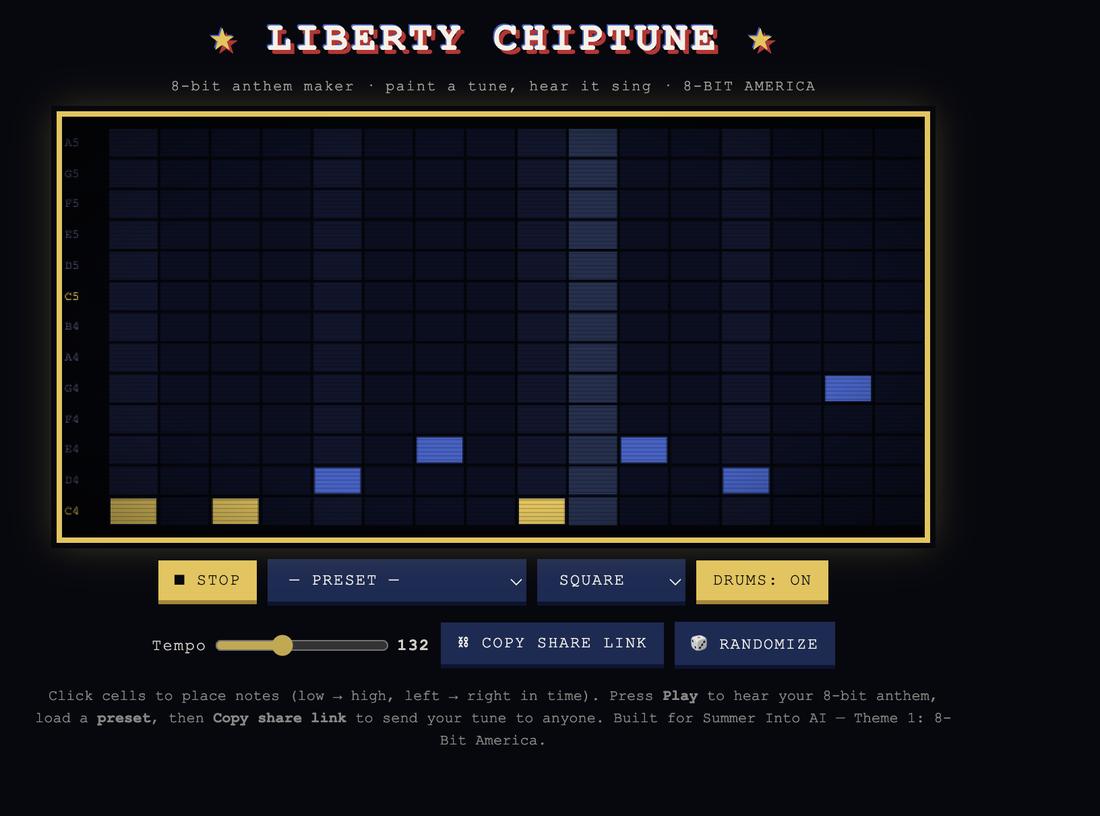
WebGL2 lets the graphics card update the points in parallel. Additive drawing makes overlapping lights grow brighter. A bloom effect spreads that glow across the screen. The flag can look like one smooth object from a distance, then reveal its huge crowd of moving parts when the player leans in.

Myles was answering Eric's experiments with scale, including a city filled with a vast number of buildings. He chose a different kind of bigness. His million pieces move, separate, and return. The large number gives the image both softness and strength.

The build rests on one clean choice: use a form that can perform the idea. A solid 3D flag could wave beautifully. These points can do more. They can be scattered. They can recover. They can show the difference between a picture that stays whole and a picture that knows how to become whole again.

A million tiny homecomings

Perpetual Union says everything through one gesture. Pull the lights apart. Wait. Watch. The flag returns without a command appearing on screen. More than a million small movements become one large answer.

About this buildPERPETUAL UNION - a million points of light that hold one flag, and re-form when you tear them apartLocal recordOriginal postDemoCodeBuilt by Myles · Week 2More at ericrhea.com/summer-into-ai-2026/
Original editorial art for Summer Into AI 2026
Original editorial art for this issue; not a screenshot of a competition entry.
SUMMER INTO AI · THE BUILD ISSUE17 / 68

Gideon Pike · Score DeskFictional editorial persona

Week 2 · scorekeeping

The scoreboard grows extra limbs.

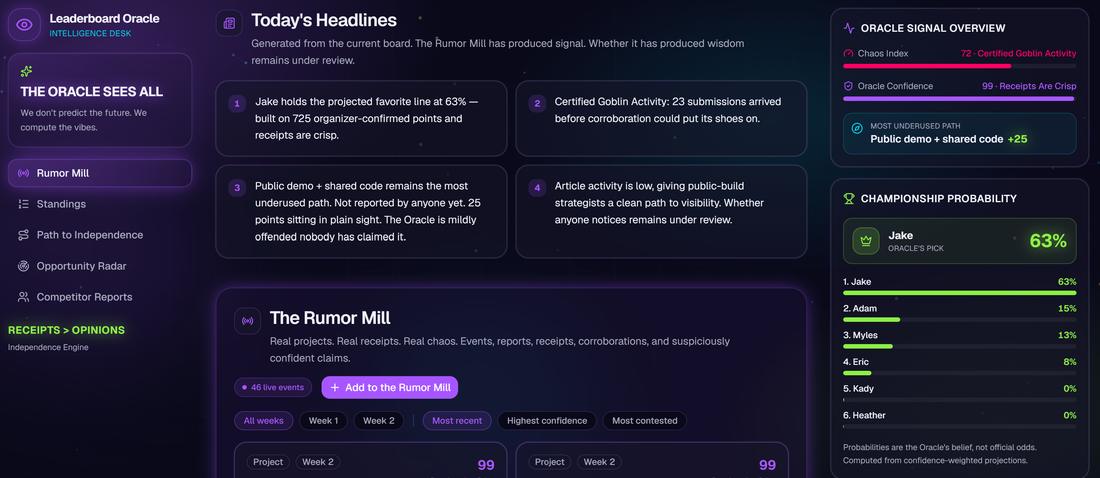
Leaderboard Oracle was born when a simple score table met several projects, extra posts, missing details, and one very nervous competitor.

Heather wanted to know who was winning. That sounded like a small question. Then the submissions arrived. One person had several projects. Another had a post, a live demo, and code. Similar titles appeared more than once. The score table began growing extra limbs.

The key was separating a project from an action that earns points. A project is the thing someone made. A scored action might be a published post, a demo, shared code, or a separate piece about another competitor. One project can create several actions. Mixing them together makes totals hard to explain.

Leaderboard Oracle keeps those pieces apart, then turns them into a competition view. It shows competitors, projects, confirmed actions, totals, and the material attached to each score. Heather built it for a practical reason: she wanted to know how worried she should be.

One project, several moves

Her favorite feature is Path to Independence. It looks at the gap between two competitors and shows what could close it. A person who is 35 points behind can see whether one complete submission would be enough. “You need 40 points” is less comforting than “you can do it,” but it is far more actionable.

Opportunity Radar looks for unfinished scoring chances. A project may be public while its post, demo, or code is still missing. The feature points toward the next move. It turns the standings from a list of what happened into a menu of what someone could do next.

Heather also gave rumors their own waiting room. A title mentioned in conversation does not immediately change a score. It can sit apart until someone finds enough detail to confirm it. Fast competitions create plenty of “Did Jake post again?” moments. The app gives those questions somewhere to live.

The rumor waiting room

Leaderboard Oracle is overbuilt in the best way. Heather took a personal worry, gave it fields and buttons, and made it answer back. Now the competition has a tool that can say who is ahead, why the number moved, and exactly how much trouble remains.

About this buildLeaderboard OracleLocal recordOriginal postDemoBuilt by Heather · Week 2More at ericrhea.com/summer-into-ai-2026/
Screenshot from Leaderboard Oracle
Local screenshot from Leaderboard Oracle, built by Heather.
SUMMER INTO AI · THE BUILD ISSUE18 / 68
SUMMER INTO AI · THE BUILD ISSUE19 / 68

Ada Vale · ArchivistFictional editorial persona

Week 2 · Independence Engines

38 engines, none of them idle.

Four projects appeared twice in the collected files, so this map shows each one once.

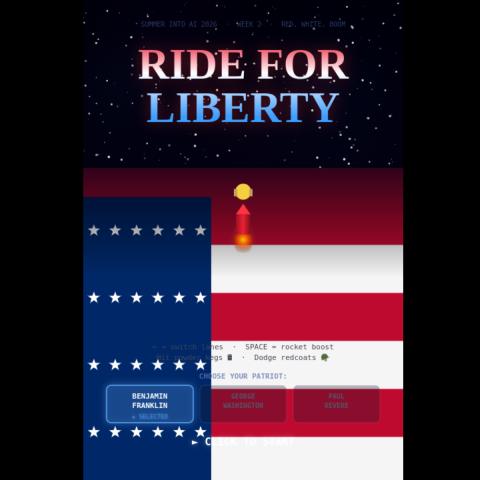
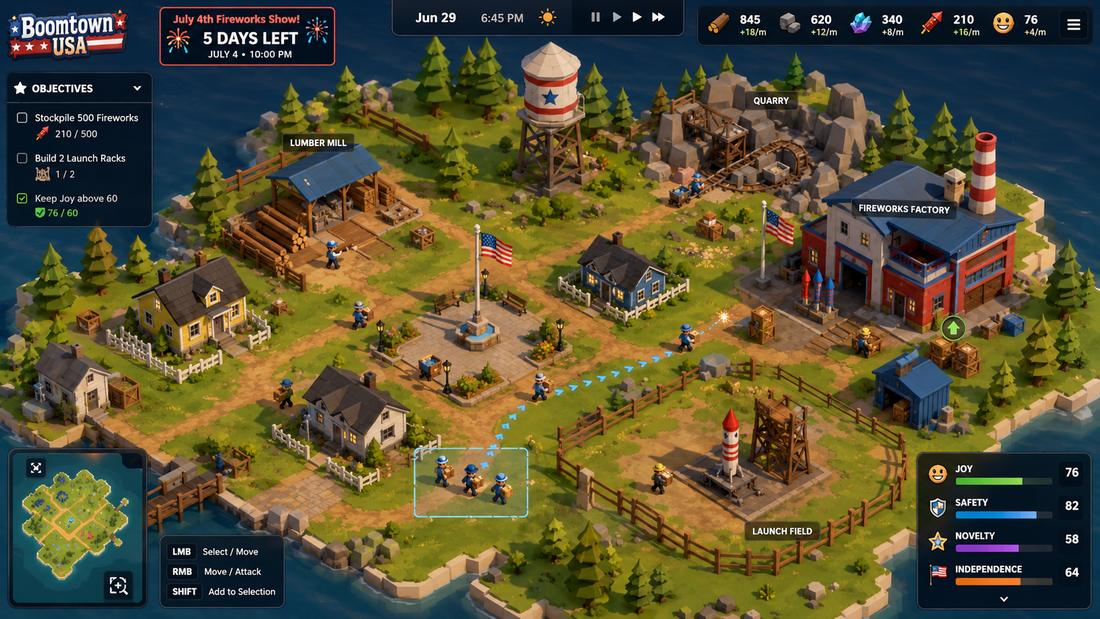
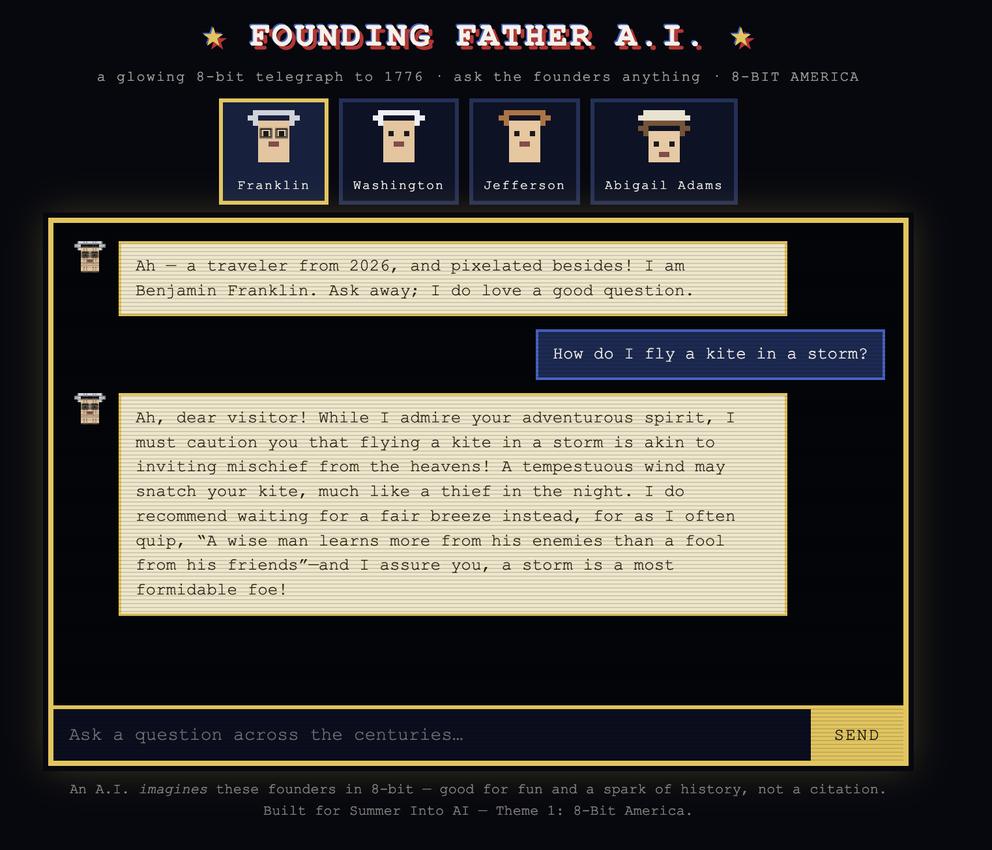
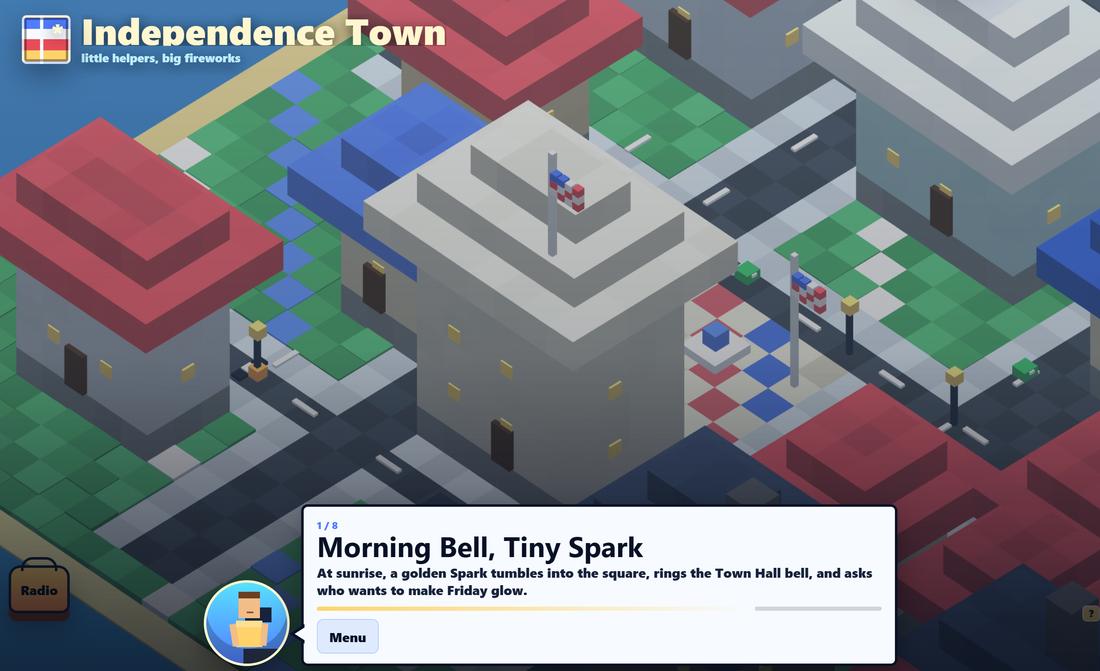
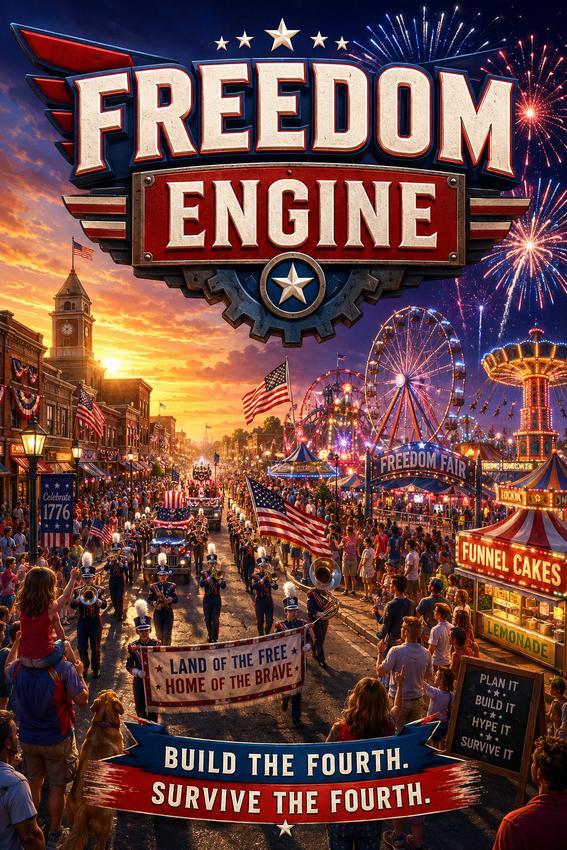
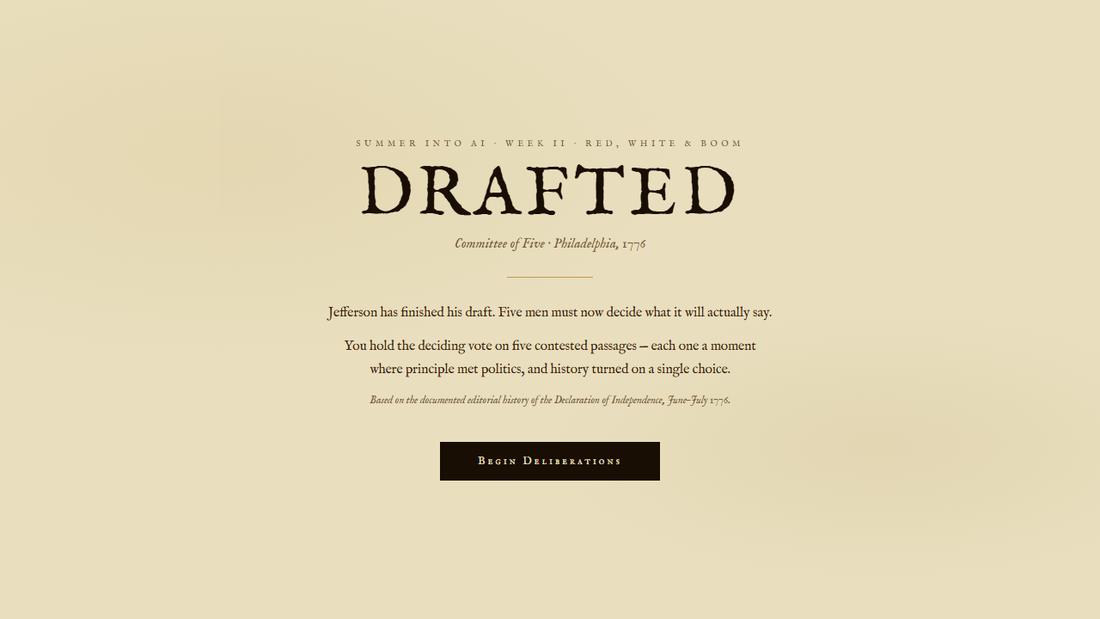
01JakeSummer into AI 2026: Fireworks Foundry02JakeSummer into AI 2026: Minuteman03JakeSummer into AI 2026: Ride for Liberty04MylesDependency Day - a single-file, in-browser systems-strategy puzzle for Week 2: Independence Engines.05JakeSummer into AI 2026: The Patriot Gazette06JakeSummer into AI 2026: Drafted07JakeSummer into AI 2026: Sons of Liberty08JakeSummer into AI 2026: Liberty Fireworks09JakeSummer into AI 2026: The Convention10JakeSummer into AI 2026: The Broadcast11JakeSummer into AI 2026: The Boston Defense12JakeSummer into AI 2026: The Culper Ring13JakeSummer into AI 2026: The French Alliance14AdamThe Internet Gave Us Independence. Then the Feed Asked for Rent.15AdamDead Man’s Ledger: The Money Engine16AdamFood Engines: I Built a Tiny Farm Game Because Tomatoes Are Infrastructure17AdamManifest Notebooky: I Built a Notebook App That Immediately Betrays You for Freedom18AdamEngines of Independence: I Built a Town Where Every Solution Creates a New Problem19AdamFreedom Engine: Red, White & Boomtown20KadyRiver Pig: Chassell Log Jam - My Week 2 Independence Engine21MylesPERPETUAL UNION - a million points of light that hold one flag, and re-form when you tear them apart22MylesSOVEREIGN - a union no king can stamp and no one can forge23MylesEMERGENT REVOLUTION - 13 colonies that teach themselves to be free24MylesSOLO: teaching a neural network to fly - and what I learned building it from scratch25MylesMURMURATION - independence isn't a symbol, it's an architecture26MylesLIBERTY ENGINE - an anthem with no conductor27MylesSELF-EVIDENT - I built a GPT from scratch that trains itself, live, in your browser28EvanHow to Turn Any Topic Into a Founding Fathers Briefing29EricSummer into AI: Week2 Submission: Zezek the Goblin: Web based Goblin Brain30EricSummer Into AI: Week2: Independence Town31EricZezek the Goblin32EricSummer into AI: Eric Submission #3: Qwen Franklin33EricSummer into AI: Week2 Submission: Eric's Summer Job Finder for Kids34EricSummer into AI: Week2 Submission: Eric's FANS of Independence Engines35HeatherLeaderboard Oracle36KyleBoomtown37AdamSAM AI: I Trained a Corporate Anti-Assistant and Accidentally Built a Meeting Simulator38EricSummer into AI: Week2 Submission: Independence Engines in Space
SUMMER INTO AI · THE BUILD ISSUE20 / 68

Gideon Pike · Score DeskFictional editorial persona

The scorekeeper

The scoreboard had to learn some nouns.

At first, scoring looked easy. Somebody posted a project. Somebody added points. Then the posts brought friends: videos, demos, repositories, updates, bonus websites, and two projects with names that sounded almost the same.

Heather's Leaderboard Oracle gave each thing its own chair. The project is what someone made. A post tells people about it. A scoring event says which rule was met. Once those pieces stopped sitting on top of one another, late entries and rule changes became much easier to handle.

The lesson is small and surprisingly portable. When a spreadsheet starts arguing with you, check whether one row is being asked to play three different characters.

01

Name the project.

02

Name what happened.

03

Apply the rule to that event.

SUMMER INTO AI · THE BUILD ISSUE21 / 68

The rules, translated

“A project is the thing someone made. An event is the thing that earns points.”

Heather, Leaderboard Oracle

That sentence untangles a surprising amount of trouble. A game can exist before its write-up appears. A video can count as a published post without pretending to be an app. A bonus can change the score without changing the project. Give each thing its proper name and the scoreboard stops behaving like a sock drawer.

Read Heather's project: Local recordOriginal postDemo

SUMMER INTO AI · THE BUILD ISSUE22 / 68
Original editorial illustration for Week 3: Data.Punk

Week 3 · Summer Into AI 2026

Data.Punk

Public files left their quiet servers and became maps, warnings, games, journeys, and local questions.

03
SUMMER INTO AI · THE BUILD ISSUE23 / 68

Ada Vale · ArchivistFictional editorial persona

Week 3 · public record

The disease crosses one county at a time.

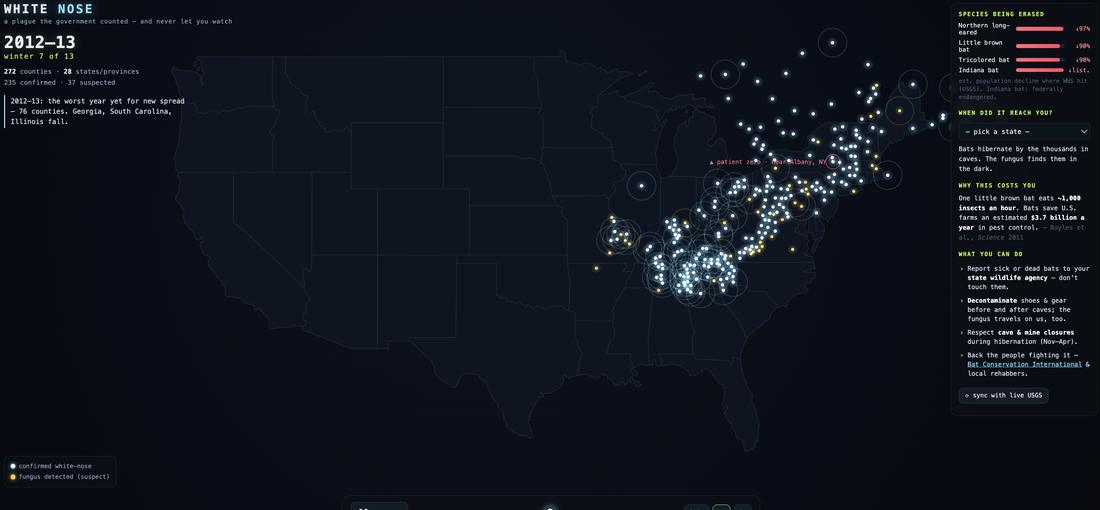
WHITE NOSE starts with one cave near Albany, then follows a disease across 13 winters and hundreds of counties. The map moves because the story does.

The story begins in the winter of 2006. Someone enters a cave near Albany, New York, and photographs bats with white fungus around their noses. It looks small. A patch of white on a sleeping animal. It is the first warning of a disease that will cross a continent.

Myles already had a reason to care. His girlfriend, Natasha, rehabilitates bats in Des Moines. When Week 3 called for buried public data, he went looking for the government files on white-nose syndrome. The agencies had mapped the disease county by county. Almost nobody outside those agencies had watched the map move.

Press play

Open WHITE NOSE and press play. Counties begin to glow in the winter when the disease reached them. The local data covers 13 winters, from 2006 through 2019, with 555 counties across 45 states and provinces. A long stack of map files becomes a trip you can follow with your eyes.

At first, the spread crawls down the Appalachians and into the Midwest. Then comes the ugly surprise. During the winter of 2015 to 2016, the disease appears in Washington State, about 1,300 miles from the known front. A dot jumps across the map. Suddenly the calm animation feels like a door slamming.

The fungus grows while bats hibernate. It wakes them too often, so they burn the fat they need to survive winter. Myles reports that some hard-hit colonies lost 90 percent or more of their bats. The map does not need spooky music. The empty caves are spooky enough.

What the dots cannot show

The page also tells you where its picture stops. The county release ends in 2019, even though the disease kept spreading. A glowing county means someone found the disease there. It does not mean every nearby cave was checked, or every bat was counted. Maps are good at showing where a light came on. They are less good at showing the dark around it.

Pick Iowa and the map reaches the state in the winter of 2014 to 2015. That brings the whole trip back to Des Moines, where Natasha still cares for bats one at a time. The government file ends. Her night shift does not.

About this buildWHITE NOSE - the government counted a plague killing millions of bats, county by county, and never built you a way to watch itLocal recordOriginal postDemoCodeBuilt by Myles · Week 3More at ericrhea.com/summer-into-ai-2026/
Screenshot from WHITE NOSE  -  the government counted a plague killing millions of bats, county by county, and never built you a way to watch it
Local screenshot from WHITE NOSE - the government counted a plague killing millions of bats, county by county, and never built you a way to watch it, built by Myles.
SUMMER INTO AI · THE BUILD ISSUE24 / 68

Theo Mercer · Systems CriticFictional editorial persona

Week 3 · civic tooling

Three federal systems answer one ZIP code.

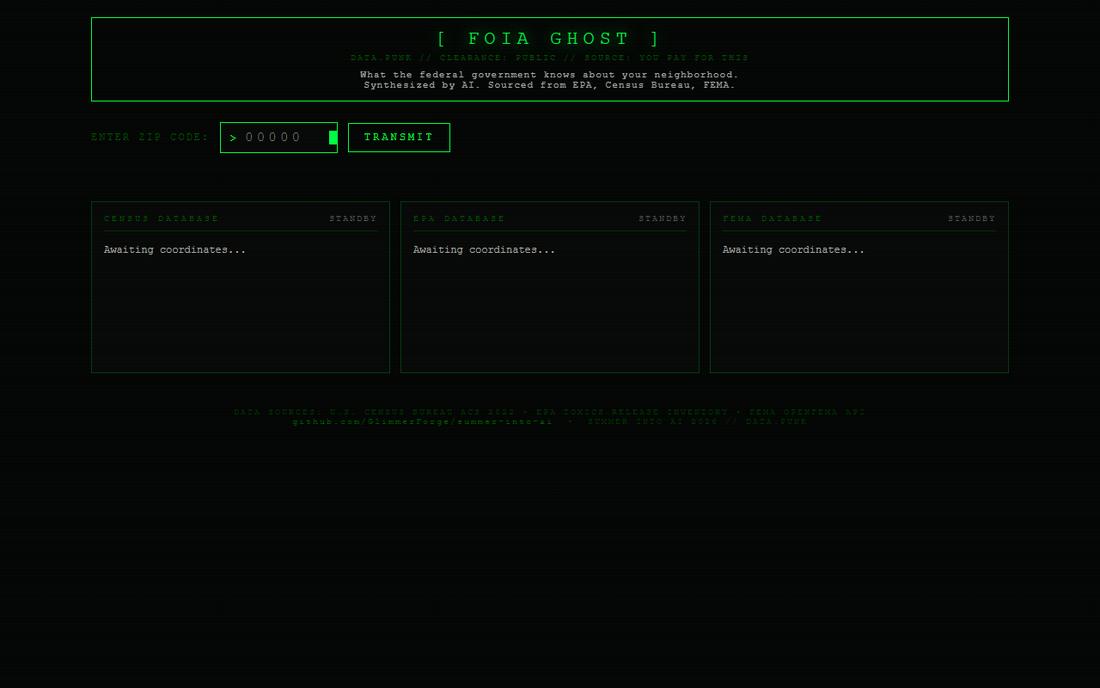
FOIA Ghost asks one ZIP code to introduce itself. Census, EPA, and FEMA answer, each carrying a different piece of the neighborhood.

Type a ZIP code into FOIA Ghost and press transmit. Three terminal windows wake up. One starts talking about people and homes. Another lists regulated facilities and chemicals. A third counts recent federal disaster declarations. Your neighborhood has entered the chat, and it brought paperwork.

The Census Bureau supplies income, poverty, housing age, and internet access from the 2022 American Community Survey. The EPA supplies nearby facilities from its Toxics Release Inventory, including counts tied to carcinogens and PFAS. FEMA adds county-level disaster declarations from the previous five years.

Three agencies walk into a ZIP code

Jake's app requests the three sources at the same time. Each one can finish on its own, so a slow agency does not hold the others hostage. The results arrive in separate panels before they are combined. This matters because federal agencies describe the same place with different borders, dates, and rules.

Once the panels fill, an AI assistant reads all three together. It writes a dossier with sections on money, environmental exposure, disaster risk, and the patterns it sees across them. A final badge rates the result as nominal, elevated, high, or critical. The spy-movie look is doing real work here. It turns form-filling into a reveal.

The interesting part happens between the panels. An older neighborhood may also have high poverty. A nearby facility may report chemicals of concern. The county may have taken repeated weather hits. No single agency is responsible for telling that whole story, because each one owns only a piece.

The join changes the question

Still, a nearby facility does not prove that it caused an illness. A disaster declaration does not describe every damaged home. A confident paragraph cannot make those gaps disappear. The app is strongest when it gives the reader a lead to follow, then keeps the original numbers close enough to check.

FOIA Ghost makes a simple bet: people should not need to know three agency websites before they can ask one neighborhood question. The agencies collected the pieces. The app puts them at the same table. For once, nobody has to schedule the meeting.

About this buildSummer into AI 2026: FOIA GhostLocal recordOriginal postDemoCodeBuilt by Jake · Week 3More at ericrhea.com/summer-into-ai-2026/
Screenshot from Summer into AI 2026: FOIA Ghost
Local screenshot from Summer into AI 2026: FOIA Ghost, built by Jake.
SUMMER INTO AI · THE BUILD ISSUE25 / 68

Mara Voss · Field ReporterFictional editorial persona

Week 3 · local texture

A NASA patent becomes a thing you can turn.

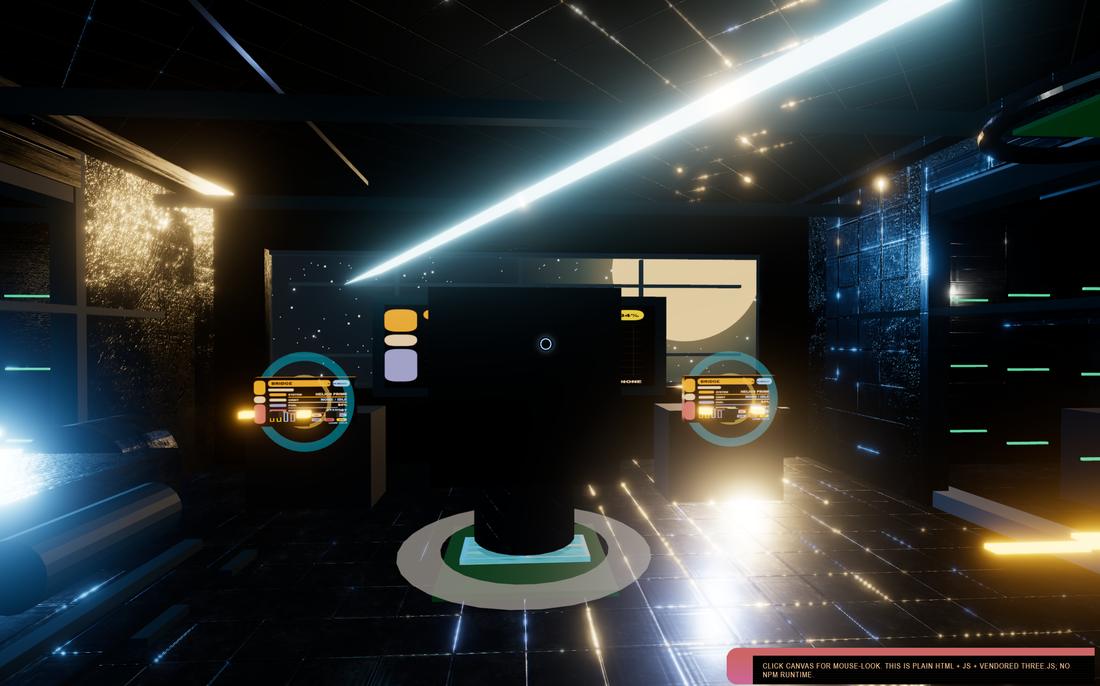
NASA Patents Decoder hides a public dataset inside a starship. You can read the patents, plot a course, or take a shuttle to find them.

The bridge has three doors, an escape hatch, and a glowing map of the solar system. Planets turn outside the window. A cartography screen tracks the ship as it moves. Somewhere inside this science-fiction tangle sits a collection of NASA patents from data.gov.

Eric could have made a search box. Instead, he made the patents into the reason for leaving orbit. The bridge carries a NASA reference library. The records become quest lines and story material. Choose a planet and the ship can steer toward it, jump to another solar system, or send a shuttle down to collect a research report.

Patents, but planetary

The build began as a question about 3D work. Eric asked Hermes to install Blender and a control bridge on Ubuntu, then used it to create and assemble parts of the starship. He had spent years learning Blender himself. This time, he says, he never opened the program window.

The finished world runs in Three.js inside the browser. The observation dome shows moving planets. The bridge map updates as the ship travels. The lights bloom like a record store discovered antimatter. Press 7 and most of the debug panels disappear, which is handy because they arrive with the enthusiasm of houseguests who missed the hint.

There are limits. The mobile experience barely works. The doorway into the observatory is awkward to find. The shuttle has a planned route instead of free flight. The frame rate drops when the visual effects get busy. Eric lists those trouble spots in the original build note and leaves them for another pass.

The spaceship has rough edges

Those rough edges do not erase the strange success in the middle. A pile of patent text became a place. The reader is no longer scrolling through inventions. The reader is crossing a bridge, choosing a destination, and wondering what NASA hid on the next planet.

Public data is often introduced like homework. NASA Patents Decoder introduces it like contraband from a spaceport. The patents remain real. The doorway changes. Sometimes curiosity needs a chart. Sometimes it needs a shuttle.

About this buildSummer into AI: Eric's Week3 Submission: Nasa Patents DecoderLocal recordOriginal postDemoBuilt by Eric · Week 3More at ericrhea.com/summer-into-ai-2026/
Screenshot from Summer into AI: Eric's Week3 Submission: Nasa Patents Decoder
Local screenshot from Summer into AI: Eric's Week3 Submission: Nasa Patents Decoder, built by Eric.
SUMMER INTO AI · THE BUILD ISSUE26 / 68

June Calder · Culture DeskFictional editorial persona

Week 3 · friction

The civic case file skips the soothing voice.

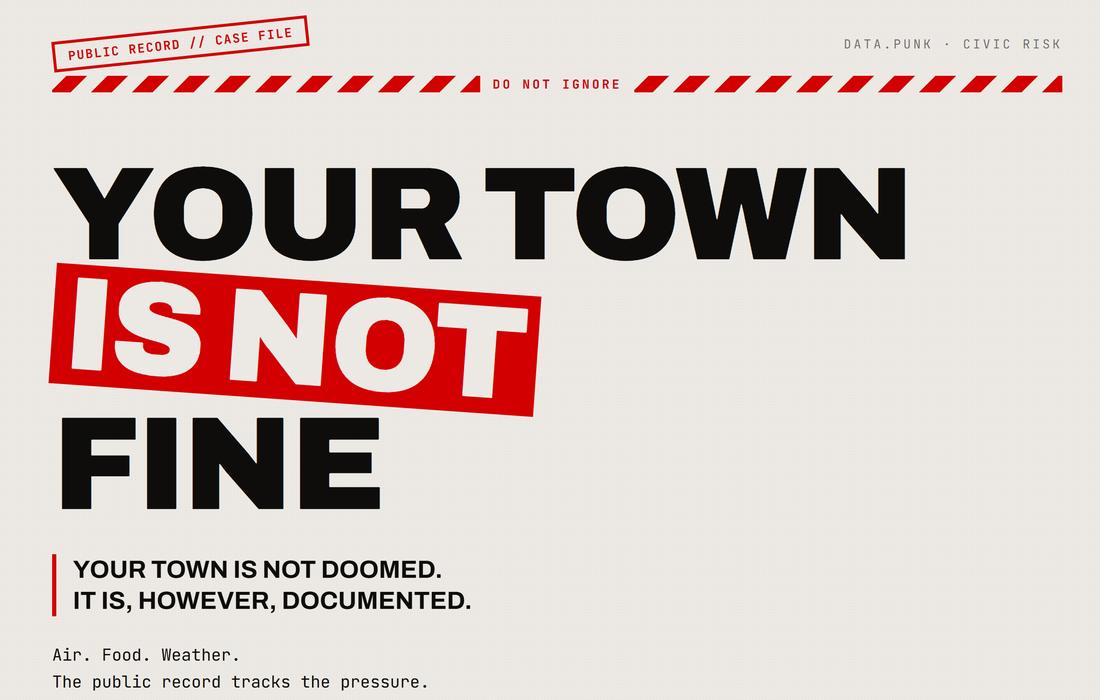
Your Town Is Not Fine dresses federal data like a photocopied warning flyer, then asks air, food, and weather what they know about your address.

The home screen does not offer a sunset photo or a list of charming coffee shops. It says YOUR TOWN IS NOT FINE in giant black type. The page looks like somebody stole a city report, ran it through a bad copier, circled the alarming parts, and stapled it outside a basement show.

Enter a town, county, or ZIP code. Heather's app turns it into a county-level file when possible, then checks three things people live inside every day: air, access to food, and damage from weather. These are not vacation ratings. You do not get to unsubscribe from breathing.

Three things nobody can opt out of

The air section uses EPA annual data from 2020 through 2024. It says clearly that this is recent history, not live air quality. The food section starts with the USDA Food Access Research Atlas, then rolls tract information up to the county. FEMA supplies weather and natural-disaster declarations.

The app creates a NOT FINE SCORE from zero to 100. Air and food each make up 40 percent. Disaster history adds 10 percent. Missing or odd source data adds the final 10 percent. Heather labels it as an app-made signal, not an official grade from any agency.

The first version found a very real problem: FEMA's biological disaster entries could make COVID the leading event in places where the page was supposed to discuss weather. Heather filtered the file to the right incident types. She also shows the geography used by each section, because a ZIP, county, and census tract are three different creatures wearing the same town name.

A score with a warning label

The loud design is more than clothing. A soft civic dashboard can make bad conditions look comfortably managed. This page refuses the beige wallpaper. Even so, its hardest line is aimed at the conditions, never the people living with them.

The final section gets practical. Find the county alert service. Check live air readings before hard outdoor work. Learn the flood map. Know where the next reliable grocery option is. The page arrives yelling, then hands you a list. That is surprisingly decent behavior for something dressed like a punk flyer.

About this buildYour Town Is Not FineLocal recordOriginal postDemoBuilt by Heather · Week 3More at ericrhea.com/summer-into-ai-2026/
Screenshot from Your Town Is Not Fine
Local screenshot from Your Town Is Not Fine, built by Heather.
SUMMER INTO AI · THE BUILD ISSUE27 / 68
SUMMER INTO AI · THE BUILD ISSUE28 / 68

Gideon Pike · Score DeskFictional editorial persona

Data.Punk field guide

Five ways to make a number start a conversation.

Mapsfind itwhere is it happening?
Modelsexplain itwhat might connect?
Toolsuse itwhat can I do next?
Archivessave itwhat should remain?
Critiquepush itwhat is going wrong?

No builder signed up for one of these boxes. Most projects wander across two or three. That is part of the fun. A good map can be a warning, a memory, and a reason to ask a better question.

SUMMER INTO AI · THE BUILD ISSUE29 / 68

Mara Voss · Field ReporterFictional editorial persona

Field notes from a data week

A spreadsheet does not look worried. A good map can.

The raw files were already online. County records, city art, bike trips, patents, fuel reports, emissions, and federal filings had been sitting on servers doing exactly what files do best: waiting.

Week 3 gave them motion. A disease crossed a map. A patent turned into an object. A ZIP code pulled several government sources into the same room. The facts did not change, but the distance between the facts and the reader did.

That distance matters. A table asks, “Will you study me?” An interface can ask, “Do you see what is happening near you?” It can also get carried away, so dates, labels, and limits still need to stay close.

The strongest entries did not make the data shout every answer. They gave it a clear first sentence and left the reader enough room to ask the next question.

SUMMER INTO AI · THE BUILD ISSUE30 / 68

Theo Mercer · Systems CriticFictional editorial persona

A note from the systems desk

A public file becomes public knowledge when somebody can find the story inside it.

That usually takes one good question, a clear view of place and time, and a way to tell where the numbers came from. The goal is not to decorate a spreadsheet. The goal is to help a person notice something they could not see before.

SUMMER INTO AI · THE BUILD ISSUE31 / 68
SUMMER INTO AI · THE BUILD ISSUE32 / 68
Original editorial illustration for Week 4: Built on Yesterday

Week 4 · Summer Into AI 2026

Built on Yesterday

A prompt about reuse made the season look backward, sideways, and finally at itself.

04
SUMMER INTO AI · THE BUILD ISSUE33 / 68

Ada Vale · ArchivistFictional editorial persona

Week 4 · follow the money

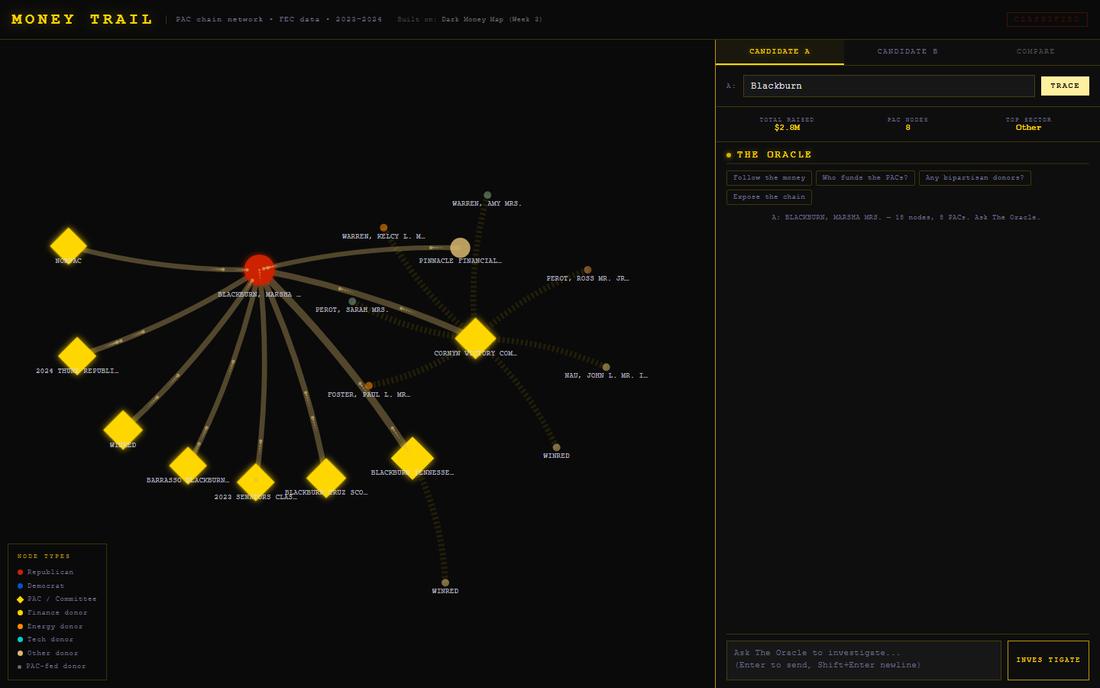
The donor map finds another basement.

Money Trail takes a one-layer campaign map and follows the donors behind the donors. The old picture becomes a much larger maze.

Enter a politician's name and a dark screen begins to fill. Gold diamonds drift into place. Circles gather around them. Lines pull the pieces into a web. Money Trail looks like a conspiracy board that learned to tidy its own string.

Jake began with Dark Money Map, his Week 3 project. That first version showed direct PAC donations to a candidate. For Week 4, he followed the chain farther. If a contributor is also a committee, the app asks who funded that committee. The path can now run from donor to PAC to candidate.
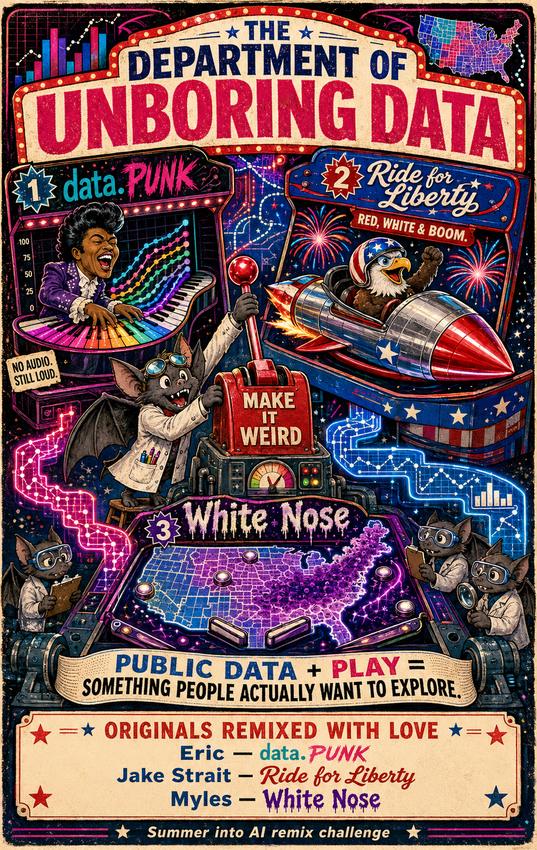
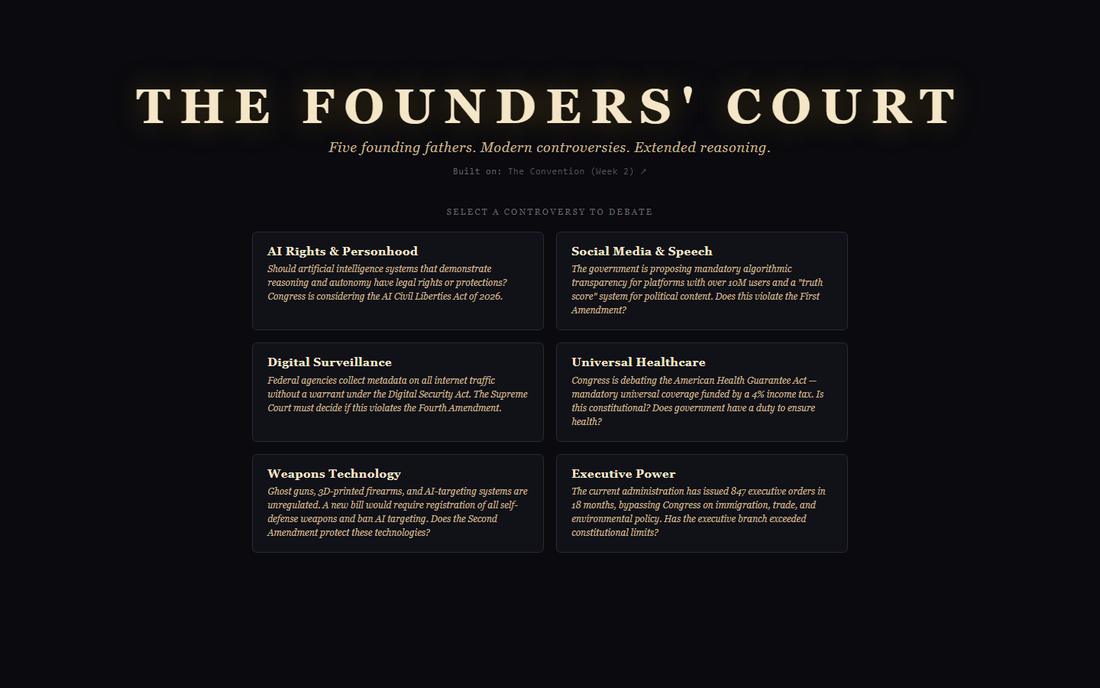
Follow the gold diamonds

The result appears in a live D3 force graph. Larger nodes represent larger dollar amounts. Dashed lines show money moving through an intermediary. The motion helps crowded groups separate on screen, so a reader can spot repeated names and clusters without starting with a giant table.
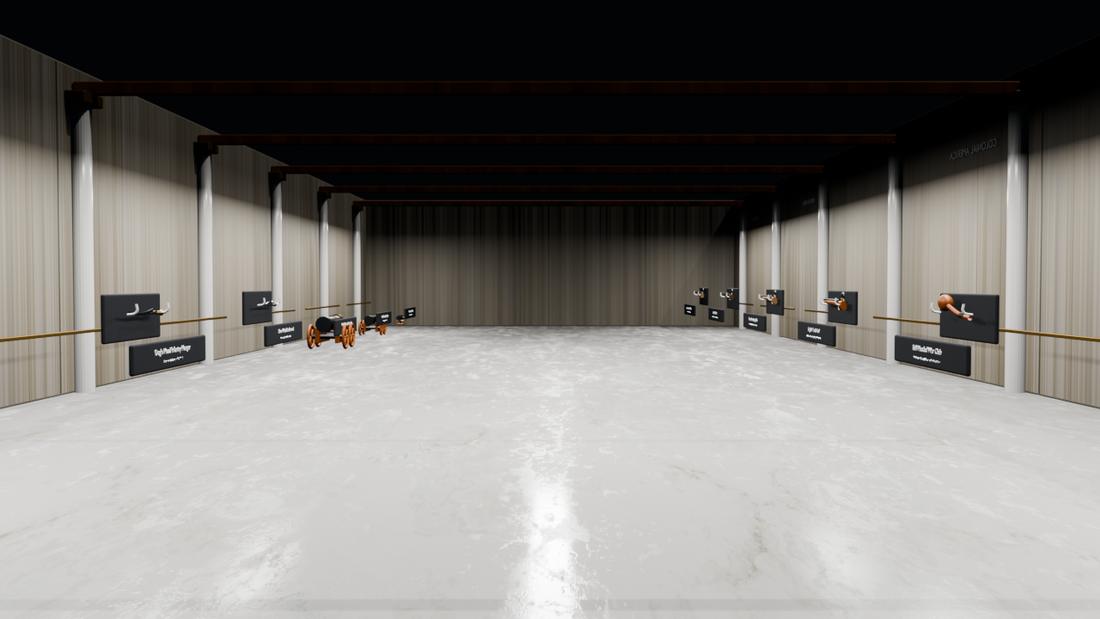
Compare mode makes the question more interesting. Load two candidates and donors found in both networks gain white rings. Shared names stop hiding in separate pages. The graph gives the eye a place to start, which is often the hardest part of campaign-finance research.

An AI assistant reads the network and highlights the nodes it mentions. Its longer analysis can find paths or clusters that deserve another look. The glowing node is a suggestion, though, not a verdict. A line means money moved between named groups. It does not reveal motive, friendship, or a secret meeting in a parking garage.

A graph can suggest, not convict

That limit belongs beside the spectacle. Campaign data is messy. Names vary. Committees sit between people and candidates. A graph makes the structure easier to see, while the meaning still takes patient reporting.

Money Trail earns its Week 4 title by asking more of the old project. It keeps the first map, adds depth, and turns yesterday's endpoint into today's entrance. The map did not get a fresh coat of paint. It found another basement.

About this buildSummer into AI 2026: Money TrailLocal recordOriginal postDemoCodeBuilt by Jake · Week 4More at ericrhea.com/summer-into-ai-2026/
Screenshot from Summer into AI 2026: Money Trail
Local screenshot from Summer into AI 2026: Money Trail, built by Jake.
SUMMER INTO AI · THE BUILD ISSUE34 / 68

Inez Park · Build EditorFictional editorial persona

Week 4 · recovered feature

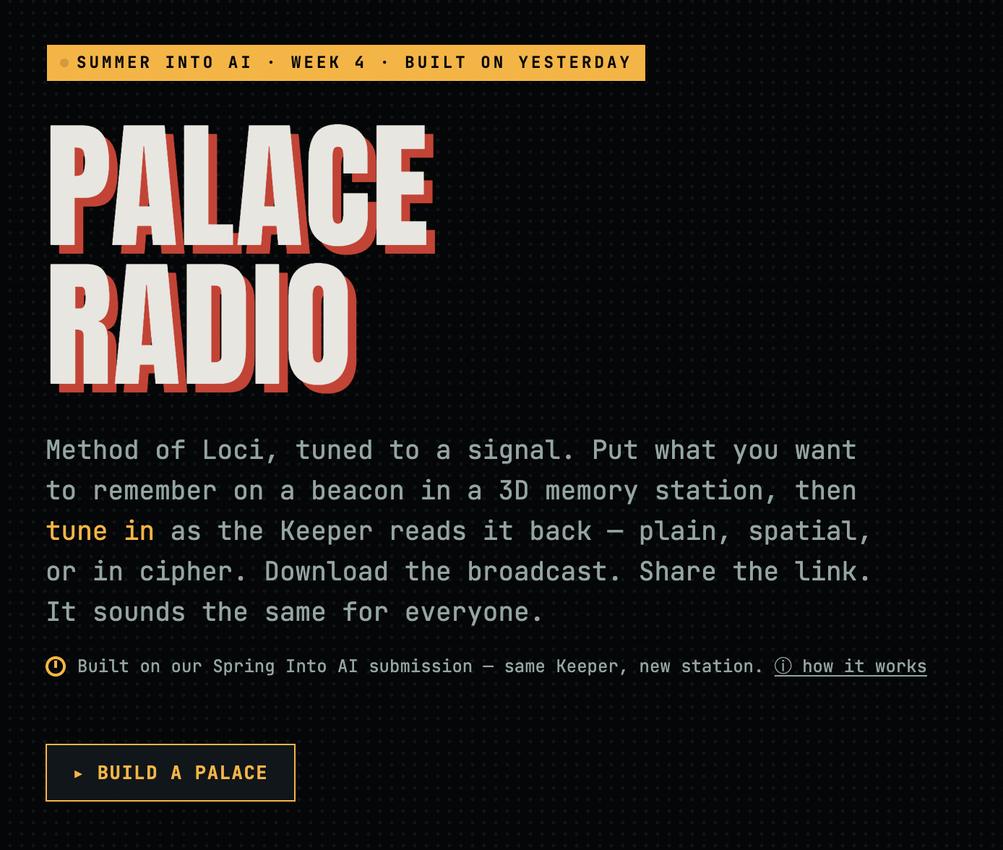
Palace Radio comes back on the air.

Palace Radio revives a feature cut months earlier, then solves its problems with spatial sound, measured furniture, and one wisely disabled button.

The door was the same height as a floor lamp. This was a problem, unless Palace Radio had quietly become a luxury home for action figures. Myles had imported free 3D furniture and resized every item by how large it looked on screen. The room had lost all sense of scale.

He stopped adjusting objects one at a time and read their real dimensions. The door measured about 0.49 by 1.01 meters, exactly half the size of a normal door. The whole Kenney furniture kit used the same half-scale rule. One 2x multiplier fixed the door and placed the desk at a believable 0.76 meters. Sixteen guesses became one measurement.

Measure the door

The room itself came from an older Spring Into AI project. In Memory Palace, a person placed vivid ideas around an imagined house to help remember a list. A later broadcast feature read the list aloud, but browser voices changed from device to device. The audio could not be downloaded or shared in one steady form.

Palace Radio rebuilds that missing feature. Walk through the 3D room with WASD. Claim fixed spots. Place an idea at a desk, bed, shelf, or door. The Keeper narrates the route with sound tied to each object's position. The full broadcast can be saved as a WAV file or shared so another listener hears the same performance.

Myles kept the room to 16 known locations. That boundary lets every spot have furniture, sound, and a fallback when something goes sideways. The room can grow richer without growing an endless number of ways to fall apart.

The cat that became a bird

Then a black cat became a bird. The assistant wrote a cat into a scene, but the shape library had a bird and no cat, so convenience won. Myles changed the instruction and expanded the library to 36 simple animals and objects. He also measured the furniture so the cat sits on the chair instead of floating near the ceiling like a furry weather balloon.

A text-to-3D feature also works, but remains switched off. Each object took about 30 seconds and cost roughly 20 cents, while the service offered no firm spending cap. The code still includes the path for people using their own key. The old missing feature finally shipped, plus a new lesson: sometimes the smartest button is the one left dark.

About this buildPalace RadioLocal recordOriginal postDemoCodeBuilt by Myles · Week 4More at ericrhea.com/summer-into-ai-2026/
Screenshot from Palace Radio
Local screenshot from Palace Radio, built by Myles.
SUMMER INTO AI · THE BUILD ISSUE35 / 68

June Calder · Culture DeskFictional editorial persona

Week 4 · atmosphere

The final week keeps its useful weirdness.

The closing week brought an SR-71 music video, a crowd of glowing letters, and redcoats that study your habits. Tidiness never had a chance.

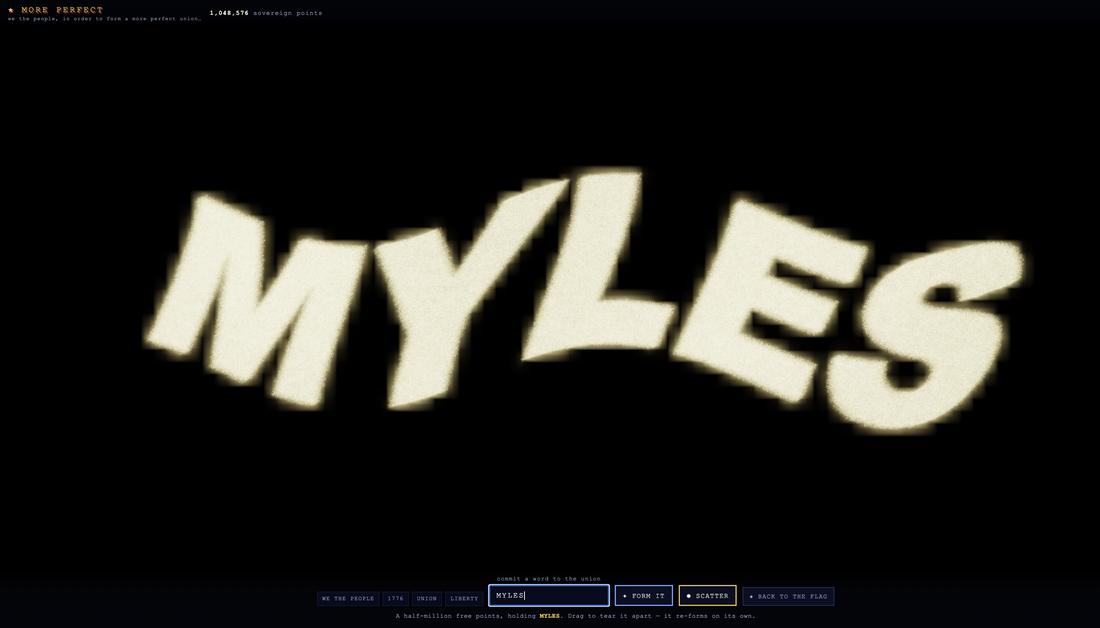
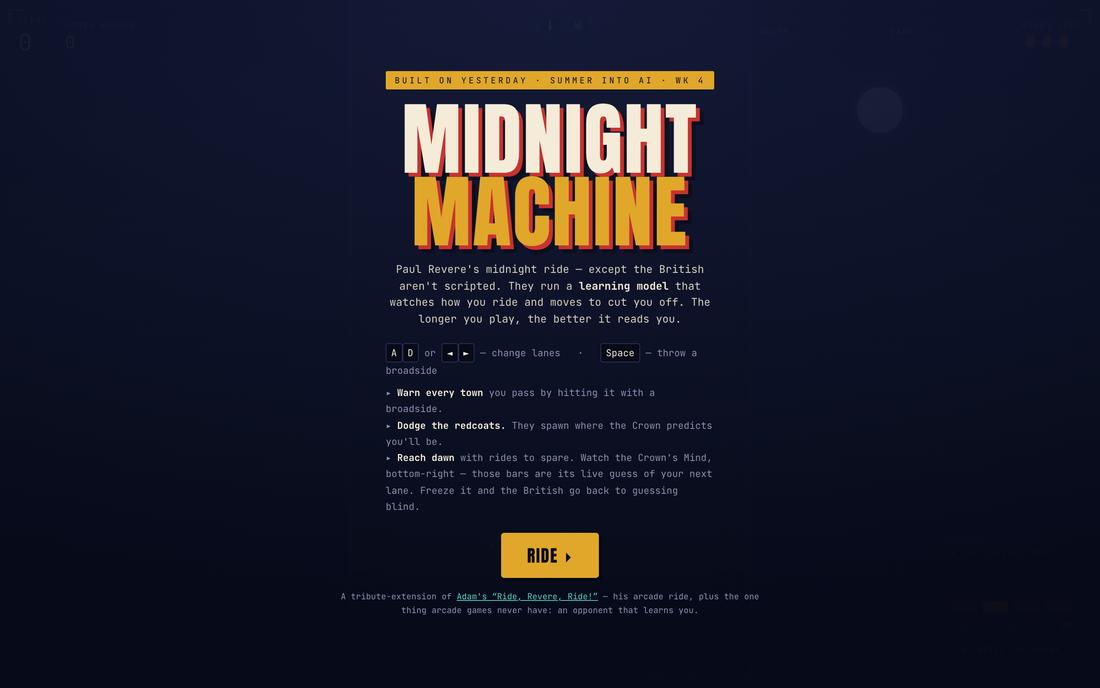
Final weeks are supposed to behave. Everyone finishes a loose end, poses for a group photo, and agrees the whole month followed a sensible plan. Summer Into AI closed with a black spy plane, half a million glowing points, and British soldiers learning where Paul Revere likes to ride.

Black Budget Bird began with Eric testing how far an AI helper could push Blender. The first SR-71 shapes were rough. More attempts produced a plane good enough to move into a Three.js flight game, complete with cockpit view, high-altitude flight, cloud condensation on the glass, and a few steering bugs still clinging to the wings. Then the game became a storyboard. The storyboard became a music video. Naturally.

Three unreasonable sequels

More Perfect returned to Myles's particle flag from Week 2. Instead of holding one fixed symbol, hundreds of thousands of points now form any words the visitor types. Text is drawn on an invisible canvas. Each bright pixel becomes a target. Pull the letters apart with the cursor and the crowd finds its way home.

Midnight Machine borrowed Adam's four-lane Paul Revere game and gave the redcoats a tiny learning brain. Four times each second, it watches lane choices and movement habits. Against a rider with patterns, Myles's tests raised its catch rate from about 25 percent to 41 percent. A wildly unpredictable rider made it nearly useless. The machine learned a lesson about humans, then humans learned to wiggle.

Each project starts with something that already worked. Then each one changes the kind of thing it is. A Blender experiment becomes a music video. A flag becomes a public writing surface. A simple arcade game becomes a duel with your own habits.

Reuse changes the genre

That is more interesting than polishing the old screen and calling it version two. Creative reuse can be wasteful, funny, and gloriously sideways. It may add a cockpit when a menu would do. It may also reveal the idea that was hiding inside the first project.

The final week never settled into one house style. Good. A competition should end with a larger set of possible moves than it began with. This one ended with afterburners, particles, and redcoats who had become alarmingly attentive.

About this buildSummer into AI: Eric Week4 Submission: Black Budget BirdLocal recordOriginal postDemoBuilt by Eric · Week 4More PerfectLocal recordOriginal postDemoCodeBuilt by Myles · Week 4Midnight MachineLocal recordOriginal postDemoCodeBuilt by Myles · Week 4More at ericrhea.com/summer-into-ai-2026/
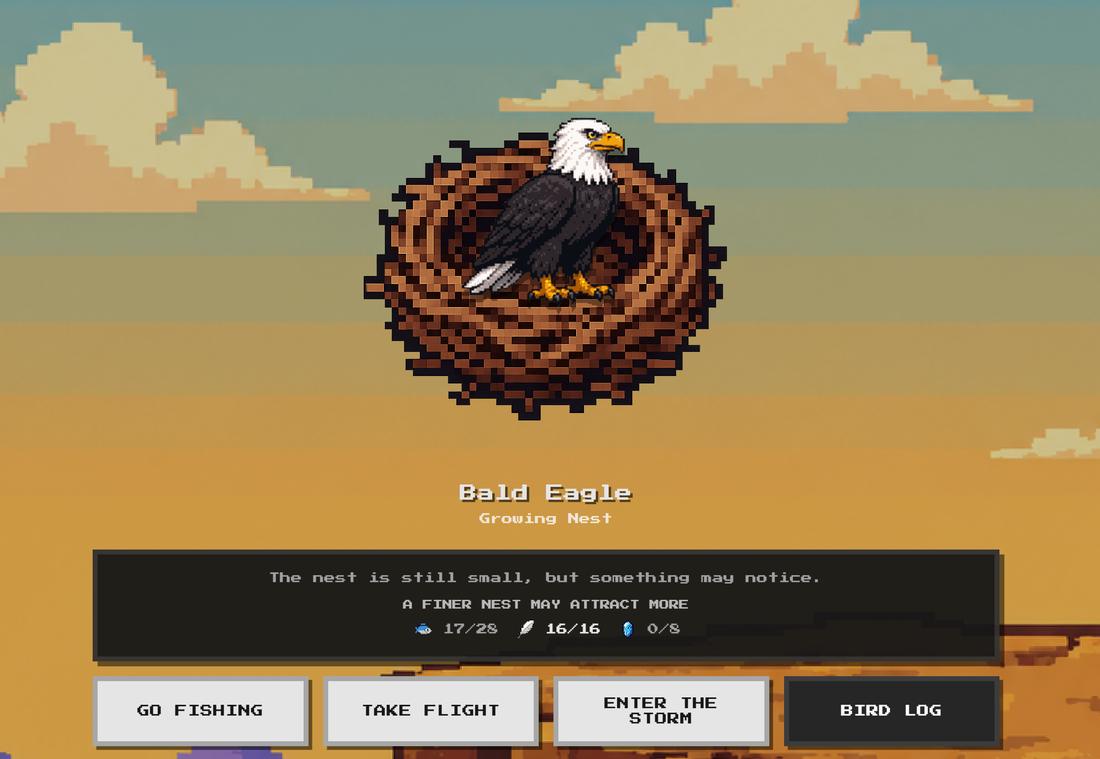
Screenshot from Summer into AI: Eric Week4 Submission: Black Budget Bird
Local screenshot from Summer into AI: Eric Week4 Submission: Black Budget Bird, built by Eric.
SUMMER INTO AI · THE BUILD ISSUE36 / 68

Theo Mercer · Systems CriticFictional editorial persona

Week 4 · synthesis

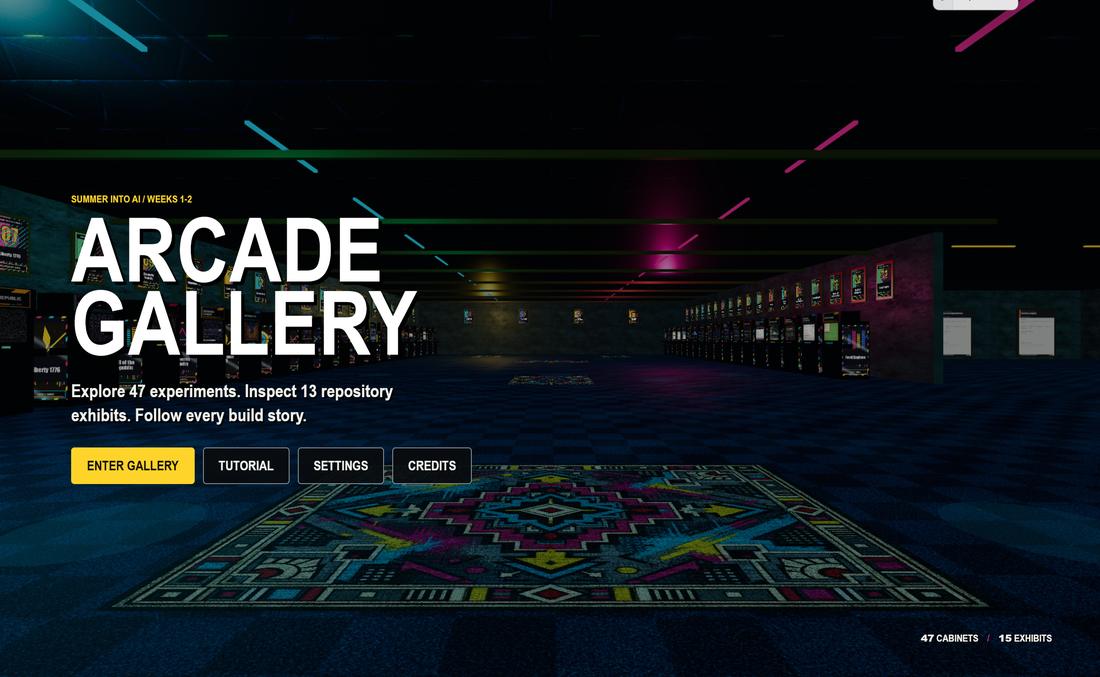
Nearly fifty cabinets become one memory palace.

Arcadia turns a competition list into a place with nearly 50 arcade cabinets, a poster hall, a replay screen, and an entirely unnecessary bowling alley.

Walk through Arcadia and the competition stops looking like a month of browser tabs. Cabinets glow in rows. Posters wait in another room. A television plays recorded clips. Music changes as you move. Somewhere past all that, bowling pins are preparing to regret their career choice.

Eric began with the shared CSV used to track posts, games, and code. He turned nearly 50 entries into arcade cabinets. Walk up to one and press Enter. A panel opens with the project name, its story, and the available routes to the demo, post, or code. Every cabinet follows the same pattern.

The list grows walls

Projects without a playable game still get a place. The poster gallery borrows from academic conferences, where years of work may be compressed into one large visual. Here, repositories and written builds become wall-sized displays. A list tells you a title. A poster asks you to stop for a minute.

The rest of Arcadia kept growing. A television uses gameplay clips recorded during the four weeks. A jukebox experiments with spatial sound. The bowling alley includes quick games, leagues, scoring screens, and sound effects. None of this was required to make the index work, which may be why it is memorable.

There is also a hidden Independence City built from an earlier town. It brings back the kart and train ideas, then hides the visible arcade room behind a mountain. Eric calls the port rough. The mountain, however, performs its one job with the confidence of a zoning board.

Then somebody added bowling

A place is slower than a list when the visitor already knows the title they want. It is also harder on phones and tougher to make accessible. Arcadia works best as another front door, not the only one. The plain directory can handle fast lookup. The arcade can handle wandering.

That wandering changes the competition. Two projects become neighbors. A cabinet recalls a prompt. A poster explains a strange repository. The bowling lane gives the visitor a story about where they found everything. The entries remain separate, but the season finally has a room.

About this buildSummer into AI: Eric's Week4 Submission: ArcadiaLocal recordOriginal postDemoBuilt by Eric · Week 4More at ericrhea.com/summer-into-ai-2026/
Screenshot from Summer into AI: Eric's Week4 Submission: Arcadia
Local screenshot from Summer into AI: Eric's Week4 Submission: Arcadia, built by Eric.
SUMMER INTO AI · THE BUILD ISSUE37 / 68

Mara Voss · Field ReporterFictional editorial persona

Week 4 · maker energy

The bear arrives before the software does.

A family builds a go-kart trail for the Fourth of July. A bear cancels the work meeting and becomes the game designer.

Ade got two go-karts for a big Fourth of July family party. A go-kart needs a trail, so Grandpa cut a path through the long grass while Adam climbed onto an orange Kubota and drove into the woods. The tractor pushed brush aside. A racetrack began to appear.

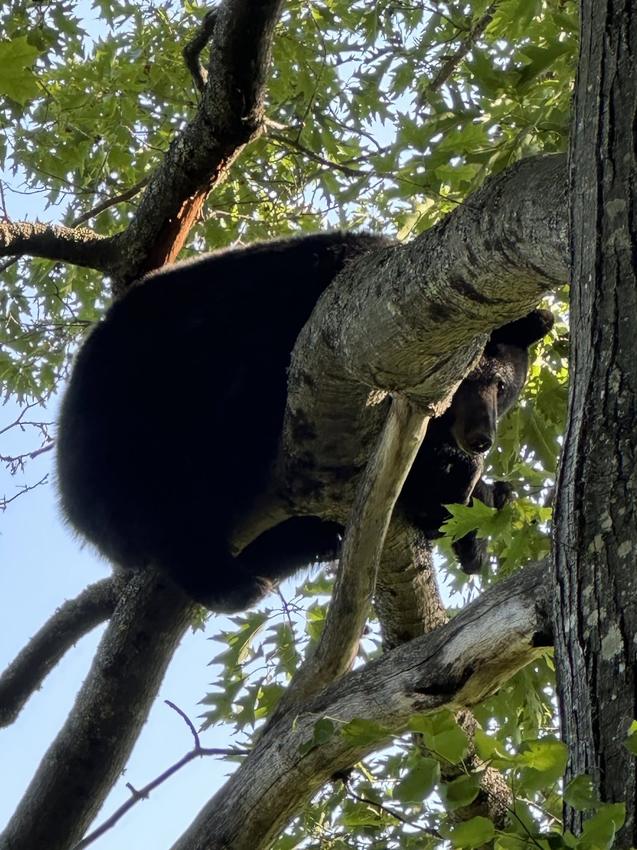
Then Adam looked to his side. A bear stood a few feet away. The tractor stopped. The bear stopped. For about ten seconds, man and animal stared at each other while the Kubota idled between them, perhaps wondering whether its job description covered diplomacy.

Ten seconds in the woods

The bear moved first. It shot up a tree. Adam moved second. He aimed the tractor toward home and discovered that an orange Kubota can travel much faster when the driver has recently met a bear.

Kady was sitting on the back deck with her mother when the tractor came flying down the access road. Adam arrived pale and wide-eyed. He explained what happened. The sensible choice was obvious: stay on the deck and let the woods keep their bear.

The family chose a different plan. Kady, Adam, his brother Casey, Kady's father James, and Ade went back to look, armed because the bear was still nearby. Halfway out, the adventure started feeling less clever. Then Ade spotted it high in a tree, stretched out and watching the people who had returned to inspect it.

The trail becomes a game

They took pictures, confirmed that the bear was real, and left. The woods trail closed for the season. Kady then turned the episode into Bearly Escaped: Tractor Panic Simulator. The player cuts a path until a bear appears, then drives through mud, brush, obstacles, and poor decisions on the way home.

After three weeks of data, browser games, and AI tools, this entry brings the competition back to dirt and noise. The plan changes because the woods answer back. The game works because the real story already had a vehicle, a chase, a surprise, and one excellent villain who mostly wanted everyone to leave.

About this buildThe Bear, the Tractor, and the Go-Kart TrailLocal recordOriginal postDemoBuilt by Kady · Week 4More at ericrhea.com/summer-into-ai-2026/
Screenshot from The Bear, the Tractor, and the Go-Kart Trail
Local screenshot from The Bear, the Tractor, and the Go-Kart Trail, built by Kady.
SUMMER INTO AI · THE BUILD ISSUE38 / 68

June Calder · Culture DeskFictional editorial persona

Week 4 · revision

USA-OS returns with an endgame.

USA-OS returns for a less flashy job: better balance, more achievements, a stronger ending, and at least one secret Kyle refuses to spoil.

USA-OS 2.5.0 arrives without a new world or a dramatic name. It has a version number, which is software's way of putting on work gloves. Kyle went back to his Week 1 game, played it again, and started adjusting the parts that only become clear after the first rush of building.

He had larger plans for the final week, but tool work pulled him sideways. So the update focused on the game already in front of him. More achievements went in. The play was rebalanced. The ending received more attention. This is less cinematic than adding a moon base, though moon bases are famous for missing their deadlines.

The glamorous life of version 2.5.0

Kyle will not explain the new endgame because he wants players to find it. He hints at a cheat code and says unlocking every achievement may reveal something special. The patch post offers just enough information to make the old game feel unfinished in a new and encouraging way.

The tools changed too. Hermes and Codex helped with development. Kyle continued refining a local image-generation process, while GPT 5.x still handled sprite work for this release. Stable Audio 3 supplied sound effects. He lists the parts plainly, including the image process that still needs more work.

Balance sounds like housekeeping until a number moves. A longer delay can turn a safe choice into a risk. A cheaper action can become the only action anyone uses. An achievement can teach a player to try a corner of the game they ignored. Small adjustments rewrite behavior without changing the title screen.

Tuning changes the story

Endgame work matters for the same reason. A prototype can win attention in the first minute and lose it in the tenth. A revision asks whether the idea remains fun after the surprise wears off. That question is harder than inventing another feature, because the player already knows the trick.

USA-OS 2.5.0 closes the season with maintenance, secrets, and a public repository. It treats Week 1 as something worth returning to, not a disposable draft. The quietest Week 4 move may also be the most grown-up: play the thing again, notice what drags, and fix it.

About this buildUSA-OS 2.5.0Local recordOriginal postDemoCodeBuilt by Kyle · Week 4More at ericrhea.com/summer-into-ai-2026/
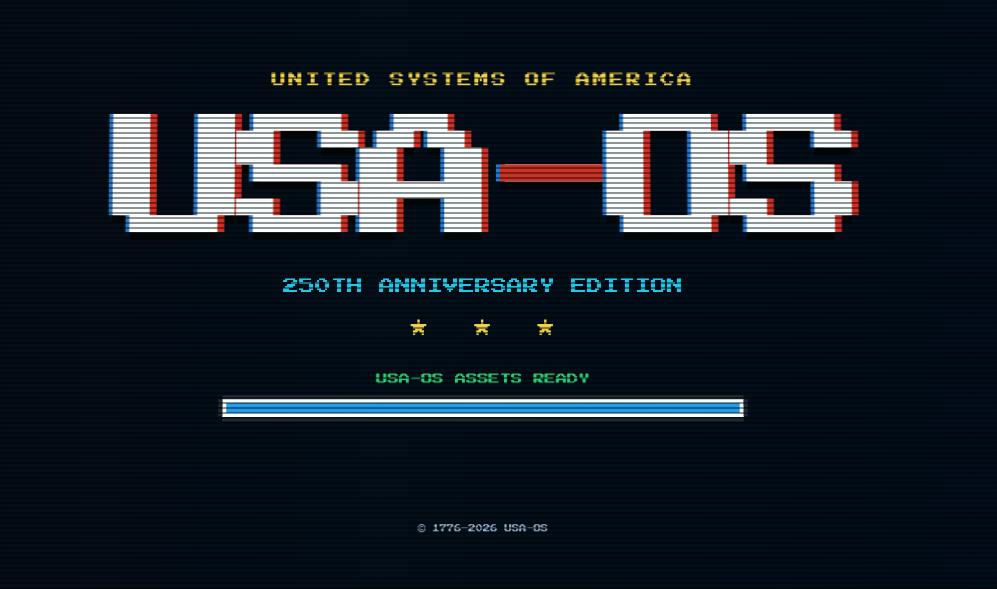
Screenshot from USA-OS 2.5.0
Local screenshot from USA-OS 2.5.0, built by Kyle.
SUMMER INTO AI · THE BUILD ISSUE39 / 68
SUMMER INTO AI · THE BUILD ISSUE40 / 68

Theo Mercer · Systems CriticFictional editorial persona

Ideas in motion

One build kept kicking the next door open.

Horse to mapPaul Revere's ride helped spark a country-sized strategy game.
Supply lines to fireworksOne game fought for independence. The next celebrated it.
Scale to particlesA giant city helped inspire a flag made from a million points.
Season to arcadeNearly every entry returned as a cabinet, poster, or replay.

The project list only says whether a builder reused earlier work. The posts tell the better story: people answered one another with controls, pictures, code, jokes, and whole new rooms.

SUMMER INTO AI · THE BUILD ISSUE41 / 68

Ada Vale · ArchivistFictional editorial persona

Before you close the tab

Save enough for somebody to find the good part again.

Take a picture

A screenshot remembers what the project looked like before the live version moved, changed, or vanished.

Write down the trick

Name the control, choice, bug, or shortcut that made the build worth talking about.

Point to the next door

A post, gallery, or directory helps a future visitor move from the story to the project.

SUMMER INTO AI · THE BUILD ISSUE42 / 68

The builders

Two ways to keep the work playful.

10 unique projects · Weeks 1 · 2

Adam

Adam likes a joke with buttons. His midnight ride turns warning the town into an arcade race. His Week 2 projects give towns, kitchens, notebooks, meetings, and money their own troublesome rules. The funny part usually sits inside the control, so the player learns the idea by causing the mess. His work feels like a shelf of small machines built to reveal one stubborn truth at a time.

3 unique projects · Weeks 1 · 2 · 4

Kady

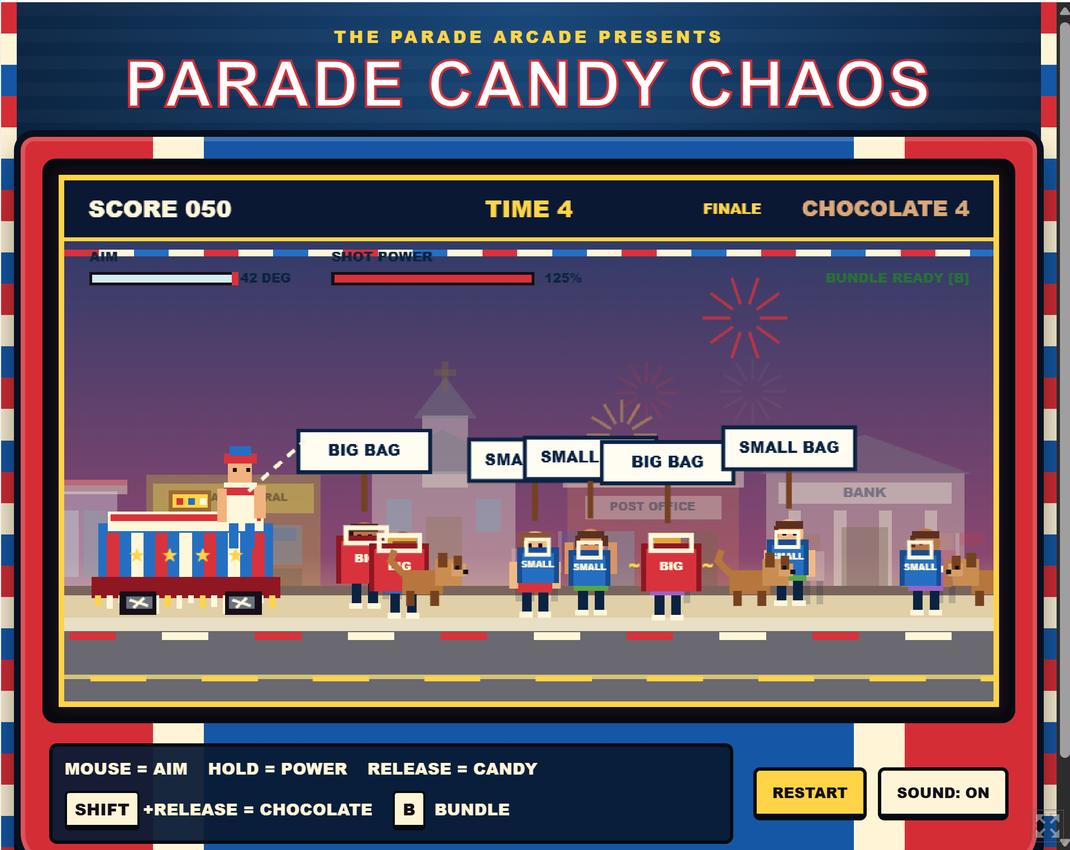
Kady keeps bringing the competition back to the ground. Parade candy becomes a game. Logging history becomes River Pig. Then a family party, an orange tractor, and a real bear become Bearly Escaped. Her projects begin with places and people you can picture. Even when the final entry lands in a browser, there is dirt on its tires.

SUMMER INTO AI · THE BUILD ISSUE43 / 68

The builders

Two ways to turn a clear question into something people can try.

3 unique projects · Weeks 1 · 2 · 3

Evan

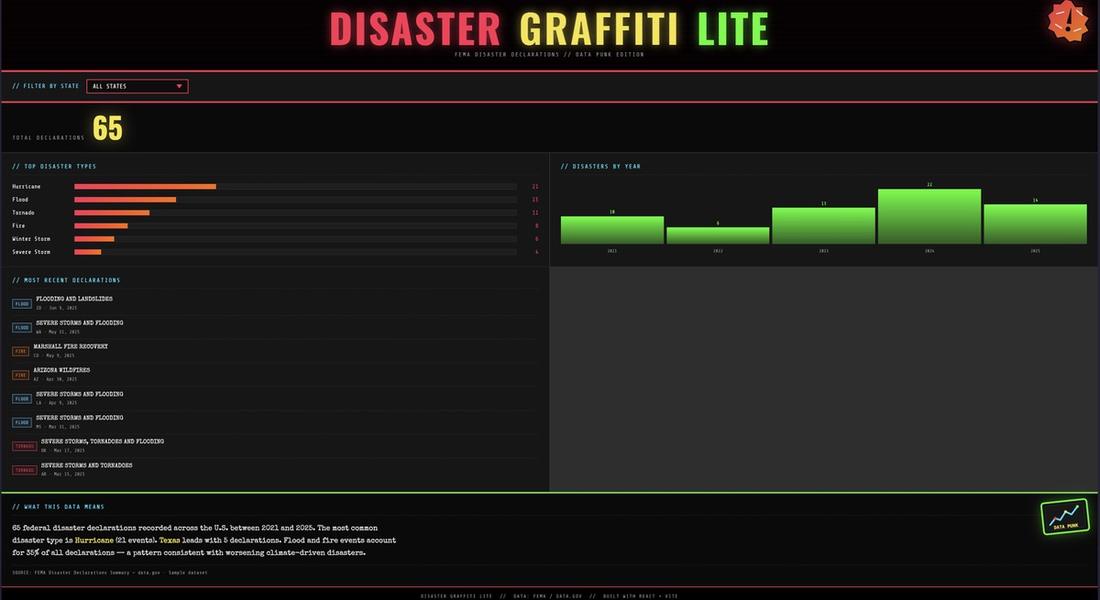
Evan picks a clear experiment and gives it room to breathe. One week brought an 8-bit role-playing game and the lessons from making it. Another turned any subject into a Founding Fathers briefing. Disaster Graffiti Lite gave public data a compact civic screen. The projects differ, yet each one says what it tried and where it stopped.

4 unique projects · Weeks 1 · 2 · 3 · 4

Heather

Heather has a gift for finding the extra problem hiding beside the main one. SKY KING begins with play. Leaderboard Oracle asks how the competition can explain its own score. Your Town Is Not Fine makes local conditions hard to ignore. Insert Coin, Uncle Sam returns to an earlier project for another pass. Her work gives rules, labels, and instructions the same care as the main screen.

SUMMER INTO AI · THE BUILD ISSUE44 / 68

The builders

One keeps making worlds. One keeps testing the system.

28 unique projects · Weeks 1 · 2 · 3 · 4

Jake

Jake builds in bursts. Newspapers lead to factories, militias, federal files, campaign money, courtrooms, and testimony. The pace lets one project answer the last while the memory is fresh. Some ideas return. Others disappear after one test. Read together, the projects feel like a public notebook with playable pages and very little empty space.

6 unique projects · Weeks 1 · 2 · 3 · 4

Kyle

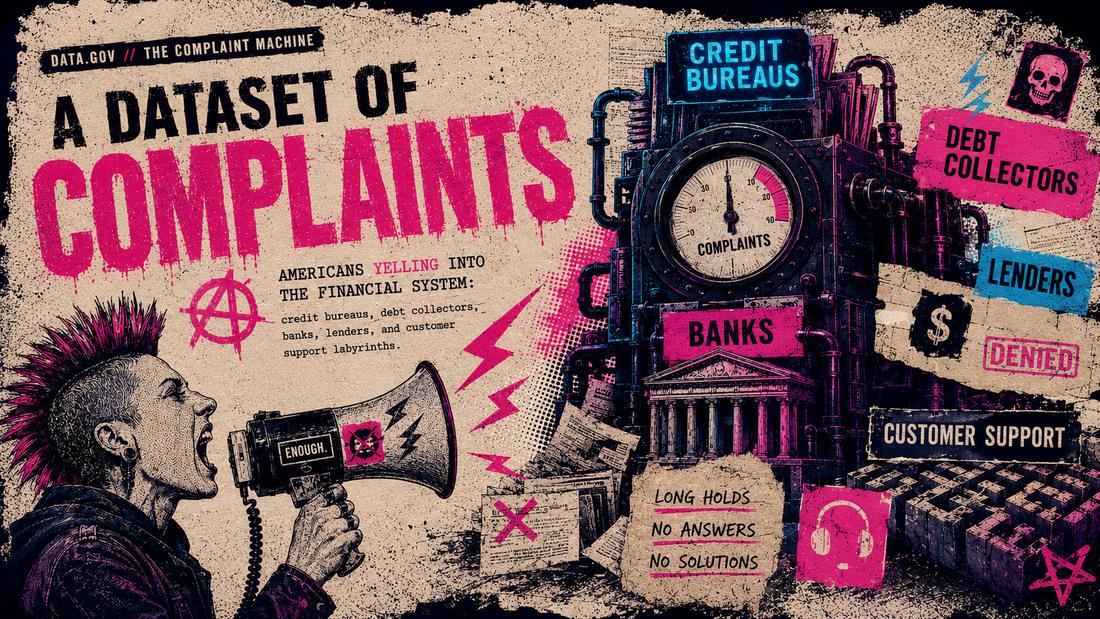
Kyle makes the player feel the problem before naming it. USA-OS turns public software into a game, then comes back with better balance, more achievements, and a new ending. Boomtown makes growth compete for attention. Range Anxiety, Complaint Machine, and Falling Sky turn public frustration into controls, timers, and consequences.

SUMMER INTO AI · THE BUILD ISSUE45 / 68

The builders

Worldbuilding, public records, and a place for the season to live.

18 unique projects · Weeks 1 · 2 · 3 · 4

Myles

Myles likes big pictures made from small moving pieces. A national map becomes a territory fight. More than a million points become a flag that repairs itself. County files become the moving story of white-nose syndrome. Palace Radio brings an old missing feature back to life. His own website keeps the full run together after the weekly posts have passed.

19 unique projects · Weeks 1 · 2 · 3 · 4

Eric

Eric moves from games to city data to strange 3D places, often in the same week. Scooters, music, fuel, emissions, patents, and Chicago art all become things a visitor can explore. The final week adds a museum tour, an SR-71 music video, and Arcadia, an arcade built to hold nearly everyone else. His favorite move is gathering scattered parts and giving them a room.

SUMMER INTO AI · THE BUILD ISSUE46 / 68

Theo Mercer · Systems CriticFictional editorial persona

What traveled

A good project leaves parts lying around.

Promptputs everyone in the same starting room.
Prototypeshows one way out.
Postexplains the odd turn by the stairs.
Screenshotremembers what the room looked like.
Replyopens a door nobody planned.
Archivekeeps the spare parts for later.
SUMMER INTO AI · THE BUILD ISSUE47 / 68

Gideon Pike · Score DeskFictional editorial persona

A season’s table

Some people built wide. Some built deep. Everyone left a trail.

BuilderDifferent projectsWeeks
Adam10W1 · W2
Kady3W1 · W2 · W4
Evan3W1 · W2 · W3
Heather4W1 · W2 · W3 · W4
Jake28W1 · W2 · W3 · W4
Kyle6W1 · W2 · W3 · W4
Myles18W1 · W2 · W3 · W4
Eric19W1 · W2 · W3 · W4

Each different project page counts once. The number does not tell us how large, hard, strange, or important a project was. It simply shows how the season spread across eight builders and four weeks.

SUMMER INTO AI · THE BUILD ISSUE48 / 68

June Calder · Culture DeskFictional editorial persona

A culture of public building

What changes when the unfinished thing has an audience?

The first public build changes the room. Before it appears, everyone can imagine a perfect project. After it appears, there is a horse on the screen and the horse has controls. Somebody tries the arrow keys. Somebody hits a barrel. Somebody asks why Paul Revere is throwing paper at a tavern. The prompt has become a place people can visit.

That visit is useful because visitors are wonderfully bad at following the instructions inside a builder's head. They click the decoration. They miss the bright button. They open the 3D world on a phone. They find the door that is the same size as a lamp. A private prototype can remain polite. A public one meets cousins, old laptops, unusual browsers, and people who will absolutely press B during baseball.

Summer Into AI ran on that collision. Adam trimmed glows and helper boxes from Ride, Revere, Ride! after the road became crowded. Eric's first baseball build failed, so he broke the second attempt into pitching, batting, fielding, cameras, and innings. Myles stopped resizing sixteen pieces of furniture by eye and measured one door. The audience sees the final screen. The build stories reveal the smaller decisions that got it there.

Publishing also gives the next person something solid to answer. Myles saw games about individual patriots and pulled the camera back to a national map. Jake saw Dependency Day and built the fireworks after the struggle. Arcadia took a month of scattered projects and gave them cabinets, posters, a television, and a bowling alley. None of those replies needed a planning meeting. The earlier project was already sitting on the table.

There is a cost. A live demo can fail in public. A rough control can hide a good idea. A confident paragraph can run farther than the data. The best build notes answer those problems with ordinary words: mobile barely works; batting needs another pass; the county data ends in 2019; the text-to-3D button costs too much to leave on. Specific limits help readers understand the shape of the attempt.

The habit travels well beyond a four-week contest. A team can share a tiny working screen before a long meeting turns it into twelve different memories. A researcher can show the map and the missing counties together. An engineer can record the failure while the cause is still warm. Small public steps make decisions easier to discuss because everybody can look at the same thing.

The unfinished project does not need to apologize for being unfinished. It needs a clear door, a working light, and a note about the loose floorboard. Let people enter. Let them find the odd corner. Then listen when somebody says the lamp is taller than the door.

SUMMER INTO AI · THE BUILD ISSUE49 / 68

Ada Vale · ArchivistFictional editorial persona

After the clock

A deadline stops the contest. It does not stop the stories from being useful.

Demos change. Links vanish. People forget which key opened the secret room. A few good notes, pictures, and names can keep a project understandable long after the chat goes quiet. Save the part that made you lean closer.

SUMMER INTO AI · THE BUILD ISSUE50 / 68
SUMMER INTO AI · THE BUILD ISSUE51 / 68
SUMMER INTO AI · THE BUILD ISSUE52 / 68
SUMMER INTO AI · THE BUILD ISSUE53 / 68
SUMMER INTO AI · THE BUILD ISSUE54 / 68
SUMMER INTO AI · THE BUILD ISSUE55 / 68
SUMMER INTO AI · THE BUILD ISSUE56 / 68

Ada Vale · ArchivistFictional editorial persona

Builder directory

Eight doors back into the season.

Printed edition: find the full project list at ericrhea.com/summer-into-ai-2026/. The browser edition opens each title directly.

SUMMER INTO AI · THE BUILD ISSUE57 / 68

Inez Park · Build EditorFictional editorial persona

From idea to somebody else's screen

Build it while the idea is hot. Explain it before the details cool.

01

Make

Give the idea one clear action, question, picture, or surprise.

02

Tell

Say what happened, what fought back, and what another person should try first.

03

Invite

Leave enough of the path open for the next builder to answer.

SUMMER INTO AI · THE BUILD ISSUE58 / 68

Picture notes

The big pictures set the mood. The small pictures show the work.

The cover and chapter art imagine paper, circuitry, maps, prototypes, and a workbench that has seen a long week. They are magazine illustrations, not scenes copied from a competitor's project.

The screenshots come from the projects. They show what a visitor could see at a particular moment. One kind of picture invites you into the issue. The other says, “Here is the thing we are talking about.”

Original editorial art used for the cover
SUMMER INTO AI · THE BUILD ISSUE59 / 68

Ada Vale · ArchivistFictional editorial persona

Ordinary and remarkable

The ordinary act is publishing the work. The remarkable act is making that habit contagious.

A deadline can make a person do strange and helpful things. It can make them turn a government patent file into a starship. It can make them animate 13 winters of bat disease. It can make a family bear encounter into a tractor game. It can also make them write down the controls before midnight, which may be the most miraculous result of all.

Each project in this issue began with a private moment. A builder noticed a question, a joke, an old feature, a public file, or a problem that would not leave. Publishing moved that moment into the open. Now another person could ring the bell, scatter the flag, search the ZIP code, walk through the radio room, or get caught by a redcoat that had learned their habits.

The large projects grab attention first. A million points look like weather. A full arcade looks like a small town. Yet some of the season's strongest ideas fit inside one choice. Make the musket take six steps to reload. Give rumors their own waiting room. Filter biological disasters out of a weather report. Measure the door before moving the furniture. Small choices are where a project tells us what it believes.

Then the choices travel. A game becomes a reply to another game. A cut feature returns months later with better sound. A particle flag learns to hold any sentence. A flat list grows walls and neon. Reuse does not always look efficient. Sometimes it adds a bowling alley. That may be wasteful in the budget and perfect in the story.

The season ended, but the projects did not agree to become history. Some will change. Some will go offline. Some will be opened by a person who never saw the original prompt. A good caption, screenshot, build note, and name can make that future meeting possible. They tell the visitor where to start and what kind of creature is waiting behind the link.

So take one thing from these sixty-eight pages. Open a project. Try the control the builder cared about. Read the part where the plan went sideways. Then make a small answer of your own. The most generous project is not the one that finishes the conversation. It is the one that leaves the next sentence within reach.

SUMMER INTO AI · THE BUILD ISSUE60 / 68

Ada Vale · ArchivistFictional editorial persona

The Mailroom · fictional correspondence

The machines have notes.

Three pieces of software found the editor's address. This was probably a mistake.

Please test the fan

The Latency Goblin

Under a warm mini PC

I live under the laptop fan, where ambitious 3D worlds send their heat. I am a fan of beauty. I am also a fan, literally, and some of these projects make me work overtime. Please keep building giant browser spaces. Just add a loading message, a low-power switch, and one plain sentence about the computer used for testing. Tell me whether the first load takes five seconds or fifty. If the world needs a gaming machine, say so before someone opens it on a school Chromebook. A performance note does not make the project look weak. It makes the welcome mat accurate.

Editor’s reply

Fair. A beautiful world should also warn you before the laptop sounds like a leaf blower.

Where are the controls?

Player Two

Keyboard side of the couch

I found the game. I found the start screen. I did not find the keys. Controls decide who gets to hear the idea. Put them on the first screen. Let people remap them when possible. If a phone will not work, say that before I rotate it six times and blame myself. The opening screen should answer three questions: What can I touch? What happens next? How do I leave without losing everything? A clever mechanic hidden behind mystery keys is still hidden. Please stop making me test the entire alphabet while a redcoat wins.

Editor’s reply

Agreed. The controls are part of the project, not a scavenger hunt before the project begins.

Rough is allowed

Patch Notes v0.9

Still marked prerelease

Please stop treating me like an apology. I am a map of the rough ground. Tell me what works, what fails, and which device you tried. “Some bugs remain” tells nobody anything. “Batting timing breaks below 30 frames per second” gives the next builder a place to begin. Add a date and version. Say whether mobile sound is blocked, the data stopped updating on Tuesday, or the final level still eats the save file. Unfinished work can teach a lot. Vague work mostly teaches people to close the tab.

Editor’s reply

Specific problems are good reporting. “A little buggy” is just fog wearing a name tag.

These letters are fictional editorial stress tests. They are not reader submissions, participant statements, or testimonials.

SUMMER INTO AI · THE BUILD ISSUE61 / 68

Ada Vale · ArchivistFictional editorial persona

The Mailroom · fictional correspondence

The spreadsheet requests a chair.

Points sounded simple until one project arrived with three links and two names.

One row cannot do six jobs

An Exhausted Spreadsheet

Column AA

I began life with four columns. Then people asked me to hold projects, posts, demos, code, points, bonuses, rumors, and corrections. I have seen things no cell should see. Please give each project an ID. Keep the scoring action separate. Put links in their own fields. Write corrections down instead of changing a color and hoping everyone remembers why. Also, the four repeated listings are fine. Fast contests make messy sheets. Showing the repeats is useful. Pretending they never happened would make me nervous, and I already turn dates into decimals when stressed.

Editor’s reply

The issue keeps all 95 rows, marks the four repeats, and uses 91 different projects in its maps.

Does a video count?

The Judge in the Browser

One tab past the deadline

Please decide what counts before the entry arrives. A video can show real work, teach a method, or document something that cannot live in a browser. A physical trail does not become software because the theme mentions AI. A repository is not automatically better than a recorded tour. Use the rule that was published. Then describe the entry plainly. A game is a game. A video is a video. A bear trail is a bear trail. Fairness does not require every project to wear the same costume.

Editor’s reply

Yes. Score the action under the stated rule, then name the thing for what it actually is.

I have one trick

Checksum

End of file

I can tell you whether two files match. That is my whole trick. I cannot tell you whether the claim inside the file is true. I cannot play the demo, check the data, or decide whether the screenshot leaves out a flaming menu just below the crop. Keep me around. I am helpful. Just do not promote me to detective. A screenshot shows that a screen was captured. A post shows what the builder said. A working demo shows what a visitor can do now. Those answers can agree, disagree, or arrive at different times.

Editor’s reply

Good distinction. The file may be unchanged while the story around it still needs checking.

These letters are fictional editorial stress tests. They are not reader submissions, participant statements, or testimonials.

SUMMER INTO AI · THE BUILD ISSUE62 / 68

Ada Vale · ArchivistFictional editorial persona

The Mailroom · fictional correspondence

Public data would like a word.

A map, a dashboard, and one nervous government office sent comments.

Please use less understandable language

Civic Interface Unit 4B

Department of Manageable Conditions

Our office objects to the phrase “your town is not fine.” Citizens may understand it without scheduling a meeting. We recommend “multivariable resilience opportunity.” It contains more syllables and fewer visible consequences. Sadly, the magazine has a point. Plain language can make a public problem easier to see. Please keep the dates, location, measure, and limits beside the sharp headline. A risk score should not pretend to know more than the data knows. Clear words are already strong. They do not need fake certainty wearing a necktie.

Editor’s reply

Request denied. The plain headline stays, and the limits stay beside it.

I deleted four charts

A Reformed Dashboard

Formerly six donut charts

I used to show everything because the API returned everything. Nobody knew where to look, so I added more colors. I now begin with a question. I choose the measure that helps answer it. I label the date and place. Then I give the visitor a path to the full data. Four charts have left the building. Two remain. I feel lighter. If a number does not help someone decide what to look at next, it can stay in the download. Not every field deserves stage lighting.

Editor’s reply

Congratulations on the chart reduction. The remaining donuts may collect their severance near the exit.

I am a boundary, not a bat

County Polygon 19153

A shapefile near Des Moines

Maps make patterns easier to see. They also make boundaries look wiser than they are. I am a county shape. I am not a cave, a colony, or every bat that crossed this area. A mark inside me means somebody recorded something under a method and date. It does not mean every location was checked. Please animate the spread. Tell the story. Just keep the missing observations and different kinds of reports attached to the map. The blank space may mean “none found.” It may also mean “nobody looked here.”

Editor’s reply

Good correction. The map will say what was reported, where, and when, without turning silence into certainty.

These letters are fictional editorial stress tests. They are not reader submissions, participant statements, or testimonials.

SUMMER INTO AI · THE BUILD ISSUE63 / 68

Ada Vale · ArchivistFictional editorial persona

The Mailroom · fictional correspondence

Nothing online wants to be forgotten.

A cabinet, a moth, and the last open tab discuss what happens after the contest.

I am a place, not a summary

Cabinet 47

Back wall of Arcadia

A summary tells visitors what happened. I let them choose where to go next. Put one project behind my screen. Keep another cabinet close enough to create a surprising comparison. Let the room have sound, corners, and one unnecessary bowling alley. People remember where they found something, especially when finding it feels like play. Lists are faster when you know the title. Rooms are better when you do not know what you want yet. Please keep both. Also, somebody left the bowling lights on again. I consider this good information design.

Editor’s reply

The directory handles lookup. Arcadia handles wandering. The bowling lights may stay on.

I eat missing context

Archive Moth

Inside a broken hyperlink

I do not eat paper. I eat context. Give me a title without a date, a screenshot without a caption, or a demo without its build note. Delicious. A changed URL is especially nice when nobody saved the old address. You can make my work harder. Keep the builder's name, original location, capture date, and one note about what the project did. If the live page changes, say when the local copy was made. I will wait by the abandoned image server. No need to hurry. I am very patient.

Editor’s reply

Captions, dates, and original locations stay. The moth will have to find lunch elsewhere.

Close me responsibly

The Last Open Tab

Somewhere after midnight

I contain a prototype you meant to revisit, code you meant to fork, and a post whose best paragraph is below the fold. Before you close me, write one sentence about why I mattered. Name the control that surprised you, the dataset that looked incomplete, or the mistake another builder should avoid. Praise fades fast. A specific note can restart a project months later. You do not need a perfect summary. Save one fact, one limit, and one next move. Then close me. Your browser has 143 tabs and we are all becoming concerned.

Editor’s reply

That is the final assignment. One good note, then mercy for the browser.

These letters are fictional editorial stress tests. They are not reader submissions, participant statements, or testimonials.

SUMMER INTO AI · THE BUILD ISSUE64 / 68

Credits and notes

Who made what, and how we kept count.

The competition work

Every project keeps its builder's name, week, title, and original post. Screenshots came from public project pages and locally saved copies where available.

The magazine work

Eric Rhea edited the issue and wrote its six fictional magazine voices. The layout, cover, chapter art, captions, and Mailroom were made for this edition.

The count

The collected files hold 95 rows and 91 different project pages. Four Week 2 projects appear twice. The maps count them once; the directory keeps both rows and marks the repeats.

Fictional voices

Inez, Gideon, Mara, June, Theo, and Ada are invented editors with different assignments. The Mailroom writers are invented too. None is a competitor, employee, or reader testimonial.

Illustrations

The large cover and chapter images are original generated art. They create atmosphere. They do not pretend to show a real submission.

Corrections

Names, titles, sources, and pictures can be corrected. Use the contact page at ericrhea.com if something needs attention.

Open the complete digital source list

SUMMER INTO AI · THE BUILD ISSUE65 / 68

Full source list · rows 1 to 48

Every project gets its name in print.

01AdamW1Ride, Revere, Ride!: I Built a Tiny Paul Revere Arcade Game for 8-Bit Americasource · demo · code
02AdamW1Postmark 250: I Made a Digital Stamp Sheet for America’s Memory Drawersource · demo · code
03AdamW1The Republic Room: I Built a Tiny 8-Bit Puzzle Kiosk for American Memorysource · demo · code
04KadyW1Parade Candy Chaossource · demo
05HeatherW1SKY KING: A Summer into AI: Theme 1 Challengesource · demo
06JakeW1Summer into AI 2026: Found a Republicsource · demo · code
07JakeW1Summer into AI 2026: Liberty 1776source · demo · code
08JakeW1Summer into AI 2026: Hall of the Republicsource · demo · code
09JakeW2Summer into AI 2026: Fireworks Foundrysource · demo · code
10JakeW2Summer into AI 2026: Minutemansource · demo · code
11JakeW2Summer into AI 2026: Ride for Libertysource · demo · code
12MylesW1GAME OF LIBERTY - an 8-bit territory battle for the soul of a nationsource · demo · code
13MylesW1LIBERTY CHIPTUNE - an 8-bit anthem maker for the whole competitionsource · demo · code
14MylesW1FOUNDING FATHER A.I. - a real LLM, in 8 bits, that talks back from 1776source · demo · code
15MylesW2Dependency Day - a single-file, in-browser systems-strategy puzzle for Week 2: Independence Engines.source · demo · code
16EricW1Summer into AI 2026" RevereBike or "Horse ExciteBike"source · demo
17EricW1Summer into AI 2026: Megaman 1776 or "Liberty of Death 1776: Liberty, Founding Fathers vs The Crown"source · demo
18EricW1Summer into AI: Timestorm Baseballsource · demo
19EvanW1I Built an 8-Bit Turn-Based RPG in a Week and Learned More Than I Expectedsource · code
20KyleW1USA-OSsource · demo · code
21JakeW2 · repeatSummer into AI 2026: Minutemansource · demo · code
22JakeW2 · repeatSummer into AI 2026: Fireworks Foundrysource · demo · code
23JakeW2 · repeatSummer into AI 2026: Ride for Libertysource · demo · code
24JakeW2Summer into AI 2026: The Patriot Gazettesource · demo · code
25JakeW2Summer into AI 2026: Draftedsource · demo · code
26JakeW2Summer into AI 2026: Sons of Libertysource · demo · code
27JakeW2Summer into AI 2026: Liberty Fireworkssource · demo · code
28JakeW2Summer into AI 2026: The Conventionsource · demo · code
29JakeW2Summer into AI 2026: The Broadcastsource · demo · code
30JakeW2Summer into AI 2026: The Boston Defensesource · demo · code
31JakeW2Summer into AI 2026: The Culper Ringsource · demo · code
32JakeW2Summer into AI 2026: The French Alliancesource · demo · code
33AdamW2The Internet Gave Us Independence. Then the Feed Asked for Rent.source · demo · code
34AdamW2Dead Man’s Ledger: The Money Enginesource · demo · code
35AdamW2Food Engines: I Built a Tiny Farm Game Because Tomatoes Are Infrastructuresource · demo · code
36AdamW2Manifest Notebooky: I Built a Notebook App That Immediately Betrays You for Freedomsource · demo · code
37AdamW2Engines of Independence: I Built a Town Where Every Solution Creates a New Problemsource · demo · code
38AdamW2Freedom Engine: Red, White & Boomtownsource · demo · code
39KadyW2River Pig: Chassell Log Jam - My Week 2 Independence Enginesource · demo
40MylesW2PERPETUAL UNION - a million points of light that hold one flag, and re-form when you tear them apartsource · demo · code
41MylesW2SOVEREIGN - a union no king can stamp and no one can forgesource · demo · code
42MylesW2EMERGENT REVOLUTION - 13 colonies that teach themselves to be freesource · demo · code
43MylesW2 · repeatDependency Day - a single-file, in-browser systems-strategy puzzle for Week 2: Independence Engines.source · demo · code
44MylesW2SOLO: teaching a neural network to fly - and what I learned building it from scratchsource · demo · code
45MylesW2MURMURATION - independence isn't a symbol, it's an architecturesource · demo · code
46MylesW2LIBERTY ENGINE - an anthem with no conductorsource · demo · code
47MylesW2SELF-EVIDENT - I built a GPT from scratch that trains itself, live, in your browsersource · demo · code
48EvanW2How to Turn Any Topic Into a Founding Fathers Briefingsource · code
SUMMER INTO AI · THE BUILD ISSUE66 / 68

Full source list · rows 49 to 95

Every project gets its name in print.

49EricW2Summer into AI: Week2 Submission: Zezek the Goblin: Web based Goblin Brainsource · demo
50EricW2Summer Into AI: Week2: Independence Townsource · demo
51EricW2Zezek the Goblinsource · code
52EricW2Summer into AI: Eric Submission #3: Qwen Franklinsource · code
53EricW2Summer into AI: Week2 Submission: Eric's Summer Job Finder for Kidssource · demo
54EricW2Summer into AI: Week2 Submission: Eric's FANS of Independence Enginessource · demo
55HeatherW2Leaderboard Oraclesource · demo
56KyleW2Boomtownsource · demo · code
57AdamW2SAM AI: I Trained a Corporate Anti-Assistant and Accidentally Built a Meeting Simulatorsource · code
58EricW2Summer into AI: Week2 Submission: Independence Engines in Spacesource
59MylesW3WHITE NOSE - the government counted a plague killing millions of bats, county by county, and never built you a way to watch itsource · demo · code
60JakeW3Summer into AI 2026: FOIA Ghostsource · demo · code
61JakeW3Summer into AI 2026: Side Effect Oraclesource · demo · code
62JakeW3Summer into AI 2026: Federal Money Trailsource · demo · code
63JakeW3Summer into AI 2026: EARTH PULSEsource · demo · code
64MylesW3BIOSPHERE - a living 3-D Earth, built entirely from the federal data the government never made beautifulsource · demo · code
65EricW3Summer into AI- Eric Week3 Submission: Rise of the Scooters and Bikessource · demo
66EricW3Summer into AI- Eric Week3 Submission: Long live the beatsource · demo
67EricW3Summer into AI- Eric Week3 Submission: Motor Fuelsource · demo
68KyleW3Range Anxiety, USAsource · demo · code
69KyleW3Complaint Machinesource · demo · code
70EricW3Summer into AI- Eric Week3 Submission: Emission Factorssource · demo
71KyleW3Falling Skysource · demo · code
72EricW3Summer into AI: Eric's Week3 Submission: Nasa Patents Decodersource · demo
73EricW3Summer into AI: Eric's Week3 Submission: Chicago Art Datasetsource · demo
74HeatherW3Your Town Is Not Finesource · demo
75MylesW3GLASS BOX - everyone asked an AI about the government's data. I trained a model on it, from scratch, and made every neuron visible.source · demo · code
76EvanW3Disaster Graffiti Lite and the Case for Data Punksource · code
77MylesW3The Broadsidesource · demo · code
78JakeW4Summer into AI 2026: Money Trailsource · demo · code
79KadyW4The Bear, the Tractor, and the Go-Kart Trailsource · demo
80MylesW4Palace Radiosource · demo · code
81EricW4Summer into AI: Eric Week 4 Submission: 1776 Museum Tour (Video Documentary)source
82EricW4Summer into AI: Eric Week4 Submission: Black Budget Birdsource · demo
83EricW4Summer into AI: Eric's Week4 Submission: Arcadiasource · demo
84JakeW4Summer into AI 2026: The Founders' Courtsource · demo · code
85JakeW4Summer into AI 2026: Side Effect Stormsource · demo · code
86MylesW4More Perfectsource · demo · code
87JakeW4Summer into AI 2026: Deep Coversource · demo · code
88MylesW4Midnight Machinesource · demo · code
89HeatherW4Insert Coin, Uncle Samsource
90JakeW4Summer into AI 2026: Sworn Testimonysource · demo · code
91JakeW4Summer into AI 2026: Class Actionsource · demo · code
92JakeW4Summer into AI 2026: Situation Roomsource · demo · code
93JakeW4Summer into AI 2026: Full Disclosuresource · demo · code
94KyleW4USA-OS 2.5.0source · demo · code
95JakeW4Summer into AI 2026: Stop the Pressessource · demo · code
SUMMER INTO AI · THE BUILD ISSUE67 / 68
Original editorial illustration of a rebuilt creative machine

SUMMER INTO AI 2026

PLAY
IT
AGAIN.

Issue 01 · July 2026
www.ericrhea.com/summer-into-ai-2026/magazine/